
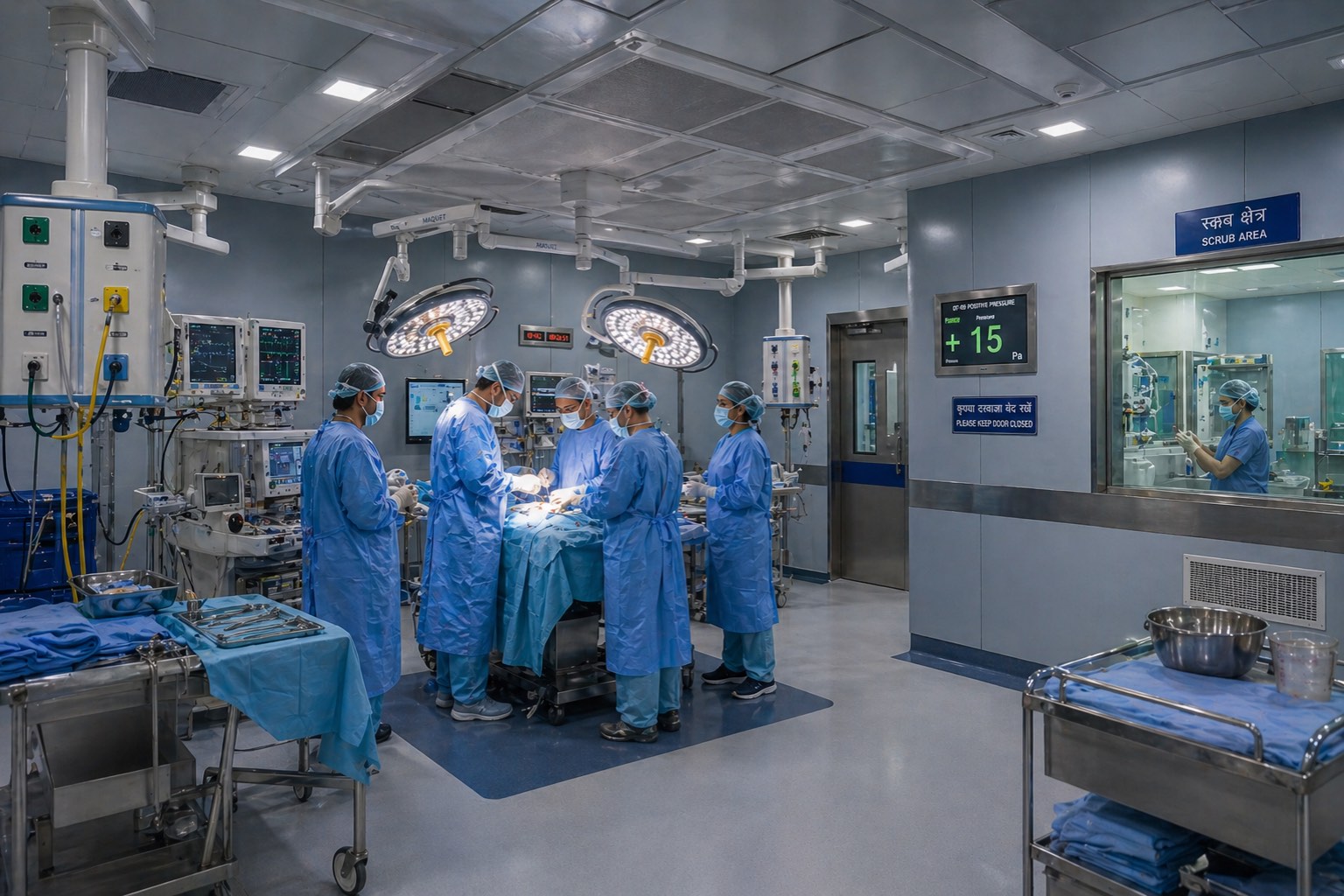
OT Suite Design in India — Planning, Services, Detailing
From Single OT to 12-OT Campus — Zone Classification, ASHRAE 170 + NABH Plant Design, Pendants and Booms and Lighting, Scrub/Induction/Recovery Geometry, CSSD Interface, Floor and Wall Finishes, and the OT Architectural Toolkit
The operation theatre suite is the most architecturally demanding space in any healthcare building. It is the room where patient lives and clinical reputations are made and unmade, where the building's mechanical systems and the patient's biology meet in continuous interaction, and where the architect's detailing discipline is most consequential. An OT that is correctly planned but poorly detailed is dangerous; an OT that is correctly detailed but badly planned is inefficient; an OT that is both well-planned and well-detailed is what the surgeon, the patient, and the regulator all expect. This guide addresses both halves.
The guide is the second in the design-focused series and assumes the reader has read the pillar regulatory reference, the relevant regulator deep-dives (NBC C-1, NABH, AERB, BMW, and Fire Safety), and the clinical adjacencies guide preceding this one.
OT design draws from three intersecting bodies of knowledge: international clean-room standards (ISO 14644 series), healthcare ventilation standards (ASHRAE 170-2021), and accreditation requirements (NABH / JCI). The Indian climate and operational context add specific demands — humidity control during monsoon, dust-loading during summer, the higher visitor density of family attendance, and the cost-sensitive but quality-uncompromising stance of most Indian healthcare clients. The architect translates the international standards into Indian working detail.
"The operating theatre is the most expensive room in a hospital and the most unforgiving. Get the air right and you've done half your work. Get the floor right and you've done the other half." — Sir Magdi Yacoub (b. 1935), cardiac surgeon, paraphrased from a 2013 lecture at Royal College of Surgeons
"The theatre is the place where the architect's drawing meets the surgeon's hand. The drawing is the slow part. The hand is the fast part. Both must be correct." — Dr. Naresh Trehan (b. 1946), cardiac surgeon and founder Medanta, paraphrased from a 2018 NABH symposium
1. The Four-Zone OT Classification
OT planning organises around four cleanliness zones. The architect's plan distinguishes these spatially and the engineer's services maintain them functionally.
| Zone | Cleanliness | Typical Spaces | Pressure | Access |
|---|---|---|---|---|
| Z1 — Transfer / Reception | General | OT lobby, patient transfer trolley exchange, family waiting | Neutral | Open with control |
| Z2 — Clean / Preparatory | Class 8 (ISO 14644) | Pre-anaesthesia, induction, scrub, OT corridor | Slight positive | Restricted |
| Z3 — Sterile / Operating | Class 7 or Class 5 at field | Operating theatre proper | Strongly positive | Sterile attire |
| Z4 — Protective / Disposal | General | OT dirty corridor, soiled instruments, used linen, BMW | Negative | Restricted |
Architectural translation: OT plan is a zoned promenade. A patient enters Z1 (lobby), transfers in Z1 (trolley exchange), changes in Z2 (induction), is operated in Z3 (theatre), recovers in Z2 (recovery bay), and is discharged through Z1 again. Surgical staff enter via Z2 (scrub/change), work in Z3, and exit via Z2 again. Used instruments and waste exit via Z4 (dirty corridor). Each zone has its own door, its own pressure, and (in mature practice) its own corridor.
2. The Two-Corridor vs Single-Corridor Decision
The most consequential OT planning decision: whether to provide a separate clean and dirty corridor, or to use single-corridor with pass-through.
| Approach | Strengths | Weaknesses | Application |
|---|---|---|---|
| Two-corridor (clean + dirty) | Clearest separation; staff don't carry contaminated instruments through clean zone; high NABH compliance | Higher footprint; more circulation; cost | Tertiary hospitals; ≥ 4 OT suites; teaching hospitals |
| Single-corridor + pass-through | Compact footprint; lower cost | Strict door-discipline required; instrument contamination risk if discipline lapses | Small hospitals (1–3 OT); nursing homes |
| Single-corridor without pass-through | Lowest cost | Operationally compromised; not NABH-compliant for major OT | Avoided in practice |
Pass-through detail (single-corridor approach):
- Clean instruments delivered from CSSD via clean pass-through window (one-way, sealed, autoclave-adjacent)
- Used instruments returned via dirty pass-through chute or window into separate CSSD receipt zone
- Door discipline: clean instrument door never opens while dirty door is open
- Pressure cascade enforces flow direction even when discipline lapses
A 1-OT nursing home can be pass-through; a 4+ OT hospital should be two-corridor.
3. ASHRAE 170 OT Plant Design
ASHRAE Standard 170-2021 (Ventilation of Healthcare Facilities) is the international reference for OT air handling. NABH 5th edition adopts ASHRAE 170 essentially verbatim with minor Indian-context overlays. The architect coordinates the plant specification with the HVAC consultant.
| Parameter | OT (General) | OT (Orthopaedic / Cardiac) | OT (Neuro / Joint Replacement) |
|---|---|---|---|
| Air changes per hour (ACH) | ≥ 20 | ≥ 25 | ≥ 25 + laminar flow |
| Outside air ACH | ≥ 4 | ≥ 4 | ≥ 4 |
| Filtration final | HEPA H13 (99.95% at 0.3 µm) | HEPA H13 + laminar diffuser | HEPA H14 + ultra-clean laminar |
| Pressure relative to corridor | + 15 to + 25 Pa | + 25 Pa | + 25 Pa |
| Temperature | 20–24°C | 18–22°C | 18–22°C |
| Relative humidity | 30–60% | 30–60% | 30–60% |
| Air pattern | Top supply, low return at 4 walls | Laminar over surgical field | Vertical laminar |
| AHU dedicated | One per OT preferred; 2 OT max per AHU | One per OT | One per OT |
| Door opening time | < 8 sec (door-closer spec) | < 8 sec | < 5 sec |
Architectural translation:
- Plant ceiling void must accommodate the AHU diffuser, return ductwork, HEPA terminal modules, and (for laminar) the laminar diffuser hood — typically 1.4–1.6 m void at OT bay.
- Floor-to-floor height for OT level: 4.2–4.5 m (3.0 m clear OT + 1.4 m plant + 0.3 m structure + 0.1 m floor finish).
- AHU plant room sized at ~ 30 m² per OT for dedicated AHU; can share for 2 OTs.
- Return air must not be from a single point — distributed low-level return at 4 walls or below 4-wall slots.
- Damper coordination — fire/smoke dampers at fire-rated wall crossings; isolation dampers for AHU service.
The ASHRAE 170 specification is the single most important OT plant decision. Skipping the dedicated AHU per OT (using shared AHUs for 4–6 OTs to save capex) is the most common cost-cutting mistake; the result is cross-contamination between theatres, longer recovery from surgical-site infection events, and NABH non-compliance.
4. The Pressure Cascade in Plan
| Space | Pressure (Pa) | Architectural Door |
|---|---|---|
| OT (operating field) | + 25 | Pneumatic / sliding hermetic; sealed gasket; viewing window |
| OT scrub | + 15 | Sliding glass; sensor open |
| Induction room | + 10 | Manual swing; self-close |
| OT clean corridor | + 5 | Manual swing; self-close |
| OT lobby (Z1) | 0 (neutral) | Manual swing |
| Dirty corridor | − 5 | Manual swing; self-close |
| Soiled utility | − 10 | Manual swing; self-close |
Door specification: the OT door must close fully within 8 seconds (modern hermetic sliding doors achieve 4–6 seconds). Door undercut must be sized to permit the cascade airflow without excessive turbulence — typically 6–10 mm undercut at the door; door sweeps fitted but spring-loaded to lift on opening.
Pressure-monitoring architecture: at NABH 5th edition, every major OT must have a continuous pressure monitor visible at the door. The architect provides the wall recess and BMS interface for this monitor.
5. The Surgical Operating Room — Geometry and Detail
| Element | Specification |
|---|---|
| Minimum area | 18 m² (state CEA minimum); 23 m² (TN); 36 m² preferred for major OT (NABH); 60 m² for cardiac / neuro |
| Plan shape | Square 6×6 to 8×8 m; rectangular 6×7 to 7×9 m |
| Ceiling height (clear) | 3.0 m minimum; 3.5 m for ceiling-mounted boom systems; 4.0 m for ultra-clean laminar |
| Door width (sliding) | 1.5 m clear minimum; for stretcher passage |
| Door swing | Pneumatic sliding preferred; hermetic gasket; emergency manual override |
| Viewing window | Glazed panel from corridor; 1.0 × 1.0 m typical; double-glazed for thermal |
| OT lighting (ceiling-mounted, shadowless) | 100,000 lux at surgical field; redundant supply; UPS-backed; colour temperature 4500 K; CRI > 95 |
| OT pendants (ceiling-mounted) | Anaesthesia pendant + surgical pendant; structural load typically 250–400 kg per pendant |
| Boom-mounted equipment | Endoscopy stack, hybrid imaging, robotic arm — additional structural loading |
| Floor finish | Conductive vinyl (resistance 10⁵ to 10⁹ Ω); welded seams; coved skirting 100 mm radius; static-dissipative |
| Wall finish | PVC panel (joint-free) or epoxy paint over plaster; antimicrobial; impact-resistant at trolley-collision height |
| Ceiling finish | Pre-finished metal panel system (modular) preferred; gypsum with epoxy paint and sealed joints acceptable |
| Pressure monitor | Continuous at door |
| Gas outlets (per OT) | O2 ×2, N2O ×1, Air ×2, Vacuum ×3, Scavenging ×1 |
| Power outlets (UPS) | 14–18 sockets minimum on UPS-backed circuit |
| Emergency stop | Multiple wall-mounted; for power, gas, equipment |
| Communications | Phone, intercom to scrub, intercom to recovery, music system if used |
| Imaging integration | Cathlab / hybrid OT — overhead C-arm, ceiling-mounted display |
Architectural integration: OT pendants and booms are structural — the floor slab above the OT must be designed for 250–400 kg point loads at specified locations. The architect provides the structural engineer with a pendant-loading schedule at preliminary design.
6. Scrub, Induction, Recovery — The Surrounding Suite
The OT proper is the centre of a small ecosystem of supporting rooms.
| Room | Area | Function | Specification |
|---|---|---|---|
| Scrub area | 1 station per surgeon per OT; 2.5 m² per station | Surgical hand-wash | Sensor-tap with knee or foot operation; clinical-grade trap; corrosion-resistant; non-touch chlorhexidine dispenser |
| Pre-anaesthesia / induction | 9–12 m² per OT | Patient preparation, anaesthesia induction | Bed-stretcher space; anaesthesia console; gas outlets; UPS power; sound dampening |
| Recovery / Post-anaesthesia care unit (PACU) | 8–12 m² per recovery bay; 2 bays minimum per OT | Recovery from anaesthesia; monitoring | Per-bay monitor, gas outlets, nurse-call, family viewing optional |
| Step-down recovery | If extended stay before IPD | 4–6 m² per chair / trolley | Less monitored than PACU |
| Sterile store (linked to OT) | 6–10 m² per OT cluster | Pre-sterilised pack storage | Adjacent to OT; pass-through from CSSD |
| OT clean store | 4–6 m² per OT | Day's working stock | In OT corridor; closed cabinets |
| Dirty utility | 6 m² per OT | Soiled instrument trolley parking; spillage clean | Pressure-negative; floor drain; sluice |
| Anaesthesia equipment store | 8–12 m² per OT cluster | Anaesthesia carts, machines, calibration | Climate controlled |
| Surgeon's lounge | 12–18 m² per OT cluster | Between cases rest, debrief, eat | Quiet, private, kitchenette |
| Surgeon's locker / change | 12–20 m² per OT cluster | Scrub change, locker, shower | Male/female separate |
| OT control desk | 6–10 m² per cluster | OT scheduling, communications, paperwork | Glazed view of OT corridor; CCTV monitor |
| OT family waiting | 25–60 m² per cluster | Family during procedure | Comfortable seating, water, charging, restroom adjacent |
A single OT thus requires roughly 180–220 m² of total OT-suite area (theatre + supporting rooms + corridor share). A 4-OT cluster requires 600–800 m². The architect's OT-suite area budget should be calibrated against this.
7. The CSSD Interface
CSSD (Central Sterile Supply Department) and OT are the most operationally bound pair in a hospital. Architectural integration is non-negotiable.
| CSSD Element | Specification | OT Interface |
|---|---|---|
| Layout flow | Receipt → washing → drying → packing → sterilisation → sterile store → issue | One-way flow; clean and dirty zones separated |
| Pass-through autoclave | 90×60×120 cm chamber (typical); double-door | Wall between CSSD sterile store and OT clean store |
| Pass-through ultrasonic / washer-disinfector | Receives soiled instruments | Wall between OT dirty corridor and CSSD wash zone |
| Sterile store | 18–25 m² for 100-bed OT; 50+ m² for 4-OT | Pass-through from sterilisation; window/door to OT corridor |
| Trolley parking | At each transition | Inside CSSD; for OT-bound trolleys |
| Floor finish | Welded vinyl in clean zone; epoxy in wash zone | Continuous from OT |
Architectural placement: CSSD must be directly adjacent to OT — same floor, sharing a common wall. CSSD on a different floor (with autoclaved instruments transported via lift) is operationally compromised and NABH-flagged. The CSSD–OT pair is therefore designed as a single planning unit.
8. Special OT Variants — Cardiac, Neuro, Cathlab Hybrid
| Variant | Specific Architectural Requirements |
|---|---|
| Cardiac OT (CABG, valve) | 50–60 m²; AGSS scavenging; bypass machine + pump space; integrated imaging (TEE); higher boom load (extra anaesthesia, perfusion); dedicated PACU adjacent |
| Neuro OT | 40–55 m²; integrated imaging (intra-operative MRI / CT optional); microscope ceiling-mount; head-fixation table; lower-temperature AC (16–18°C) |
| Cathlab (cardiac catheterisation) | 50 m² procedure + 20 m² control + 20 m² equipment + 15 m² recovery; lead-shielded walls (AERB); ceiling-mounted C-arm + display; viewing window for family/observer |
| Hybrid OT | 80–100 m² combining OT and cathlab functions; structurally complex; AERB compliant; OT-grade clean air |
| Robotic OT (da Vinci, etc.) | 50–60 m²; structural for robotic arm (~ 1500 kg); larger plant for robotic cooling |
| Day-care OT (cataract, hernia) | Smaller — 20–25 m²; standard OT spec; recovery adjacent |
| Caesarean OT (LDR concept) | 25–30 m²; warming infant resuscitation cot; LMO outlet for newborn; family presence option |
| Dental OT (oral surgery) | 18–22 m²; suction integrated; X-ray integrated (AERB) |
| Ophthalmic OT | 18–25 m²; phaco machine integration; specific lighting |
| Burn unit OT | 25–30 m²; isolation; HEPA; humidity control 60% |
Each variant changes the architectural specification — the architect cannot copy a general OT detail to a cardiac or hybrid OT without re-engineering.
9. Materials, Finishes, and Detailing
| Element | Specification | Indian Sourcing Note |
|---|---|---|
| Floor — conductive vinyl | Welded sheet; 10⁵–10⁹ Ω resistance; coved skirting; no joints; chemical-resistant | Tarkett, Polyflor, Armstrong, Forbo — available in India via authorised distributors |
| Wall — PVC panel | Pre-finished, joint-free, antimicrobial coating; impact-resistant; 4 mm thick | Kingspan, Altro, Forbo, Trespa — imported |
| Wall — epoxy alternative | Two-coat epoxy over plaster; antimicrobial; coved skirting | Domestic Asian / Berger / Sherwin-Williams |
| Ceiling — modular metal | Powder-coated aluminium panel; gasket-sealed; access-friendly | Imported (Hunter Douglas, Armstrong); some Indian options |
| Ceiling — gypsum | Sealed gypsum with epoxy; less preferred; cheaper | Mainstream |
| Door — hermetic sliding | Pneumatic; sealed gasket; vision panel | Hörmann, Dorma, Tormax — imported |
| Door — manual swing | 30-min fire-rated; vision panel; spring close | Domestic Indian + imported hardware |
| Glazing — viewing | Double-glazed; lead in cathlab/AERB | Domestic + imported |
| Lighting — surgical | Ceiling-mounted shadowless; 100,000 lux; LED; sterilizable | Trumpf, Maquet, Steris, Mizuho — imported |
| Lighting — ambient | LED panel; 4000–4500 K; flicker-free; sealed | Domestic Indian (Wipro, Havells, Philips) |
| Pendants | Ceiling-mounted; anaesthesia + surgical | Maquet, Steris, ALM, Drager — imported |
| Pressure monitor | Wall-mounted; BMS-compatible | Aircuity, Dwyer — imported |
| Gas outlets | NIST or DIN — coordinated with manifold | Domestic + imported |
| Sterile pass-through | Stainless steel chamber; dual interlocked doors | Domestic Indian (BPL, Fabrik); imported (Belimed, Steris) |
Cost reality check (2026 indicative for a 36 m² major OT, full detail):
| Element | Cost (₹ lakh) |
|---|---|
| Civil + structural | 8–12 |
| HVAC + ducting (dedicated AHU) | 25–35 |
| Floor / wall / ceiling finishes | 10–15 |
| Doors + glazing | 4–6 |
| Lighting (ambient + surgical) | 3–5 |
| Pendants | 8–15 |
| Medical gas outlets + manifold + pipeline share | 4–6 |
| Electrical / UPS / data | 5–8 |
| Pressure monitor + BMS | 1–2 |
| Door interlock + indicators | 1–2 |
| Total per major OT | 70–105 lakh (₹7–10.5 m) |
This excludes equipment (anaesthesia machine, surgical lights, monitors). Equipment adds another ₹40–80 lakh per OT.
10. Common OT Detailing Failure Modes
| # | Failure | Prevention |
|---|---|---|
| 1 | Plant ceiling void < 1.4 m | 4.2 m floor-to-floor at OT level |
| 2 | Shared AHU for 4+ OTs | Dedicated AHU per OT; max 2 OT shared |
| 3 | Pressure cascade not measurable at door | Wall-mounted pressure monitor at every OT door |
| 4 | OT doors close in > 12 sec | Pneumatic sliding with sensor |
| 5 | CSSD on different floor | CSSD adjacent — same floor |
| 6 | Single corridor without pass-through autoclave | Two-corridor or pass-through pre-design |
| 7 | OT floor finish PVC tile (not welded) | Welded conductive vinyl — sheet not tile |
| 8 | Wall paint without antimicrobial / coved skirting | PVC panel or coved-and-coated epoxy |
| 9 | Lighting < 100,000 lux at field | Specify CRI ≥ 95, 4500 K, 100,000 lux confirmed |
| 10 | Pendant load ignored in structural design | Pendant-loading schedule at preliminary design |
| 11 | No dedicated UPS for surgical-critical loads | UPS branch + DG auto-transfer |
| 12 | Family waiting outside OT corridor (not in dedicated room) | Designed waiting space within OT-suite zone |
| 13 | Surgeon's lounge in IPD wing | Within OT suite, between Z1 and Z2 |
| 14 | OT clean store undersized | 4–6 m² per OT; pass-through to CSSD |
| 15 | No emergency stop for power/gas | Wall-mounted, multiple |
| 16 | Door swing fails to maintain pressure during transit | Air-lock or rapid-close door |
| 17 | Material spec not specified for procurement | Brand-and-model schedule by architect |
| 18 | OT temperature drift outside 18–24°C | AHU control + BMS; Indian summer / monsoon stress |
11. The Architect's OT Design Toolkit
A 12-step design method.
| # | Step | Output |
|---|---|---|
| 1 | Scope: number of OT, types (general / cardiac / neuro / etc.), case mix | OT brief |
| 2 | Decide single vs two-corridor approach | Layout decision |
| 3 | Plan adjacency: OT cluster ↔ CSSD ↔ ICU ↔ recovery | Adjacency confirmed |
| 4 | Size each OT bay per programme | OT plan |
| 5 | Provide plant ceiling void (1.4 m+) | Floor-to-floor decision |
| 6 | Engage HVAC consultant for ASHRAE 170 plant design | HVAC scheme |
| 7 | Dedicated AHU per OT (or 1 per 2 OT) | Plant room sizing |
| 8 | Specify pressure cascade with continuous monitors | Pressure monitoring schedule |
| 9 | Pendant + boom structural loading | Structural engineer brief |
| 10 | Specify finishes — conductive vinyl, PVC panel, modular ceiling | Material schedule |
| 11 | Door specification — hermetic sliding, fire-rated | Door schedule |
| 12 | Coordinate medical gas, UPS, BMS, pressure monitoring, lighting | Services GFC |
References
- ASHRAE (2021) Standard 170-2021: Ventilation of Health Care Facilities. Atlanta: ASHRAE.
- Bartley, J.M. (2010) 'APIC State-of-the-Art Report: The role of infection control during construction in health care facilities', American Journal of Infection Control, 28(2), pp. 156–169.
- Borg, M.A. (2010) 'Bed occupancy and overcrowding as determinant factors in the incidence of MRSA infections within general ward settings', Journal of Hospital Infection, 75(3), pp. 184–185.
- Chandra, R., Khan, A.N., Aggarwal, R. and Mehrotra, A. (2017) 'Comparative study of laminar flow versus conventional ventilation in operating rooms', Indian Journal of Anaesthesia, 61(7), pp. 567–572.
- Dharan, S. and Pittet, D. (2002) 'Environmental controls in operating theatres', Journal of Hospital Infection, 51(2), pp. 79–84.
- Facility Guidelines Institute (2022) Guidelines for Design and Construction of Hospitals. St. Louis: FGI.
- Friberg, B. (1998) 'Ultraclean laminar airflow ORs', AORN Journal, 67(4), pp. 841–851.
- ISO (2015) ISO 14644-1:2015 Cleanrooms and associated controlled environments — Part 1: Classification of air cleanliness. Geneva: International Organization for Standardization.
- Joshi, D.C. and Joshi, M. (2018) Hospital Administration. 2nd edn. New Delhi: Jaypee Brothers.
- Kobus, R.L., Skaggs, R.L., Bobrow, M., Thomas, J. and Payette, T.M. (2008) Building Type Basics for Healthcare Facilities. 2nd edn. Hoboken: Wiley.
- NABH (2020) Standards for Hospitals, 5th Edition. New Delhi: NABH.
- Petty, B.G. (2014) 'Designing the operating room — a primer for surgeons', Journal of the American College of Surgeons, 218(6), pp. 1232–1238.
- Smith, B. (2012) 'Best practice in operating theatre design', Journal of Perioperative Practice, 22(8), pp. 252–257.
- Stocks, G.W., O'Connor, D.P., Self, S.D., Marcek, G.A. and Thompson, B.L. (2011) 'Directed air flow to reduce airborne particulate and bacterial contamination in the surgical field during total hip arthroplasty', Journal of Arthroplasty, 26(5), pp. 771–776.
- Verderber, S. (2010) Innovations in Hospital Architecture. Abingdon: Routledge.
- Wagenaar, C. (Ed.) (2018) The Architecture of Hospitals. Rotterdam: NAi.
- Zilm, F. (2010) 'Estimating Operating-Room Requirements: A New Approach', HERD, 3(4), pp. 31–47.
Author's Note: OT design is the single most consequential architectural decision in a hospital project. The international standards are clear; the failures are nearly always at the detailing and integration stage, not at the standards stage. This guide concentrates on translation — taking ASHRAE 170, NABH 5th edition, and FGI 2022 standards and converting them into the working architectural detail an Indian project requires. Subsequent guides in this series will go deeper on adjacent topics — ICU, NICU, EBD, HVAC, and specialty typologies.
Disclaimer: This article is for informational and educational purposes only and does not constitute professional architectural or engineering advice. OT design depends on the specific surgical scope, equipment, climate, regulatory framework, and operational context that must be assessed project-by-project by qualified architects, healthcare planners, and HVAC engineers. Studio Matrx, its authors, and contributors accept no liability for decisions made on the basis of the information in this guide.
Export this guide
Related Tools — Try Free
Cross-Ventilation Analyzer
Estimate airflow and air changes per hour (ACH) from room size, window areas, layout, and local wind — with NBC 2016 Part 8 compliance check.
Ventilation CalculatorMaterial Schedule Generator
Generate a room-wise finish schedule — walls, floors, ceilings, trim, and joinery by location.
Material ScheduleClient Brief Generator
8-section questionnaire that produces a professional design brief PDF with signature lines.
Brief Generator