
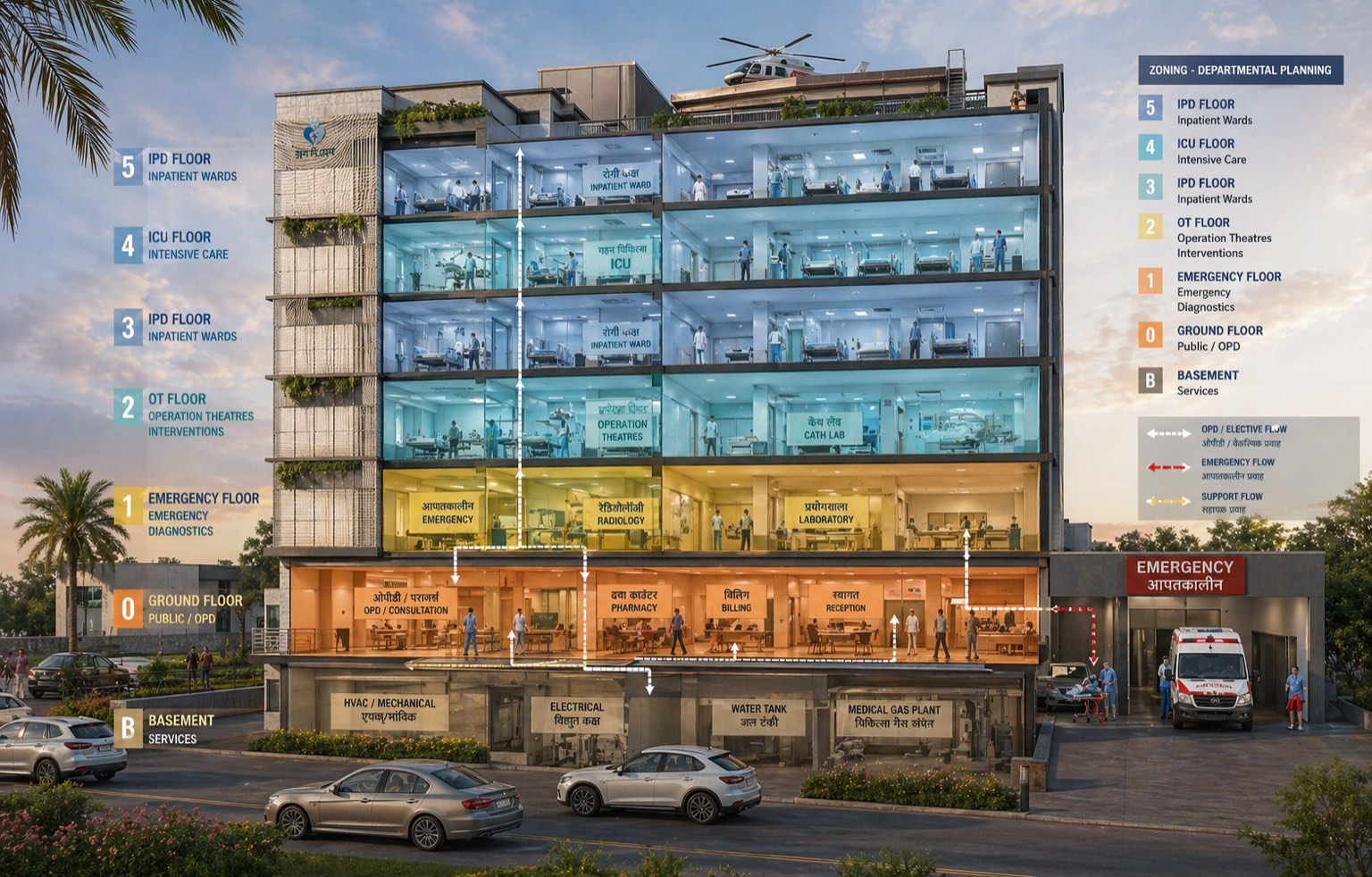
Clinical Adjacencies & Departmental Planning for Indian Hospitals
An Architect's Working Reference — Functional Zoning, the 7-Zone Model, Clean/Dirty Separation, Adjacency Matrix Method, Vertical vs Horizontal Stacking, Circulation Hierarchy, IPHS/FGI Departmental Sizing, and the Hospital Block-Plan Toolkit
Hospital architecture is, before everything else, a problem of organising activity in space. A 100-bed hospital contains roughly 35–45 distinct departmental functions — registration, OPD, ED, IPD wards, ICU, OT, CSSD, pharmacy, pathology, radiology, blood bank, kitchen, laundry, BMW, mortuary, administration, plant rooms, and so on — that must each have appropriate dimensions and finishes, that must be appropriately adjacent to some functions and appropriately separated from others, and whose patient/staff/visitor/supply/waste flows must not interfere with each other. The discipline of working out which functions go where — and how each connects to its neighbours — is clinical adjacency planning. It is the most consequential design decision an architect makes on a hospital project, and the one that distinguishes the experienced healthcare practice from the firm that has read the brief but not yet thought through the building.
This guide is the first in the second ten-part series for healthcare architects. It assumes the reader has read the pillar reference on healthcare regulation and the regulatory deep-dives. It opens the design-focused series — twelve guides covering clinical planning, OT and ICU design, EBD and biophilic strategy, HVAC and services, specialty typologies, sustainability, and the business of healthcare commissions. The intent of this opening guide is to provide the working method by which the architect organises a healthcare brief into a planning diagram before any massing, structure, or facade decision is made.
Adjacency planning has its origins in Florence Nightingale's pavilion-ward rationalisation in Notes on Hospitals (1863), in Llewelyn-Davies & Macaulay's Hospital Planning and Administration (WHO, 1966), and in the post-war efficiency studies that produced the Department-Functional-Zone (DFZ) method now incorporated into FGI's Guidelines for Design and Construction of Hospitals. The Indian context adds layers — IPHS for government tier hospitals, the joint-family visitor culture, the climatic preference for courtyards and verandahs, and the operational economics of a healthcare system where labour is comparatively cheap and equipment comparatively expensive. The architect's task is to apply the international planning method to Indian programme reality.
"In a hospital, the architectural problem is not the wall. It is the line between two activities. The wall comes after." — Sir Sydney Berry, hospital planner, paraphrased citation in Llewelyn-Davies & Macaulay (1966)
"The most efficient hospital plan is the one in which a patient walks the shortest distance, a nurse walks the shortest distance, a sample travels the shortest distance, and a meal travels the shortest distance. Each of these four is a separate optimisation; together, they are an architectural problem." — D.C. Joshi (1934–2018), hospital administrator, paraphrased from Hospital Administration (Joshi, 2018)
1. The 7-Zone Functional Model
The cleanest organising framework for healthcare departmental planning is the seven-zone model — a synthesis of FGI, NHS HBN, and IPHS approaches that treats every department as belonging to one of seven functional zones with characteristic adjacencies and separations.
| Zone | Activities | Typical Departments | Visitor Access |
|---|---|---|---|
| Z1 — Public/OPD | Registration, consultation, dispensing, public waiting | OPD, registration, billing, pharmacy, public toilets, cafeteria | Open |
| Z2 — Acute/Emergency | Resuscitation, acute observation, ambulance arrival | Emergency / Casualty, observation, minor OT | Limited |
| Z3 — Diagnostic | Imaging, lab sampling, blood storage | Radiology, pathology, blood bank, ECG / pulmonary | Controlled |
| Z4 — Intervention | Sterile procedures, surgery, recovery | OT suite, recovery, ICU, HDU, cathlab | Restricted |
| Z5 — Inpatient | Continuous patient care, monitored stay | IPD wards, NICU/PICU, isolation, BMT, dialysis | Visiting hours |
| Z6 — Service & Support | Logistics, sterilisation, laundry, catering | CSSD, kitchen, laundry, stores, pharmacy bulk, BMW | Staff only |
| Z7 — Administration & Education | Management, training, records, religious / counselling | Admin, MRD, library, training, prayer, mortuary admin | Staff/family |
Architectural translation of the 7-zone model:
- Z1 (Public/OPD) sits closest to the main entry — public-facing, ground floor or near-ground.
- Z2 (Emergency) has its own ambulance entry and a direct internal connection to Z3 (Diagnostic) and Z4 (Intervention) for trauma stabilisation.
- Z3 (Diagnostic) bridges Z1 and Z4, serving outpatients and inpatients alike — typically lower floors with logistics access.
- Z4 (Intervention) is high-dependency, sterile, restricted — usually concentrated on a dedicated floor with controlled access.
- Z5 (Inpatient) is repetitive ward floors above Z4 — visitors permitted within hours.
- Z6 (Service) is back-of-house — basement, top floor, or service block — with separate goods/service circulation.
- Z7 (Admin) can be off-axis — a separate office wing or top floor — visitor-friendly but staff-controlled.
This zoning is the first abstraction. It precedes any departmental sizing, structural grid, or facade.
2. The Adjacency Matrix Method — How to Read and Build One
The adjacency matrix is the formal planning tool that converts brief into block plan. Every department is listed on both axes; each cell records the desired relationship.
Adjacency strength categories
| Symbol | Meaning | Example |
|---|---|---|
| 3 or "Direct" | Departments must share a wall or door | OT ↔ Recovery; CSSD ↔ OT clean store |
| 2 or "Close" | Departments must be on the same floor or one floor apart, with direct lift / corridor access | Emergency ↔ Imaging; Pharmacy ↔ OPD |
| 1 or "Same building" | Functional connection but not floor-critical | Admin ↔ Records |
| 0 or "Neutral" | No specific adjacency need | Mortuary ↔ Cafeteria (must be separated) |
| −1 or "Avoid" | Departments must be separated by distance / barrier / floor | Kitchen ↔ Mortuary; Public ↔ BMW |
Sample adjacency matrix — 100-bed hospital (excerpt)
| OPD | ED | OT | ICU | IPD | Imaging | Lab | Pharmacy | CSSD | Kitchen | Mortuary | |
|---|---|---|---|---|---|---|---|---|---|---|---|
| OPD | — | 2 | 0 | 0 | 1 | 2 | 1 | 3 | 0 | 0 | −1 |
| ED | 2 | — | 2 | 2 | 1 | 3 | 2 | 1 | 1 | 0 | 1 |
| OT | 0 | 2 | — | 3 | 1 | 2 | 1 | 1 | 3 | 0 | 0 |
| ICU | 0 | 2 | 3 | — | 2 | 2 | 1 | 1 | 1 | 0 | 0 |
| IPD | 1 | 1 | 1 | 2 | — | 1 | 0 | 1 | 0 | 1 | 0 |
| Imaging | 2 | 3 | 2 | 2 | 1 | — | 0 | 0 | 0 | 0 | 0 |
| Lab | 1 | 2 | 1 | 1 | 0 | 0 | — | 1 | 0 | 0 | 0 |
| Pharmacy | 3 | 1 | 1 | 1 | 1 | 0 | 1 | — | 0 | 0 | 0 |
| CSSD | 0 | 1 | 3 | 1 | 0 | 0 | 0 | 0 | — | 0 | 0 |
| Kitchen | 0 | 0 | 0 | 0 | 1 | 0 | 0 | 0 | 0 | — | −1 |
| Mortuary | −1 | 1 | 0 | 0 | 0 | 0 | 0 | 0 | 0 | −1 | — |
The architect builds this matrix at the concept stage — before any floor plan exists. The matrix then drives the block plan: 3-rated pairs cluster; 2-rated pairs share floors; −1-rated pairs separate. The entire planning logic flows from the matrix, not from the architect's intuition.
3. Clean / Dirty / Mixed — The Cross-Cutting Discipline
Every department-to-department connection must be classified by cleanliness. The discipline is simple: clean and dirty must not cross.
| Flow | Example | Hospital Architectural Implication |
|---|---|---|
| Clean | Sterile instruments leaving CSSD; clean linen leaving laundry; cooked meals leaving kitchen | One-way clean corridor; separate trolley |
| Dirty | Used instruments returning to CSSD; soiled linen entering laundry; food waste leaving kitchen | One-way dirty corridor; separate trolley |
| Mixed | Patient (clean before surgery, semi-clean after); visitor; clinical staff | Designated public/staff corridors; controlled entry to clean zones |
| Sterile | OT clean side; CSSD sterile store; pharmacy IV admixture | Restricted access; pressure-positive HVAC |
The architectural rule: every department whose flow crosses clean and dirty must be planned as a two-corridor department or with pass-through connections. The OT, CSSD, kitchen, and laundry are the four canonical examples. A hospital with single-corridor CSSD will fail NABH; a hospital with single-corridor kitchen will fail FSSAI; a hospital with mixed-flow laundry will recurrently re-infect the clean linen.
4. Vertical vs Horizontal Stacking — The Big Architectural Choice
Hospitals organise vertically (multi-storey podium-and-tower), horizontally (single-storey racetrack or campus), or hybrid. Each has consequences.
| Approach | Strengths | Weaknesses | Typical Indian Application |
|---|---|---|---|
| Vertical stack (G+5 to G+15) | Compact site; efficient floor plate; centralised services | Lift-dependent; longer evacuation; service shaft conflict | Urban metro hospitals (Mumbai, Bengaluru, Delhi tertiary) |
| Horizontal racetrack (G to G+2) | Short stretcher walks; daylight to all wards; passive ventilation; resilience | Larger footprint; longer corridors; harder logistics | Tier-2/3 city hospitals; specialty clinics |
| Podium + tower hybrid | Public/diagnostic/OT/ICU on podium; IPD on tower above; service in basement | Complexity; vertical patient transfer; structural cost | Multi-specialty hospitals 100–500 beds |
| Courtyard / pavilion (Nightingale) | Cross-ventilation; daylight; biophilic; dignified scale | Larger plot; longer walks; more façade | Specialty hospitals; tier-2 government hospitals; institutional sites |
| Linear "spine and limb" | Service spine with departmental limbs; predictable expansion | Long corridors; campus-scale | Government district hospitals; campus-style projects |
The decision-driver matrix:
| If… | Then… |
|---|---|
| Plot is < 1 acre and urban | Vertical stack with podium + tower |
| Plot is > 4 acres and peri-urban | Horizontal racetrack or pavilion |
| Capex is sensitive and operational labour is plentiful | Horizontal (lower lift cost, lower MEP) |
| Capex permits but operational efficiency is critical | Vertical (concentrated services, shorter staff walks) |
| Climate is extreme (warm-humid, composite) | Pavilion / courtyard for passive performance |
| Programme demands tertiary specialty | Podium + tower with concentrated intervention |
The vertical-vs-horizontal choice precedes departmental planning — the adjacency matrix is then projected onto the chosen stacking strategy.
5. Circulation Hierarchy — Five Distinct Flows
Hospital circulation is not one system. It is five overlaid systems that must be designed in coordination:
| Flow | Volume (100 beds, daily) | Architectural Provision |
|---|---|---|
| Patient flow — outpatient | 200–400 visits | OPD-side dedicated corridor; queue management; accessibility |
| Patient flow — inpatient | 50–80 admissions / discharges | Admission desk, lift, ward access; stretcher-compatible |
| Staff flow | 200–400 staff movements | Staff entry, change rooms, parallel corridors, duty rooms |
| Visitor flow | 300–600 visitor movements | Public lobby, ward visiting hours, family lounges |
| Supply flow | 50–80 trolley moves | Service lift, service corridor, BMW transport, kitchen, linen |
| Waste flow | 40–60 trolley moves | Service corridor; BMW route; service lift exclusive use |
The architectural discipline: provide separate corridors and lifts for at least three of the five flows. Patient + staff can share; visitor must be partially separated; supply + waste must be separated from clinical flow. A hospital that funnels all five through one main corridor will read as efficient on paper but fail operationally — it is the most common single-cause reason that "efficient-looking" hospitals feel chaotic.
6. Departmental Sizing — IPHS and FGI Schedules
IPHS for government and FGI for international reference provide departmental size schedules. The architect uses these as starting points, then adjusts to programme.
IPHS — Government tier hospitals
| Tier | Beds | OPD Area | ED Area | OT Count | ICU Beds | Lab Area |
|---|---|---|---|---|---|---|
| PHC | 6 | 80–100 m² | — | 1 (minor) | — | 18 m² |
| CHC | 30 | 200–250 m² | 60 m² | 1–2 | 4 | 60 m² |
| SDH | 31–100 | 350–500 m² | 120 m² | 2–4 | 6–10 | 120 m² |
| DH (small) | 100–200 | 600–800 m² | 200 m² | 4–6 | 12–18 | 200 m² |
| DH (large) | 200–500 | 1000–1500 m² | 350 m² | 6–10 | 24–40 | 350 m² |
FGI — Indicative private hospital schedule (architect adapts)
| Department | 100-bed | 200-bed | 500-bed |
|---|---|---|---|
| OPD | 700–900 m² | 1,200–1,500 m² | 2,500–3,200 m² |
| ED | 250–350 m² | 400–550 m² | 700–900 m² |
| OT suite (per OT incl. recovery) | 180–220 m² | 180–220 m² | 180–220 m² |
| ICU (per bed incl. support) | 22–28 m² | 22–28 m² | 22–28 m² |
| IPD ward (per bed incl. support) | 28–32 m² | 28–32 m² | 28–32 m² |
| Pharmacy | 80–100 m² | 150–200 m² | 350–450 m² |
| Pathology + microbiology | 120–150 m² | 250–320 m² | 500–650 m² |
| Radiology | 200–300 m² | 400–600 m² | 1,000–1,400 m² |
| CSSD | 80–120 m² | 150–200 m² | 350–500 m² |
| Kitchen | 100–150 m² | 200–280 m² | 500–650 m² |
| Laundry | 80–120 m² | 150–200 m² | 350–450 m² |
| Mortuary | 30–50 m² | 60–80 m² | 120–160 m² |
| Plant rooms (HVAC, MEP) | 250–350 m² | 500–650 m² | 1,200–1,600 m² |
| Administration | 150–200 m² | 280–350 m² | 600–800 m² |
Total built-up indicative: 100-bed ~6,000–7,500 m² · 200-bed ~12,000–15,000 m² · 500-bed ~28,000–35,000 m². Indian projects typically run 10–15% leaner due to corridor efficiency and programme compression; international comparable projects run 10–15% larger due to single-bed wards and atrium provisions.
7. The Block-Plan Toolkit — From Brief to Block Plan in Six Steps
A working method for the architect's first design week.
| Step | Action | Output |
|---|---|---|
| 1 | List all departments with sizing target (per IPHS / FGI / brief) | Department sizing schedule |
| 2 | Build adjacency matrix (3 / 2 / 1 / 0 / −1) | Adjacency matrix |
| 3 | Cluster by zone (Z1–Z7) | Zone diagram |
| 4 | Choose stacking strategy (vertical / horizontal / hybrid) | Stacking diagram |
| 5 | Project zones onto stacking — assign each department to a floor and a quadrant | Block plan |
| 6 | Verify circulation: trace patient/staff/visitor/supply/waste flows; identify conflicts | Circulation overlay |
Iteration discipline: the block plan is iterated 3–5 times in the first two weeks. Each iteration is checked against the matrix, the circulation overlay, and the brief. By iteration 4 or 5, the plan has settled — at which point detailed planning (room sheets, structural grid, MEP) can begin.
8. Common Adjacency Failure Modes
Catalogue of recurring planning errors.
| # | Failure | Consequence | Prevention |
|---|---|---|---|
| 1 | OT not directly connected to recovery | Patient transferred over distance under anaesthesia | OT ↔ recovery 3-rated; share wall |
| 2 | CSSD on different floor from OT | Sterile supply contaminated in transit | OT ↔ CSSD 3-rated; pass-through autoclave |
| 3 | ED not connected to imaging | Trauma patient transported through public corridor to imaging | ED ↔ imaging 3-rated |
| 4 | Mortuary access via OPD lobby | Family viewing dignity lost; public observation | Service-side mortuary; family corridor separate |
| 5 | Kitchen near mortuary | Cross-contamination perception; FSSAI flag | Kitchen and mortuary at opposite ends |
| 6 | BMW transport via public corridor | Infection risk; aesthetic | Service-side BMW route; service lift exclusive |
| 7 | Single corridor in ward floor | Staff/visitor/supply mixing | Two-corridor ward or sub-divided corridor |
| 8 | ICU on top floor without dedicated lift | Slow vertical transfer; lift-dependent | ICU adjacent to OT, fire / stretcher lift dedicated |
| 9 | Radiology on different floor from ED | Trauma stabilisation delayed | Imaging ↔ ED 3-rated; same floor |
| 10 | OPD pharmacy on different floor | Outpatient walks 300 m to dispense | OPD ↔ pharmacy 3-rated; share floor |
| 11 | Visitor and patient corridors merge in lobby | Crowding; infection; anxiety | Branched lobby with patient-only and visitor-only paths |
| 12 | Staff entry through public lobby | Mass crowd at shift changes | Separate staff entry with timing buffer |
| 13 | Service lift in patient corridor | Trolley collision risk | Service lift via service corridor only |
| 14 | Cafeteria in clinical corridor | Smell, smoke, foot-traffic in clinical | Cafeteria off main lobby, smoke-managed |
| 15 | Religious / prayer room not designed | Family stress not accommodated; ad-hoc spaces | Multi-faith prayer room near IPD, > 100 beds |
9. Indian Joint-Family Adjustment
Indian healthcare programme has a planning premise that international guidelines underestimate: visitor density. A single inpatient typically receives 3–6 family members at any time, with up to 8–12 over a day. The planning consequences:
| Implication | Architectural Response |
|---|---|
| Higher visitor flow | Larger lobby, broader visiting corridors, family lounges per ward |
| Family overnight | Attendant beds in IPD rooms; recliner chairs; family seating in ICU |
| Religious practice | Multi-faith prayer room; tulasi / shrine-in-room option for some wards |
| Communal eating | Family dining area near IPD; pantry per ward |
| Local-language signage | Bilingual or trilingual wayfinding (state language + Hindi + English) |
| Caregiver facilities | Toilets, washbasins, sleeping space for attenders |
| Cultural sensitivity | Mortuary with ritual space, body-washing facility for some communities |
Western-derived guidelines often plan for visitor-as-occasional. Indian planning treats visitor-as-resident — a different programme that drives larger lobbies, dedicated family circulation, and integrated cultural space.
"In an Indian hospital, the visitor is not a guest. The visitor is a co-patient. The architect who plans for the patient alone has missed half the brief." — Anonymous senior healthcare architect, paraphrased
10. Architect's Departmental Planning Checklist
| # | Item | Stage |
|---|---|---|
| 1 | All departments listed with target areas | Brief |
| 2 | Adjacency matrix completed | Concept |
| 3 | Zone diagram (Z1–Z7) drawn | Concept |
| 4 | Stacking strategy chosen | Concept |
| 5 | Block plan iterated 3–5 times | Concept–Schematic |
| 6 | Five-flow circulation overlay verified | Schematic |
| 7 | Clean / dirty separations confirmed | Schematic |
| 8 | Two-corridor / pass-through CSSD planned | Schematic |
| 9 | One-way kitchen and laundry flow verified | Schematic |
| 10 | OT–recovery–CSSD cluster integrated | Schematic |
| 11 | ED–imaging direct connection | Schematic |
| 12 | Mortuary on service side; not via OPD | Schematic |
| 13 | Family circulation designed | Schematic |
| 14 | Multi-faith prayer / counselling room (≥ 100 beds) | Schematic |
| 15 | Service lift exclusive for supply / waste | Schematic |
| 16 | Patient/staff/visitor entries differentiated | Schematic |
| 17 | Bilingual signage strategy | Schematic |
| 18 | Cross-references to regulatory requirements | Schematic |
"The hospital that flows is the hospital that heals. The architect's lines are not arbitrary — they are the channels of recovery." — Roger Ulrich (1946–2024), environmental psychologist, paraphrased from public lecture
References
- Bromley, E. (2012) 'Building patient-centeredness: hospital design as an interpretive act', Social Science & Medicine, 75(6), pp. 1057–1066.
- Cain, C.L. and Haque, S. (2008) 'Organizational workflow and its impact on work quality', in Hughes, R.G. (ed.) Patient Safety and Quality: An Evidence-Based Handbook for Nurses. Rockville: AHRQ.
- Carthey, J. (2008) 'Reinventing the hospital: the architecture of healthcare', World Hospitals and Health Services, 44(4), pp. 35–39.
- Facility Guidelines Institute (2022) Guidelines for Design and Construction of Hospitals. St. Louis: FGI.
- Government of India (2022) Indian Public Health Standards 2022. New Delhi: MoHFW.
- Hardy, O.B. and Lammers, L.P. (1986) Hospitals — The Planning and Design Process. 2nd edn. New York: Van Nostrand Reinhold.
- Hosking, S. and Haggard, L. (1999) Healing the Hospital Environment: Design, Management and Maintenance of Healthcare Premises. London: E & FN Spon.
- James, P. and Tatton-Brown, W. (1986) Hospitals: Design and Development. London: Architectural Press.
- Joseph, A. (2006) The Impact of the Environment on Infections in Healthcare Facilities. Concord: Center for Health Design.
- Joshi, D.C. and Joshi, M. (2018) Hospital Administration. 2nd edn. New Delhi: Jaypee Brothers.
- Kobus, R.L., Skaggs, R.L., Bobrow, M., Thomas, J. and Payette, T.M. (2008) Building Type Basics for Healthcare Facilities. 2nd edn. Hoboken: Wiley.
- Llewelyn-Davies, R. and Macaulay, H.M.C. (1966) Hospital Planning and Administration. Geneva: WHO.
- Mehrotra, R. (2011) Architecture in India Since 1990. Mumbai: Pictor / Hatje Cantz.
- Nightingale, F. (1863) Notes on Hospitals. 3rd edn. London: Longman.
- NHS Estates (various) Health Building Note 00-01: General Design Guidance for Healthcare Buildings. London: Department of Health (UK).
- Sakharkar, B.M. (2009) Principles of Hospital Administration and Planning. 2nd edn. New Delhi: Jaypee Brothers.
- Stichler, J.F. (2010) 'Healing by Design: Integrating evidence-based design principles into healthcare', HERD, 3(2), pp. 3–6.
- Ulrich, R.S., Zimring, C., Zhu, X., DuBose, J., Seo, H.B., Choi, Y.S., Quan, X. and Joseph, A. (2008) 'A review of the research literature on evidence-based healthcare design', HERD, 1(3), pp. 61–125.
- Verderber, S. (2010) Innovations in Hospital Architecture. Abingdon: Routledge.
- Wagenaar, C. (Ed.) (2018) The Architecture of Hospitals. Rotterdam: NAi.
Author's Note: This guide opens the design-focused series — twelve articles covering clinical adjacencies, OT and ICU design, EBD and biophilic strategy, HVAC and services, specialty typologies, sustainability, and the business of healthcare commissions. The intent is to provide the architect with a working method for the most consequential design decision on a hospital project: how to organise activity in space. Subsequent guides in this series will go deeper on specific departments and dimensions of the planning craft.
Disclaimer: This article is for informational and educational purposes only and does not constitute professional architectural advice. Hospital planning depends on the specific site, brief, programme, climate, and statutory framework that must be assessed project-by-project by qualified architects and healthcare planners. Studio Matrx, its authors, and contributors accept no liability for decisions made on the basis of the information in this guide.
Export this guide
Related Tools — Try Free
Cross-Ventilation Analyzer
Estimate airflow and air changes per hour (ACH) from room size, window areas, layout, and local wind — with NBC 2016 Part 8 compliance check.
Ventilation CalculatorApartment Furniture Size Chart
Standard furniture dimensions for Indian apartments — sofas, beds, tables, dining, storage.
Reference ChartMaterial Decision Framework (M-Score)
Score 30+ Indian construction materials across cost, durability, climate fit, maintenance, and sustainability.
Materials