
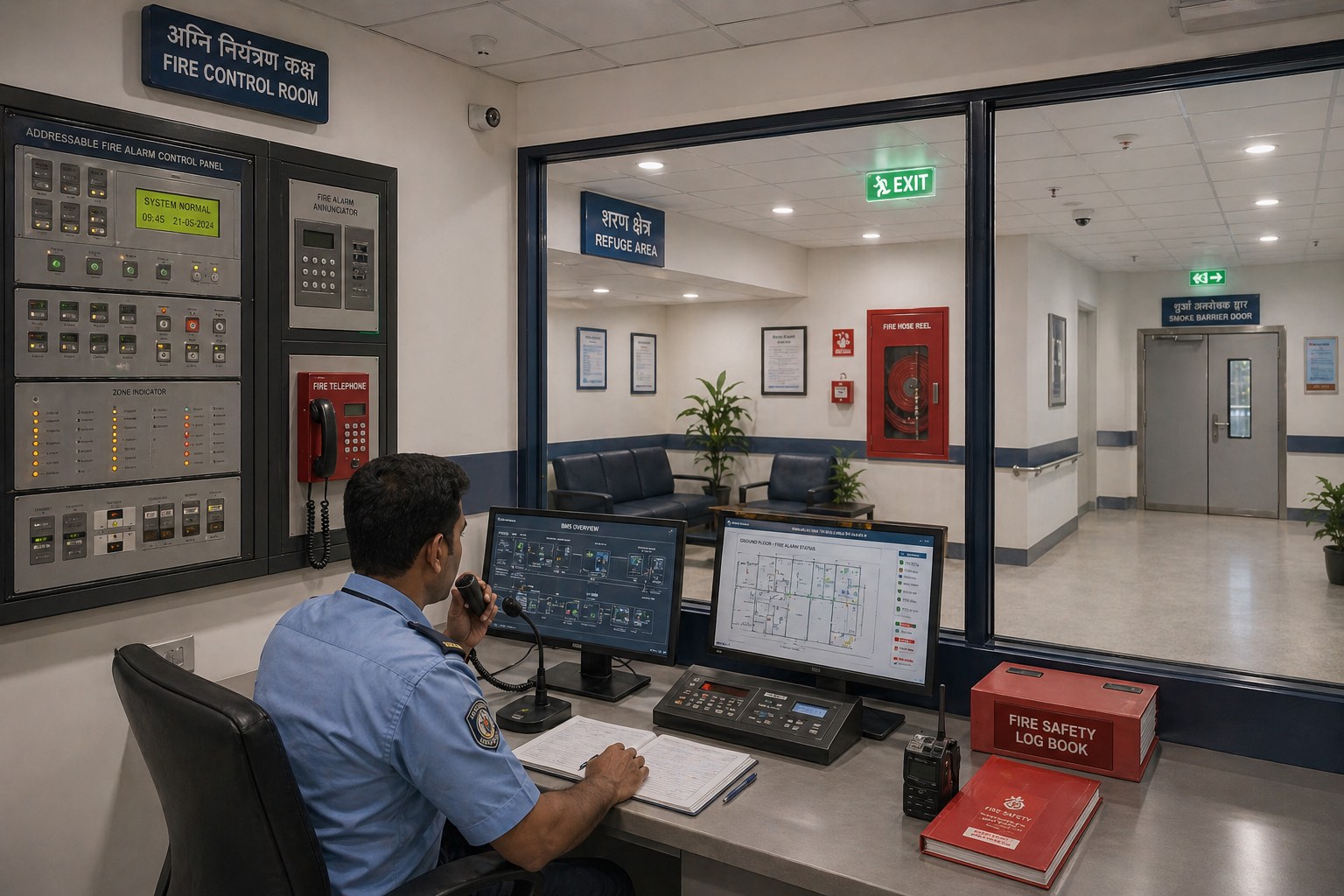
Fire Safety in Healthcare Buildings in India: An Architect's Working Reference
NBC 2016 Part 4 + State Fire Codes (TN, KA, MH, DL, GJ, WB, KL, UP, RJ, AP, TS) — Compartmentation, Detection, Suppression, Smoke Management, Evacuation Strategy for Non-Ambulatory Patients, OT/ICU Special Scenarios, Fire NOC Process, and the Hospital-Specific Fire Strategy Framework
Fire safety is the single most consequential life-safety concern in any healthcare building. Patients in hospitals, by definition, include those who cannot evacuate themselves — newborns in NICU, post-surgical patients, ventilator-dependent ICU patients, elderly bedbound patients, patients in restraint, patients on chemotherapy or dialysis. The fire-safety strategy in a healthcare building therefore cannot rely on the conventional "evacuate within 2.5 minutes" model that office buildings depend on. It must instead engineer the building such that staff can defend patients in place, evacuate horizontally to fire-protected smoke compartments, or vertically only as a last resort.
This guide is the tenth and final guide in the regulatory series. It assumes the reader has read the pillar reference, the facility-type guides, and the regulatory deep-dives on NBC Group C-1, CEA state variations, NABH, AERB, and BMW Rules.
Fire safety in Indian healthcare is governed by NBC 2016 Part 4 at the national level and by state fire codes that overlay NBC. The state codes are not optional — they are the actual approval-issuing framework, and several states (Tamil Nadu, Maharashtra, Karnataka, Delhi, Gujarat) have their own statutes that materially alter NBC's prescriptions in healthcare-relevant ways. Fire NOC failure remains the single most common single-cause delay in hospital commissioning across India; this guide is structured to pre-empt it.
"Fire in a hospital is not an event to be evacuated from. It is an event to be contained. The architecture decides whether containment is possible." — Sir Eric Marsden, fire engineer (UK), paraphrased from a Society of Fire Protection Engineers symposium
"After the AMRI Hospital fire of 2011, every Indian hospital architect should have re-read NBC Part 4. Most have not." — Anonymous senior fire-services consultant in Kolkata, paraphrased
1. The National Floor — NBC 2016 Part 4 in Hospital-Specific Reading
NBC 2016 Part 4 — Fire and Life Safety — places hospitals in Group C, sub-class C-1 (covered in detail in the NBC C-1 reference guide). The headline requirements:
| NBC C-1 Requirement | Quick Reference |
|---|---|
| Travel distance | 22.5 m direct; 45 m total |
| Stairway width | 2.0 m minimum |
| Two protected staircases | At opposing ends; > 9 m separation |
| Refuge area | Above 24 m height; 0.3 m²/person |
| Smoke compartment | ≤ 1000 m² each |
| Sprinkler | Throughout |
| Wet riser | 100 mm; landing valves per floor |
| Hose reel | Per 60 m corridor |
| Detection | Addressable smoke; throughout |
| PA / voice evacuation | Throughout |
| Fire lift | ≥ 15 m height |
| Stretcher lift | 1100 × 2400 mm cabin |
| Compartmentation | OT, ICU, kitchen, generator — 2 hours; record store — 2 hours |
This guide builds on the NBC C-1 reference and focuses on the layers above NBC: state fire codes, healthcare-specific fire scenarios, and the hospital fire strategy framework.
2. State Fire Codes — Where NBC Stops Being Enough
Each state operates its own fire-services act, with rules and bye-laws that may exceed NBC in specific provisions. The most architecturally consequential state codes:
| State | Statute | Notable Healthcare-Specific Provisions |
|---|---|---|
| Tamil Nadu | TN Fire Service Act 1985 + TN Fire Service Rules 1990 + TN Fire Prevention & Fire Safety Act 2017 | Stricter compartmentation in hospital; mandatory sprinkler from G+1; horizontal evacuation evidenced |
| Karnataka | Karnataka Fire Force Act 1964 + Karnataka State Fire & Emergency Services Department guidelines | Stretcher lift on every IPD floor; voice evacuation system; specified sprinkler density for OT-corridor |
| Maharashtra | Maharashtra Fire Prevention & Life Safety Measures Act 2006 | Mandatory fire safety officer for hospitals > 50 beds; quarterly mock drills; structural NOC at design |
| Delhi (NCT) | Delhi Fire Service Act 2007 + Delhi Fire Service Rules | Separate ambulance entry above 100 beds; hospital height limits; helipad provisions |
| Gujarat | Gujarat Fire Prevention & Life Safety Measures Act 2013 | Stricter sprinkler density; earthing audit; OT smoke purge |
| West Bengal | WB Fire Service Act 1950 (amended) | Post-AMRI 2011 reforms; mandatory third-party fire audit; stretcher lift; manual call points at higher density |
| Kerala | Kerala Fire Force Act 1962 | Stricter ventilation in OT for fire scenarios |
| Uttar Pradesh | UP Fire Prevention & Fire Safety Act 2005 | Mandatory voice evacuation; PA system pre-recorded messages |
| Rajasthan | Rajasthan Fire Prevention & Fire Safety Act 2018 | Recent statute; modern provisions including BMS interface |
| Andhra Pradesh / Telangana | AP / TS Fire Service Act | Stretcher lift, refuge floor, helipad provisions |
The post-AMRI imperative — the AMRI Hospital fire in Kolkata, December 2011, killed 90+ people and resulted in significant tightening of state fire codes across India. Architects designing hospitals in West Bengal in particular, but also nationally, work in a fire-regulatory environment shaped by AMRI's lessons: third-party fire audits, mandatory sprinkler in basement plant areas, evacuation drills evidenced, and architectural provision for full compartmentation.
3. Compartmentation — The Architectural Skeleton of Fire Safety
Fire compartmentation is the single most architecturally consequential fire-safety strategy in a hospital. A properly compartmented hospital can survive an internal fire by sealing it within a compartment for hours; an inadequately compartmented hospital cannot.
| Compartment Type | Fire-Resistance Rating | Hospital Application |
|---|---|---|
| Stair enclosure | 2 hours | All staircases C-1 |
| Lift shaft enclosure | 2 hours | All lifts |
| OT suite | 2 hours | OT cluster as a unit |
| ICU | 2 hours | ICU cluster |
| NICU | 2 hours | Isolated cluster |
| BMT / immuno | 2 hours | Higher rating recommended |
| Kitchen | 2 hours | Including service shafts |
| Generator room | 4 hours | Major separation |
| Switchgear | 2 hours | Adjacent to building |
| UPS room | 2 hours | UPS plant |
| LMO / medical gas manifold | 2 hours | Gas plant |
| Pharmacy bulk store | 2 hours | Pharmaceutical fire load |
| Records / archive | 2 hours | Paper fire load |
| Linen store | 1 hour | Linen fire load |
| Mortuary plant | 1 hour | Refrigerant hazard |
| Helipad refuelling | Special clean-agent | Fuel hazard |
Compartmentation discipline: every penetration through a fire-rated wall — duct, pipe, conduit, cable — must be sealed with an approved fire-stop product to maintain the rating. The architect's drawing set must include a fire-stop schedule. A 2-hour wall with one unsealed conduit is a 0-hour wall.
4. Smoke Compartments — Within-Floor Separation
Smoke compartmentation prevents smoke spread within a floor — critical for non-ambulatory patients who shelter in place.
| Smoke Compartment Provision | NBC C-1 |
|---|---|
| Trigger | Each floor with usable area ≥ 1000 m² in C-1 |
| Compartment area | ≤ 1000 m² each |
| Cross-corridor smoke barrier | 1-hour rated; full-height; self-closing 30-min smoke door |
| Door swing | In direction of egress |
| Vision panel | Wired-glass |
| Slab-to-slab | Continuous; no gap in ceiling void |
| Smoke detector | At smoke barrier |
Smoke barriers must be designed at concept stage. Retrofit smoke barriers are difficult — they require slab-to-slab construction with continuous sealing through services.
5. Active Fire Suppression — Sprinkler, Wet Riser, Hose Reel, Hydrant
| System | Specification | Hospital Application |
|---|---|---|
| Sprinkler | Throughout C-1; density per IS 15301 | Ceiling void ≥ 0.5 m for piping |
| Sprinkler exemption | OT (clean-agent FM-200 or Novec 1230 substitute); MRI room (separate strategy) | Gas storage room near OT |
| Pre-action sprinkler | OT corridor (delayed water release) | OT clean-area protection |
| Wet riser | 100 mm dia; landing valves each floor | Riser shaft sized 600 × 1000 mm |
| Hose reel | One per 60 m corridor; 30 m hose | Recess in corridor wall |
| Hydrant | Perimeter at 60 m; one per face | Site planning |
| Fire pump | Jockey + main + standby per IS 15301 | Pump room ≥ 30 m² |
| Fire-water tank | 100,000–200,000 L for 100 beds | UG or OH; structural |
| Pressure-reducing valves | Where pressure > 5 bar | Per riser |
Clean-agent suppression for OT — FM-200, Novec 1230, or NAF-S-III — is required because water cannot be used in OT (electrical equipment, sterile field) and CO2 cannot be used in occupied spaces. The agent storage room is typically 6–10 m² near the OT cluster.
6. Detection, Alarm, and Voice Evacuation
| System | Specification |
|---|---|
| Smoke detection — addressable | Throughout, including patient rooms (multi-criteria sensors to reduce false alarms) |
| Heat detection | Kitchen, plant rooms |
| Manual call points | At every staircase, every exit, 30 m corridor intervals |
| Fire alarm panel | Main + repeater at security / fire control room |
| PA / voice evacuation | Required throughout C-1 in NBC and most state codes |
| Beacon / strobe | Visual alarm in noisy areas |
| Emergency lighting | Throughout escape routes; battery 2 hours |
| Exit signage — illuminated | At every exit |
| BMS integration | Fire alarm interface with HVAC, lift, access control |
Voice evacuation specifics for hospitals:
- Pre-recorded messages in two languages (state language + English; some states + Hindi)
- Phased evacuation messages (initial alert, evacuate this compartment, evacuate this floor, evacuate building)
- Speaker placement in every patient room, ICU bay, OT, lobby, corridor
- Volume calibration to overcome HVAC noise, alarms, equipment
- BMS-controlled selective broadcasting (zone-specific messaging)
7. Smoke Management & Stair Pressurisation
Smoke management is the under-documented half of hospital fire safety.
| Smoke Management Element | Specification |
|---|---|
| Stair pressurisation | Mandatory > 24 m height; ≥ 50 Pa positive |
| Lift lobby pressurisation | Where lift serves combined function |
| Smoke purge — atrium | Mechanical extraction from top |
| OT smoke management | OT to be evacuable; dampers close on smoke detection |
| Kitchen smoke purge | Hood ventilation with shutoff |
| Generator room smoke purge | Independent exhaust |
| Refuge area cross-ventilation | Mechanical or natural |
| Smoke dampers at fire-rated wall | Where ducts cross |
| Smoke detection in air handler return | AHU shutdown on smoke |
The smoke-management strategy must be designed in coordination with HVAC. A hospital with HVAC that does not shut down on smoke detection will distribute smoke across the building via return-air ducts — the most insidious fire-spread mechanism in modern hospitals.
8. Evacuation Strategy for Non-Ambulatory Patients
The conventional fire-evacuation model — rapid evacuation by occupants under their own power — does not apply in hospitals. The hospital fire-safety strategy is a hierarchy of responses:
| Response | When | Architectural Provision |
|---|---|---|
| Defend in place | Initial response; patients in ward / ICU not directly threatened | Compartmentation; smoke barriers; HVAC shutdown |
| Horizontal evacuation | Smoke in compartment; move patients to adjacent compartment | Cross-corridor smoke barriers; wide stretcher-friendly doors |
| Vertical evacuation — non-fire stair | Compartment compromised; move to floor below | Stretcher lift; non-fire stair |
| Vertical evacuation — fire stair | Major incident; staff-assisted | Wide protected stair; refuge zones |
| External evacuation | Major; building unsafe | Refuge floor; fire-tender access; external assembly |
Architectural pre-conditions for the hierarchy:
- Compartmentation that holds for 2 hours minimum
- Cross-corridor smoke barriers
- Stretcher lifts with emergency power
- Wide stretcher-friendly doors and corridors (≥ 2.4 m clear)
- Refuge floor with assembly capability
- Fire-tender access on at least two perimeter sides
9. Special Fire Scenarios — Healthcare-Specific Risks
| Scenario | Risk | Architectural Response |
|---|---|---|
| OT fire | Oxygen-rich atmosphere; flammable surgical drapes; electrical equipment | Anti-static OT flooring; clean-agent suppression FM-200/Novec; surgical-drape spec for low flammability; oxygen shutoff at OT entry |
| ICU fire | Ventilator oxygen; non-ambulatory patients | Compartmentation; HVAC shutdown; clean-agent local; trained staff |
| Kitchen fire | High-temperature cooking; oil; gas | Hood suppression (wet-chemical / dry-chemical); gas shutoff; separate fire compartment |
| Generator room fire | Diesel fuel; high-current electrical | 4-hour fire compartment; separate ventilation; FM-200 or CO2 (unoccupied) |
| Mortuary refrigerant hazard | Ammonia / refrigerant leak | Plant isolation; ventilation; gas detection |
| Helipad fuel fire | Aviation fuel | Foam suppression; isolated compartment; emergency rundown |
| Pharmacy bulk fire | Combustible drugs; alcohol | Sprinkler + compartmentation |
| Records / archive fire | High paper load | Sprinkler + compartmentation; off-site backup |
| Linen store fire | Combustible | Sprinkler + compartmentation |
| NICU fire | Newborns; oxygen-rich | Highest priority; clean-agent local; staff-assisted evacuation |
| CT/MRI room fire | Equipment value; magnet quench (MRI) | Clean-agent or careful suppression; MRI quench protocol |
| AERB room fire | Radioactive sources (nuclear medicine) | Source containment; specialised fire-fighter PPE |
| Oxygen pipeline rupture | Explosive enrichment | LMO shutoff; manifold isolation |
10. Fire NOC Process — State by State
| State | Fire NOC Authority | Pre-Construction Stage | Pre-Operation Stage |
|---|---|---|---|
| TN | Fire & Rescue Services Department | Provisional NOC at building permit | Final NOC after construction |
| KA | Karnataka Fire & Emergency Services | Provisional NOC | Final NOC |
| MH | Maharashtra Fire Service | Scrutiny + provisional | Final after fire-safety officer audit |
| Delhi | Delhi Fire Service | Pre-construction NOC | Final NOC after audit |
| GJ | Gujarat Fire Service | Provisional + scrutiny | Final NOC |
| WB | WB Fire & Emergency | Pre-construction NOC | Final after third-party fire audit |
| KL | Kerala Fire Force | NOC + scrutiny | Final |
| UP | UP Fire Service | Pre-construction NOC | Final |
| RJ | RJ Fire Service | NOC + scrutiny | Final |
| AP / TS | Fire Service | Pre-construction | Final |
The pre-construction fire NOC is required before building permit in most states. The architect's submission includes: fire scheme drawings, evacuation strategy, suppression and detection drawings, hydraulic calculations, and water-tank capacity. The final NOC is issued only after fire-safety system commissioning, including pump test, sprinkler test, alarm test, and walk-through.
11. Hospital Fire Strategy Framework — A 12-Point Architectural Method
| # | Strategy Element | Architectural Decision |
|---|---|---|
| 1 | Sub-classification (C-1) confirmed | Brief stage |
| 2 | Travel distance ≤ 22.5 m verified | Concept block plan |
| 3 | Two protected staircases; > 9 m separation | Concept |
| 4 | Refuge floor / per-floor refuge | Concept (if > 24 m) |
| 5 | Smoke compartments designed | Concept |
| 6 | Fire compartmentation — OT, ICU, kitchen, generator, switchgear | Concept |
| 7 | Stair / lift-lobby pressurisation | Preliminary |
| 8 | Sprinkler riser shafts | Preliminary |
| 9 | Wet-riser shafts | Preliminary |
| 10 | Fire-pump room and water tank | Preliminary |
| 11 | Hydrant placement | Preliminary |
| 12 | Detection / PA / voice evacuation | Detailed |
| 13 | Smoke management — HVAC shutdown, dampers | Detailed |
| 14 | Special suppression — clean-agent OT, kitchen | Detailed |
| 15 | Door schedule — fire-rated, smoke-rated | Detailed |
| 16 | Fire-stop schedule — every penetration | Detailed |
| 17 | Helipad, mortuary, pharmacy, MRI special protocols | Detailed |
| 18 | Voice-evacuation pre-recorded messages | Commissioning |
| 19 | Mock drill protocol | Commissioning |
| 20 | Third-party fire audit (WB, MH) | Commissioning |
12. Common Hospital Fire-Safety Failure Modes
| # | Failure | Prevention |
|---|---|---|
| 1 | Single staircase on a wing | Two-staircase compliance from concept |
| 2 | Staircase < 2.0 m width | NBC C-1 from concept |
| 3 | Travel distance > 22.5 m | Block-plan check |
| 4 | Refuge area absent above 24 m | Designate at concept |
| 5 | Smoke barriers not slab-to-slab | Continuous detail |
| 6 | OT without clean-agent suppression | Specify at design |
| 7 | Generator without 4-hour compartment | Specification |
| 8 | Stair not pressurised > 24 m | HVAC engineering |
| 9 | HVAC return-air without smoke-shutdown | BMS interface |
| 10 | Voice evacuation not bilingual | Pre-recorded message spec |
| 11 | Fire-stop schedule absent | Designed-in schedule |
| 12 | Stretcher-lift cabin sub-spec | 1100 × 2400 mm at concept |
| 13 | Fire-pump room < 30 m² | Sized at preliminary |
| 14 | Water tank capacity inadequate | IS 15301 sizing |
| 15 | Mock drill protocol absent | Documentation at commissioning |
References
- Bureau of Indian Standards (2016) National Building Code of India 2016, Part 4 — Fire and Life Safety. New Delhi: BIS.
- Bureau of Indian Standards (1986) IS 1641: Code of Practice for Fire Safety of Buildings (General). New Delhi: BIS.
- Bureau of Indian Standards (1989) IS 1642: Details of Construction. New Delhi: BIS.
- Bureau of Indian Standards (1988) IS 1643: Exposure Hazard. New Delhi: BIS.
- Bureau of Indian Standards (1988) IS 1644: Exit Requirements. New Delhi: BIS.
- Bureau of Indian Standards (2008) IS 2189: Code of Practice for Selection, Installation and Maintenance of Automatic Fire Detection and Alarm System. New Delhi: BIS.
- Bureau of Indian Standards (2003) IS 15301: Hydraulic Design of Fixed Fire Protection Systems. New Delhi: BIS.
- Bureau of Indian Standards (2007) IS 14435: Code of Practice for Fire Lifts. New Delhi: BIS.
- Bureau of Indian Standards (1991) IS 3614: Fire-Check Doors. New Delhi: BIS.
- Cain, J. and Yusof, M.M. (2013) 'Hospital fire safety: a review of fatal hospital fires in the developing world', International Journal of Disaster Risk Reduction, 5, pp. 6–13.
- Government of Tamil Nadu (1985) Tamil Nadu Fire Service Act 1985. Chennai.
- Government of Maharashtra (2006) Maharashtra Fire Prevention and Life Safety Measures Act 2006. Mumbai.
- Government of NCT of Delhi (2007) Delhi Fire Service Act 2007. New Delhi.
- Government of West Bengal (1950 / amended) West Bengal Fire Service Act. Kolkata.
- Government of Karnataka (1964) Karnataka Fire Force Act 1964. Bengaluru.
- Government of Gujarat (2013) Gujarat Fire Prevention and Life Safety Measures Act 2013. Gandhinagar.
- Government of Uttar Pradesh (2005) UP Fire Prevention and Fire Safety Act 2005. Lucknow.
- Government of Rajasthan (2018) Rajasthan Fire Prevention and Fire Safety Act 2018. Jaipur.
- Government of Kerala (1962) Kerala Fire Force Act 1962. Thiruvananthapuram.
- Klote, J.H. and Milke, J.A. (2002) Principles of Smoke Management. Atlanta: ASHRAE.
- NFPA (2024) NFPA 101: Life Safety Code. Quincy: National Fire Protection Association.
- NFPA (2021) NFPA 99: Health Care Facilities Code. Quincy: NFPA.
- NFPA (2019) NFPA 13: Standard for the Installation of Sprinkler Systems. Quincy: NFPA.
- Proulx, G. and Sime, J.D. (1991) 'To prevent panic in an underground emergency: why not tell people the truth?', Fire Safety Science, 3, pp. 843–852.
- Stollard, P. and Abrahams, J. (2013) Fire from First Principles. 4th edn. London: Routledge.
- World Health Organization (2008) Essential Environmental Health Standards in Health Care. Geneva: WHO.
Author's Note: This guide closes the regulatory series. Fire safety is the regulatory domain that punishes architectural shortcuts most severely — a fire-NOC failure can delay commissioning by months, and a fire incident can cost lives. The architect who internalises the discipline of NBC C-1 + state code + healthcare-specific scenarios produces hospitals that pass NOC and serve patients safely. The forthcoming guides in adjacent series will address design-focused dimensions — clinical adjacency, evidence-based design, biophilic strategy, and energy optimisation — which build upon (rather than substitute for) the regulatory foundation laid in this ten-part series.
Disclaimer: This article is for informational and educational purposes only and does not constitute legal, regulatory, or professional architectural or fire-engineering advice. Fire safety compliance for a specific facility depends on the bed strength, building height, scope, state-specific regulations, and current code amendments. Always engage a qualified fire consultant and submit to the state fire service for NOC. Studio Matrx, its authors, and contributors accept no liability for decisions made on the basis of the information in this guide.
Export this guide
Related Tools — Try Free
Electrical Safety & Load Audit
Home electrical audit — 10 categories, 65+ checkpoints across earthing, RCCB, MCB, wiring, switchboards, appliance circuits, DG/inverter backup.
Safety AuditCross-Ventilation Analyzer
Estimate airflow and air changes per hour (ACH) from room size, window areas, layout, and local wind — with NBC 2016 Part 8 compliance check.
Ventilation CalculatorMaterial Schedule Generator
Generate a room-wise finish schedule — walls, floors, ceilings, trim, and joinery by location.
Material Schedule