
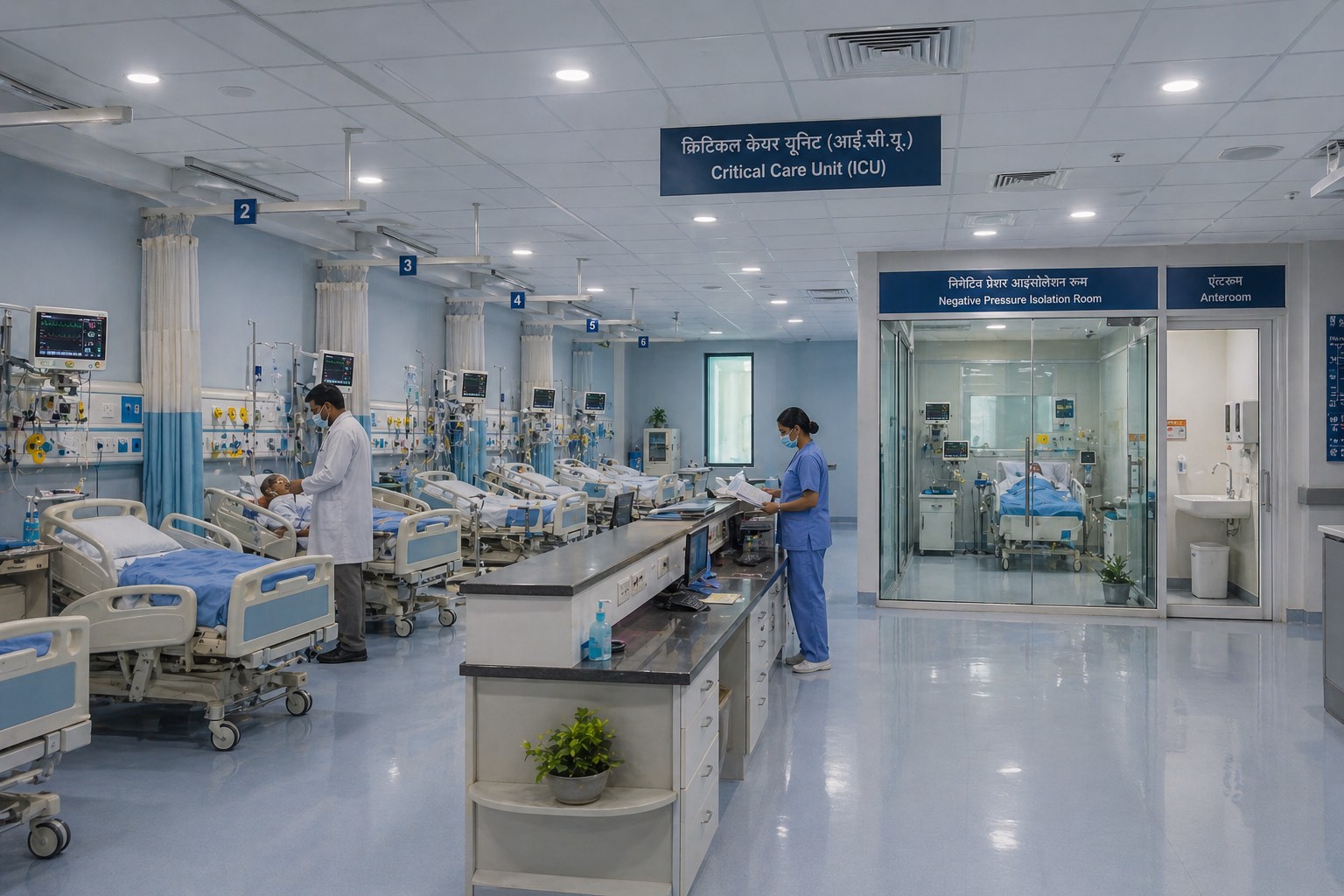
NABH Physical Infrastructure Standards Decoded for Architects
The 5th Edition Standards, the SHCO 3rd Edition, and Specialty Accreditations Translated into Architectural Detail — Chapter-by-Chapter Architectural Translation, Pre-Assessment Readiness, Common Architectural Shortfalls, and the Documentation Evidence Files
NABH accreditation has, over two decades, transitioned from a voluntary mark of distinction to a practically mandatory credential for hospitals seeking empanelment in CGHS, ECHS, AB-PMJAY tier-bonus, ESIC, and most insurance-payer networks. For nursing homes and small clinics, NABH's Small Health Care Organisations (SHCO) standard plays a similar role at smaller scale. For specialty facilities — eye, dental, dialysis, blood bank, AYUSH, fertility — NABH's specialty standards provide accreditation pathways tailored to the typology.
This guide is the seventh in the ten-part series. It assumes the reader has read the pillar reference, the facility-type guides on hospitals, nursing homes, and clinics, the NBC Group C-1 reference, and the CEA state variations guide.
The guide focuses on the architectural translation of NABH — converting standards written in clinical and managerial language into the building elements, room layouts, finishes, and infrastructure that the assessor expects to find. Because NABH assessment is conducted at an operational, in-use facility (not a paper review), architectural shortfalls discovered at pre-assessment can take 12–24 months to remediate. The discipline at design stage is therefore disproportionately consequential.
"NABH is not a paper exercise. The assessor walks into the OT and asks where the laminar flow filter is. If it is not there, no documentation can save you." — Dr. K.K. Kalra, former CEO, NABH, paraphrased from a 2018 quality conference
"Quality in healthcare is the discipline of doing routine things, routinely well. The building either supports that discipline or sabotages it." — Dr. Atul Gawande, surgeon and writer, paraphrased from The Checklist Manifesto (Gawande, 2009)
1. NABH Standards Landscape — The Complete Family
NABH publishes multiple standards under the umbrella of healthcare quality accreditation:
| Standard | Target | Scope |
|---|---|---|
| NABH for Hospitals — 5th Edition (2020) | Full-service hospitals | 100 standards across 10 chapters |
| NABH SHCO — 3rd Edition | Small Health Care Organisations (≤ 50 beds; including non-bed clinics, labs, dental, eye day-care) | Reduced-scope standards |
| NABH Entry-Level Hospital | Hospitals beginning accreditation journey | Foundational subset |
| NABH Entry-Level SHCO | Smaller facilities at entry | Foundational SHCO subset |
| NABH Eye Care | Standalone eye hospitals / clinics | Specialty |
| NABH Dental | Dental clinics / hospitals | Specialty |
| NABH Dialysis | Standalone dialysis centres | Specialty |
| NABH Blood Bank / Transfusion Medicine | Standalone blood banks | Specialty |
| NABH AYUSH | Ayurveda, Yoga, Unani, Siddha, Homoeopathy | Specialty |
| NABH Fertility / ART | IVF / ART clinics | Specialty |
| NABH Wellness Centres | Wellness, preventive | Lifestyle |
| NABH Allopathic Clinics | Standalone clinics | Specialty |
| NABL collaboration | Pathology / diagnostic labs (NABL-led) | Specialty |
The architect should confirm with the client which NABH standard is the target, before designing. Designing for NABH-Hospitals 5th edition standards when the client intends only SHCO is over-design; designing for SHCO when the client intends Hospital is under-design.
2. NABH Hospital 5th Edition — The Ten Chapters
The 5th edition is structured into ten chapters, each with multiple standards (objective elements). The architect's contribution is concentrated in three chapters — AAC (Access, Assessment, Continuity), HIC (Hospital Infection Control), and FMS (Facility Management & Safety) — but every chapter has architectural implications.
| Chapter | Code | Focus | Architectural Concern |
|---|---|---|---|
| AAC | Access, Assessment, Continuity | Patient registration, triage, transfer, discharge | OPD, ED, IPD flow; wayfinding; transfer corridors |
| COP | Care of Patients | Clinical care delivery in OPD, IPD, ED, OT, ICU, OBG | Care areas as designed |
| MOM | Management of Medication | Pharmacy, prescription, administration | Pharmacy layout, cold chain, ward storage |
| PRE | Patient Rights & Education | Information, consent, charter, language | Patient charter wall, signage |
| HIC | Hospital Infection Control | Hand hygiene, isolation, sterilisation | Wash-basin frequency, isolation rooms, CSSD |
| CQI | Continuous Quality Improvement | Quality framework | Documentation infrastructure |
| ROM | Responsibilities of Management | Governance | Administration spaces |
| FMS | Facility Management & Safety | Fire, electrical, biomedical, radiation, gas, accessibility | Comprehensive |
| HRM | Human Resource Management | Staff welfare, training | Duty rooms, lockers, training |
| IMS | Information Management System | Records, IT, IPHIS | Records room, IT closet |
3. AAC — Architectural Translation
The Access, Assessment, Continuity standards address how patients move through the hospital from arrival to discharge. The architect provides the spatial structure.
| AAC Standard | Architectural Translation |
|---|---|
| Defined entry / exit routes | Dignified main entry + emergency entry separately; visitor / patient flow distinction |
| Triage at ED | Triage area within ED with examination and decision capacity |
| Registration & admission | Reception desk with wheelchair-accessible section; queueing system |
| Examination & consultation | Privacy in OPD consultation rooms (door, curtain, acoustic) |
| Inpatient transfer | Stretcher-compatible corridors, lifts; transfer-friendly door swings |
| Continuity of care — handover | Nurses' station with line-of-sight observation |
| Discharge | Discharge room or discharge desk; pharmacy adjacency; family lounge |
| Wayfinding | Bilingual signage system + tactile + Braille at critical points; colour-coded zoning |
| Emergency egress | NBC-compliant + non-ambulatory evacuation strategy |
| Mortuary access | Service-side; family viewing room; dignity preserved |
Common architectural shortfall: wayfinding signage as a retrofit. NABH expects a coherent signage system from main entry through every department. Retrofit signage is invariably inconsistent and is flagged at assessment.
4. COP — Care of Patients Architectural Standards
| COP Care Area | NABH Architectural Expectation |
|---|---|
| OPD | Privacy, accessible seating, clear signage |
| ED / Casualty | 24×7; resuscitation bay; ambulance access; observation beds |
| IPD wards | Bed area per state CEA + NABH; nurse station with visibility; family seating |
| ICU | 9 m²/bed minimum; isolation capability; visual control from nurse station |
| HDU | Step-down from ICU; similar specs |
| NICU / PICU | Specialised paediatric/neonatal layouts; isolation; family presence; reduced lighting |
| OT | Per ASHRAE 170 + NABH OT standard; pressure cascade |
| Labour & delivery | LDR (labour-delivery-recovery) rooms preferred; privacy; emergency caesarean access |
| Recovery | Post-anaesthesia recovery 8–12 m² per trolley |
| Day-care / observation | Recovery chairs; monitoring; pharmacy adjacency |
| Specialty units (BMT, dialysis, oncology) | Specialty-specific layouts |
| End-of-life / palliative | Dignified, family-friendly room |
5. HIC — Hospital Infection Control Architecture
HIC is the chapter most architecturally consequential after FMS. Infection control architecture is a discipline in itself.
| HIC Element | Architectural Specification |
|---|---|
| Hand-hygiene infrastructure | Wash-basin at every nurses' station; alcohol-rub at every patient point; sensor taps |
| Wash-basin frequency in ICU | One per 6 beds minimum; sensor-tap with wrist mixer |
| Wash-basin in IPD | One per ward (4–6 beds typical) |
| OT wash basin | One scrub station per surgeon; sensor-tap; clinical-grade trap |
| Negative-pressure isolation room | Anteroom; HEPA exhaust; 12 ACH; pressure cascade; viewing |
| Positive-pressure isolation (BMT, immuno) | HEPA supply; pressure cascade; anteroom |
| OT clean / dirty corridor | Two-corridor preferred; pass-through autoclaves where single corridor |
| CSSD layout | Receipt → wash → pack → sterilise → store → issue (one-way) |
| Kitchen | Receipt → wash → preparation → cooking → plating → service (one-way); HACCP-based zoning |
| Laundry | Soiled receipt → wash → dry → fold → store → issue (one-way) |
| BMW segregation room | Bin set with colour code; surface washable |
| Cytotoxic drug pharmacy | BSC class II; spill kit; ventilation |
| Endoscopy reprocessing | Washer-disinfector; scope-storage cabinet |
| TB / respiratory isolation | Anteroom; HEPA exhaust; UV |
| Patient toilet bidet / hand-shower | Sensor or lever; bidet preferred |
| Linen handling — soiled | Closed trolley; separate route from clean |
| Surface specification | Joint-free, washable, antimicrobial in critical areas |
The pressure-cascade discipline: OT (positive) → corridor (neutral) → soiled utility (negative). Isolation room (negative) ← anteroom (positive to corridor, negative to room) ← corridor. Architects who do not coordinate door undercut, damper, and HVAC plant capacity at design stage will fail HVAC commissioning.
6. MOM — Pharmacy Architectural Standards
| MOM Element | Architectural Specification |
|---|---|
| Main pharmacy | Storage by class (general, refrigerated, narcotic, schedule X) |
| Cold chain | Pharmacy refrigerator with monitoring + backup; 2°C–8°C and –20°C if vaccine |
| Narcotic / opioid cabinet | Locked, double-key, register; under NDPS |
| Schedule X cabinet | Locked separately |
| Cytotoxic preparation | Class II BSC; spill space; isolation gowning |
| Ward stock cupboard | At each nursing station; locked |
| Crash cart | At each ward / ICU; mobile |
| IV admixture room (if central) | Class A laminar hood within Class B-D background |
| Compounding (if applicable) | Per WHO GMP — separate space |
| Pharmacy dispensing window | Patient-facing; queueing space |
| Returns | Separate area for returned / expired drugs |
7. FMS — Facility Management & Safety (Most Comprehensive)
FMS is the chapter that translates the entire infrastructure layer into NABH standards.
| FMS Topic | NABH Expectation |
|---|---|
| Fire safety | Full NBC C-1 + state code; fire scheme drawings; mock drills |
| Electrical safety | IS 732 compliant; UPS-backed critical loads; earthing |
| Medical gas — central | NBC Part 8 + AS 2896 / IS 7902; manifold; pipeline; alarm |
| Suction | Central or local; per bed |
| Vacuum | Per OT, ICU, ward; AGSS for OT |
| Structural safety | Seismic compliance; periodic structural audit |
| Hazardous material | Storage; MSDS; spill response |
| Radiation safety | AERB compliant; RSO; signage |
| Biomedical waste | BMW Rules 2016 + storage; segregation; CBWTF |
| Lift safety | IS 14665; periodic inspection; emergency power |
| Emergency power | DG with auto-transfer; UPS for critical |
| Plumbing & water | Hot water 60°C+; cold ≤ 25°C; chlorination; potable monitoring |
| Sewage / effluent | ETP / STP per SPCB; pre-treatment of yellow waste optional |
| Building accessibility | Harmonised 2021; ramps; lifts; toilets; signage |
| Patient safety — fall prevention | Bedrails; grab-bars in toilet; non-slip flooring |
| Visitor safety | Glazing; railings; signage |
| Security | Access control; CCTV; panic button at ED, women's ward |
The FMS chapter alone contains 150+ assessable elements. The architect's drawing set must coordinate with each.
8. PRE — Patient Rights, Charter, and Display
| PRE Element | Architectural Specification |
|---|---|
| Patient charter | Wall display in OPD lobby — bilingual + Braille |
| Tariff display | Wall display — bilingual; pre-treatment estimate display in WB |
| Grievance redressal | Officer + room (statutory in WB; voluntary in others) |
| Information desk | At entrance; bilingual staff |
| Privacy | Curtains, doors, single-sex wards optional |
| Consent forms | Available at admission; dedicated consent room for procedures |
| Spiritual / religious | Multi-faith prayer room (hospitals > 100 beds typical) |
| Counselling rooms | Adjacent to wards / specialty |
9. SHCO — The Reduced-Scope Standard for ≤ 50 Beds
NABH SHCO 3rd edition is structured similarly to the hospital standard but with reduced documentation and proportionate infrastructure expectations.
| SHCO Architectural Expectation | Reduced from Hospital | Maintained from Hospital |
|---|---|---|
| Bilingual signage | Required | Required |
| Hand hygiene | Required | Required |
| Negative-pressure isolation | At least 1 if facility takes infectious patients | Required |
| One-way flow CSSD / kitchen / laundry | Required | Required |
| OT compliance | ASHRAE 170 minimum | Required |
| Fire safety | NBC C-1 | Required |
| Pharmacy | Required | Required |
| Medical gas | Required | Required |
| Documentation | Reduced volume | Format simplified |
| Quality framework | Reduced KPI count | Maintained |
For nursing homes seeking empanelment in CGHS / AB-PMJAY tier-bonus / ECHS, SHCO accreditation is the practical entry standard. Architects designing nursing homes should target SHCO compliance from concept stage.
10. Specialty Accreditations — Architectural Specifics
| Specialty | Key Architectural Specifics |
|---|---|
| Eye Hospital | Refraction lanes; OT clean-air; phaco station; recovery; counselling |
| Dental Clinic / Hospital | Operatory layout; X-ray with shielding; sterilisation; sterilisation pass-through |
| Dialysis Centre | Reverse-osmosis water plant; chair layout; isolation cubicle; emergency response |
| Blood Bank | Reception, processing, serology, storage, issue; refrigeration; traceability |
| AYUSH Centre | Panchakarma rooms (heated wood; specific dimensions); steam room; massage tables |
| Fertility / ART | Embryology lab Grade A/B/C/D; theatre; recovery; counselling |
| Wellness Centre | Spa, gym, relaxation; healthier-food kitchen; aesthetic-oriented yet clinical |
| Allopathic Clinic | Consultation, examination, pharmacy, BMW |
Each specialty's architectural detail is a sub-discipline. The architect should engage a specialty consultant for IVF and AYUSH in particular, where details are most idiosyncratic.
11. NABH Pre-Assessment Readiness — The Architect's Punch List
NABH pre-assessment is conducted typically 6 months after operational opening. By this point the building is in use; architectural changes are expensive. The architect's pre-design discipline should anticipate the pre-assessment punch list.
| # | Pre-Assessment Element | Architectural Pre-emption |
|---|---|---|
| 1 | Bilingual signage everywhere | Comprehensive signage system at design |
| 2 | Tactile / Braille at critical points | Tactile signage spec at design |
| 3 | Wash-basin frequency in IPD, ICU | Frequency designed in plumbing |
| 4 | Negative-pressure isolation operational | Designed-in HVAC + anteroom |
| 5 | Pressure cascade in OT measurable | Designed-in plant capacity |
| 6 | CSSD one-way flow demonstrable | Two-corridor or pass-through |
| 7 | Kitchen HACCP zoning visible | One-way flow at design |
| 8 | Laundry one-way flow | One-way flow at design |
| 9 | BMW storage cooled, labelled | Cooled storage at design |
| 10 | Patient charter wall + tariff display | Wall designed-in |
| 11 | Grievance officer's room (where required) | Designated at design |
| 12 | Multi-faith prayer room | Designed-in for hospitals > 100 beds |
| 13 | Disability-accessible toilets per floor | Designed-in |
| 14 | Lift accessibility — Braille buttons, tactile floor markers | Spec |
| 15 | Emergency lighting throughout | NBC compliant |
| 16 | Fire-extinguisher placement | NBC compliant |
| 17 | Manual call points, smoke detectors at frequency | NBC compliant |
| 18 | Radiation signage at AERB rooms | AERB compliant |
| 19 | Hazardous material labelling at storage | Designed-in spec |
| 20 | DG and UPS performance (BMS log) | Designed-in capacity |
A hospital that has not pre-empted this list at design stage will have a 6–18 month gap between operational opening and NABH accreditation — during which CGHS / insurance empanelment is delayed, with material commercial consequence.
12. Documentation Evidence Files — Architect's Contribution
The architect contributes multiple documentation files to the NABH evidence package. These are part of the architectural deliverable.
| # | File | Architect's Contribution |
|---|---|---|
| 1 | Building plan with NBC compliance | Stamped fire-NOC-approved drawings |
| 2 | OT layout with HVAC pressure cascade | Engineering coordination drawings |
| 3 | ICU layout with isolation rooms | Engineering coordination |
| 4 | CSSD layout with one-way flow | Drawing and specification |
| 5 | Kitchen layout with HACCP zones | Drawing and specification |
| 6 | Laundry layout with one-way flow | Drawing and specification |
| 7 | BMW storage room drawings | Specification |
| 8 | Pharmacy layout with cold chain | Drawing and specification |
| 9 | AERB-approved radiology room layouts | AERB certificate + drawings |
| 10 | PNDT registration USG room | PNDT certificate + drawings |
| 11 | Accessibility compliance report | Harmonised 2021 mapping |
| 12 | Fire scheme drawings + NOC | NBC + state |
| 13 | Signage system drawings | Bilingual + tactile system |
| 14 | Patient charter wall design | Drawing |
| 15 | Tariff display board design | Drawing |
| 16 | Mortuary layout (where required) | Drawing |
| 17 | Service drawings — HVAC, plumbing, electrical, gas | Coordinated with consultants |
| 18 | Equipment layout per room | Final equipment plan |
| 19 | As-built drawings | Post-construction |
References
- ASHRAE (2021) Standard 170-2021: Ventilation of Health Care Facilities. Atlanta: ASHRAE.
- Bureau of Indian Standards (2016) National Building Code of India 2016, Part 4, Part 8. New Delhi: BIS.
- Bureau of Indian Standards (2003) IS 7902: Pipeline Distribution System for Medical Gases — Code of Practice. New Delhi: BIS.
- Department of Empowerment of Persons with Disabilities (2021) Harmonised Guidelines and Standards for Universal Accessibility in India 2021. New Delhi: Government of India.
- Gawande, A. (2009) The Checklist Manifesto: How to Get Things Right. New York: Metropolitan Books.
- Indian Council of Medical Research (2017) National Guidelines for Accreditation, Supervision and Regulation of ART Clinics in India. New Delhi: ICMR.
- Joshi, D.C. and Joshi, M. (2018) Hospital Administration. 2nd edn. New Delhi: Jaypee Brothers.
- Kobus, R.L., Skaggs, R.L., Bobrow, M., Thomas, J. and Payette, T.M. (2008) Building Type Basics for Healthcare Facilities. 2nd edn. Hoboken: Wiley.
- NABH (2020) Standards for Hospitals, 5th Edition. New Delhi: NABH, Quality Council of India.
- NABH (2020) Standards for Small Health Care Organisations (SHCO), 3rd Edition. New Delhi: NABH.
- NABH (2019) Standards for Eye Care Hospitals, 4th Edition. New Delhi: NABH.
- NABH (2018) Standards for Dental Clinics & Hospitals. New Delhi: NABH.
- NABH (2019) Standards for Dialysis Provider, 2nd Edition. New Delhi: NABH.
- NABH (2019) Standards for Blood Banks / Blood Centres & Transfusion Services. New Delhi: NABH.
- NABH (2018) Standards for AYUSH Hospitals & Wellness Centres. New Delhi: NABH.
- NABH (2020) Standards for Fertility / ART Clinics. New Delhi: NABH.
- Sax, H., Allegranzi, B., Uçkay, I., Larson, E., Boyce, J. and Pittet, D. (2007) ''My five moments for hand hygiene': a user-centred design approach to understand, train, monitor and report hand hygiene', Journal of Hospital Infection, 67(1), pp. 9–21.
- Stichler, J.F. (2010) 'Healing by Design: Integrating evidence-based design principles into healthcare', Health Environments Research & Design Journal, 3(2), pp. 3–6.
- Ulrich, R.S., Zimring, C., Zhu, X., DuBose, J., Seo, H.B., Choi, Y.S., Quan, X. and Joseph, A. (2008) 'A review of the research literature on evidence-based healthcare design', HERD, 1(3), pp. 61–125.
- World Health Organization (2008) Essential Environmental Health Standards in Health Care. Geneva: WHO.
Author's Note: NABH standards are revised periodically — the 5th edition Hospital standards (2020) and the 3rd edition SHCO standards are the current reference at publication. NABH publishes amendments and clarifications between editions; architects should track NABH's website for revisions every 6 months. The chapters and standard structure presented here are accurate as of 2026 publication.
Disclaimer: This article is for informational and educational purposes only. NABH standards are detailed and revised; always work with the official NABH standard document and a NABH-empanelled consultant for an accreditation-bound project. Studio Matrx, its authors, and contributors accept no liability for decisions made on the basis of the information in this guide.
Export this guide
Related Tools — Try Free
Electrical Safety & Load Audit
Home electrical audit — 10 categories, 65+ checkpoints across earthing, RCCB, MCB, wiring, switchboards, appliance circuits, DG/inverter backup.
Safety AuditCross-Ventilation Analyzer
Estimate airflow and air changes per hour (ACH) from room size, window areas, layout, and local wind — with NBC 2016 Part 8 compliance check.
Ventilation CalculatorMaterial Schedule Generator
Generate a room-wise finish schedule — walls, floors, ceilings, trim, and joinery by location.
Material Schedule