
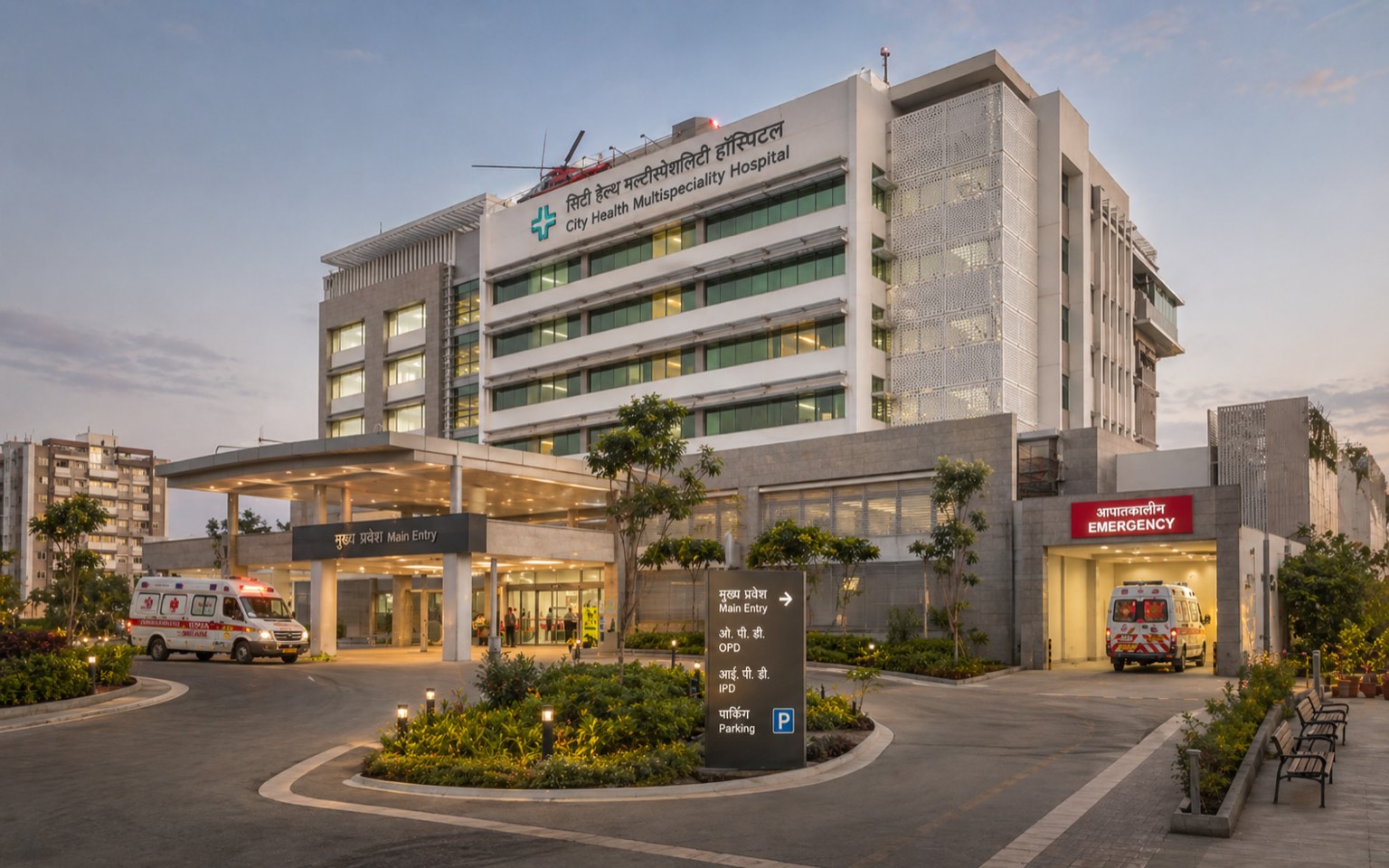
Designing Hospitals in India (>30 beds): A Statutory Compliance Roadmap
An Architect's Working Reference — NBC Group C-1, Bed-Strength Regulatory Tiers, OT/ICU/CSSD Compliance, Environmental Clearance, SPCB, State CEA, Fire, IPHS for Government Hospitals, and the Hospital-Specific Compliance Calendar
When a healthcare facility crosses the 30-bed threshold, its regulatory character changes. Below 30 beds, a facility is treated by most state acts as a nursing home — an inpatient facility with relatively light infrastructure expectations. At and above 30 beds it is a hospital: subject to the full weight of NBC 2016 Group C-1 institutional fire & life-safety provisions, the full state Clinical Establishments Act schedules, environmental clearance thresholds, state pollution control board liquid-effluent and biomedical-waste norms, NABH accreditation expectations from empanelment partners, and (in the public sector) the binding Indian Public Health Standards. The architect who designs a 35-bed facility with the regulatory mindset of a 25-bed nursing home will deliver a building that cannot be commissioned without re-design.
This guide is the second in the ten-part series and the first facility-type deep-dive. It assumes the reader has read the pillar reference and turns the pillar's three-layer model into a hospital-specific working roadmap. It is written for architects on commission for facilities of 30 beds and above — whether 35-bed nursing-home-converted hospitals, 100-bed multi-specialty hospitals, 300-bed tertiary hospitals, or 800-bed academic medical centres.
The hospital scale also introduces architectural problems that nursing-home and clinic scales do not face: separate ambulance and visitor entries, distinct clean and dirty corridors, vertical service shafts that thread thirty consultants' work without conflict, refuge floors at scheduled vertical intervals, and the staggering coordination of HVAC pressure cascades across operation theatres, ICUs, isolation rooms, and BMT units. The regulator's signature on the building is not the end of compliance; it is the start of operational compliance under conditions the building must continue to support.
"A hospital should be a hospital. It should not pretend to be a luxury hotel that has somehow allowed sick people to wander in. The architect's first loyalty is to the patient who cannot stand up." — Ar. Christopher Charles Benninger (1942–2024), architect & teacher, paraphrased from a 2016 lecture at CEPT
"In a hospital, the corridor is the most important room." — Sir Sydney Berry, hospital planner, paraphrased citation widely attributed in Llewelyn-Davies & Macaulay (1966)
1. The 30-Bed Threshold — Why the Regulation Changes Character
The 30-bed line is not arbitrary. It corresponds to the operational scale at which a facility:
- Runs a continuous (24×7) nursing roster, not a doctor-on-call regime
- Operates one or more dedicated operation theatres, not a procedure room
- Has a discrete intensive care or high-dependency unit
- Generates biomedical waste in volumes requiring CBWTF tie-up rather than sharps-only disposal
- Generates liquid effluent requiring pre-treatment under most state pollution norms
- Requires central HVAC, central medical gases, and central UPS — not split-system equivalents
- Demands non-ambulatory evacuation strategy in the fire scheme
Each of those operational facts triggers regulatory consequences. The architectural translation is summarised below.
| Capability Crossed at 30 Beds | Operational Consequence | Regulatory Consequence | Architectural Consequence |
|---|---|---|---|
| 24×7 nursing | Roster sleep / rest space | NABH staff-welfare standard | Nurses' station + duty room per ward |
| Dedicated OT(s) | OT-grade clean-air requirement | NBC Part 8 + ASHRAE 170 + NABH | OT plant room, HEPA modules, interlocked doors |
| ICU | High dependency, isolation capability | NABH + state CEA + ASHRAE 170 | ICU layout, negative-pressure capability, glazed observation |
| BMW > 50 kg/day | CBWTF transport at 48-hr cycle | BMW Rules 2016 — full storage room | Cooled BMW storage room sized for 60-hr generation |
| Effluent > 5 KLD | Pre-treatment required | State PCB CTE/CTO with ETP | ETP / STP plant room + tank yard |
| Central O2 / N2O / vacuum | Manifold + pipe network | PESO + NBC Part 8 | LMO yard, manifold room, pipeline shaft |
| Central UPS | Critical-load segregation | NBC Part 8 + CEA | UPS room, critical-load circuits, generator parallel |
| Non-ambulatory evacuation | Cannot use stairs in fire | NBC Part 4 Group C-1 + state fire | Refuge area, horizontal compartments, fire lift |
The 30-bed threshold is therefore not a design preference; it is a regulatory hinge. State acts (KPME, TN CEA, WB CEA) explicitly elevate the facility schedule beyond the nursing-home minimum once this line is crossed — and several specifically require dedicated mortuary, dedicated isolation room, and dedicated grievance redress space (in WB) above the 30-bed mark.
2. NBC 2016 Group C-1 — The Hospital-Specific Working Reference
The National Building Code 2016 Part 4 classifies institutional buildings as Group C, with sub-divisions:
| NBC Sub-Group | Building Type | Healthcare Application |
|---|---|---|
| C-1 | Hospitals & Sanatoria — buildings ordinarily occupied by sick or infirm people who cannot evacuate themselves | Multi-specialty hospitals, tertiary hospitals, district hospitals, larger nursing homes |
| C-2 | Custodial — penal/correctional with healthcare provision | Forensic medical facility, prison hospital |
| C-3 | Other institutional | Outpatient-only buildings, day-care surgery in some interpretations |
For the practising architect, the Group C-1 ruleset is the binding fire-and-life-safety canvas for the hospital project. The headline NBC C-1 provisions:
| NBC C-1 Provision | Requirement | Architectural Implication |
|---|---|---|
| Maximum travel distance to exit | 22.5 m direct, 45 m total via corridor | Determines ward depth and corridor lengths |
| Minimum corridor width — IPD | 2.4 m clear (some interpretations 3.0 m for stretcher passing) | Sets primary structural grid; affects bay sizing |
| Minimum stairway width | 2.0 m (1.5 m where occupant load < 50/floor) | Two protected staircases minimum for any ward floor |
| Smoke compartment | Each floor ≥ 1000 m² to be split into ≥ 2 smoke compartments | Cross-corridor smoke barriers required |
| Refuge area | One refuge / floor above 24 m, sized 0.3 m²/person served | Architectural integration of refuge into typical floor |
| Fire lift | Mandatory for buildings ≥ 15 m or above 4 storeys | Separate from regular lifts, on emergency power |
| Stretcher lift | One per IPD floor minimum; cabin 1100 × 2400 mm | Lift core sizing affected significantly |
| Sprinkler protection | Mandatory throughout C-1 | Ceiling void, riser shafts, plant room |
| Wet riser & hose reel | Per NBC Part 4 hydraulic schedule | Riser shafts at planned intervals |
| Detection & alarm — addressable | Throughout, with patient-room sensors | Cabling routes, BMS interface |
| Public-address & voice-evacuation | Required throughout | Speaker layout to OT, ICU, ward |
| Fire-resistant compartmentation — OT, ICU, CSSD, kitchen, generator, switchgear | 2-hour rated separation | Wall and door specs by activity |
| Service-shaft compartmentation | Each floor break sealed | Penetration sealing detailing |
| Atrium provisions | Smoke-extraction and sprinkler-backshelf if atrium present | Mechanical extraction strategy |
The architect's most consequential NBC C-1 decisions are made at the block-plan stage: bay sizing for stretcher passing, staircase pair location for non-overlapping evacuation, refuge floor placement at vertical intervals, and the smoke-compartment lines. Hospital projects that are re-detailed for fire safety after concept tend to lose 4–9% of usable floor area to retrofit compartmentation — an avoidable loss.
3. Bed-Strength Regulatory Tiers — 50, 100, 200, 500
Within the hospital category, bed strength itself activates further regulatory tiers. The architect should assess the brief against the four tier transitions.
| Bed Strength | Regulatory Tier Crossed | What Changes |
|---|---|---|
| 30 beds | Hospital tier (vs. nursing home) | Full Group C-1, dedicated OT/ICU, mortuary, BMW storage, ETP |
| 50 beds | SPCB CTE/CTO threshold in most states | Mandatory ETP, STP, ambient air monitoring, formal CTE |
| 100 beds | NBC Part 4 — full institutional regime | Refuge floors, full sprinkler, fire lifts, wet risers, escape lighting; Delhi separate ambulance entry |
| 200 beds | Tertiary regulatory expectation | Dedicated emergency department, blood bank licensure (separate), full IPHS-equivalent infrastructure if government, JCI common in private |
| 500 beds | Tertiary academic / state hospital scale | Helipad provision, separate trauma stream, separate paediatric stream, NABH plus accreditations, telemedicine infrastructure |
The architect's task is to design the building so that future bed expansion does not breach the next tier without architectural re-work. A 90-bed hospital designed without sprinkler risers cannot expand to 110 beds without a major retrofit. A 175-bed hospital with a single ambulance entry will need a re-grading of the entry forecourt to expand to 250 beds. Tier-aware planning is a quiet but consequential architectural discipline.
4. The Operation Theatre Suite — Statutory & Code Requirements
The OT suite is the most heavily regulated room set in any hospital. Compliance is layered: NBC Part 8 (HVAC), ASHRAE 170-2021 (ventilation of healthcare facilities), NABH 5th edition (infection control & monitoring), state CEA OT minimums, and (where applicable) FGI Guidelines or IPHS for government hospitals.
| OT-Suite Element | Code / Standard | Architectural Requirement |
|---|---|---|
| OT minimum area | KPME 18 m² / TN 23 m² / WB 20 m² / NABH preferred 36 m² for major OT | OT bay sized to largest applicable spec |
| OT clean-air supply | ASHRAE 170 — ≥ 20 ACH; 25–30 ACH for orthopaedic & cardiac | Ceiling height 3.6 m to 4.2 m for laminar flow modules |
| Pressure cascade | OT positive (+15 to +25 Pa) → corridor → utility zone (negative) | Door and damper coordination |
| HEPA terminal modules | H13 (99.95% at 0.3 µm) | Ceiling grid coordination, plant-room volume |
| Door interlock | Inter-OT and OT-corridor doors not simultaneously openable | Door schedule, electrical interlock |
| OT corridor — clean side | Sterile-supply corridor separate from used-instrument return | Two-corridor layout (preferred) or pass-through windows |
| Scrub area | 1 scrub station per surgeon per OT, sensor tap | Scrub bay outside OT, water and drain provisioning |
| Pre-anaesthesia / induction | Optional per state act; required at NABH for major OT | 9–12 m² adjacent to OT |
| Post-anaesthesia / recovery | Required per most state acts for facilities > 30 beds | Recovery bay sized to OT count × 2 trolleys minimum |
| CSSD interface | Pass-through autoclaves between OT clean store & CSSD | Autoclave pass-through wall designed at construction stage |
| Floor finish | Conductive vinyl, monolithic, coved skirting | Dissipation < 10⁹ ohms; static-control conductive flooring |
| Wall finish | Joint-free, washable, antimicrobial | Pre-finished panels or epoxy with epoxy joint |
| Ceiling finish | Sealed, washable, monolithic | Gypsum with sealed joints or prefabricated metal ceiling |
| OT lighting | Ceiling-mounted shadowless, 100,000 lux at field, redundant supply | Lighting shaft and UPS critical loop |
| OT pendants | Anaesthesia and surgical pendants on independent rails | Structural slab loading + access |
| Medical gas outlets per OT | O2 ×2, N2O ×1, Air ×2, Vacuum ×3, Scavenging ×1 (typical) | Gas-shaft provisioning; outlet schedule |
| AGSS (anaesthetic gas scavenging) | Required if N2O used | Vent shaft to roof |
The OT suite is the highest-cost-per-square-metre space in any hospital — a major OT typically costs ₹35,000–₹65,000 per square metre to construct (2026 indicative). The architect who under-provisions the OT plant ceiling void at concept stage cannot cure the problem at detail stage without floor-to-floor re-design.
5. The ICU & Critical Care Suite
ICUs require similar HVAC discipline as OTs but with different planning logic — observation, accessibility, and isolation.
| ICU Element | Code / Standard | Architectural Requirement |
|---|---|---|
| Bed area per patient | NABH 9 m² minimum; 12 m² for cubicle ICU; 15 m² for isolation bay | Module sizing for grid |
| Inter-bed clearance | NABH 1.8 m minimum | Bay-to-bay column placement |
| Nurses' station | 1 per 6–8 beds, with full visual control | Glazed observation lines |
| Negative-pressure isolation rooms | Required ≥ 1 per 12 ICU beds at NABH; ASHRAE 170 ≥ 12 ACH; anteroom; HEPA exhaust | Isolation cluster at the end of ICU |
| BMT / immuno-compromised | Positive-pressure isolation, HEPA supply | Separate cluster, often dedicated unit |
| Medical gas outlets per bed | O2 ×2, Air ×1, Vacuum ×3 | Headwall design |
| Power per bed | UPS-backed minimum 12 socket points; emergency lighting | Headwall rough-in |
| Plumbing | Hand-wash sink at every 2 beds (NABH) | Plumbing layout |
| Visitor viewing | Glazed gallery, controlled access | Visitor corridor separate from clinical |
| Door | Hermetic-seal sliding door for isolation | Door supplier coordination |
| Floor | Seamless vinyl, antibacterial | Continuous from corridor with cove |
A 12-bed ICU with one negative-pressure isolation room and one positive-pressure BMT-grade room requires roughly 250–300 m² of floor area at NABH compliance — including nurses' station, doctor on-call, soiled and clean utility, equipment store, and family waiting. The architect who plans 180 m² will need to re-plan.
"The ICU is where the building's mechanical systems and the patient's biology meet. It is not a room. It is a machine." — Dr. Devi Shetty (b. 1953), cardiac surgeon and founder, Narayana Health, paraphrased from a 2014 design review
6. CSSD, Pharmacy, and Pathology — Departmental Compliance
| Department | Regulatory Reference | Compliance Note |
|---|---|---|
| CSSD | NABH IC.5; ISO 13485 sterilisation | Two-corridor (clean / dirty); washer-disinfector zone, packing zone, sterilisation zone, sterile store; flow one-way |
| Pharmacy | Drug & Cosmetics Act + state drug controller | Dispensing area ≥ 10 m²; cold storage ≥ 4 m²; schedule X cabinet locked; refrigeration with temp log |
| Pathology — General | NABL / NABH | Sample reception, separated processing zones (haematology, biochemistry, microbiology); biosafety BSL-2 minimum |
| Microbiology | NABL + ICMR biosafety | BSL-2 standard; BSL-3 for TB / select pathogens; Class II BSC; autoclave; decontamination |
| Blood Bank / Transfusion | Drug Controller (separate license) | Reception, processing, storage, issue rooms; serology lab; blood storage refrigerator with backup |
| Radiology | AERB | Lead shielding, console, viewing, control; see Article 8 |
| Mortuary | State CEA + NBC | Cold storage 1 body / 25 beds; dignified body-handling route; viewing room; service-side access |
| Kitchen | FSSAI + NBC Part 6 | HACCP-based zoning: raw → washing → preparation → cooking → plating → service; one-way flow |
| Laundry | NABH + state | Soiled receipt → wash → dry → fold → store → issue; one-way flow; separate access |
The architectural pattern for almost every department above is one-way flow — clean and dirty must not intersect. The architect who plans circular or crossing flows will fail NABH and (in the case of CSSD) state CEA.
7. Environmental Clearance, ETP/STP, and SPCB Compliance
For hospitals, the environmental clearance and pollution-control layer is non-trivial.
| Approval | Trigger | Architectural Implication |
|---|---|---|
| EIA / Environmental Clearance (MoEFCC EIA Notification 2006, as amended) | BUA > 20,000 m² (or 50,000 m² depending on amendment cycle and state) | Full EIA report; site environmental impact; STP, rainwater harvesting, tree compensation |
| State PCB CTE — Consent to Establish | Hospital ≥ 50 beds (typical) or specified BUA | Pre-construction clearance; ETP/STP provision in plan |
| State PCB CTO — Consent to Operate | Pre-operation clearance | ETP/STP commissioned, monitoring point |
| ETP | Liquid effluent above prescribed BOD/COD | Plant room sized to KLD; chlorination |
| STP | Sewage above 10 KLD | Plant room with reuse for landscape & flushing |
| DG Set Norms (CPCB) | DG > 800 kW | Stack height 30 m or rule-based; acoustic enclosure |
| Rainwater Harvesting | State / city by-law | Recharge pit / collection tank |
| Solid Waste — non-BMW | SPCB | Segregation room; e-waste handling |
The ETP/STP plant room for a 100-bed hospital typically requires 60–90 m² and a separate buffer zone. A 200-bed hospital requires 120–180 m². The architect who plans this in basement service layer at concept stage avoids painful restitution at detail stage.
8. State CEA / Nursing Home Act — Hospital-Specific Schedules
Above 30 beds, every state act activates its hospital-specific schedule. The architect must read the specific schedule for the project state. Common features across major state acts:
| Schedule Element | Typical Hospital Provision (≥ 30 beds) |
|---|---|
| Out-Patient Department (OPD) | Registration, waiting, triage, consultation, examination — minimum 60–100 m² |
| Emergency / Casualty | 24×7 staffed; ambulance-side access; resuscitation bay; minor OT (varies) |
| In-Patient Department | Ward layout per state minimum bed-room area; nurses' station per ward |
| Operation Theatre | Per state schedule (see §4 above) |
| Labour / Delivery | Required if obstetrics offered; minimum area per state |
| Recovery / Post-anaesthesia | Required ≥ 30 beds in most states |
| ICU | Required for hospitals offering surgery / acute care |
| Diagnostic — radiology, pathology | Required spectrum varies; minimum equipment list per state |
| Pharmacy | Required |
| Mortuary | Required ≥ 30 beds in most states |
| Blood storage / blood bank | Required for surgical hospitals; full blood bank ≥ 100 beds typical |
| Kitchen / dietary | Required ≥ 30 beds (some states ≥ 50) |
| Laundry | Required ≥ 30 beds |
| CSSD | Required ≥ 30 beds with surgery |
| Medical records | Required, dedicated locked room |
| Administration & accounts | Required |
| Public toilets — OPD | Per occupancy load + accessibility |
Each state's schedule reads the same headings differently — Karnataka's KPME emphasises minimum equipment lists; Tamil Nadu's TN CEA emphasises minimum areas; West Bengal's WB CEA emphasises transparency (rate display, grievance redress); Delhi's NH Act emphasises infrastructure minima from a 1953 base. The architect's deliverable is a schedule-versus-design table showing compliance with the specific state act for the project.
9. Fire & Life Safety — Group C-1 Specifics
Beyond the headline NBC C-1 provisions in §2, hospital fire & life safety has specific operational features:
| Topic | Hospital-Specific Rule | Architectural Implication |
|---|---|---|
| Evacuation for non-ambulatory | Defend-in-place + horizontal evacuation to adjacent compartment | Smoke compartments per floor with 30-minute holding capacity |
| OT fire scenario | OT fire is rare but high-stakes; flammable atmospheres considered | Anti-static OT flooring, sprinkler exemption with clean-agent suppression in OT |
| Oxygen-rich atmosphere risk | OT, ICU, NICU | Material specification — non-combustible textiles, sealed electricals |
| Kitchen fire | Hospital kitchens are 24×7 high-volume | Separate fire compartment, suppression at hood, gas shutoff |
| Generator room | DG fuel storage hazard | 2-hour rated separation from main building, separate ventilation |
| Linen store / record store | High fire load | Sprinklered, fire-rated walls |
| Mortuary cold storage | Refrigerated low fire load but ammonia / refrigerant hazard | Separate plant area |
| Helipad (if provided) | Roof-top landing platform | Separate FM-200 or foam suppression at fuel storage if any |
| Fire NOC application — state specifics | TN, KA, MH, DL, GJ, WB have their own state fire codes layered on NBC | Architect reads state code first; NBC second |
Fire NOC failure is the most common single-cause delay for hospital commissioning across India — typically responsible for 6–18 weeks of slippage in 30–40% of projects. Most failures are avoidable: travel-distance violation, insufficient refuge area, single staircase on a wing, or wet-riser shaft sized for residential rather than institutional flow.
10. The IPHS Layer — Indian Public Health Standards (Government Hospitals)
For government-sector hospitals — district hospitals, sub-divisional hospitals, community health centres, primary health centres — the Indian Public Health Standards 2022 are binding (not advisory). IPHS prescribes facility lists, staffing, equipment, and infrastructure for each tier.
| IPHS Tier | Population Served | Bed Range | Mandatory Architectural Elements |
|---|---|---|---|
| Sub-Health Centre / Health & Wellness Centre | 3,000–5,000 | 0–2 (observation) | Examination, dressing, antenatal, dispensing |
| PHC — Primary Health Centre | 30,000 (rural) / 20,000 (tribal) | 6 | OPD, OT (minor), labour, observation, lab, pharmacy |
| CHC — Community Health Centre | 80,000–120,000 | 30 | Specialist OPD, IPD, OT, labour, X-ray, lab, blood storage |
| SDH — Sub-Divisional Hospital | 5–6 lakh | 31–100 | Multi-specialty, ICU, blood bank, X-ray, full diagnostic |
| DH — District Hospital | 8–25 lakh | 100–500 | Tertiary referral, all specialties, blood bank, NICU, PICU, mortuary |
For government projects, IPHS is the architect's primary spec. The PWD or executing agency briefs against the IPHS schedule; deviation requires explicit waiver. A district hospital architect who designs to "private 200-bed equivalent" rather than IPHS-DH schedule will deliver a building the state cannot accept.
11. NABH 5th Edition — Hospital Architectural Implications
NABH accreditation is voluntary but has become practically mandatory for hospitals seeking CGHS, ECHS, AB-PMJAY tier-bonus, ESIC, and most insurance empanelment. The 5th edition standards group into chapters: Access, Assessment & Continuity (AAC), Care of Patients (COP), Management of Medication (MOM), Patient Rights & Education (PRE), Hospital Infection Control (HIC), Continuous Quality Improvement (CQI), Responsibilities of Management (ROM), Facility Management & Safety (FMS), Human Resource Management (HRM), Information Management System (IMS).
The architecturally-consequential standards:
| NABH Chapter | Standard | Architectural Application |
|---|---|---|
| AAC | Patient flow & wayfinding | Bilingual signage system; tactile paving; clear entry zoning |
| COP | Care areas — OT, ICU, ER, OBG | Spatial standards as in §4-§5 |
| HIC | Hand hygiene infrastructure | Wash-basin frequency in IPD, ICU |
| HIC | Isolation room provision | At least 1 negative-pressure isolation per ward unit |
| FMS | Fire safety, electrical safety | Full NBC C-1 + IS standards |
| FMS | Patient & visitor safety | Bedrails, grab-bars, anti-slip flooring |
| FMS | Medical gas, suction | NBC Part 8 + manifold to standard |
| FMS | Hazardous material — radioactive, chemical | Storage, signage, MSDS |
| MOM | Pharmacy infrastructure | Cold chain, narcotic cabinet, bulk store |
| HIC | Laundry, kitchen, CSSD | One-way flow architecture |
NABH pre-assessment is typically conducted six months after operational opening. A hospital with architectural shortfalls discovered at NABH pre-assessment can take 12–24 months to remediate — the architect's discipline at the design stage prevents this entirely avoidable cost.
"Quality in healthcare is not a poster on the wall. It is the wall." — Dr. Girdhar Gyani, founder Director-General, Association of Healthcare Providers (India), paraphrased from a 2019 NABH conference
12. Hospital-Specific Failure Modes & Prevention
A condensed catalogue of failure modes that recur in Indian hospital projects.
| # | Failure | Prevention |
|---|---|---|
| 1 | OT plant ceiling void inadequate (< 1.4 m) for HEPA + duct | Floor-to-floor 4.2 m minimum at OT zone |
| 2 | ICU isolation cluster planned without anteroom | Anteroom 4.5 m² adjacent to each isolation room |
| 3 | CSSD planned as one-corridor; clean / dirty mix at packing | Two-corridor CSSD or pass-through autoclaves |
| 4 | Mortuary access via OPD lobby | Service-side mortuary with cold-storage near labour |
| 5 | Single ambulance arrival shared with visitor parking | Separate ambulance entry with controlled-traffic forecourt — Delhi mandate above 100 beds |
| 6 | ETP / STP basement allocation insufficient | 60–90 m² for 100-bed; 120–180 m² for 200-bed |
| 7 | LMO yard set-back violation | PESO setbacks pre-checked at site planning |
| 8 | Smoke-compartment line violates ward-bay logic | Compartment lines designed at concept, not detail |
| 9 | Helipad without full fire & gas safety scheme | Roof helipad as separate fire compartment with foam/dry-chem |
| 10 | DG room shared wall with OT / ICU | DG isolated 2-hour rated; vibration-isolated |
| 11 | Lift core under-sized; stretcher lift wrong cabin | Stretcher lift 1100 × 2400 mm cabin, fire lift separate |
| 12 | NABH signage retro-fit | Bilingual + tactile signage at design |
| 13 | Pharmacy without cold chain space | Cold storage + monitored fridge from concept |
| 14 | Blood bank licensure delayed by lab adjacency | Blood bank as separate licensed unit, separated from general lab |
| 15 | Patient rights / grievance redress room missing — WB | Grievance redress room near OPD lobby in WB projects |
References
- AERB (2016) Safety Code for Medical Diagnostic X-Ray Equipment and Installations. AERB/RF-MED/SC-3 (Rev. 2). Mumbai: Atomic Energy Regulatory Board.
- ASHRAE (2021) Standard 170-2021: Ventilation of Health Care Facilities. Atlanta: American Society of Heating, Refrigerating and Air-Conditioning Engineers.
- Bureau of Indian Standards (2016) National Building Code of India 2016, Part 4 — Fire and Life Safety. New Delhi: BIS.
- Bureau of Indian Standards (2016) National Building Code of India 2016, Part 8 — Building Services. New Delhi: BIS.
- Cain, J. and Yusof, M.M. (2013) 'Hospital fire safety: a review of fatal hospital fires in the developing world', International Journal of Disaster Risk Reduction, 5, pp. 6–13.
- Central Pollution Control Board (2018) Bio-Medical Waste Management Rules, 2016 (with 2018 amendment). New Delhi: MoEFCC.
- Department of Empowerment of Persons with Disabilities (2021) Harmonised Guidelines and Standards for Universal Accessibility in India 2021. New Delhi: Government of India.
- Facility Guidelines Institute (2022) Guidelines for Design and Construction of Hospitals. St. Louis: FGI.
- Government of Karnataka (2017) Karnataka Private Medical Establishments (Amendment) Act 2017. Bengaluru.
- Government of Tamil Nadu (2018) Tamil Nadu Clinical Establishments (Regulation) Act 2018. Chennai.
- Government of West Bengal (2017) West Bengal Clinical Establishments (Registration, Regulation and Transparency) Act 2017. Kolkata.
- Joshi, D.C. and Joshi, M. (2018) Hospital Administration. 2nd edn. New Delhi: Jaypee Brothers Medical Publishers.
- Kobus, R.L., Skaggs, R.L., Bobrow, M., Thomas, J. and Payette, T.M. (2008) Building Type Basics for Healthcare Facilities. 2nd edn. Hoboken: Wiley.
- Llewelyn-Davies, R. and Macaulay, H.M.C. (1966) Hospital Planning and Administration. Geneva: World Health Organization.
- Ministry of Health and Family Welfare (2022) Indian Public Health Standards 2022 — District Hospital, Sub-Divisional Hospital, Community Health Centre Guidelines. New Delhi: MoHFW.
- NABH (2020) Standards for Hospitals, 5th Edition. New Delhi: NABH, Quality Council of India.
- Petroleum and Explosives Safety Organisation (2016) Static and Mobile Pressure Vessels (Unfired) Rules 2016. Nagpur: PESO.
- Stichler, J.F. (2010) 'Healing by Design: Integrating evidence-based design principles into healthcare', Health Environments Research & Design Journal, 3(2), pp. 3–6.
- Ulrich, R.S., Zimring, C., Zhu, X., DuBose, J., Seo, H.B., Choi, Y.S., Quan, X. and Joseph, A. (2008) 'A review of the research literature on evidence-based healthcare design', HERD, 1(3), pp. 61–125.
- World Health Organization (2008) Essential Environmental Health Standards in Health Care. Geneva: WHO.
- Zilm, F. (2010) 'Estimating Operating-Room Requirements: A New Approach', HERD, 3(4), pp. 31–47.
Author's Note: This guide concentrates on the regulatory and statutory dimension of hospital design above the 30-bed threshold. It is not a substitute for the design dimension — clinical adjacency, patient experience, evidence-based design, biophilic strategy, and energy optimisation each merit their own treatment, which subsequent guides in this series and adjacent series will address. The architect should read this guide in conjunction with the pillar reference on the regulatory landscape, and with the forthcoming guides on AERB, BMW, fire safety, NABH, and CEA-state variations.
Disclaimer: This article is for informational and educational purposes only and does not constitute legal, regulatory, or professional architectural advice. Hospital design compliance depends on the specific state, city, plot, brief, scope, bed strength, and applicable amendments at the time of design. Confirm all statutory requirements with the state health department, state pollution control board, AERB, fire service, MoEFCC/SEIAA, NABH, IPHS executing agency (where applicable), and other relevant regulators before any binding design or construction commitment. Studio Matrx, its authors, and contributors accept no liability for decisions made on the basis of the information in this guide.
Export this guide
Related Tools — Try Free
Rainwater Tank Sizer
How big should your rainwater tank be? Computes annual harvest, recommended tank capacity in litres, water-bill savings, and payback — for 10 Indian cities.
RWH CalculatorCross-Ventilation Analyzer
Estimate airflow and air changes per hour (ACH) from room size, window areas, layout, and local wind — with NBC 2016 Part 8 compliance check.
Ventilation CalculatorMaterial Schedule Generator
Generate a room-wise finish schedule — walls, floors, ceilings, trim, and joinery by location.
Material Schedule