
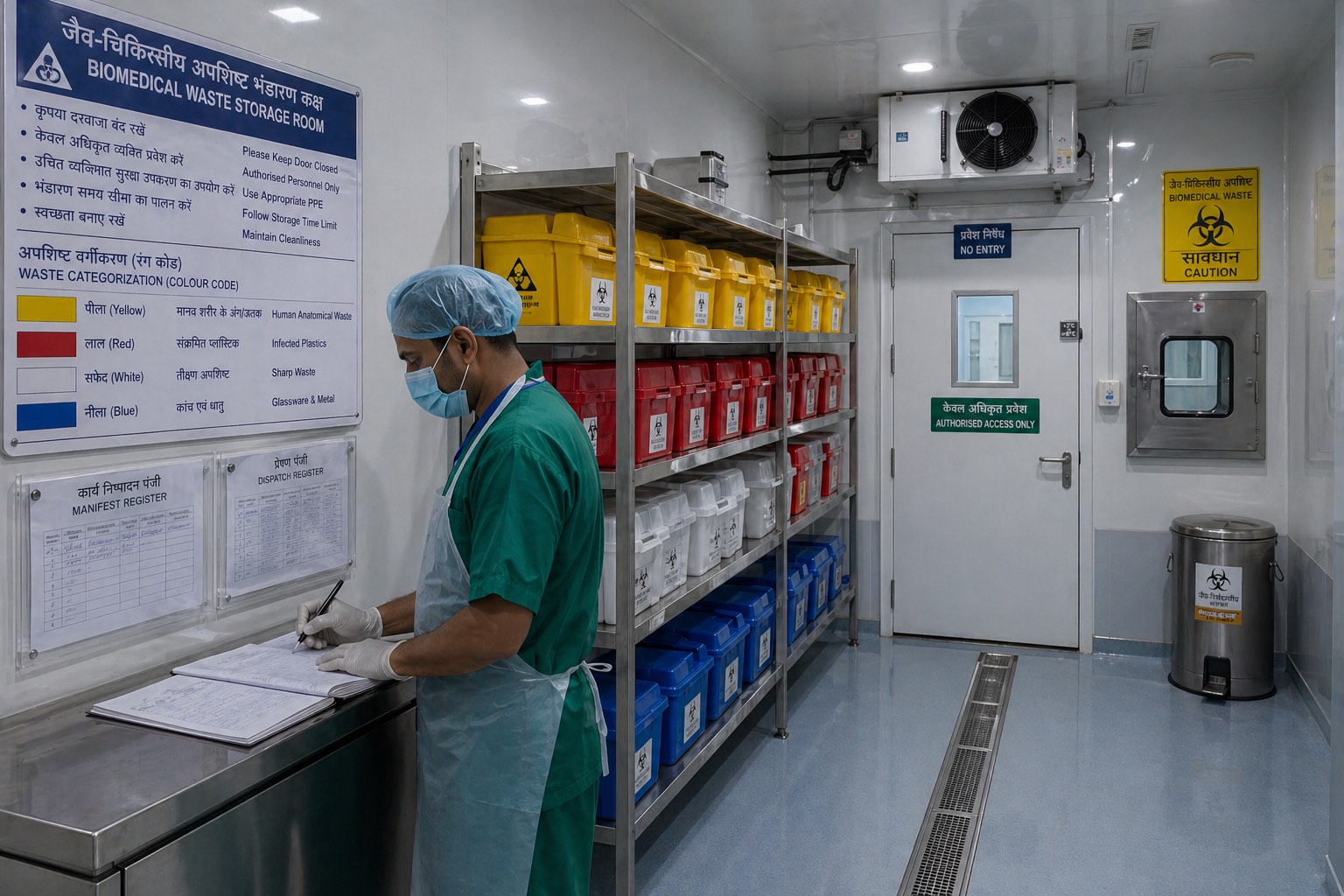
Bio-Medical Waste Management Rules: Architectural Implications for Healthcare Buildings
BMW Rules 2016 and the 2018 / 2019 Amendments Translated into Building Detail — Four-Bin Segregation, Storage Room Sizing, Cooling and Surfaces, ETP Provisions, CBWTF Interface, Yellow-Stream Pre-Treatment, Sharps Architecture, Cytotoxic and Mercury Waste, Documentation, and the Architect's BMW Compliance Checklist
The Bio-Medical Waste Management Rules 2016 (with significant 2018 and 2019 amendments) govern the segregation, storage, transport, treatment, and disposal of biomedical waste in India. For the architect, BMW compliance is the most often-underestimated layer of healthcare regulation: the volume of waste generated by even a 50-bed hospital is large enough to require a dedicated storage room, a temperature-controlled storage strategy, segregated transport corridors, and a CBWTF interface — each of which has direct architectural consequences. A clinic that overlooks BMW architecture may pass inspection at first registration but will be flagged at re-inspection; a hospital that does the same will fail SPCB consent to operate.
This guide is the ninth in the ten-part series. It assumes the reader has read the pillar reference, the facility-type guides, and the regulatory deep-dives on NBC Group C-1, CEA state variations, NABH, and AERB.
The architectural translation of BMW Rules begins at the point of generation — every patient room, OT, ICU, lab, pharmacy — and ends at the point of off-site disposal — the CBWTF vehicle leaving the building. Between those points, the architect designs a system of bins, transport routes, storage rooms, refrigeration, signage, and documentation infrastructure that is operationally robust, inspector-credible, and worker-safe.
"Biomedical waste is the silent killer of hospital infection control. A perfectly executed surgical procedure can be undone by a torn red bag in a corridor. Architecture either prevents this or invites it." — Dr. Randeep Guleria (b. 1957), former Director AIIMS New Delhi, paraphrased from a 2019 hospital-infection-control symposium
"In India, the BMW chain breaks at the storage room. Either the room does not exist, or it is too small, or it is unrefrigerated, or it is in the wrong place. The architect can fix this in one design decision." — Senior CPCB officer, paraphrased from a 2020 inspection-training programme
1. The Regulatory Framework — Rules 2016, 2018, 2019
| Document | Year | Key Provisions |
|---|---|---|
| Bio-Medical Waste Management Rules | 2016 | Replaces 1998 rules; four-bin segregation; CBWTF strengthening; barcoding; reporting |
| BMW Rules Amendment | 2018 | Phase-out timelines for chlorinated bags; mercury phase-out; pre-treatment of yellow waste |
| BMW Rules Amendment | 2019 | Further timelines; ETP requirements; documentation |
| Implementing authority | — | State Pollution Control Board / Pollution Control Committee (UTs) |
| Generator categories | — | Bedded (hospital, nursing home) vs non-bedded (clinic, lab, dispensary) |
| Authorisation | — | Mandatory for all generators; renewal periodic |
2. The Four-Bin Segregation System
| Bin Colour | Waste Category | Typical Items | Treatment / Disposal |
|---|---|---|---|
| Yellow | Anatomical waste, soiled waste, expired drugs, chemical liquids, microbiological waste, animal carcasses | Body parts, placenta, blood-soaked dressings, expired medicines, lab cultures | Incineration / plasma pyrolysis (yellow-stream waste pre-treated for microbiology before mixing) |
| Red | Contaminated recyclable plastics | IV tubing, urine bags, IV bottles (contaminated), catheters, plastic syringes (without needle) | Autoclaving / microwaving + recycling |
| White (translucent puncture-proof) | Sharps | Needles, scalpels, blades, broken glass with sharps | Autoclaving + shredding / encapsulation |
| Blue | Broken glass, metallic implants, contaminated glass without sharps | Glass ampoules (broken), broken glass slides, metallic body implants | Disinfection + recycling |
Architectural translation: every bin set is replicated at every point of generation. A 100-bed hospital has approximately 200 bin sets distributed across patient rooms, OT suites, ICU, ED, OPD, lab, pharmacy, kitchen, and administration. The architect specifies the bin location and the cabinetry / wall recess that holds them.
Bin set spatial allocation
| Location | Bin Set Configuration | Architectural Provision |
|---|---|---|
| Patient room (ward) | Yellow + red + sharps bin (in ensuite or near bed) | Built-in or mobile bin holder |
| Nurses' station | Full set (4) | Bin alcove; 1.5 m² |
| OT prep / scrub | Full set + cytotoxic if used | OT corridor recess |
| ICU | Full set per bed cluster | Per cluster recess |
| Lab (sample) | Full set + biohazard sub-category | Lab waste cluster |
| Pharmacy | Yellow (expired drugs) + cytotoxic + general | Pharmacy waste shelf |
| Kitchen | General (not BMW for non-bedded patient food) | Kitchen waste route |
| Public toilet | Yellow only (sanitary napkin bin) | Bin holder inside cubicle |
3. BMW Storage Room — The Core Architectural Question
The BMW storage room is the architectural heart of BMW compliance. It is where waste is consolidated before CBWTF pickup.
| Storage Room Parameter | Specification by Bed Count |
|---|---|
| Single-doctor clinic | 1.5–3 m² sealed bin set; not strictly a "room" |
| Polyclinic / day-care | 4–8 m² ventilated bin storage |
| Nursing home (10–30 beds) | 6–10 m² cooled storage if > 48 hours |
| Small hospital (30–100 beds) | 12–20 m² cooled (≤ 5°C) storage |
| Mid-sized hospital (100–250 beds) | 25–40 m² cooled storage |
| Large hospital (250–500 beds) | 45–65 m² cooled storage with separate yellow / red zones |
| Tertiary hospital (> 500 beds) | 70–100 m² with multiple cooled zones |
Storage room architectural specification
| Element | Specification |
|---|---|
| Refrigeration | ≤ 5°C ambient (yellow & red); critical for storage > 48 hours |
| Floor finish | Epoxy with cove skirting; sloped to drain |
| Drain | Sloped floor drain with grease trap and disinfection point |
| Wall finish | Epoxy or PVC washable to ceiling |
| Ceiling | Sealed, washable |
| Ventilation | Independent exhaust to roof; minimum 6 ACH; HEPA optional |
| Lighting | LED, IP-rated; UV-C disinfection optional |
| Door | Lockable; sealed; double if ante-room |
| Hand-wash basin | Adjacent (outside or in anteroom) |
| Eye-wash / safety shower | If chemicals stored (cytotoxic / mercury) |
| Spill kit | Mounted at entry |
| Signage | Bilingual + biohazard symbol |
| Trolley parking area | Outside room; for trolley sanitisation |
| Vehicle bay | CBWTF vehicle access (3.5 t to 7.5 t truck) |
| Camera surveillance | Recommended; CPCB-friendly |
| Documentation board | Form 4 weekly entries; pickup log |
Architectural location: the storage room is on the service-side of the building, with direct vehicular access for CBWTF pickup. It must not be near OPD entry, kitchen, or main public flow. Typically located near the service / staff entry, often basement or rear ground floor with truck access.
4. BMW Transport Within the Building — The Hidden Choreography
Waste flow inside the hospital is the underestimated half of BMW architecture.
| Transport Element | Specification |
|---|---|
| Trolley | Closed, lockable, washable; separate trolleys for waste vs clean |
| Service lift | Separate from passenger lift; sized for trolleys; cabin sealable |
| Service corridor | Separate from clinical / public corridors where possible |
| Vertical service shaft | If chute is used (rare in modern hospitals); sealed |
| Time-of-pickup discipline | Off-peak; signage to indicate "BMW transport in progress" |
| Trolley wash bay | Adjacent to BMW storage; with chemical disinfection |
| Linen / waste route separation | Linen and BMW must not share trolleys; separate routes |
The architect's plan must explicitly show the BMW transport route from the most distant point of generation (typically ICU or OT) to the storage room, with the route not crossing OPD lobby, kitchen, or sterile supply.
5. Yellow-Stream Pre-Treatment
The 2018 amendment requires pre-treatment of yellow-stream microbiology waste (lab cultures, microbiological waste) on-site before it joins the general yellow stream for CBWTF transport.
| Pre-Treatment Architecture | Specification |
|---|---|
| Dedicated autoclave or microwave | In lab or BMW pre-treatment room |
| Pre-treatment room | 6–10 m²; near the lab |
| Validation indicator | Bowie-Dick or chemical indicator |
| Logging | Per cycle |
For hospitals < 50 beds, pre-treatment is sometimes outsourced to the CBWTF; for hospitals > 50 beds with active microbiology lab, on-site pre-treatment is the norm.
6. Liquid Effluent — ETP, STP, and BMW Liquid Waste
Liquid biomedical waste (lab effluent, dialysis waste, mortuary effluent) requires pre-treatment before it joins the sewer.
| Liquid Stream | Treatment |
|---|---|
| Lab effluent | Disinfection (chlorination, UV); pH neutralisation |
| Dialysis effluent | Direct sewer (mostly water + dilute chemicals) |
| Mortuary | Disinfection + sewer |
| OT / ICU drains | Trapped + disinfection point |
| Imaging (developer, fixer) | Recovery if film-based; rare in digital era |
| Kitchen | Grease trap + sewer |
| General hospital sewage | STP — typically 10 KLD threshold |
The ETP (effluent treatment plant) and STP (sewage treatment plant) are sized by KLD (kilolitres per day):
| Hospital Bed Count | Effluent (typical) | STP Capacity | ETP Capacity |
|---|---|---|---|
| 30 beds | 12 KLD | 15 KLD | Optional |
| 100 beds | 50 KLD | 60 KLD | 5–10 KLD |
| 200 beds | 100 KLD | 120 KLD | 10–20 KLD |
| 500 beds | 250 KLD | 300 KLD | 25–40 KLD |
Plant rooms are sized accordingly: 25 m² for 100 KLD STP, 60 m² for 250 KLD STP. The architect's basement allocation must accommodate these.
7. Sharps Architecture
Sharps require specific architectural treatment because injury risk is highest.
| Sharps Element | Specification |
|---|---|
| Sharps bin | Puncture-proof, translucent, lockable lid |
| Bin location | At every point of needle / scalpel use — bedside, OT, lab, ICU |
| Bin holder | Wall-mounted preferred; non-removable when locked |
| Bin replacement | When ¾ full; never compressed |
| Treatment | Autoclaving + shredding + encapsulation |
| Reporting | Sharps injuries logged |
A 100-bed hospital uses approximately 50–80 sharps bins per month. The architect specifies the bin holder and replacement protocol.
8. Cytotoxic and Mercury Waste — Special Streams
| Stream | Source | Storage | Treatment |
|---|---|---|---|
| Cytotoxic (chemotherapy) | Oncology, day-care chemo, central pharmacy | Locked yellow-coded; separate from general yellow | Incineration; high-temperature |
| Mercury | Thermometers, sphygmomanometers (phasing out by 2018 amendment) | Sealed container; spill kit | Manufacturer take-back; restricted handling |
| Radioactive | Nuclear medicine, radiotherapy | Lead-lined safe; decay storage | Decay-in-storage; AERB-licensed disposal |
| Pharmaceutical | Expired drugs, controlled substances | Yellow + locked | Manufacturer take-back; incineration |
Cytotoxic preparation and waste require BSC (Class II biological safety cabinet) for compounding and a separate transport / storage chain. Mercury is being phased out under the Minamata Convention adoption in India.
9. CBWTF Interface — The External Contract
CBWTF (Common Bio-Medical Waste Treatment Facility) is the off-site facility licensed by SPCB to treat BMW from multiple generators. Every healthcare facility ties up with a CBWTF.
| CBWTF Interface | Architectural Implication |
|---|---|
| Vehicle bay | Truck dock at storage room; weather protection |
| Vehicle access | 3.5 m wide minimum; 4.5 m turning circle; 7.5 t load capacity |
| Pickup frequency | 24-hour for hospitals > 1000 beds; 48-hour standard; 72-hour rural |
| Container exchange | CBWTF supplies bins; generator returns at pickup |
| Manifest signing | At each pickup |
| Barcode tracking | 2018 amendment — barcode on each bag |
| Documentation table | At storage room entry |
If the building's truck access is inadequate for CBWTF vehicle, the BMW storage chain breaks. The architect's site plan must confirm CBWTF vehicle access from the design stage.
10. Documentation — Forms 1, 2, 3, 4
| Form | Purpose | Architect Role |
|---|---|---|
| Form I | Application for authorisation | Architect provides building plan + BMW infrastructure plan |
| Form II | Authorisation grant | — (regulator's form) |
| Form III | Annual report by generator | Documentation infrastructure (storage logbook, manifest binder) |
| Form IV | Accident / incident report | Documentation room |
Documentation infrastructure is part of the architect's brief: a logbook station at the BMW storage room, a documentation cabinet, and a notice board for SPCB inspection are all designed-in.
11. BMW Architectural Failure Modes
| # | Failure | Prevention |
|---|---|---|
| 1 | Storage room undersized | Size for 60-hour generation + buffer |
| 2 | Storage room uncooled | Refrigeration ≤ 5°C |
| 3 | Storage near OPD / kitchen | Service-side location |
| 4 | CBWTF vehicle cannot access | Site plan vehicle path |
| 5 | Trolley path crosses public corridor | Service corridor |
| 6 | No trolley wash bay | Adjacent to storage |
| 7 | Sharps bin not lockable | Locking spec in furniture |
| 8 | Cytotoxic chain merged with general yellow | Separate locked storage |
| 9 | No yellow-stream pre-treatment | Autoclave / microwave at lab |
| 10 | ETP / STP under-sized | KLD-based sizing |
| 11 | Mortuary effluent untreated | Disinfection at mortuary |
| 12 | Documentation infrastructure absent | Logbook station at storage |
| 13 | Bilingual biohazard signage absent | Signage spec |
| 14 | Floor drain absent in storage | Sloped floor + drain |
| 15 | Ventilation independent fan absent | Independent exhaust to roof |
References
- Central Pollution Control Board (2016) Bio-Medical Waste Management Rules, 2016. New Delhi: Ministry of Environment, Forest and Climate Change.
- Central Pollution Control Board (2018) Amendment to Bio-Medical Waste Management Rules, 2018. New Delhi: MoEFCC.
- Central Pollution Control Board (2019) Amendment to Bio-Medical Waste Management Rules, 2019. New Delhi: MoEFCC.
- Central Pollution Control Board (2018) Guidelines for Common Bio-Medical Waste Treatment and Disposal Facilities. New Delhi: CPCB.
- Datta, P., Mohi, G.K. and Chander, J. (2018) 'Biomedical waste management in India: critical appraisal', Journal of Laboratory Physicians, 10(1), pp. 6–14.
- Government of India (2010) Implementation of the Minamata Convention on Mercury — National Action Plan. New Delhi: MoEFCC.
- Hossain, M.S., Santhanam, A., Nik Norulaini, N.A. and Omar, A.K.M. (2011) 'Clinical solid waste management practices and its impact on human health and environment — A review', Waste Management, 31(4), pp. 754–766.
- Ministry of Health and Family Welfare (2018) Guidelines on Disposal of Pharmaceutical Wastes. New Delhi: MoHFW.
- Pascal, P., Das, A. and Mishra, S. (2020) 'Biomedical waste management in India: A review of regulatory framework, challenges and future directions', Indian Journal of Public Health Research, 11(2), pp. 122–129.
- Pruss-Ustun, A., Giroult, E. and Rushbrook, P. (eds.) (2014) Safe Management of Wastes from Health-Care Activities. 2nd edn. Geneva: World Health Organization.
- Singh, R., Mathur, A.K., Chaturvedi, A. and Singh, J. (2018) 'Biomedical waste management practices in India: an overview', International Journal of Environmental Health Research, 28(5), pp. 538–549.
- World Health Organization (2017) Safe Management of Wastes from Health-Care Activities: A Summary. Geneva: WHO.
Author's Note: BMW Rules are revised periodically. The 2016 framework with 2018 and 2019 amendments is the current operational reference. The architect should track CPCB publications and SPCB-specific guidelines for state variations. Compliance is enforced both at the time of consent to operate and at periodic SPCB inspection — building infrastructure that meets BMW Rules at design stage avoids the cost and disruption of retrofit.
Disclaimer: This article is for informational and educational purposes only and does not constitute legal, regulatory, or professional architectural advice. BMW compliance for a specific facility depends on the bed strength, scope of services, state-specific guidelines, and current regulatory amendments. Always verify with the State Pollution Control Board, the registered CBWTF, and a qualified BMW consultant for a project. Studio Matrx, its authors, and contributors accept no liability for decisions made on the basis of the information in this guide.
Export this guide
Related Tools — Try Free
Contract Studio
AI generates professional architecture service agreements with milestones and scope.
ArchitectAICross-Ventilation Analyzer
Estimate airflow and air changes per hour (ACH) from room size, window areas, layout, and local wind — with NBC 2016 Part 8 compliance check.
Ventilation CalculatorClient Brief Generator
8-section questionnaire that produces a professional design brief PDF with signature lines.
Brief Generator