
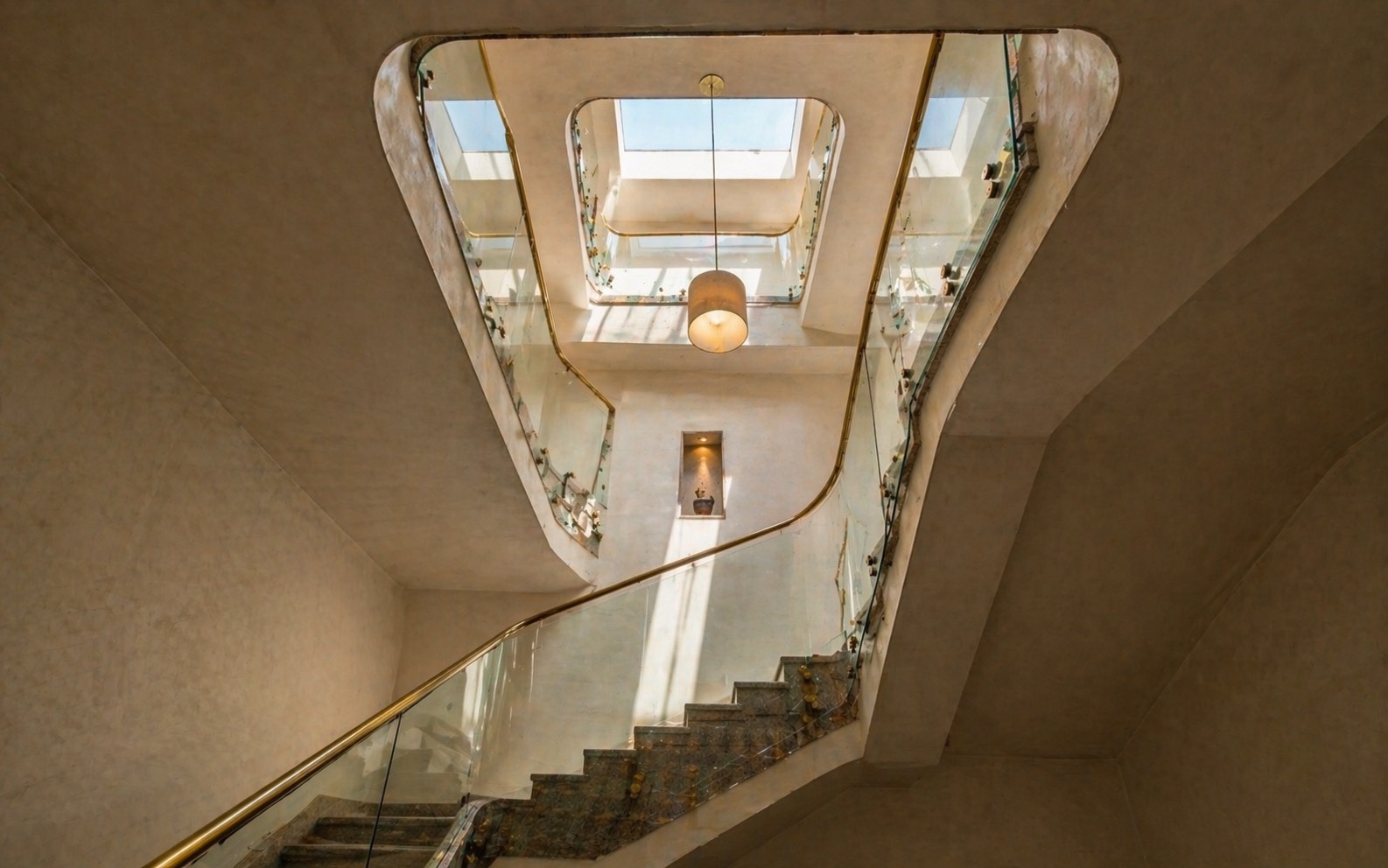
Staircase Design — Dimensions, Safety, and Placement
A Rigorous Guide to Residential Staircases — Geometry, Structure, Materials, and NBC Compliance
A staircase is a machine for ascending. It is also, almost inevitably, a defining element of the plan — often the single most expensive structural component of a residence, the loudest circulation path in daily use, and the element whose failure produces the largest immediate injury risk in the home (approximately 60 per cent of Indian home-based accidents involve staircases, per Ministry of Health statistics). Good staircase design handles each of these responsibilities simultaneously: comfort to climb, efficient to build, safe in use, and architecturally composed rather than incidentally placed.
This guide is a rigorous treatment of residential staircase design: the geometry that governs comfort, the NBC 2016 Part 4 compliance requirements, the typologies available and when to choose which, the four dominant structural systems and their trade-offs, the materials and finishes that serve durability and aesthetics, handrails and balustrades under IS 3437, lighting strategy, accessibility, Vastu considerations, and the common failure modes that repeat across hundreds of Indian residential projects. The companion Staircase Calculator tool implements the geometric and NBC-compliance checks discussed here; this guide is the theoretical foundation behind the tool's numbers.
"A staircase is the most intimate public space in the house. You use it alone but you build it for everyone." — Paraphrased observation attributed to Juhani Pallasmaa
1. The Staircase as Plan Element
Before touching any number, recognise what the staircase is architecturally.
Five Roles of a Residential Staircase
1. A vertical circulation machine. It moves occupants between floors. Its geometric performance (comfort to climb) is the primary functional criterion.
2. A daylight shaft. If placed well and topped with a light well or skylight, it becomes the daylight source for the building's interior — often the only vertical element that conducts natural light to the ground floor of a compact plan.
3. A structural element. The staircase slab or stringer transfers its own weight plus live load (250–400 kg/m² for residential) to beams, columns, or load-bearing walls. The structural system chosen determines the staircase's form, cost, and aesthetic.
4. An acoustic path. Footfalls on treads, voices in stair wells, echo in high stair volumes — acoustic management is part of design.
5. A symbolic element. The first impression of a home is often its entrance + staircase. The material, the curve, the handrail detail, the light quality on the first tread — these carry weight.
Bad Staircase Consequences
A bad staircase manifests in symptoms the homeowner cannot attribute to design:
- Falls (especially among elderly and children)
- Fatigue when climbing daily
- Dark well that needs perpetual artificial light
- Noise transmission between floors
- Wasted floor area (oversized)
- Disproportionate cost (undersized but compensated with exotic materials)
- Vastu conflict (stair orientation discouraged; easy to verify; sometimes overlooked)
These are not incidentals — they are the persistent friction of a home. Good staircase design prevents every one of them with numbers that are fully known and freely available (NBC 2016, IS 3437, Blondel 1683).
"We climb a hundred thousand stairs a year in our homes. Architecture that respects this is an architecture of care." — Juhani Pallasmaa (b. 1936)
2. Geometric Fundamentals — Rise, Going, Pitch
Three dimensions define a staircase: rise, going, and the pitch angle these two produce.

The Three Fundamentals
| Parameter | Definition | Typical residential range | NBC 2016 residential limit |
|---|---|---|---|
| Rise (R) | Vertical height of each step | 150–200 mm | Max 190 mm |
| Going (G) | Horizontal tread depth (excluding nosing) | 250–325 mm | Min 250 mm |
| Pitch (α) | Inclination of the stair relative to horizontal | 25°–35° | (computed from R/G) |
| Tread depth (T) | Going + nosing projection | Going + 20–30 mm | — |
| Headroom (H) | Clear height above nosing | 2,100–2,300 mm | Min 2,100 mm |
| Clear stair width | Usable tread width | 900–1,200 mm | Min 900 mm |
Deriving One From Others
A floor-to-floor height of 2,700 mm (common Indian residential) with NBC-compliant rise 190 mm requires 2,700 / 190 = 14.2 risers — rounded up to 15 risers (rise becomes 180 mm), giving 14 treads (always one less tread than riser). At 275 mm going per tread, total going = 14 × 275 = 3,850 mm. Pitch α = arctan(180/275) = 33.2°.
This is the calculation the Staircase Calculator automates for any floor-to-floor height.
Consistency Rule
Every step in a flight must have the same rise and the same going. Variable steps — even a single "trick" step at the top or bottom — cause disproportionate falls. Research in residential fall injury (Templer, 1992, The Staircase: Studies of Hazards, Falls, and Safer Design) documents that 75 per cent of stair-fall injuries occur on the first or last three steps, and that irregular rise dimensions are the single largest contributing factor. Consistency is not an aesthetic choice; it is a safety requirement.
Nosing
The nosing is the rounded or chamfered edge where the tread meets the riser. It serves three purposes:
1. Visual cue — signals the edge of the tread to the eye
2. Structural — the concentrated load at the step edge is at the nosing
3. Safety — rounded edge minimises injury from glancing contact
Typical nosing: 20–30 mm projection, 3 mm radius rounded. Too large a nosing (> 40 mm) catches the heel on descent, causing trips.
3. Blondel's Rule — The Comfort Formula
In 1683, French engineer Nicolas-François Blondel published Cours d'Architecture, deriving the rise-going relationship from observing people climb Parisian steps. His formula has proven extraordinarily durable:
``
2R + G = 600 to 650 mm
``
Where R is rise in millimetres and G is going in millimetres. A step that satisfies this formula feels comfortable to climb; one that violates it feels cramped or awkward.

Why Blondel Works
The formula approximates the natural gait on an incline. Walking on flat ground, the human stride length is roughly 600–650 mm (measured heel-to-heel). On stairs, each step forward is combined with an upward lift — the formula captures the trade-off between horizontal and vertical effort that produces the same apparent work per step as flat walking.
Blondel Examples
| R (mm) | G (mm) | 2R + G | Verdict |
|---|---|---|---|
| 150 | 320 | 620 | Comfortable, generous |
| 170 | 290 | 630 | Comfortable, standard |
| 180 | 270 | 630 | Comfortable, efficient (NBC-compliant) |
| 190 | 255 | 635 | At NBC limit, borderline comfortable |
| 200 | 250 | 650 | Steep; non-compliant R > 190 in NBC |
| 150 | 350 | 650 | Shallow, monumental — used in public buildings |
| 220 | 220 | 660 | Very steep; fail |
| 140 | 380 | 660 | Too shallow; fatiguing long run |
Related Rules
Two additional comfort checks are used in serious residential design:
Pitch rule: The angle α = arctan(R/G) should be 25°–35° for residential. Below 25° (shallow) makes the staircase long and space-consuming; above 35° (steep) makes it tiring and falls-prone.
Product rule: R × G ≈ 45,000–50,000 mm². This variant captures the combined safety consideration: the higher the rise, the deeper the going needs to be to maintain foot placement.
Elderly rule: For accessible design serving older users, aim for R + G = 430–460 mm with R ≤ 150 mm. This is more generous than Blondel's standard — it prioritises reduced lift over stride length.
4. NBC 2016 Part 4 — Fire Safety and Staircase Standards
NBC 2016 Part 4 (Fire and Life Safety) establishes the mandatory minima for residential staircases. These are not guidelines — they are the regulatory floor for plan approval.
NBC 2016 Part 4 Residential Staircase Requirements
| Requirement | Single-family residence | Multi-unit residential |
|---|---|---|
| Minimum clear width | 900 mm | 1,200 mm (for buildings ≥ G+3) |
| Maximum rise (R) | 190 mm | 190 mm |
| Minimum going (G) | 250 mm | 250 mm |
| Minimum headroom | 2,100 mm | 2,100 mm |
| Maximum flight length | No more than 12 risers without landing | Same |
| Minimum landing width | Equal to stair width | Same |
| Handrail | Required on open sides | Required both sides if width > 1,500 mm |
| Fire rating (stair enclosure) | Not required for G+1, G+2 | 2-hour for G+3 and above |
| Fire-rated door to stair | Not required single-family | Required multi-unit G+3+ |
| Non-combustible treads | Residential: permitted combustible | Required non-combustible in multi-unit G+3+ |
The 12-Riser Rule
NBC 2016 requires a landing after a maximum of 12 risers in residential construction. This is the basis for why a 15-riser single flight is not permitted without a mid-landing — it must be split as, say, 8 + 7 with a landing between. This splitting adds footprint but meaningfully reduces fatigue (the landing provides recovery) and reduces fall distance (a fall from tread 6 down is limited to the landing).
Emergency Egress
For multi-unit residential (apartments), the staircase also functions as emergency egress — and NBC 2016 Part 4 governs:
- Enclosure with fire-rated walls (2-hour rating minimum)
- Fire-rated self-closing doors
- Smoke-free enclosure (pressurisation or natural vent)
- Exit discharge to open space at ground
Single-family homes escape most of this but benefit from voluntary adoption in projects with elderly residents or flammable storage adjacent to stair.
Illumination
NBC 2016 Part 4 requires emergency lighting on staircases in multi-unit residential. Single-family is discretionary but good practice — a staircase should be safely navigable in a power failure, which requires a battery-backup or solar-powered light on each landing.
5. Typologies — Straight, L, U, Spiral, Winders
Typology Overview
| Type | Footprint | Rise per step (comfortable) | Structural complexity | Best for |
|---|---|---|---|---|
| Straight single flight | ~0.9 m × 4.5 m (~4.0 m²) | 150–190 mm | Simplest | Narrow plots; backup stair |
| L-shape (dog-leg) | ~2.4 m × 2.4 m (~5.8 m²) | 150–190 mm | Moderate (mid-landing) | Compact residential default |
| U-shape (switchback) | ~3.0 m × 2.0 m (~6.0 m²) | 150–190 mm | Moderate (half-landing) | Premium residential; light well opportunity |
| Spiral (helical) | ~1.4 m diameter (~1.5 m²) | 180–220 mm (steep) | Custom fabrication | Accent stair only; never main stair |
| Winders (turning treads) | Variable (~3.0–4.5 m²) | 150–190 mm | Custom | Compact plots with direction change |
| Bifurcated (Y-split) | > 10 m² | 150–180 mm (shallow) | Heavy structural | Monumental residential / public |
Detailed Notes on Each
Straight flight: The simplest construction, the smallest footprint, and the cheapest — but the longest continuous climb (fatigue), the poorest daylight (one-end only), and safety-critical (a fall goes the full height). Use only where flight length is limited or as a backup/service stair.
L-shape / dog-leg: The workhorse of Indian residential. A mid-landing between two perpendicular flights provides recovery, breaks the fall distance, and creates a corner light well. 2.4 × 2.4 m is the compact sweet spot; 3.0 × 3.0 m is generous.
U-shape / switchback: Two parallel flights with a half-landing. The central void between flights can become a skylight-lit light shaft — this is where the U-shape shines. Premium residential default. Needs 3.0 m linear space.
Spiral: Decorative but functionally compromised. Steep risers, triangular treads (foot placement ambiguous), and cannot carry furniture. Use only as a backup or as an accent connecting, say, a library to a mezzanine.
Winders: Turning treads (wedge-shaped) at corners, replacing a landing. Save footprint but create inconsistent tread depth near the inner edge — fall risk. Use only where a landing truly does not fit. NBC 2016 permits winders subject to minimum tread depth of 150 mm at 300 mm from inner edge.
Bifurcated / Y-split: A wide single flight that splits at a half-landing into two narrower flights going left and right. Monumental; used in villas and public residential. Space-consuming but spatially memorable.
Choosing the Typology
| Criterion | Recommend |
|---|---|
| Plot ≥ 30×40 ft, plan can afford 6 m² | L-shape or U-shape |
| Plot < 25×40 ft, compact plan | L-shape (corner stair) |
| Narrow plot (20 ft wide) | Straight flight along long axis |
| Two staircases (for servant circulation) | Main L or U; backup straight |
| Monumental entry desired | Bifurcated (requires villa-scale plot) |
| Accent only, secondary | Spiral or floating straight |
6. Structural Systems — Four Approaches

Indian residential staircases are constructed in one of four structural systems, each with its own cost, aesthetic, and constraints.
1. RCC Waist Slab — The Default
An inclined reinforced concrete slab with concrete steps cast on top. The "waist" is the slab thickness (typically 150 mm), measured perpendicular to the inclination. Treads and risers are formed as integral extrusions above the waist.
- Mass: 380–420 kg/m²
- Max span: 3.5–4.0 m for single flight (between landings)
- Steel: Main bars 8 mm at 150 mm c/c along length; distribution 8 mm at 200 mm c/c across
- Cost: ~₹1,200–1,800 per sq ft finished (2026 Indian prices)
- Finish: Ceramic tiles / granite on cement screed
This is 90 per cent of Indian residential stairs. It is cheap, durable, and structurally conservative. The only aesthetic concern is the heavy soffit — the underside of the stair is a massive inclined surface that can feel intrusive in compact plans. Solutions: paint soffit dark (recedes); integrate storage under stair (closed soffit); or choose another structural system.
2. Steel Stringer — Contemporary
Two parallel steel channels or plates running the full length of the stair, with treads spanning between them. Risers optional (open-riser permitted in single-family residential per NBC).
- Mass: 90–130 kg/m²
- Max span: 4–5 m
- Steel: ISMC 150×75 channels or 12 mm plate stringers
- Treads: Chequered MS plate, timber (sal or teak), precast concrete, or stone
- Cost: 1.5–2.0× RCC baseline
- Finish: Powder-coat or galvanise the steel; treads receive separate finish
Advantages: lighter than RCC (matters in vertical-load-constrained buildings); visually airier (open risers); prefabricated off-site. Disadvantages: corrosion in coastal climates; metallic footstep sound; cost premium.
3. Cantilever — Dramatic / Minimalist
Individual treads cantilever from a structural wall (typically 300 mm RCC) with no visible support. The visual effect is floating steps.
- Mass: 150–200 kg/m² (concentrated in the wall)
- Wall requirement: 300 mm RCC or equivalent mass; treads embed 250–350 mm into wall
- Tread construction: Steel core wrapped in stone / timber veneer
- Cost: 3–5× RCC baseline
- Finish: Matched to interior (marble, teak, granite); glass balustrade common
Cantilever stairs are showpieces. They require structural-consultant sign-off (deflection limits under occupant load), a precisely-detailed wall, and expert construction. Suitable for premium residential where the staircase is a primary interior feature.
4. Hidden-Stringer Floating — Contemporary Minimalist
A single central steel spine runs under the treads (concealed from view). Treads cantilever from the spine on either side. The appearance is floating treads without cantilever from a wall.
- Mass: 80–110 kg/m²
- Spine: ISMB 250–300 mm, welded full length
- Treads: Fabricated with welded tabs that bolt to spine
- Cost: 2.5–4× RCC baseline
- Finish: Treads any material (wood, stone, steel plate)
The hidden-stringer float is an elegant compromise — cantilever aesthetic without the 300 mm RCC wall requirement. It needs a capable fabricator and a structural engineer to size the spine for the live load.
Selection Matrix
| Priority | Structural choice |
|---|---|
| Cost-first residential | RCC waist slab |
| Contemporary aesthetic | Steel stringer or hidden-stringer float |
| Monumental entry | RCC waist slab (scale) or bifurcated RCC |
| Premium minimalist | Cantilever (requires structural wall) |
| Renovation in existing building | Steel stringer (retrofit-friendly) |
| Very wide flight (> 1,500 mm) | Central spine + cantilever treads |
"The staircase is the most expensive 6 square metres in your house. Put the thought in." — Paraphrased design-writing observation
7. Materials and Finishes
Tread Materials
| Material | Durability | Slip resistance | Cost (₹/sqft) | Indian suitability |
|---|---|---|---|---|
| Granite (polished) | Excellent | Poor when wet | 350–600 | Common; specify matte for safety |
| Granite (flamed/leather) | Excellent | Good | 400–700 | Ideal combination |
| Marble (polished) | Very good | Poor when wet | 450–1,200 | Premium; requires anti-slip strips |
| Kota stone | Excellent | Moderate | 80–180 | Budget classic; perfect for traditional |
| Teak timber | Good (maintenance) | Good | 650–1,500 | Premium; refinish every 5–7 yrs |
| Sal timber | Very good | Good | 450–750 | Economic timber option |
| Ceramic tile (anti-skid) | Good | Good | 80–300 | Mid-tier; widely available |
| Vitrified tile | Very good | Moderate (some skid) | 120–400 | Modern; finish grade matters |
| Vetrified anti-skid | Very good | Good | 180–500 | Safer than polish vitrified |
Nosing Treatments
Nosings are high-wear; specifying them with harder / grippier material than the main tread extends life.
- Brass / aluminium strip — 3 mm width, inlaid at nosing edge; traditional and durable
- SS anti-slip strip — metallic grip pattern; most effective safety nosing; industrial aesthetic
- Rubber / vinyl insert — cheap, effective grip; replaceable; best for servant staircases
- Stone with rough edge — leather-finished tread with rough nosing band; integrated aesthetic
Anti-slip nosings are required by NBC 2016 Part 4 for multi-unit residential. Highly recommended for all staircases, including single-family.
Riser Treatment
Risers can be:
- Closed (concrete/tile/timber) — standard; hides the step structure
- Open (no riser) — permitted in single-family residential; visually airy; children's toe-catch risk
- Decorative tile — patterned (Rajasthani kasuti, azulejo, terracotta) as an accent
Open risers are not permitted by NBC 2016 for multi-unit residential or for staircases serving more than 6 m height (fall-through risk).
Under-Stair Treatment
The soffit (underside) of a staircase is a design opportunity often neglected. Options:
- Plaster + paint — default; use dark colour to recede visually
- Exposed RCC — modern industrial finish; seal with matte acrylic
- Wooden lining — teak, pine planks; rich aesthetic; adds thickness
- Storage enclosure — the under-stair cavity becomes a closet, study nook, or powder room
- Planter — at the lowest steps, shallow planter with climbing ivy
8. Handrails and Balustrades — IS 3437 Compliance
Regulatory Framework
IS 3437:2019 (Barrier Free and Accessible Built Environment) and NBC 2016 Part 4 specify handrail and balustrade requirements:
| Requirement | Residential |
|---|---|
| Handrail height | 900–1,000 mm above nosing |
| Handrail diameter (graspable) | 32–45 mm |
| Gap from wall | 40–50 mm (allows full grip) |
| Balustrade height | 1,000–1,200 mm above tread level |
| Max gap between balusters | 100 mm (prevents child head entrapment) |
| Both sides required | If stair width > 1,500 mm; or if open |
| Handrail extension beyond last step | 300 mm (safety for continuation) |
Handrail Materials
Steel round bar — 32 mm dia MS or SS; 50 mm gap from wall on brackets; painted or galvanised. Economical. Cold to touch in winter.
Timber (teak, sal, pine) — 40–50 mm round or oval profile; 50 mm gap from wall. Warm to touch. Refinish every 3–5 years.
Brass / bronze — 32–38 mm oval; patinates over time to deep brown. Classic residential choice in North Indian homes.
Glass with metal cap — 10–12 mm toughened glass balustrade capped with SS or brass rail. Contemporary; visually light; cleans well.
Rope / woven — traditional (Kerala thatched homes); suitable only as accent, not as primary handrail.
Balustrade Design
Balusters fill the space between handrail and stair edge. Options:
- Vertical bars (MS, SS, timber) — simple, classic, easy to clean
- Panels (solid or perforated) — visual continuity; cast iron, fabricated steel, or wood
- Glass panels — toughened 10–12 mm; visually open; shows off architectural stair
- Cable / wire — horizontal SS wires; modern industrial; NBC-compliant only if spacing < 100 mm at tightest point
- Lattice / jali — traditional; wooden or metal; decorative and culturally rooted
Safety Check
For child-occupied homes, every balustrade detail must pass the "100 mm sphere test": no opening should allow a 100 mm sphere to pass through. This prevents the head-entrapment failure mode responsible for child deaths in older staircases. Specifically check: horizontal balusters are not compliant because a child can climb them.
9. Lighting the Staircase
A staircase needs four distinct lighting functions:
The Four Lighting Layers
1. Ambient (general fill) — Pendant or surface-mount on each landing; 150–300 lux at tread level. This is the baseline.
2. Step lighting (tread-level) — LED strip under nosing or wall-mounted at skirting. Safety lighting; makes step edges visible at night without flooding the house.
3. Accent (architectural) — Pendant or chandelier over the stair well (U-shape and switchback); or sconces on stair wall. Creates the architectural moment.
4. Natural daylight — Through clerestory, skylight, or light shaft above the stair. The most important of the four for long-term comfort.
Lighting Design Principles
- Tread edges must be visible. Shadow patterns that obscure step edges cause falls. Direct overhead lighting (vertical downlight) creates edge-obscuring shadows; angled lighting or tread-level strips resolve this.
- No glare. Bright light source in direct sightline to descending eye causes momentary blindness. Shade all lamps; use diffusers.
- Two-way switching at top and bottom of each flight. Cost: ₹400 per switch pair. Dramatically reduces "fumbling in dark" falls.
- Battery backup — at least one light on each landing on UPS or emergency battery. ₹2,000 per fixture.
- Daylight path — at least one exterior-facing window on the stair well, even if small. The Rajasthani havelis used tiny jaalis at stair landings for exactly this; the principle holds.
Daylight in the Stair Well
The staircase well is the best vertical shaft available for daylighting a deep plan. A 2 × 2 m well with a 1.5 × 1.5 m skylight at the top delivers approximately 800–1,200 lux at the top-floor landing, 300–500 lux at the middle, and 80–150 lux at the ground floor — under overcast sky. Under clear sky these figures quadruple. For compact plans with limited external wall area, the stair-well skylight is often the single largest daylight contribution to the whole house.
10. Accessibility — Ageing in Place, Step-Free Entry
The Elder Accessibility Problem
A staircase becomes difficult with age. Balance declines; knees strain; vision worsens; falls become more consequential. Indian homes, with their typically steep stairs (R ≈ 190 mm) and narrow widths (900 mm), exacerbate this. Three accessibility strategies apply:
1. Design the stair for ageing in the first place.
- Rise ≤ 150 mm (shallower than NBC allows)
- Going ≥ 300 mm
- Stair width ≥ 1,050 mm (for balance / stair lift future)
- Handrails both sides
- Non-slip material
- Continuous handrail without breaks
2. Provide a bedroom on ground floor. Even in a three-bedroom home, one should always be on ground floor — the one the elderly occupant will use when stairs become impractical. Attached bathroom with grab bars is part of this commitment.
3. Provide the future stair-lift path. A stair lift requires 650 mm clear beside the stair. Designing the stair 1,050 mm wide preserves 400 mm for traffic plus 650 mm for future lift. Retrofitting a lift onto a 900 mm stair is impossible.
Step-Free Entry
For homes on stilted plots or with ground-floor thresholds, one entry must be step-free. A ramp at 1:12 slope (per IS 3437) achieves this — for a 150 mm step, a 1.8 m ramp. Integrate as a landscape element rather than an afterthought.
IS 3437 Accessibility Guidelines
For homes being designed with accessibility explicitly as a brief priority (elder-facing home, special-needs family member):
- Handrail continuity across landings
- Landing dimension min 1.5 × 1.5 m for stair-lift turn
- Non-reflective tread surface (low glare)
- Visual contrast between tread and riser (minimum 30 per cent LRV difference)
- Tactile warning at top/bottom of flight (sharp textural change)
11. Staircase Placement — Where in the Plan
The Staircase as Plan Hinge
In multi-storey homes, the staircase is the plan's hinge. Its placement determines:
- The connection between ground and upper floors
- The light quality on both floors
- The privacy of upper floors from visitors to ground floor
- The perceived spaciousness of the home
- The circulation efficiency (or its absence)
Five Placement Strategies
1. Central (courtyard replacement). The stair takes the plan's geometric centre; rooms arrange around. Best for daylight (central light shaft); best for circulation (shortest routes from stair to any room). Takes the middle; no grand central living room possible. Common in compact 30×40 plots.
2. Side (along one wall). Stair along one of the long walls (typically the north or service side); living/bedrooms on the other. Maximises clear central volume. Standard BBMP 30×40 strategy. Visible from entry; becomes architectural feature.
3. Behind entry (wall-aligned). Stair tucked against a wall immediately past the entry foyer, climbing up and away. Compact and efficient. Visitor sees the stair but doesn't have to pass it. Common in narrow plots.
4. Near the service zone. Stair adjacent to kitchen and utility; serves as servant circulation path to upper floors (avoiding family zones). Practical in villa-scale homes with live-in domestic staff.
5. Open feature (villa scale). Stair in the centre of a double-height living room, visible from entry, treated as a sculptural element. Only for homes with 180+ m² footprints where space permits.
Vastu Alignment for Stairs
Traditional Vastu prescribes specific directional preferences for staircases:
| Direction | Vastu view | Functional rationale |
|---|---|---|
| South (S) or SW | Preferred | Heavier structure in SW (mass + stability) |
| Southeast (SE) | Acceptable | Aligns with fire-zone / kitchen; coherent |
| West (W) | Acceptable | Evening sun; not critical |
| Northeast (NE) | Avoid | Sacred zone; stair mass and descent disrupts |
| North (N) | Avoid if central | Cool zone; stair in N blocks daylight |
| East (E) | Generally acceptable | Morning light path |
The Vastu rule of thumb: stairs should ascend clockwise (right-handed spiral when climbing) and should start from north or east and end at south or west. These rules have functional roots (muscle-memory of handedness; avoiding ascending into evening sun). Most modern Indian Vastu practitioners accept variations within a ±15° orientation window.
Placement Errors That Recur
- Stair directly facing main door (visitor sees stair rising; Vastu conflict; also spatially unwelcoming)
- Stair under the master bedroom (acoustic: footfalls wake the sleeper)
- Stair with its first step landing inside the living room area (traffic crosses seating)
- Stair without daylight (oppressive, requires 24/7 artificial light)
- Stair with no storage or functional use of under-stair cavity (wasted volume)
- Stair so narrow furniture cannot pass (wardrobe stuck at lower floor)
12. Worked Example and Summary Checklist
Worked Design — 30×40 Bengaluru Home
Floor-to-floor height: 2,850 mm (slab-to-slab, accounts for 150 mm slab)
Clear rise: 2,700 mm
Choose R = 180 mm → 15 risers (2,700 / 180)
14 treads × 275 mm going = 3,850 mm total run
Pitch = arctan(180/275) = 33.2° ✓
2R + G = 360 + 275 = 635 mm ✓ (within comfort band)
NBC 2016 Part 4: 180 ≤ 190 ✓, 275 ≥ 250 ✓ ✓
Typology: U-shape with central light well
- First flight: 7 risers (8 treads including landing edge) × 275 mm = 2,200 mm
- Half-landing: 1,000 × 2,000 mm
- Second flight: 8 risers (7 full treads) × 275 mm = 2,200 mm
- Total footprint: 1,000 × 2,200 × 2 with landing = 3.0 m × 2.0 m = 6.0 m²
Light well: 800 × 1,400 mm open to sky, skylight with operable ventilator
Material: RCC waist slab 150 mm thick; granite treads (leather finish); MS round handrail (teak capped); glass balustrade 10 mm toughened
Per-floor cost estimate: ₹1,25,000 per floor × 2 flights = ₹2,50,000 total for stair (materials + labour, Bengaluru 2026 rates)
Final Design Checklist
For any residential staircase, verify:
1. Geometry — R ≤ 190 mm; G ≥ 250 mm; 2R + G within 600–650 mm
2. NBC compliance — width ≥ 900 mm; headroom ≥ 2,100 mm; max 12 risers before landing
3. Consistency — every rise equal; every going equal; no trick step
4. Handrail — one side minimum; height 900–1,000 mm; graspable profile; continues at landings
5. Balustrade — height ≥ 1,000 mm; gaps < 100 mm; passes sphere test
6. Material — non-slip tread (or anti-slip nosing); tread matched to finish scheme
7. Lighting — two-way switching; step-level fixtures; one ambient per landing; battery backup
8. Daylight — window or skylight in stair well (even if small)
9. Accessibility — ≥ 1,050 mm width or ≥ 1,000 mm for future lift; continuous handrail
10. Vastu — if specified; orient within acceptable directional envelope
11. Under-stair use — storage, study nook, powder room (not dead cavity)
12. Acoustic — ensure no stair directly under bedroom; soffit absorbent
Using the Staircase Calculator
The Staircase Calculator tool implements:
- NBC 2016 Part 4 compliance check (rise/going/headroom)
- Blondel rule verification
- Pitch angle calculation
- Flight footprint (straight, L, U)
- Auto-generated SVG section drawing
- One-click BOQ export
The tool is appropriate for schematic and design-development stage. For detailed construction drawings including reinforcement design and foundation connection, engage a structural consultant.
References
- Alexander, C., Ishikawa, S. and Silverstein, M. (1977) A Pattern Language: Towns, Buildings, Construction. New York: Oxford University Press.
- Blondel, N.F. (1683) Cours d'Architecture enseigné dans l'Académie Royale d'Architecture. Paris: Collombat. (Translated in historical architectural texts.)
- Bureau of Indian Standards (2000) IS 456:2000 — Plain and Reinforced Concrete — Code of Practice. New Delhi: BIS.
- Bureau of Indian Standards (2016) SP 7:2016 — National Building Code of India 2016, Part 4: Fire and Life Safety. New Delhi: BIS.
- Bureau of Indian Standards (2019) IS 3437:2019 — Barrier Free and Accessible Built Environment. New Delhi: BIS.
- Bureau of Indian Standards (1987) SP 41 (S&T):1987 — Handbook on Functional Requirements of Buildings. New Delhi: BIS.
- Ching, F.D.K. (2015) Architecture: Form, Space, and Order. 4th edn. Hoboken: John Wiley & Sons.
- Ching, F.D.K. (2020) Building Construction Illustrated. 6th edn. Hoboken: John Wiley & Sons.
- Government of India, Ministry of Social Justice and Empowerment (2016) Harmonised Guidelines and Space Standards for Barrier-Free Built Environment for Persons with Disabilities and Elderly Persons. New Delhi: MoSJE.
- Hall, E.T. (1966) The Hidden Dimension. New York: Doubleday.
- Kumar, P. and Muraleedharan, V.R. (2018) 'Domestic injuries and fall pattern among elderly in India: evidence from the Longitudinal Ageing Study in India', Journal of Clinical Gerontology and Geriatrics, 9(2), pp. 48–54.
- Neufert, E. and Neufert, P. (2012) Architects' Data. 4th edn. Oxford: Wiley-Blackwell.
- Pallasmaa, J. (2012) The Eyes of the Skin: Architecture and the Senses. 3rd edn. Chichester: John Wiley & Sons.
- Pheasant, S. and Haslegrave, C.M. (2006) Bodyspace: Anthropometry, Ergonomics and the Design of Work. 3rd edn. London: CRC Press.
- Rawn, V. (2011) Staircases: The Architecture of Ascent. New York: Rizzoli.
- Stellingwerff, M. (2012) 'A Brief Overview of Staircase Design: Past, Present and Future', Design Studies, 33(4), pp. 369–394.
- Templer, J. (1992) The Staircase: Studies of Hazards, Falls, and Safer Design. Cambridge MA: MIT Press.
- Templer, J. (1992) The Staircase: History and Theories. Cambridge MA: MIT Press.
- Tregenza, P. and Wilson, M. (2011) Daylighting: Architecture and Lighting Design. London: Routledge.
Author's Note: The staircase is one of those architectural elements where the received wisdom — NBC limits, Blondel's rule, consistent rise — actually works, and where deviation is almost always a mistake. The temptation to make a staircase "interesting" by varying rise, skipping a landing, or compressing pitch produces falls, fatigue, and failures. The way to make a staircase interesting is through material, light, daylight, and the placement of the staircase in plan — not through its geometric departure from the proven dimensions. This guide is a restatement of proven dimensions and an advocacy for elevating staircase design from "element to pass regulations" to "element that defines the home." The Staircase Calculator tool automates the compliance checks so the architect can focus on the architectural questions.
Disclaimer: This article is for informational and educational purposes only. It does not constitute professional architectural or structural engineering advice. Staircase design must be undertaken by qualified architects and, where structural assessment is needed, by licenced structural engineers, in accordance with NBC 2016, IS 456, IS 3437, and all applicable local bye-laws. Studio Matrx, its authors, and its contributors accept no liability for decisions made on the basis of the information contained in this guide.
Export this guide
Related Tools — Try Free
Cross-Ventilation Analyzer
Estimate airflow and air changes per hour (ACH) from room size, window areas, layout, and local wind — with NBC 2016 Part 8 compliance check.
Ventilation CalculatorFull-Room BOQ — Living, Bedroom, Kitchen, Bath
Room-wise BOQ across living, bedrooms, kitchen, utility, and bathrooms with line-item pricing.
Full-Room BOQVastu Shastra Compliance Checker
Score your home across 21 Vastu criteria with a weighted score, compliance band, and remedial guidance.
Vastu Scoring