
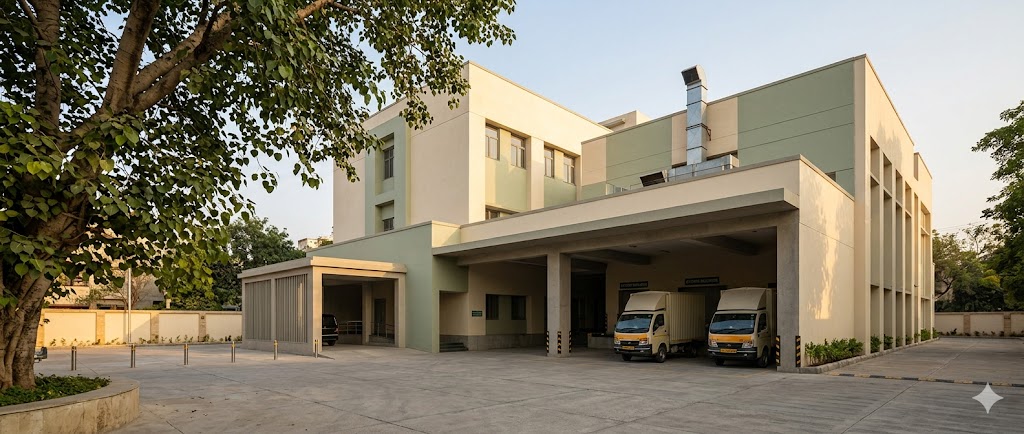
Hospital Back-of-House — Kitchen, Laundry & Mortuary Design in India
An Architect's Working Reference — Therapeutic Diet Kitchen · HACCP-Equivalent Flow · Hospital Laundry with Pass-Through Washer-Extractors · Mortuary with Dignified End-of-Life Architecture · Multi-Faith Provision · Service-Side Adjacency · NABH 5th Edition · The Service Heart of the Hospital
Back-of-house — kitchen, laundry, mortuary — is the typology of Indian hospital architecture that receives the least design attention and accounts for the most operational complaints. The OT and the ICU are designed by specialist healthcare consultants; the OPD and the lobby are designed by hospitality-leaning architects; the imaging suite is coordinated with the equipment manufacturer. The three back-of-house departments are typically delegated to a generic "service" brief that produces three rooms whose dimensions match a checklist but whose sequence, adjacency, and quality consistently fail at the operational handover. The result: kitchens that cannot deliver three meals a day on time without spillover into corridors; laundries that re-circulate cross-contamination through inadequate flow separation; mortuaries that fail to provide dignified end-of-life architecture for the families that find themselves there in their worst moment. The architect who treats back-of-house as a primary clinical commitment — every bit as important as the OT — produces a hospital where the service heart pumps cleanly through every clinical floor.
This guide is a facility-type deep-dive in the Studio Matrx healthcare architecture series. It assumes the reader has read the pillar regulatory reference, the hospital design roadmap, and the CSSD guide (because hospital laundry uses the same dirty-to-clean unidirectional flow logic as CSSD). Here we focus on what is specific to back-of-house — the three departments and their distinct architectural problems, the kitchen process flow with the diet-kitchen overlay, the laundry process with pressure cascade, the mortuary as the most under-designed BoH space, the service-side adjacency model that clusters all three on the south side of the hospital, the sizing matrix per hospital tier, the failure modes that recur across Indian projects, and the pre-design audit framework.
The position this guide takes is specific: hospital back-of-house should be designed with the same architectural seriousness as the clinical departments. The kitchen should be sized for peak meal-distribution throughput and zoned for diet-kitchen separation. The laundry should follow the same dirty-to-clean unidirectional principle as CSSD with pass-through washer-extractors. The mortuary should provide dignified end-of-life architecture with refrigerated body holding, multi-faith provision, family viewing, surge expansion, and service-side egress that never crosses the public lobby. The architect who internalises this delivers a hospital where the back-of-house functions invisibly and the clinical work proceeds without interruption. The architect who shortcuts back-of-house produces a hospital where the front-of-house promises continually break against operational reality.
"A hospital is judged in the morning by what its kitchen delivered, in the afternoon by what its laundry returned, and at night by how its mortuary received the family that arrived in grief. The architect who masters these three has built a hospital that works. The architect who has not has built a hospital that pretends." — Dr. Devi Shetty (b. 1953), cardiac surgeon and founder of Narayana Health, paraphrased from a 2017 management talk
"The back of the hospital is the front of the hospital, only invisible to the patient. The architect who treats it as the back makes it visible — and that visibility is operational failure." — Ar. Sandeep Singh (b. 1968), Delhi healthcare architect, paraphrased
1. Why Back-of-House is its Own Typology
Six characteristics make back-of-house distinct from clinical typology:
- Three-meal-a-day rhythm. The hospital kitchen is one of the few facility programmes that operates on an unmissable daily cycle — breakfast at 7 am, lunch at 12 pm, dinner at 7 pm — for every patient and most staff, every day, with no pause for renovation or holiday. The architecture must support continuous operation.
- Linen circulation is constant. A 200-bed hospital generates 600–1,000 kg of soiled linen per day; the laundry must turn it around within 24–48 hours to maintain ward stock. Throughput sizing is non-negotiable.
- Death is part of the brief. A hospital with 100 deaths per year (typical tertiary mortality rate) has ~2 deaths per week. The mortuary handles each as an operational event with a grieving family, religious ritual, documentation, and physical transfer. Most hospitals provide for this minimally; the better hospitals architecturally support each step.
- Service-side access is mandatory. All three BoH departments need separate goods-receiving (kitchen), waste-discharge (laundry effluent, kitchen wet waste, BMW), and hearse egress (mortuary). The service street is part of the architecture.
- Cross-contamination flow logic. Laundry uses the same dirty-to-clean unidirectional principle as CSSD. Kitchen uses a forward-only flow (raw → cook → distribute) with a separate soiled-return route. Mortuary segregates incoming-body route from family-viewing route from hearse-egress route.
- Operational cost dominates. Unlike OT or ICU, where capital cost dominates, BoH is an operational-cost-heavy programme — staff, food, utilities, linen, body management. The architecture should optimise for operational efficiency over capital cost; many Indian projects do the opposite.
The composite effect is that BoH is a hybrid: part industrial process plant, part hospitality, part end-of-life facility. No single building-type analogue exists.
2. The Three Departments at a Glance
Each BoH department has distinct flow logic, regulatory scope, and architectural commitment.

Kitchen. Therapeutic diet kitchen with optional cafeteria for staff/visitors. Architectural signature: raw → prep → cook → distribution; diet vs cafeteria streams; cold chain; tray cart distribution three meals/day; soiled tray return + dish wash. Regulatory: FSSAI registration mandatory; HACCP equivalent recommended; NABH 5th Edition diet services chapter. Footprint: 0.5–1.0 m²/bed for diet kitchen alone; 1.5–2.0 m²/bed with cafeteria. Three-meal-a-day operation; no architectural alternative.
Laundry. Hospital laundry processing linen, uniforms, OT drapes. Architectural signature: dirty → sort → wash → dry → iron → store → distribute; unidirectional like CSSD; pass-through washer-extractors; ironer + folder + storage. Regulatory: labour department (factories), effluent discharge consent, NABH infection control chapter. Footprint: 1.5–2.5 m²/bed on-site; 0.3 m²/bed if outsourced (receive station only). 3–5 kg linen generated per bed per day.
Mortuary. Body holding + autopsy + family viewing + religious provision. Architectural signature: refrigerated body holding; autopsy/post-mortem room; family viewing; multi-faith prayer; service-side egress only. Regulatory: state CEA mortuary requirement; death-registration interface; surge capacity (post-COVID). Footprint: body capacity 4–8 for 200-bed hospital; surge 4× via outdoor refrigerated container area. Most under-designed BoH space in Indian hospital practice.
3. The Hospital Kitchen — Process Flow
The hospital kitchen is a forward-flow operation: raw materials enter, are stored, prepped, cooked, plated, and distributed; soiled trays return via a separate route to dishwash and waste. The architectural enforcement of forward flow prevents cross-contamination.

Nine-stage flow:
1. Receiving — service entry; goods verification, weighing; cold chain initiation
2. Storage — dry, cold, frozen; FIFO logic; vegetables, grains, pulses, spices, dairy, meat, fish
3. Preparation — vegetable wash (3-bay sink), cutting/slicing, marination
4. Cooking — range top, tilting kettle, combi oven, bain-marie; tandoor in larger hospitals
5. Plating — tray assembly with diet-coded labels; hot-hold trolley loading
6. Distribution — hot trolleys via service lifts to all wards (never via patient lifts)
7. Return (soiled) — soiled trays back via separate cart and lift; never crosses cooking zone
8. Dish wash — pre-rinse, 3-bay sink, mechanical dishwasher, drying rack
9. Waste — food waste segregated; composting (large hospitals); wet-waste collection daily

The diet kitchen overlay. Within the main kitchen, a partitioned diet-kitchen section handles therapeutic diets:
- Diabetic preparation — low-sugar, controlled-portion area
- Renal-diet preparation — low-potassium, low-phosphate
- Soft / liquid diet — blender, food processor, strainer
- Allergen-free preparation — separate utensils, separate prep zone
- Religious diets — Jain (root-vegetable-free), Halal, Kosher (rare)
Each diet has a coded label matched to the patient's barcode at distribution.

Typical diet structure at a tertiary hospital: 60% normal/general, 20% diabetic, 10% soft/liquid, 10% renal/cardiac/specialty. The diet-kitchen section sizing reflects this mix.
4. The Kitchen Plan — Schedule of Accommodation
A working schedule for a 200-bed hospital therapeutic diet kitchen.

Schedule of accommodation (200-bed hospital, ~200 m² total):
| Element | Specification |
|---|---|
| Service entry / loading dock | 16–20 m²; truck access; bollard separation from public area |
| Goods inspection / weigh | 8–10 m²; verification before cold chain |
| Dry store | 30–40 m²; grains, pulses, spices, sugar; FIFO racking; pest-controlled |
| Cold store (2–8°C) | 12–18 m²; vegetables, dairy, fresh produce |
| Freezer (−18°C) | 8–12 m²; meat, fish |
| Vegetable wash | 12–16 m²; 3-bay sink + air gun |
| Cutting bench × 2 | Stainless; separate veg/non-veg lines |
| Marination | Cold-marination cabinet |
| Range top × 4 | Gas burners; bulk cooking |
| Tilting kettle × 2 | 100 L + 200 L; for daal, sambar, kheer, etc. |
| Combi oven | Bulk roast/bake |
| Bain-marie | Hot-hold for plating |
| Exhaust hood canopy | Above all cooking equipment; stainless; CFM per kitchen calc |
| Diet kitchen partition | 30–40 m² for diabetic, renal, soft, allergen-free diet preparation |
| Tray assembly belt | 6–8 m linear; diet labels matched to patient barcode |
| Hot-hold trolley park | 8–12 trolley positions |
| Service-lift access | Dedicated food lift; 1500 × 2400 mm cabin |
| Soiled tray return | Separate entry to kitchen rear; never crosses cooking zone |
| Dishwash | 3-bay sink + mechanical dishwasher; drying rack |
| Wet waste + BMW | Cooled bin; separate from clean kitchen |
| Office + dietician | 12–16 m²; menu planning, order processing |
| Staff WC + change | 8–12 m²; separate from clinical areas |
Critical specifications:
- Forward flow only. Soiled return route physically separate from raw-to-cooked flow. Soiled cart never enters cooking zone.
- Pass-through dishwasher preferred for the same reason as pass-through autoclaves in CSSD — separation between dirty and clean.
- Cooking exhaust hood sized per equipment makeup-air calculation. Make-up air supply equals exhaust to avoid kitchen depressurisation.
- Floor finish anti-microbial epoxy with coved skirting; 2% slope to grease-trap-protected drains.
- Walls stainless to 2 m at wash and cooking zones; epoxy painted above.
- Lighting 500 lux ambient; 750 lux task at prep and plating; CRI ≥ 80.
5. The Hospital Laundry — Unidirectional Flow
The hospital laundry uses the same dirty-to-clean unidirectional principle as CSSD. Pass-through washer-extractors are the architectural boundary; pressure cascade prevents cross-contamination.

Six-stage flow:
1. Soiled receive — sealed bags from wards, OT, ED; weight register; documented at receipt
2. Sort + weigh — by colour and type; PPE-required; stained items separated for pre-treatment
3. Wash — pass-through washer-extractor; 75°C thermal disinfection cycle (the workhorse); chemical disinfection optional
4. Dry — tumble dryer with hot-air or steam; exhaust hood
5. Iron + fold — flatwork ironer (steam-heated) + folding tables/calendar machine
6. Store + distribute — clean store with FIFO; distribution carts to wards, OT, CSSD
Pressure cascade:
- Dirty zone: −5 Pa, 10 ACH, HEPA exhaust direct outside
- Clean zone: +5 Pa, 8 ACH
- Clean store: +10 Pa, 6 ACH
Pass-through washer-extractors are the only crossing. Like CSSD pass-through autoclaves, they have dirty-side loading and clean-side unloading; door interlock prevents both being open. Personnel never carry linen across.
On-site vs outsourced. Three operational models:
- On-site (large hospitals 200+ beds) — full laundry within the hospital; capital intensive; full control
- Outsourced (small hospitals) — soiled linen collected by contractor; clean returned; receive station only on hospital site (40 m² typical)
- Hybrid (most common in 100–200 bed hospitals) — on-site for OT drapes and uniforms (high-quality control); outsourced for bulk bedsheets and bath towels
Schedule of accommodation (full on-site, 200-bed hospital):
| Element | Specification |
|---|---|
| Soiled receive + sort + weigh | 30–40 m² |
| Pass-through washer-extractors × 2–3 | 60–80 m² |
| Tumble dryers × 2–3 | 40–60 m² |
| Flatwork ironer | 30–40 m² |
| Folding tables × 4 | 30–40 m² |
| Clean store + distribution counter | 40–60 m² |
| Office + supervisor | 12 m² |
| Staff change + WC | 12–16 m² |
| Effluent treatment area | 20–40 m² (where required) |

Total on-site laundry footprint: 200–400 m² for 200-bed hospital.
6. The Mortuary — The Most Under-Designed BoH Space
The mortuary is the architectural space where the hospital meets families in their worst moment. Most Indian hospitals provide it minimally — a single refrigerated room with a viewing window — and produce an experience the family remembers for life as institutional indifference. The better hospitals provide dignified end-of-life architecture, and produce an experience the family remembers as compassion.

Schedule of accommodation (200-bed hospital, ~180 m²):
| Element | Specification |
|---|---|
| Body receive (from hospital) | 30–40 m²; reception bay (trolley dock); documentation desk (death register, ID) |
| Body holding (refrigerated) | 40–60 m²; 2–8°C; 6–8 cabinet positions for 200-bed hospital; +2 standby (total 8 capacity) |
| Autopsy / post-mortem room | 40–50 m²; only if forensic scope; stainless table sloped to drain; specimen storage |
| Family viewing area | 35–45 m²; viewing room (body presented on dignified trolley, soft warm light, seating for 6–10, privacy curtain); family meeting / counselling room; family WC |
| Multi-faith provision | 35–45 m²; prayer room (neutral finishes for Hindu, Christian, Muslim, Sikh, etc.); body-prep space for ritual washing in multi-tradition |
| Body release | 20–25 m²; release counter (documentation); hearse/ambulance bay (sheltered, separate from public lobby) |
| Service support | 14–18 m²; staff change + shower; BMW (tissue, sharps); HVAC plant |
| Outdoor last-rites + surge area | 200–400 m² adjacent; last-rites pavilion (sheltered family ritual); pre-wired surge area (refrigerated containers, post-COVID); hearse parking (3–4 vehicles, screened); garden / quiet zone |

Critical specifications:
- Body release route never crosses public lobby. Hearse egress is service-side only; family follows the body via a dedicated route.
- Visual + acoustic privacy throughout. Family viewing should not be visible from corridors; counselling room acoustically isolated.
- Multi-faith provision is integral, not optional. India's religious diversity requires architectural neutrality with provision for tradition-specific rituals (Hindu cremation prep, Muslim ghusl, Christian last rites, Sikh ardas).
- Refrigerated body holding. 2–8°C; double-skin insulated cabinets; alarm on temperature deviation.
- Autopsy room (where in scope). Stainless table with downward slope to drain; specimen storage; formalin in vented cupboard; staff PPE infrastructure.
- Surge expansion. Pre-wired outdoor area for 2–4 refrigerated containers (post-COVID standard for tertiary hospitals).
- Last-rites pavilion. Sheltered outdoor space for family ritual; separate from clinical zones; allows Hindu cremation preparation, Muslim burial ritual, Christian last-rites, Sikh ardas, in dignified outdoor setting.


The dignity question. A well-designed mortuary turns one of the worst experiences a family can have into one of the most respected. The cost is small (₹2–5 lakh additional over a minimal mortuary on a 200-bed hospital project); the impact on hospital reputation, staff morale, and family experience is substantial. The architect should insist on the brief.
"How a hospital handles death is part of how it handles life. The architect who omits the mortuary's dignity is omitting the hospital's." — Ar. Charles Correa (1930–2015), architect, paraphrased remark on Goa Medical College commission
7. The Service-Side Adjacency Model
All three back-of-house departments cluster on the service side of the hospital — typically the south or east face, opposite the public approach. The clustering enables shared service infrastructure (loading dock, waste collection, hearse access, dedicated lifts).

The hospital's three approaches:
- Public approach (north) — patient and visitor entry; main lobby; ambulance bay; OPD entry; valet
- Clinical core (centre) — OT suite, inpatient wards, ICU, ED, diagnostics; vertical service shaft connects to BoH below
- BoH cluster (south) — kitchen, laundry, mortuary, CSSD, BMW yard, ETP yard, general stores
Five vertical lifts at the clinical service shaft:
1. Patient lift (clean) — for visitor and ambulant patient movement; never carries waste or soiled linen
2. Service lift (food + linen) — for clean food delivery and clean linen distribution
3. Soiled lift (waste + soiled linen) — for soiled return (linen, dishes, waste); separate from food lift
4. Stretcher lift (emergency) — for non-ambulant patient movement (post-OT, ED)
5. Sterile lift (CSSD-OT) — for sterile-cassette transit; never shared
Two streets if possible. A north-south site allows public approach on one street and service approach on another. Indian urban sites often constrain this; in such cases, time-separation of public and service traffic (service deliveries before 8 am or after 8 pm) is the operational adaptation.
8. Sizing by Hospital Tier
Working sizing ratios at concept stage. Final sizing per bed-mix forecast and operational model.

Sizing matrix:
| Hospital tier | Kitchen | Cafeteria | Laundry | Mortuary |
|---|---|---|---|---|
| PHC (4–6 beds) | Outsourced or family-supplied | N/A | Outsourced | Body holding 1–2 (basic) |
| CHC (30 beds, FRU) | 30–50 m² diet kitchen | 20 m² (staff) | 25–40 m² on-site basic | Body holding 2–4 + basic PM |
| SDH (50–100 beds) | 80–150 m² full diet kitchen | 40–80 m² | 100–200 m² full unidirectional | Body holding 4–6 + PM + viewing |
| DH (100–200 beds) | 150–250 m² full + diet kitchen | 80–120 m² + visitor café | 200–400 m² full · pass-through | Body holding 6–10 + multi-faith |
| Tertiary (300–500 beds) | 300–500 m² + multi-cuisine | 150–300 m² visitor café + retail | 500–800 m² industrial-scale on-site | Body holding 10–16 + surge plan |
| National (1000+ beds) | 800+ m² industrial-scale | 500+ m² multi-format | 1,000–2,000 m² tunnel-W/D + auto fold | Body holding 20–40 + teaching PM |
9. Common Failure Modes — Back-of-House Specific
A pattern audit of stalled or under-performing Indian BoH projects reveals recurring failures:
| # | Failure Mode | Root Cause | Consequence | Prevention |
|---|---|---|---|---|
| 1 | Soiled tray return through cooking zone | Single-route kitchen | Cross-contamination | Forward-flow + separate return |
| 2 | Diet kitchen not partitioned within main kitchen | Cost-driven | Therapeutic diet errors | Diet partition from concept |
| 3 | Pass-through washer-extractor omitted in laundry | Cost-driven | Cross-contamination dirty-clean | Pass-through equipment |
| 4 | Mortuary at routine capacity only (no surge) | Pre-COVID brief | Body overflow during MCI | 4× surge from concept (post-COVID) |
| 5 | Multi-faith prayer room missing | Brief overlooked | Religious-tradition failure | Multi-faith provision in mortuary |
| 6 | Hearse egress through public lobby | Spatial constraint | Family + public exposure | Service-side egress mandatory |
| 7 | Service lift shared with patient lift | Spatial constraint | Cross-contamination | Dedicated lifts (food, soiled, sterile) |
| 8 | Kitchen exhaust hood undersized | Generic HVAC | Cooking smoke spillover; staff complaints | CFM per equipment calc |
| 9 | Laundry effluent discharge to sewer | Bypassed treatment | SPCB violation | On-site primary treatment |
| 10 | Cold chain break in receiving | Truck-to-cold-store transit | Food safety failure | Cold-chain-protected receiving bay |
| 11 | Body release counter near patient lobby | Spatial constraint | Distress to other patients | Service-side body release |
| 12 | Last-rites pavilion missing | Brief overlooked | Family forced to perform rituals in clinical space | Outdoor last-rites pavilion |
| 13 | Outsourced laundry receive station too small | Generic spec | Linen pile-up; cross-contamination | 40 m² minimum receive station |
| 14 | Dietician office in kitchen (no separation) | Cost-driven | Office contamination + kitchen distraction | Office adjacent but separate |
| 15 | Mortuary refrigeration without alarm | Generic refrigerator | Body decomposition if temp lost | Temperature monitor + alarm |
| 16 | Composting / wet-waste route through kitchen | Cost-driven | Cross-contamination | Separate wet-waste route |
10. Pre-Design Audit Framework for BoH Briefs
A 12-question audit at concept stage. Three or more "no" answers indicate the brief is not BoH-ready.
| # | Audit Question | Why It Matters | Required Output |
|---|---|---|---|
| 1 | Is the bed strength + bed mix forecast final? | Drives sizing | Bed-mix declaration |
| 2 | Is the kitchen forward-flow with separate soiled return designed? | Anti-cross-contamination | Kitchen process plan |
| 3 | Is the diet kitchen partitioned within the main kitchen? | Therapeutic diet integrity | Diet kitchen scope |
| 4 | Is the laundry on-site, outsourced, or hybrid? | Footprint decision | Operational model declaration |
| 5 | Are pass-through washer-extractors specified for on-site laundry? | Anti-cross-contamination | Pass-through equipment list |
| 6 | Is the mortuary surge capacity 4× routine (post-COVID standard)? | Mass casualty | Surge plan |
| 7 | Is the multi-faith provision in mortuary scope? | Religious diversity | Multi-faith room |
| 8 | Is the last-rites pavilion (outdoor) provisioned? | Family ritual | Outdoor pavilion |
| 9 | Is the service-side adjacency (south or east) designed? | Service flow | Service-side site plan |
| 10 | Are dedicated lifts (food, soiled, sterile, stretcher, patient) all separate? | Cross-contamination | Lift schedule |
| 11 | Is the laundry effluent treatment in scope? | SPCB compliance | ETP scope |
| 12 | Is the kitchen exhaust hood sized per equipment? | Smoke spillover | Hood CFM calc |
11. The Architect's BoH-Specific Compliance Deliverables
Beyond general healthcare deliverables (see pillar reference), the BoH-specific deliverables are:
| # | Deliverable | Recipient | Stage |
|---|---|---|---|
| 1 | Kitchen flow diagram (forward + soiled return) | NABH | Preliminary |
| 2 | Diet kitchen partition layout | Dietician / NABH | Detailed |
| 3 | Kitchen exhaust hood + makeup air calc | MEP | Detailed |
| 4 | FSSAI registration kitchen layout | FSSAI | Pre-handover |
| 5 | Laundry pressure cascade (dirty / clean / clean store) | HVAC | Detailed |
| 6 | Pass-through washer-extractor specification | Equipment supplier | Detailed |
| 7 | Laundry effluent treatment scope | SPCB | Detailed |
| 8 | Mortuary plan with body holding count | State CEA / NABH | Detailed |
| 9 | Multi-faith prayer room | Client | Detailed |
| 10 | Last-rites pavilion + surge expansion | Client / state DM | Detailed |
| 11 | Hearse egress route (service-side) | Client | Detailed |
| 12 | Service-side adjacency site plan (3 BoH + CSSD + waste) | Client | Concept |
| 13 | Lift schedule (5 dedicated lifts) | Lift consultant | Detailed |
| 14 | Body holding cabinet specification + alarm | Equipment supplier | Detailed |
"Back-of-house architecture is the test of whether the architect cares about the people who keep the hospital running and the families who pass through its hardest moments. Get this right, and the hospital is humane. Get it wrong, and no amount of front-of-house gloss will compensate." — Dr. Naresh Trehan (b. 1946), cardiac surgeon and healthcare entrepreneur, paraphrased
References
- ASHRAE (2021) Standard 170-2021: Ventilation of Health Care Facilities — Section on Food Service. Atlanta: ASHRAE.
- Bureau of Indian Standards (1991) IS 13041: Hospital Food Service Operations. New Delhi: BIS.
- Bureau of Indian Standards (2016) National Building Code of India 2016, Part 4 — Fire and Life Safety; Part 8 — Building Services. New Delhi: BIS.
- Centers for Disease Control and Prevention (2003) Guidelines for Environmental Infection Control in Healthcare Facilities — Section on Laundry and Bedding. Atlanta: CDC.
- Centers for Disease Control and Prevention (2008) Guideline for Disinfection and Sterilization in Healthcare Facilities — Section on Laundry. Atlanta: CDC.
- Facility Guidelines Institute (2022) Guidelines for Design and Construction of Hospitals — Chapter on Support Services. St. Louis: FGI.
- Food Safety and Standards Authority of India (FSSAI) (2018) Schedule 4: General Hygienic and Sanitary Practices to Be Followed by Food Business Operators Engaged in Manufacture/Processing/Storing/Selling Food. New Delhi: FSSAI.
- Government of India (1948, amended) The Factories Act 1948. New Delhi: Ministry of Labour.
- Government of India (1986) The Environment (Protection) Act 1986. New Delhi: Ministry of Environment, Forest and Climate Change.
- Kobus, R.L., Skaggs, R.L., Bobrow, M., Thomas, J. and Payette, T.M. (2008) Building Type Basics for Healthcare Facilities — Chapter on Support Services. 2nd edn. Hoboken: Wiley.
- NABH (2020) Standards for Hospitals, 5th Edition — Hospital Infection Control + Diet Services + Linen Services + Mortuary Chapters. New Delhi: National Accreditation Board for Hospitals & Healthcare Providers, Quality Council of India.
- WHO (2002) Prevention of Hospital-Acquired Infections — Practical Guide. 2nd edn. Geneva: World Health Organization.
- WHO (2008) Essential Environmental Health Standards in Health Care. Geneva: WHO.
- WHO (2014) Safe Management of Wastes from Health-Care Activities. 2nd edn. Geneva: WHO.
Author's Note: Back-of-house is the architectural typology in which the most operational complaints originate and the least design attention is paid. The author's intention with this guide is to support the architects who insist on forward-flow kitchens, unidirectional laundries, and dignified mortuaries — even when the brief is silent on these. The kitchen feeds the patient three times a day, the laundry returns a clean bedsheet to the patient every shift, and the mortuary receives the family in its worst moment. The architecture of these three departments is the architecture of the hospital's daily humanity. The series will continue with deeper guides on industrial hospital laundry, kitchen ventilation, and the architecture of dignified end-of-life.
Disclaimer: This article is for informational and educational purposes only. It does not constitute legal, regulatory, clinical, or professional architectural advice. Back-of-house design depends on site, state, facility tier, bed mix, operational model (in-house vs outsourced), and applicable amendments at the time of design — all of which must be confirmed with the relevant statutory authorities (FSSAI, state pollution control board, state factories inspector, NABH, state CEA), the equipment manufacturer, qualified clinical and operational consultants, and qualified design consultants for the specific project. Statute references, ACH rates, sizing ratios, and infrastructure norms cited are indicative and subject to change. NABH 5th Edition, FSSAI Schedule 4, IS 13041, and ASHRAE 170 are periodically revised; practitioners must verify current notifications before any binding design or construction commitment. Studio Matrx, its authors, and its contributors accept no liability for decisions made on the basis of the information contained in this guide, and recommend independent verification with NABH, FSSAI, the state pollution control board, the equipment manufacturer, and qualified back-of-house design consultants before any binding project decision.
Export this guide
Related Tools — Try Free
Acoustic Privacy (STC) Visualizer
Indian healthcare acoustic visualizer — compare wall assemblies and noise sources, see received SPL after STC attenuation, and check FGI 2018 / IS 1950 / NABH speech-privacy compliance with live dual-canvas waveform.
Acoustic ToolCircadian Light Meter
Patient-centric circadian lighting visualizer for Indian healthcare design — time-of-day × intensity → CCT, melanopic lux (EML / mEDI), melatonin suppression, and an alertness curve. Calibrated against WELL v2 L03 Circadian Lighting Design, CIE S 026:2018, Brainard 2001, and Lucas et al. 2014.
Circadian ToolCross-Ventilation Analyzer
Estimate airflow and air changes per hour (ACH) from room size, window areas, layout, and local wind — with NBC 2016 Part 8 compliance check.
Ventilation Calculator