
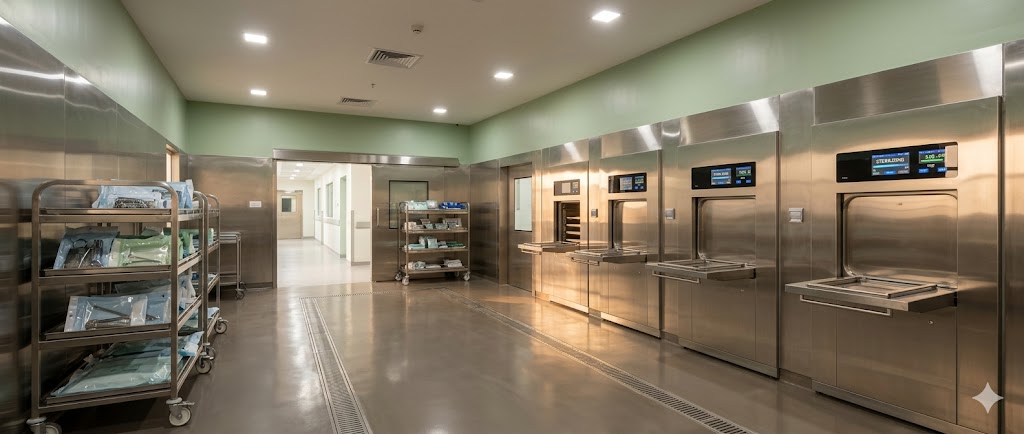
CSSD — Central Sterile Services Department Design in India
An Architect's Working Reference — Dirty-to-Clean Unidirectional Flow · Decontamination Zone · Inspection & Packing · Sterilisation (Steam · Plasma · EO · Gamma) · Sterile Storage · OT-CSSD Adjacency Models · NABH 5th Edition & ISO 13485 · The Logistics of Surgical Sterility
CSSD — the Central Sterile Services Department — is the architectural backbone of every operating theatre in every hospital. The OT cannot operate without sterile instruments; sterile instruments cannot exist without a properly designed CSSD; and a properly designed CSSD is one of the most architecturally specific, most regulatorily exacting, and most operationally demanding rooms in any healthcare facility. The architect who treats CSSD as a "back-of-house" service department produces a hospital where the OT goes idle waiting for trays, infection rates rise above NABH thresholds, and the surgical programme operates at 70% of its potential capacity. The architect who treats CSSD as a primary clinical instrument — every bit as critical as the OT itself — produces a hospital where surgical sterility is the default state, the OT runs on schedule, and the infection-control audit passes without remediation.
This guide is a facility-type deep-dive in the Studio Matrx healthcare architecture series. It assumes the reader has read the pillar regulatory reference, the hospital design roadmap, and the HVAC for healthcare facilities guide (because CSSD is largely a pressure-cascade and HVAC problem expressed architecturally). Here we focus on what is specific to CSSD design — the unidirectional dirty-to-clean flow as the organising architectural principle, the four-zone CSSD model, the decontamination zone as the dirtiest space in the hospital, the inspection-and-packing zone as the workstation-heavy clean side, the sterilisation zone with the four modalities, the sterile storage and issue, the HVAC pressure cascade, the OT-CSSD adjacency models, the sizing matrix per OT count, the NABH and ISO 13485 architectural requirements, and the failure modes that recur across Indian projects.
The position this guide takes is specific: CSSD architecture is not optional or generic. It must follow the four-zone unidirectional model; it must enforce the pressure cascade through dedicated AHUs; it must use pass-through equipment as the only crossing between dirty and clean; and it must be sized correctly per surgical volume. The architect who shortcuts any of these — combining decontamination and packing in one room, sharing AHUs across zones, omitting pass-through equipment, undersizing the autoclave count — produces a CSSD that may pass at handover but fails operationally within months. The discipline is to insist on the architecture even when the cost-engineering pushes against it, because the cost of operational failure (OT downtime, infection-control remediation, NABH audit observations) far exceeds the cost premium of a correctly-designed CSSD.
"The CSSD is the heart of the surgical hospital. It pumps sterility into every OT, every wound dressing, every catheterisation. The architect who designs the heart well gives the hospital decades of clean function. The architect who designs the heart poorly gives the hospital decades of operational pain that no OT renovation can fix." — Dr. Naresh Trehan (b. 1946), cardiac surgeon and healthcare entrepreneur, paraphrased from a 2019 talk on hospital design
"In CSSD, the sequence is the architecture. Get the sequence right, and the rooms follow. Get the sequence wrong, and no amount of room quality will save the operation." — Ar. Hafeez Contractor (b. 1950), architect, paraphrased remark on Tata Memorial Centre commission
1. Why CSSD is its Own Typology
Six characteristics make CSSD distinct from general support architecture:
- Unidirectional flow is the architectural law. Soiled instruments enter the dirty side and never return. Clean instruments leave the clean side and never go back to dirty without re-decontamination. The architecture must enforce this — wall, pass-through equipment, pressure cascade, no shared corridor. A CSSD with even one bidirectional pathway is a CSSD with cross-contamination risk.
- The pressure cascade is the architectural firewall. Air flows from clean (positive) to dirty (negative); never the reverse. The cascade is the architectural device that prevents pathogen migration even when doors are momentarily open. Loss of the cascade = loss of CSSD function.
- Pass-through equipment is the only crossing. Washer-disinfectors and pass-through autoclaves are the architectural devices that allow instruments to cross from dirty to clean to sterile without staff or air crossing. They are not "equipment" in the routine sense; they are part of the building envelope.
- CSSD is workstation-heavy. The packing zone has 4–8 workstations per OT served; the inspection zone has 2–4. Workers stand at these stations for 6–8 hour shifts inspecting micro-grade instruments. Ergonomics, lighting, and acoustics are clinical-grade specifications, not amenity considerations.
- Sterilisation is multi-modality. Steam autoclave is the workhorse but cannot sterilise everything. Plasma (H₂O₂) for heat-sensitive items, EO for long-lumen scopes, gamma off-site for single-use items. Each modality has different equipment, different room requirements, different services.
- The OT-CSSD adjacency is non-negotiable. Sterile cassettes must reach OT within minutes; soiled instruments must return within minutes after surgery. Three architectural patterns exist (vertical, horizontal, hybrid); pattern selection drives the entire hospital floor plate.
The composite effect is that CSSD is one of the most architecturally specific rooms in any hospital. The architect's task is to internalise the sequence, enforce the pressure cascade, size the equipment correctly, and ensure the adjacency works.
2. The Four-Zone Unidirectional Flow Model
Every CSSD anywhere in the world resolves to four zones: decontamination, inspection-and-packing, sterilisation, sterile-storage-and-issue. The architecture is the spatial expression of this sequence.

Zone 1 — Decontamination (dirty side). Soiled instruments arrive from OT, wards, and ED. Activities: counting, sorting, manual washing, ultrasonic cleaning, washer-disinfection. Pressure: NEGATIVE −5 Pa to corridor. Air change: 10 ACH. ISO classification: ISO 9 or unclassified. Finishes: stainless steel walls to 2.0 m, anti-microbial epoxy floor, coved 100 mm at all walls, 2% slope to floor drain. PPE required for entry; staff change room with shower at exit.
Zone 2 — Inspection & Packing (clean side). Decontaminated instruments arrive via pass-through washer-disinfectors. Activities: visual inspection (10× magnifier), functional testing, lubrication, tray assembly, packing in sterilisation wrap or rigid container, chemical-indicator placement, labelling, barcoding. Pressure: slight POSITIVE +5 Pa to corridor. Air change: 10 ACH. ISO classification: ISO 8. Finishes: epoxy walls (washable), epoxy floor, anti-fatigue mat at workstations.
Zone 3 — Sterilisation. Packed trays enter pass-through autoclaves from the clean side. Activities: steam, plasma, or EO sterilisation cycles; biological-indicator test packs; Bowie-Dick daily test (steam). Pressure: POSITIVE +10 Pa. Air change: 12 ACH. ISO classification: ISO 8. Equipment: 2–4 steam autoclaves (typically pass-through); 1 plasma; 1 EO (where in scope, in a dedicated room). Heat exhaust hood at autoclave loading aisle.
Zone 4 — Sterile Storage & Issue. Sterilised trays cool, are stored, and are issued to OTs and wards on demand. Activities: cooling, FIFO storage, labelling-verified pickup, issue counter. Pressure: POSITIVE +15 Pa (most positive zone). Air change: 15 ACH. ISO classification: ISO 7. Temperature: 22°C ± 2°C. Humidity: 50% ± 10% RH. Finishes: epoxy walls, epoxy floor, sealed shelving (closed cabinets preferred over open shelves).
The architectural enforcement. A continuous physical wall separates Zone 1 from Zones 2/3/4. Pass-through equipment (washer-disinfectors, autoclaves) is the only crossing. Personnel never carry instruments through; only via the chamber. Doors interlock so dirty side and clean side cannot both be open simultaneously. Pressure cascade prevents air migration.
3. The Decontamination Zone — The Dirtiest Space in the Hospital
The decontamination zone is, by design, the dirtiest single space in the entire hospital. It receives every soiled instrument from every OT, every dressing pack from every ward, every contaminated linen item from the operative suite. The architecture must contain this contamination absolutely.

Schedule of accommodation:
| Element | Specification |
|---|---|
| Soiled receive area | 30–50 m²; trolley return point; counting / sorting bench; BMW yellow bin |
| Manual wash | 20–30 m²; 3-bay sink (wash / rinse / final); air gun; spray gun; eyewash + safety shower |
| Ultrasonic bath | 30–50 L tank for micro-grade items |
| Washer-disinfectors | 2–4 pass-through; 800 mm trays; 60–90 minute cycles |
| Staff change | 14–18 m²; PPE-on at entry, PPE-doff at exit, separate from each other; shower at exit |
| Floor finish | Anti-microbial epoxy; coved 100 mm; 2% slope to floor drain with grease trap |
| Wall finish | Stainless to 2.0 m; epoxy painted above |
| Ceiling | Monolithic; cleanable; no exposed services |
| Lighting | 750 lux task; CRI ≥ 90; sealed fixtures |
| HVAC | Negative pressure −5 Pa; 10 ACH; HEPA exhaust direct outside |

Total decontamination zone footprint: 60–90 m² for a 4-OT hospital scale.
Critical specifications:
- Pressure containment is non-negotiable. A loss of negative pressure exports contamination to clean side. Continuous pressure monitor with audible alarm.
- Floor drainage is critical. Decontamination involves continuous water and detergent. Floor must be coved at all walls (not L-junction), sloped 2% to multiple drains, with grease trap before main sewer.
- PPE infrastructure is part of the architecture. Gowning at entry; doffing at exit (separate from gowning); shower at exit; locker for personal items outside the zone. Worker safety is built in.
- No common corridor with clean side. Personnel exiting decontamination must pass through doffing + shower before re-entering hospital. Soiled-side staff have separate dining and rest area.
The sub-CSSD reality. In multi-floor hospitals with vertical CSSD, a "soiled receiving" station on each OT floor is common — soiled instruments are collected, manually counted, placed in covered carts, and lift-transported to the main decontamination zone. The receiving station is small (4–6 m²) but architecturally consequential: it must have a sink, BMW bin, covered cart parking, and clear separation from the OT's sterile pack receiving station.
4. The Inspection & Packing Zone
The packing zone is workstation-heavy. The quality of packing determines the quality of sterilisation; sterilisation that follows incorrect packing is operationally useless.

Schedule of accommodation:
| Element | Specification |
|---|---|
| Inspection benches | 2–4 magnifier stations; 10× magnification with LED illumination; functional testing equipment |
| Packing benches | 4–8 tray-assembly benches; stainless steel; adjustable-height; anti-fatigue mat |
| Wrap station | Sterilisation-wrap material storage; heat sealer for pouches |
| Container station | Rigid-container storage; filter renewal area |
| Labelling + indicators | Chemical indicator strips; Bowie-Dick test packs; barcode label printer |
| Consumables store | Sterilisation wraps, pouches, indicators, gloves; FIFO stocking |
| Loading trolleys | Sterilizer-cart park area; 4–8 carts |
| HVAC | +5 Pa positive; 10 ACH; ISO 8; HEPA filtered supply |
| Lighting | 750–1000 lux task; CRI ≥ 90; daylight supplement preferred |
| Acoustic | NC ≤ 45 (workers concentrate on small details for hours) |

Total inspection and packing footprint: 80–120 m² for 4-OT hospital scale.
The workstation specification. Each packing workstation should have:
- Stainless steel work surface, 800 × 1200 mm minimum
- Adjustable height (sit-stand)
- Anti-fatigue mat
- Task lighting at 1000 lux
- Wrap dispenser within arm's reach
- Indicator strip storage within arm's reach
- Computer terminal for tray-content verification (some hospitals)
The barcoding and tracking system. Modern CSSD increasingly uses barcoded or RFID-tagged trays for tracking through the sterilisation cycle. The architectural deliverable: barcode reader at each station; printer for wrap labels; network connection to hospital information system. Tracking is operational, not architectural per se, but the IT infrastructure must be built in.
5. The Sterilisation Zone — Four Modalities
Sterilisation is multi-modality because no single method works for all surgical instruments. The architect must accommodate the modality mix at the specific facility.

Modality 1 — Steam autoclave (the workhorse, ~70% of CSSD load). Cycle: 121°C × 15 min OR 134°C × 4 min flash, with pre-vacuum and drying phases. Equipment: pass-through autoclaves of 600–800 L typical, 2–4 chambers in a row at the sterilisation aisle. Compatible: stainless instruments, linen and textiles, glass, metal, pharmaceutical glassware. Not compatible: most plastics, fibre-optic scopes, heat-sensitive seals. Services: steam supply at 4 bar, DI water, drainage, 3-phase 30 kW. Cost: 1.0× baseline. The architectural workhorse.
Modality 2 — Plasma / hydrogen peroxide vapour (~15% of CSSD load). Cycle: 45–55°C × 28–60 minutes; uses H₂O₂ vapour and RF plasma. Equipment: Sterrad / V-Pro / similar; 100–200 L chamber. Compatible: rigid endoscopes, light cables, battery-powered tools, heat-sensitive plastics. Not compatible: cellulosic materials (paper, cotton), liquids, powders, lumens longer than 40 cm. Services: H₂O₂ cassettes, vacuum pump, 3-phase 8 kW, no water, no steam. Cost: 2.5–3.0× steam autoclave. Essential for endoscope sterilisation.
Modality 3 — Ethylene oxide (EO) (~10% of CSSD load; declining). Cycle: 37–55°C × 4–24 hours plus aeration 12–48 hours. Equipment: EO chamber 200–400 L plus aeration cabinet, in a dedicated room. Compatible: long-lumen scopes, PVC catheters, battery-powered tools, heat-sensitive implants. Critical hazard: EO is toxic, flammable, and a probable carcinogen. The dedicated room with leak detection, dedicated exhaust, and PESO licensing is mandatory. Cost: 2.0× steam plus safety burden. Declining as plasma replaces it for most applications.
Modality 4 — Gamma (off-site, ~5% of CSSD load; outsourced). Industrial Co-60 source, 25 kGy. Used by manufacturers for single-use medical devices (syringes, gloves, gowns, drapes, sutures). The hospital purchases pre-sterilised stock; no on-site CSSD. Architectural impact: receiving area for vendor-sterilised stock and FIFO storage logic.

The modality mix at the facility. A working specification for a 4–6 OT hospital is: 2–4 steam autoclaves + 1 plasma sterilizer + 1 EO sterilizer (in dedicated room) + receiving area for gamma-sterilised single-use items. The mix scales with surgical volume; tertiary hospitals may have 5–8 steam, 2 plasma, 2 EO.
6. The Sterile Storage and Issue Zone
The sterile storage zone holds processed packs awaiting issue to OTs and wards. It is the cleanest zone in CSSD and the most positively pressurised.
Schedule of accommodation:
| Element | Specification |
|---|---|
| Cooling area | 8–12 m²; for trays exiting autoclave to cool to room temperature before storage; ambient air |
| Storage shelving | 30–50 m² depending on capacity; closed cabinets preferred over open shelves; FIFO logic in stocking |
| Issue counter | 6–8 m²; window or counter to clean corridor; for issue to OT, wards, ED |
| Records / documentation | Computer terminal for tray-issue tracking |
| HVAC | +15 Pa positive; 15 ACH; ISO 7; 22°C ± 2°C; 50% RH ± 10% |
| Lighting | 500 lux ambient; sealed fixtures |
| Floor | Epoxy; coved at walls |

Total sterile storage and issue footprint: 60–90 m² for 4-OT hospital scale.
Shelf life of sterile packs:
- Wrapped trays (sterilisation wrap): 6 months in ISO 7 storage (some institutions extend to 12 months with audit)
- Rigid containers: 6 months
- Pouched single items: 6 months (or per pouch material expiry)
FIFO logic. First-in, first-out — older packs issued before newer. The architectural deliverable: shelving organised so that loaded packs go in at one end and issued packs come out at the other. Without this, packs at the back of shelves can age beyond shelf life.
7. HVAC Pressure Cascade
CSSD HVAC is more nuanced than general healthcare HVAC because the pressure cascade is the primary anti-cross-contamination defence.

The pressure progression:
| Zone | Pressure | ACH | ISO | Notes |
|---|---|---|---|---|
| Decontamination | −5 Pa | 10 | ISO 9 | HEPA exhaust direct outside; 100% outdoor air |
| Packing | +5 Pa | 10 | ISO 8 | HEPA filtered supply |
| Sterilizer loading | +10 Pa | 12 | ISO 8 | Plus autoclave heat exhaust hood |
| Sterile store | +15 Pa | 15 | ISO 7 | Most positive; FIFO storage |
| Issue area | +5 Pa | 10 | ISO 8 | Connects to clean corridor |
Key HVAC design rules:
- Dedicated AHU per zone — no shared return air across zones. Sharing return air defeats the cascade.
- 100% outdoor air for decontamination zone — exhaust never recirculated.
- HEPA filtration at supply for clean-side zones — HEPA at the AHU final filter (some specifications) or terminal HEPA at the supply diffusers (preferred for ISO 7 sterile store).
- Pressure monitor at every door between zones — visible to staff; audible alarm on differential loss.
- Sterilizer heat exhaust — autoclaves generate 5–8 kW of heat per cycle; dedicated exhaust hood at the sterilizer loading aisle prevents heat accumulation and removes residual steam.
- Door interlocks — at major dirty-clean boundaries, doors should not both be open simultaneously (pressure cascade collapse).

Commissioning verification. At handover, the CSSD must be commissioned with measured pressure differentials at every door, ACH verification for every zone, and HEPA integrity testing (DOP test) for all HEPA filters. Without commissioning, the design is unverified.
8. The OT-CSSD Adjacency — Three Working Patterns
CSSD must connect to OT for sterile-pack delivery and soiled-instrument return. Three architectural patterns dominate.

Pattern 1 — Vertical (CSSD below OT). OT floor and CSSD floor are vertically stacked, connected by dedicated sterile and soiled lifts. Service floor between (HVAC plant, MEP risers) typically separates them. Best for: tertiary multi-OT hospitals. AIIMS, Tata Memorial, most large corporate hospitals use this pattern. Advantages: maximum OT proximity, vertical service shafts, clean separation. Disadvantage: requires lift-shaft real estate.
Pattern 2 — Horizontal (CSSD adjacent to OT on same floor). OT suite and CSSD share a wall on the same floor; pass-through autoclaves are in the wall itself. Best for: secondary hospitals, single-floor configurations. CHCs, SDHs, mid-tier private hospitals use this pattern. Advantages: no vertical lifts needed, simpler construction. Disadvantage: floor-plate must be wide enough; harder to expand CSSD if surgical volume grows.
Pattern 3 — Hybrid (sub-CSSD on OT floor + main CSSD remote). OT floor has a small "sub-CSSD" with flash autoclave and limited sterile store; main CSSD is below or in adjacent block. Best for: large tertiary hospitals (9–14 OTs) and academic medical centres. Apollo, Fortis, Manipal flagship hospitals use this. Advantages: flash sterilisation at OT for emergency turnover, bulk processing remote, scalable. Disadvantage: most complex coordination; two CSSDs to maintain quality across.

Lift sizing. For vertical or hybrid patterns, sterile and soiled lifts have specific sizing requirements:
- Sterile lift cabin: 1500 × 2400 mm minimum (accommodates sterile cassette racks)
- Soiled lift cabin: 1500 × 2400 mm minimum (accommodates soiled instrument carts)
- Both with stainless cabin finish, washable
- Lifts must NOT mix with patient or visitor lifts under any circumstances
The pass-through pattern selection. The choice of pattern is set at concept stage and is hard to change. A hospital with 4 OTs growing to 10 over 15 years should consider hybrid from the start; a hospital with 2 OTs that will stay 2 OTs can use horizontal economically.
9. CSSD Sizing — by Hospital OT Count
A working sizing matrix for the architect at concept stage. Detailed sizing must be verified per equipment supplier and surgical-volume forecast.

Working sizing matrix:
| Hospital tier / OT count | Total CSSD area | Steam autoclaves | Plasma + EO | Washer-disinfectors |
|---|---|---|---|---|
| PHC / minor (0–1 OT) | 20–40 m² | 1 small (60 L) | None | None |
| CHC (1–2 OT) | 60–100 m² | 2 (300 L pass-through) | None | 1 small |
| SDH / Small DH (3–4 OT) | 200–280 m² | 2 (600 L) | 1 plasma | 1 P/T (300 L) |
| Tertiary (5–8 OT) | 350–450 m² | 3–4 (800 L) | 1 plasma + 1 EO | 2 P/T (600 L) |
| Comprehensive (9–14 OT) | 600–900 m² | 5–8 (800–1000 L) | 2 plasma + 1–2 EO | 4 P/T (800 L) |
| National (15+ OT) | 1,000–1,800 m² | 8–14 (1000+ L) | 3+ plasma + 2+ EO | 8+ P/T + tunnel-W/D |
Working ratio. At tertiary scale: 50–60 m² of CSSD per OT (across all four zones). Surgical volume forecast: a typical OT generates 4–8 instrument trays per case × 8–12 cases per day. Tray-throughput drives autoclave count more than OT count alone.
Throughput sizing example. A 6-OT tertiary hospital running 8 cases per OT per day = 48 cases/day × 6 trays/case = 288 trays/day. Autoclave cycle 60 minutes (including loading/unloading) = 18 cycles per chamber per 12-hour day. Three autoclave chambers at 80% utilisation = 43 cycles × 6 trays/cycle = 258 trays/day. Insufficient — need a 4th autoclave to clear 288/day with surge headroom. Always size for peak throughput, not average.
10. NABH 5th Edition and ISO 13485 Architectural Requirements
CSSD architecture is regulated by two principal standards in India.
NABH 5th Edition (2020+) — Mandatory for accredited hospitals. The CSSD chapter prescribes:
- Four-zone unidirectional flow (mandatory)
- Pass-through equipment between zones (mandatory)
- Pressure cascade (verified at audit)
- HEPA filtration in clean-side zones (verified at audit)
- ISO 7 sterile storage (verified at audit)
- Documented sterilisation cycles with biological-indicator results
- Tray-tracking system (RFID, barcode, or paper-based)
- Staff training records (PPE, decontamination protocols, cycle-management)
ISO 13485:2016 — Medical Devices, Quality Management Systems. Where the CSSD reprocesses items defined as "medical devices" (which includes most surgical instruments), ISO 13485 applies. Architecturally:
- Documented procedures for every process step
- Equipment qualification (IQ, OQ, PQ — installation, operational, performance)
- Traceability of every device through the cycle
- Validation of sterilisation cycles
- Environmental monitoring records
The architect's deliverable for NABH/ISO 13485 compliance:
- Layout drawings with zone designations and pressure markings
- Equipment list with cycle parameters and validation procedures
- Workflow procedure document
- Training program outline
- Maintenance schedule
The architect is not the operator, but the architect's documentation is the foundation on which operational compliance is built.
11. Common Failure Modes — CSSD Specific
A pattern audit of stalled or under-performing Indian CSSD projects reveals recurring failures:
| # | Failure Mode | Root Cause | Consequence | Prevention |
|---|---|---|---|---|
| 1 | Decontamination and packing in same room | Cost-driven; "small CSSD" brief | Cross-contamination; NABH non-compliance | Four-zone separation from concept |
| 2 | Pressure cascade not designed | Generic HVAC | Air migration from dirty to clean | Dedicated AHU per zone |
| 3 | Pass-through equipment omitted | Cost-driven | Personnel carry instruments through | Pass-through autoclaves and washer-disinfectors |
| 4 | Insufficient autoclave count | Generic sizing | OT downtime waiting for trays | Throughput sizing per surgical volume |
| 5 | EO sterilizer in shared room | "We rarely use EO" | PESO non-compliance; staff exposure | Dedicated EO room from concept |
| 6 | Sterile storage at ISO 8 (not ISO 7) | Generic clean room spec | Sterile pack contamination risk | ISO 7 spec at preliminary design |
| 7 | Floor drains insufficient in decontamination | Cost-driven | Standing water; cross-contamination | Multiple floor drains with grease trap |
| 8 | Stainless wall cladding only to 1.2 m | Cost-driven | Wall corrosion above stainless line | Stainless to 2.0 m minimum |
| 9 | Sterile lift shared with patient lift | Spatial constraint | Cross-contamination | Dedicated sterile lift; non-negotiable |
| 10 | Soiled lift discharges in main corridor | Spatial constraint | Public exposure to soiled instruments | Dedicated soiled lift to dirty corridor |
| 11 | Bowie-Dick test pack space omitted | Generic packing zone | Daily QC test cannot be run | Designated test-pack area |
| 12 | Sterilizer heat exhaust missing | Generic HVAC | Heat accumulation; staff discomfort | Dedicated exhaust hood at autoclave aisle |
| 13 | Anti-fatigue matting omitted at workstations | "Furniture" classification | Worker injury; fatigue | Mat specification in interior brief |
| 14 | Lighting at 500 lux (not 750+) | Generic office spec | Inspection failure; instrument oversight | 750–1000 lux task spec |
| 15 | No sub-CSSD on OT floor (large tertiary) | Cost-driven; vertical-only model | Emergency turnover delays | Sub-CSSD for > 8 OTs |
| 16 | Tray-tracking IT not provisioned | Treated as operational | Manual tracking error rate high | IT infrastructure in detailed design |
12. Pre-Design Audit Framework for CSSD Briefs
A 12-question audit at concept stage. Three or more "no" answers indicate the brief is not CSSD-ready.
| # | Audit Question | Why It Matters | Required Output |
|---|---|---|---|
| 1 | Is the OT count and surgical volume forecast final? | Drives sizing | OT and volume forecast |
| 2 | Is the four-zone unidirectional flow designed? | Anti-cross-contamination | Zone layout drawing |
| 3 | Is pass-through equipment specified at every dirty-clean boundary? | Personnel never cross zones | Pass-through equipment list |
| 4 | Is the OT-CSSD adjacency pattern declared (vertical / horizontal / hybrid)? | Building-massing decision | Adjacency declaration |
| 5 | Is the autoclave count sized for peak throughput? | OT continuity | Throughput calc |
| 6 | Is plasma sterilizer in scope (heat-sensitive instruments)? | Endoscopes, etc. | Modality declaration |
| 7 | Is EO sterilizer in scope (and dedicated room)? | Long-lumen scopes | EO room scope |
| 8 | Is the pressure cascade designed (dedicated AHU per zone)? | Anti-contamination | HVAC strategy |
| 9 | Is the sterile lift dedicated (not shared with patient/visitor)? | Cross-contamination | Lift schedule |
| 10 | Is the sub-CSSD provisioned (for > 8 OTs)? | Emergency turnover | Sub-CSSD scope |
| 11 | Is the tray-tracking IT infrastructure in design? | Quality + compliance | IT specification |
| 12 | Is the EO PESO license / dedicated room compliance verified? | Statutory | PESO compliance note |
13. The Architect's CSSD-Specific Compliance Deliverables
Beyond general healthcare deliverables (see pillar reference), the CSSD-specific deliverables are:
| # | Deliverable | Recipient | Stage |
|---|---|---|---|
| 1 | Four-zone layout drawing with pressure markings | NABH / ISO 13485 | Concept |
| 2 | Equipment list with cycle parameters | Healthcare planner | Concept |
| 3 | OT-CSSD adjacency declaration | Client | Concept |
| 4 | Throughput sizing calculation | Healthcare planner | Preliminary |
| 5 | Pass-through equipment specifications | Equipment supplier | Detailed |
| 6 | HVAC pressure cascade drawing | HVAC consultant | Detailed |
| 7 | Dedicated lifts (sterile + soiled) layout | Lift consultant | Detailed |
| 8 | EO room layout with PESO compliance | PESO / state factories inspector | Detailed |
| 9 | Floor drainage drawing for decontamination | Plumbing | Detailed |
| 10 | Stainless cladding spec (2.0 m wall) | Interior consultant | Detailed |
| 11 | Anti-fatigue mat + workstation spec | Interior consultant | Detailed |
| 12 | Lighting + acoustic spec per zone | MEP | Detailed |
| 13 | Tray-tracking IT infrastructure | IT consultant | Detailed |
| 14 | Sub-CSSD layout (where applicable) | Client | Detailed |
| 15 | Commissioning verification protocol | All | Pre-handover |
"The CSSD is the most under-designed and over-stressed department in Indian healthcare. The architect who insists on the four zones, the pressure cascade, the pass-through equipment, and the correct autoclave count is doing the surgical service a service that the surgeons themselves rarely articulate but always notice." — Ar. Sandeep Singh (b. 1968), Delhi healthcare architect, paraphrased from a 2021 conference
References
- AAMI (2017) ANSI/AAMI ST79: Comprehensive Guide to Steam Sterilization and Sterility Assurance in Health Care Facilities. Arlington, VA: Association for the Advancement of Medical Instrumentation.
- AAMI (2021) ANSI/AAMI ST91: Comprehensive Guide to Flexible and Semi-Rigid Endoscope Reprocessing. Arlington, VA: AAMI.
- ASHRAE (2021) Standard 170-2021: Ventilation of Health Care Facilities — Section 7.5.3 Sterile Processing. Atlanta: ASHRAE.
- Bureau of Indian Standards (2008) IS 10361: Air Conditioning of Hospitals. New Delhi: BIS.
- Bureau of Indian Standards (2016) National Building Code of India 2016, Part 4 — Fire and Life Safety; Part 8 — Building Services. New Delhi: BIS.
- Centers for Disease Control and Prevention (2008) Guideline for Disinfection and Sterilization in Healthcare Facilities. Atlanta: CDC.
- Facility Guidelines Institute (2022) Guidelines for Design and Construction of Hospitals — Chapter on Sterile Processing. St. Louis: FGI.
- Government of India (1948, amended) The Factories Act 1948. New Delhi: Ministry of Labour.
- IAHCSMM (2016) Central Service Technical Manual — 8th Edition. Chicago: International Association of Healthcare Central Service Materiel Management.
- ISO (2016) ISO 13485:2016 Medical Devices — Quality Management Systems. Geneva: International Organization for Standardization.
- ISO (2015) ISO 14644-1:2015 Cleanrooms and Associated Controlled Environments — Part 1: Classification of Air Cleanliness by Particle Concentration. Geneva: ISO.
- ISO (2018) ISO 17665-1:2018 Sterilization of Health Care Products — Moist Heat — Part 1: Requirements for the Development, Validation and Routine Control of a Sterilization Process for Medical Devices. Geneva: ISO.
- Kobus, R.L., Skaggs, R.L., Bobrow, M., Thomas, J. and Payette, T.M. (2008) Building Type Basics for Healthcare Facilities — Chapter on Sterile Services. 2nd edn. Hoboken: Wiley.
- NABH (2020) Standards for Hospitals, 5th Edition — Hospital Infection Control + Sterile Services Chapters. New Delhi: National Accreditation Board for Hospitals & Healthcare Providers, Quality Council of India.
- Petroleum and Explosives Safety Organisation (PESO) (1981, amended) The Gas Cylinders Rules. Nagpur: PESO.
- Rutala, W.A. and Weber, D.J. (2013) 'Disinfection and sterilization: an overview', American Journal of Infection Control, 41(5), pp. S2–S5.
- Spaulding, E.H. (1968) 'Chemical disinfection of medical and surgical materials', in Lawrence, C.A. and Block, S.S. (eds.) Disinfection, Sterilization, and Preservation. Philadelphia: Lea & Febiger.
- World Health Organization (2016) Decontamination and Reprocessing of Medical Devices for Health-Care Facilities. Geneva: WHO.
Author's Note: CSSD is one of the most architecturally specific and operationally consequential rooms in any hospital, yet it receives a small fraction of the design attention given to the OT or the ICU. The author's intention with this guide is to support the architects who internalise the four-zone unidirectional flow, who insist on the pressure cascade, who specify pass-through equipment at every boundary, and who size autoclaves and washer-disinfectors for peak throughput rather than average. The architecture of CSSD is the architecture of every successful surgical operation in the building. The series will continue with deeper guides on individual sterilisation modalities, on flexible-endoscope reprocessing, and on the IT infrastructure of tray tracking.
Disclaimer: This article is for informational and educational purposes only. It does not constitute legal, regulatory, clinical, or professional architectural advice. CSSD design depends on site, state, facility tier, OT count, surgical-volume forecast, equipment manufacturer, and applicable amendments at the time of design — all of which must be confirmed with the relevant statutory authorities (state health department, NABH, PESO for EO and gas cylinders, state factories inspector, state PWD), the equipment manufacturer, qualified clinical consultants (infection prevention and control, surgical, biomedical engineering), and qualified design consultants for the specific project. Statute references, ACH rates, pressure differentials, equipment counts, and infrastructure norms cited are indicative and subject to change. NABH 5th Edition, ISO 13485, ISO 14644, ISO 17665, AAMI ST79/ST91, and ASHRAE 170 are periodically revised; practitioners must verify current notifications and the specific equipment's installation requirements before any binding design or construction commitment. Studio Matrx, its authors, and its contributors accept no liability for decisions made on the basis of the information contained in this guide, and recommend independent verification with NABH, the equipment manufacturer, qualified IPC consultants, and qualified CSSD-design consultants before any binding project decision.
Export this guide
Related Tools — Try Free
Acoustic Privacy (STC) Visualizer
Indian healthcare acoustic visualizer — compare wall assemblies and noise sources, see received SPL after STC attenuation, and check FGI 2018 / IS 1950 / NABH speech-privacy compliance with live dual-canvas waveform.
Acoustic ToolCircadian Light Meter
Patient-centric circadian lighting visualizer for Indian healthcare design — time-of-day × intensity → CCT, melanopic lux (EML / mEDI), melatonin suppression, and an alertness curve. Calibrated against WELL v2 L03 Circadian Lighting Design, CIE S 026:2018, Brainard 2001, and Lucas et al. 2014.
Circadian ToolCross-Ventilation Analyzer
Estimate airflow and air changes per hour (ACH) from room size, window areas, layout, and local wind — with NBC 2016 Part 8 compliance check.
Ventilation Calculator