
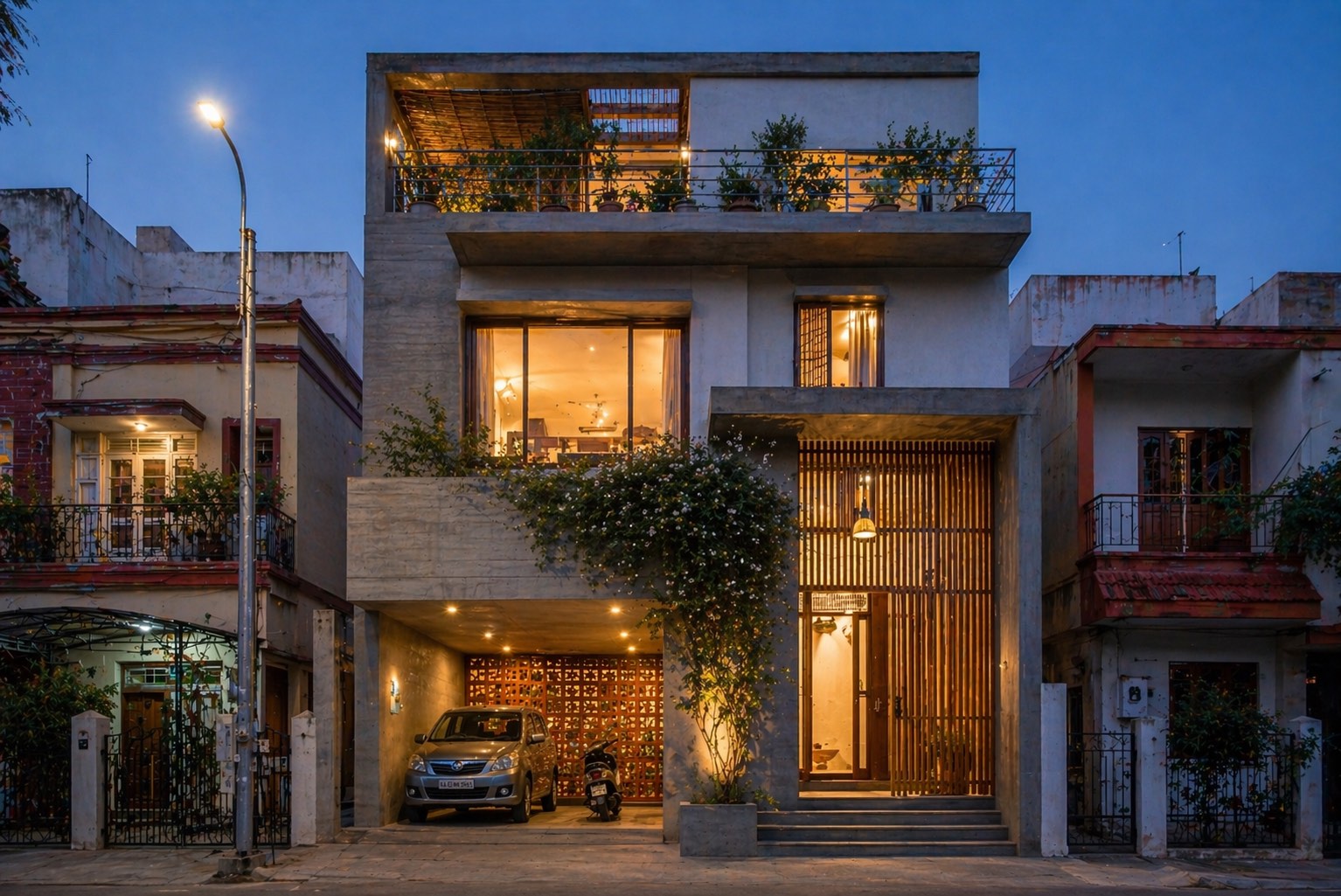
Compact Urban Home Planning — Making Small Plots Work
A Design Guide for 30×40 / 20×30 / Irregular Plots in Indian Cities
India's cities are densifying. The 30×40 ft (112 m²) and 30×50 ft (140 m²) plots that defined middle-class Bengaluru in the 1990s are, today, the plots a typical middle-income buyer can afford — if they can afford land at all in the core city. In Mumbai and Chennai, even these are unattainable; the typical purchase is an apartment in a building on someone else's plot. Across Indian metros, what the architect is increasingly asked to plan is not a spacious house on a generous plot but a compact home on a constrained plot, with FSI, setbacks, height limits, and parking provisions all simultaneously pressing on the design.
Compact planning is not merely "small planning." It is a distinct discipline with its own priorities, its own typologies, its own ingenuities. A well-planned 30×40 home can feel more generous than a poorly-planned 40×60 because the planning invests every square foot in function, integrates storage into structure, and captures daylight and air through vertical circulation and light wells that larger plots do not need. The best examples of compact Indian residential design — the Chettinad row-house, the Gujarati pol, the Old Delhi haveli on a 60 sq yd plot — demonstrate that spatial generosity has never depended on plot size alone.
This guide is a practical framework for compact residential planning in contemporary India. It covers the reading of the plot (narrow, square, irregular), FSI maximisation within bylaws, vertical organisation strategies, the efficient planning of kitchens and bathrooms (which consume disproportionate floor area in compact homes), staircase design (a crucial efficiency lever), multi-functional rooms, and the outdoor-indoor strategies that make compact homes liveable. A complete worked example — a 30×40 ft Bengaluru plot — closes the guide.
"In architecture, as in medicine, the hardest cases are the compact ones — where constraint is absolute and every move matters." — Charles Correa (1985)
1. The Compact Urban Plot Reality
Indian urban residential plots have been shrinking for three decades, and this trend is accelerating.
Typical Plot Sizes by City
| City | Common plot sizes | Cost per sq ft (land, 2026 estimates) | Typical owner |
|---|---|---|---|
| Bengaluru | 30×40 (112 m²); 30×50 (140 m²); 40×60 (223 m²) | ₹3,500–12,000 | Middle-income; upper-middle |
| Chennai | 20×30 (55 m²); 30×40 (112 m²); 30×60 (167 m²) | ₹5,000–18,000 | Middle-income |
| Mumbai | Mostly apartments; sites 100+ m² | ₹25,000–60,000+ | Upper-middle; premium |
| Delhi | 60–200 m² (plots rare in core) | ₹15,000–50,000 | Upper-middle |
| Hyderabad | 30×40 (112 m²); 30×60 (167 m²) | ₹2,500–9,000 | Middle |
| Ahmedabad | 100–200 m² | ₹3,000–10,000 | Middle-upper |
| Pune | 120–200 m² | ₹4,000–12,000 | Middle-upper |
| Kolkata | 1,500–3,000 sq ft (139–279 m²) | ₹4,000–12,000 | Middle |
A 30×40 ft plot (112 m²) is the smallest plot on which a three-bedroom independent house is comfortably possible within Indian bylaws. Below this, compromises compound — either the bedrooms become tiny, or one bedroom migrates to upper floors (compromising accessibility), or the ground floor loses its proper living area to parking.
The Compact-Plot Design Problem
The constraints on a compact plot are:
| Constraint | Example on 30×40 ft plot |
|---|---|
| Setback | 3 m front, 3 m rear, 1.5 m side each → buildable 9.0 × 6.0 m (~54 m² per floor) |
| FSI | BBMP 1.75 for 30×40 → ~196 m² total BUA across floors |
| Height limit | 11.5 m (G + 2) for 30×40 roads; 15 m for 40+ ft roads |
| Parking | 1 per dwelling unit minimum; on plot (surface or stilt) |
| Ground coverage | 50–60 % typical maximum |
Within these, a 30×40 plot typically delivers 1,800–2,100 sq ft carpet area across three floors — substantially less than the FSI 1.75 × 112 = 1,960 sq ft net buildable, because setbacks, common areas (staircase, lobby), wall-thickness accumulation, and balcony deductions eat 15–20 per cent.
2. Reading the Plot — Three Typologies
Before planning can begin, the plot's typology determines the design strategy.

The Three Typologies
Narrow plots (20×30, 20×40, 15×50): Length 3–5 times the width. Only one short facade faces the road. Cross-ventilation is constrained to front-to-back; central rooms lose daylight; light shafts become essential. Common in Chennai, Mumbai suburbs, old Delhi wards.
Square plots (30×40, 30×50, 40×40): Length 1.0–1.5 times the width. All four facades have exposure. Cross-ventilation achievable. Central courtyard feasible on larger examples. The "middle-class Indian plot" of the 1990s.
Irregular plots (corner, trapezoidal, L-shaped, angled): The plot geometry departs from rectangular. Two road frontages (corner) is actually an asset (two entries possible). Trapezoidal or angled plots challenge room geometry but can yield unique design opportunities.
Plot Assessment Checklist
For any compact plot, document:
| Parameter | Measure |
|---|---|
| Plot dimensions (both frontages if corner) | Tape or total station |
| Plot shape (rectangular / irregular) | Sketch with angles |
| Road width (frontage) | Determines height permissible |
| Setbacks applicable per bylaw | BBMP/CMDA/DDA rules |
| FSI permissible | City + plot size + road width + tdb use |
| Ground coverage permissible | Bylaw — typically 50–60% |
| Levels and slope | Spot levels at corners; note direction |
| Soil bearing capacity | From soil test or estimate |
| Orientation (true N not magnetic) | Compass + sun-path check |
| Existing trees (retention requirement) | Note and diameter |
| Service connections (water, sewer, power) | Location and capacity |
| Neighbouring buildings (height, windows) | Impact on daylight and privacy |
| Water table depth | Affects foundation and plumbing |
The Studio Matrx Plot Evaluation Toolkit and Bylaw Checker document and verify these systematically.
3. FSI Maximisation — What the Bylaws Give You
Floor Space Index (FSI) — also called Floor Area Ratio (FAR) — is the ratio of permissible built-up area to plot area. An FSI of 1.75 on a 112 m² plot permits 196 m² of built-up area. In practice, usable carpet area is 75–85 per cent of BUA after walls, staircase, balconies, and common areas.
FSI by City and Plot Size
| City | 30×40 ft plot | 40×60 ft plot | 60×90 ft plot |
|---|---|---|---|
| Bengaluru (BBMP) | 1.75 | 2.25 | 3.00 |
| Chennai (CMDA) | 1.50 (for 30 ft road) | 1.75 | 2.00 |
| Hyderabad (HMDA) | 2.00 | 2.50 | 3.00 |
| Mumbai (MCGM, DCR 2034) | 1.0–5.0 (variable, TDR applicable) | Same | Same |
| Delhi (DDA MPD) | 1.80 | 2.40 | 3.00 |
| Pune (PMC) | 1.10 (base) | 1.10 | 1.10 |
| Ahmedabad (AMC) | 1.80 | 2.25 | 2.25 |
(Figures indicative; verify current bylaws — many cities are in active revision.)
FSI Exclusions
Certain areas are excluded from FSI calculation (and therefore are "free" floor area):
| Exclusion | City (examples) | Typical value |
|---|---|---|
| Stilt parking | BBMP, HMDA, MCGM | Ground floor can be parking without counting |
| Staircase + lift | Most cities | Up to ~4 m² per floor |
| Double-height volumes | Most cities | Counted once not twice |
| Balconies | Variable (some count partially) | 30–50% deduction |
| Terrace (unbuilt) | All cities | Excluded |
| Parapet walls | All cities | Excluded |
| Cut-outs / light wells | Most cities | Excluded |
Skilled compact-plot design exploits these exclusions. A stilt parking under a G+2 house effectively gives 4 floors of usable area (G+2 residential + stilt) for 3 floors of FSI. A double-height living room gives two-storey spatial quality for single-storey FSI. A cut-out light well gives central daylight without eating floor area.
The FAR / FSI Calculator
The Studio Matrx tool computes exact permitted BUA for any Indian city plot, applying city-specific exclusions and deductions. It is the authoritative starting point for compact-plot design.
4. Vertical Organisation — Stilt + G+n Strategies
On compact plots, vertical organisation is where design intelligence shows. The choice of which functions go on which floor, whether to include a stilt, and how many storeys to build — all determine how the house lives.

The Three Common Vertical Strategies
Stilt + G + 2 (four physical levels, three residential): Best for Bengaluru, Hyderabad, Pune in composite climate; monsoon parking protection; elder suite on ground floor (above stilt). Effective FSI utilisation where stilt is FSI-excluded.
G + 2 no stilt (three residential): Best where FSI is generous and stilt exclusion is limited; maximises buildable area at the cost of open parking and losing flood buffer. Common where plot cost makes every square foot of carpet precious.
G + 3 tall-narrow (four residential): Best where height bylaw permits and family size demands more bedrooms; elders move to ground floor; staircase becomes a major programming element (3 flights).
Programming by Level
A consistent heuristic for the three-level compact home:
| Level | Function | Rationale |
|---|---|---|
| Stilt (if present) | Parking + entry lobby + outdoor seating | FSI-excluded; rain protection; semi-public |
| Ground (with stilt) OR Ground (no stilt) | Elder suite + puja + guest bedroom + shared utility | Accessibility for elders; proximity to entry |
| First | Living + dining + kitchen + family room + balcony | Social zone; receives most foot traffic |
| Second | Master + children's bedrooms + study + terrace | Private zone; furthest from street noise |
| Terrace | Drying area + water tank + solar panels + garden | Functional services; informal green space |
The Case for Living on First, Not Ground
Traditional Indian homes place living on the ground floor (accessible to visitors). Compact-plot homes often invert this: ground floor becomes elder suite (accessibility), and living moves to first floor (away from street noise, better daylight above neighbours, access to balcony). This inversion is common in Bengaluru and Pune middle-class homes and is generally successful — but it does require a clear ground-floor entry and a welcoming arrival experience, since the visitor's first impression is of a lobby + stair rather than a living room.
Stair Position as Planning Hinge
In a compact home the staircase is not a corridor item — it is the fulcrum of the plan. Three common positions:
1. Central — stair at the plan's centre, with rooms around. Best for daylight (central light well) and circulation (minimum distances), but takes the plan's spatial middle, so no large central room is possible.
2. Side (along one wall) — stair on one side (typically the leeward or north side), living/bedrooms on the other. Maximises the clear central volume; a standard BBMP 30×40 strategy.
3. Front (next to entry) — stair visible from entry; climbing immediately. Best for visitor access to upper floor (if living is there). Can feel cramped if not widened.
The Staircase Calculator computes riser/tread geometry and footprint for each option.
5. The Ground-Floor Compromise
On a compact plot, the ground floor is contested territory. It must accommodate:
1. Parking — typically one car minimum; two for upper-middle-class homes
2. Entry — lobby, foyer, shoe-removal, staircase access
3. Service entry — rear or side access for domestic workers, waste collection
4. Elder suite (if living on first) — bedroom + attached bath + puja
5. Utility — often on ground (well, meter box, electrical panel)
6. Garden / open space — per ground-coverage rules, some plot must remain open
Fitting these onto 54 m² of buildable ground-floor area (on a 30×40 plot with 3 m front + 3 m rear + 1.5 m side setbacks) requires discipline.
Common Ground-Floor Configurations on 30×40
| Config | Parking | Elder suite | Entry | Garden |
|---|---|---|---|---|
| A — Stilt parking + full GF above | Stilt (exc FSI) | Full GF elder suite + puja + guest | Staircase | Rear setback |
| B — Surface parking + partial GF | Front half | Rear half elder suite + utility | Side staircase | Rear + sides |
| C — Parking on rear (drive-around) | Rear | Front elder suite + puja | Front staircase | Front and sides |
| D — Shared ground floor | Front parking | None — elders on first | Centre staircase | Rear |
Config A (stilt) maximises usable ground-floor residential area and is most suitable where FSI permits. In BBMP zones with 1.75 FSI on 30×40, stilt often delivers an additional 54 m² of residential carpet area — a material benefit.
Config D (no elder suite) is increasingly popular among nuclear families and young couples without elderly dependents. It concentrates all residential functions on upper floors; the ground floor becomes pure service. Not suitable where ageing parents may move in.
6. Efficient Kitchen Planning
Kitchens in compact homes are the single most space-consuming functional area per occupant (after bathrooms). Efficient kitchen planning can add 15–20 per cent to effective household living area.
Kitchen Minimum vs Comfortable
| Size | Plan footprint | Layout | Suitability |
|---|---|---|---|
| 5.0 m² (NBC minimum) | 1.8 × 2.8 m | Single-wall, counter only | Studio apartment |
| 7.0 m² | 2.1 × 3.3 m | L-shape with small island | 1BHK |
| 10.0 m² | 2.7 × 3.7 m | L-shape + breakfast counter, or U-shape | Standard 2BHK / 3BHK compact |
| 12–15 m² | 3.0 × 4.0 m+ | U-shape or parallel with island | Upper-middle home |
For 3BHK compact (30×40), 10 m² is the sweet spot — efficient enough to respect the overall plan budget, large enough for Indian cooking workflows (multiple burners, ghee-splatter, tawa + kadhai, dry/wet prep).
Kitchen Work-Triangle (Indian Adaptation)
The classic kitchen work-triangle (NKBA) connects sink, cooktop, refrigerator. For Indian kitchens, the modified triangle adds:
- Wet area (sink, wet prep, washing) — often distinct from main sink
- Cooktop with integrated chimney (IS 1884 compliant)
- Dry prep (dough rolling, chopping board, masala station)
- Pantry/store (dal, rice, masala bulk)
- Refrigerator (often on opposite wall from cooktop for convenience)
Sum of triangle edges: 3.6–6.5 m is efficient; < 3.6 m is cramped; > 6.5 m is fatiguing.
Kitchen Storage — Accessible Volumes
| Storage zone | Height | Use |
|---|---|---|
| Floor to 600 mm | Base — deep | Utensils, bulk, rarely-used |
| 600 to 900 mm | Drawer / shelf | Daily utensils, servingware |
| 900 to 1800 mm | Primary work + wall cabinet | Most-used items, spices, glasses |
| Above 1800 mm | Overhead — uses stool | Store, festival items |
Good kitchen design puts the most-used items in the 900–1800 mm reach zone. Bulk and storage go either very low or very high. The Furniture Size Chart and Storage Calculator help specify exact volumes.
Kitchen Cross-Ventilation
Kitchens require high ACH (10 recommended, 6 minimum per IS 3362). Compact kitchens often fail this — a single window over the sink is insufficient. Design moves:
- Add a second opening (service door or window) on opposite wall
- Install IS 1884-compliant chimney with duct to exterior (not recirculating)
- Provide a high clerestory or ventilator above cooktop
- Never locate kitchen in an internal position (no exterior wall) — always requires an external opening
7. Efficient Bathroom Planning
Bathrooms consume 6–12 per cent of total residential floor area. In compact homes, efficient bathroom planning is a direct determinant of bedroom size.
Bathroom Sizes
| Type | Minimum footprint (m²) | Comfortable (m²) | Config |
|---|---|---|---|
| Powder room (WC + basin) | 1.2 × 1.5 (1.8) | 1.5 × 1.8 (2.7) | Under stairs / near entry |
| Basic bath (WC + basin + shower) | 1.5 × 2.1 (3.2) | 1.8 × 2.4 (4.3) | Common bath in 2/3 BHK |
| Master bath (WC + basin + shower + tub) | 2.1 × 2.7 (5.7) | 2.4 × 3.0 (7.2) | Master suite |
| Premium master bath | 2.7 × 3.3 (8.9) | 3.0 × 4.0 (12.0) | Walk-in shower + separate WC + vanity |
Bathroom Layout Principles
- Stack wet walls — all water-facing walls stack over wet walls above/below; plumbing economy + noise control
- Dry zone vs wet zone — separate the shower/wet area from the WC/basin area with a threshold or screen
- WC corner-away from entry — visitor should not see WC directly through an open door
- Door swing outward — compact bathrooms benefit from outward-opening doors (free internal space)
- Ventilation on external wall — every bathroom should have either a window or mechanical exhaust (NBC 2016)
Bathroom Clearances (SP 41)
| Between | Minimum (mm) |
|---|---|
| WC centre to side wall | 450 |
| WC front clearance | 600 |
| Basin centre to side wall | 350 |
| Basin front clearance | 600 |
| Shower cubicle internal | 900 × 900 |
| Shower to WC distance | 600 |
| Tub minimum length | 1,500 |
8. Storage Strategy — Vertical, Integrated, Multi-Use
Compact homes live or die on storage. A 30×40 home has 2,000 sq ft of floor area; a typical Indian family generates 500–800 sq ft of storage need (wardrobes, kitchen storage, linen, bulk groceries, festival utensils, shoes, books, etc.). Without a systematic storage strategy, the home fills with visible clutter within two years.
Storage Heuristics
1. Vertical — use ceiling height. Wardrobes to ceiling (2,400 mm typical) store 30 per cent more than 2,100 mm wardrobes; overhead kitchen cabinets to ceiling. The top 600 mm is rarely-used (festival, archive) — accepting this is OK.
2. Built-in — use walls. Alcove shelving built into walls uses space otherwise "wasted" in wall thickness. Walk-in pantries and dressing alcoves integrate storage into circulation.
3. Under-stair, under-seat, under-bed. Compact homes should use every under-usable cavity. Under-stair → shoe cabinet or store; window seats → lift-up storage; bed boxes → seasonal bedding.
4. Multi-use furniture. Sofa-cum-bed, coffee table with drawers, dining benches with storage, wall-bed (Murphy bed) for guest bedrooms that also serve as study.
5. Seasonal rotation. Winter bedding in summer storage, summer bedding in winter storage. Festival utensils in a "deep" cabinet accessed once a year. Don't allocate prime access to rarely-used items.
Storage Inventory for a 4-person family (typical Indian household)
| Category | Volume (m³) | Best location |
|---|---|---|
| Clothes (everyday) | 3.0–4.5 | Bedroom wardrobes |
| Clothes (seasonal, festival) | 2.0–3.0 | Deep wardrobe or loft |
| Kitchen (daily utensils) | 1.5 | Base + upper cabinets |
| Kitchen (festival + bulk) | 1.0 | Overhead / pantry |
| Bedding (current season) | 1.0 | Bed-box + linen closet |
| Bedding (off-season) | 1.0 | Loft or deep cabinet |
| Books | 1.5–3.0 | Study or shared bookshelf |
| Shoes | 0.5–1.0 | Entry cabinet |
| Cleaning supplies | 0.3 | Utility + bathroom cabinets |
| Children's toys / schoolbooks | 1.0 | Children's bedroom |
| Sports / hobbies | 0.5–2.0 | Utility or dedicated niche |
| Files and papers | 0.3 | Study |
Total: roughly 15–20 m³ of storage for a 4-person family. For a 2,000 sq ft (186 m²) home, that is roughly 8–11 per cent of floor area devoted to storage — a meaningful design provision, not an afterthought.
9. Staircase Design for Compact Homes

The staircase is a space-consuming but unavoidable element in any multi-storey compact home. Its design directly affects the livable floor area per level.
Staircase Comparison
| Type | Footprint (m²) | Comfort | Daylight | Suitability |
|---|---|---|---|---|
| Straight flight | 3.0 | Lowest (no landing) | Poor (one end only) | Narrow plots; backup stair |
| L-shape / dog-leg | 5.8 | Moderate (mid-landing) | Good (corner well) | Default compact choice |
| U-shape / switchback | 6.0 | Good (half-landing) | Excellent (central void) | Premium compact |
| Spiral | 2.5 | Poor (hard to carry) | Variable | Never main stair |
| Open-tread modern | 4.5–5.5 | Variable (guard-rail needed) | Excellent | Architect-led design |
Staircase Economics
A 30×40 home with a 2.7 m ceiling needs roughly 13 risers per floor (at 200 mm riser) — 13 treads at 275 mm each giving a 3.6 m run. On a U-shape staircase, this folds into a 2.0 m × 3.0 m footprint.
In a three-floor house, the staircase consumes 6.0 m² × 3 floors = 18 m² — approximately 10 per cent of a 2,000 sq ft home's floor area. Investing in a well-designed staircase (say, a U-shape with a light well) returns this investment in the form of better daylight, easier movement, and a plan organisation that feels less cramped.
NBC 2016 Minimum Staircase Dimensions
| Parameter | Minimum (residential) |
|---|---|
| Clear stair width | 900 mm |
| Rise per tread | 190 mm max |
| Going (tread depth) | 250 mm min |
| Headroom | 2,100 mm |
| Landing width | Equal to stair width minimum |
| Handrail height | 900–1,000 mm |
For compact homes, aim for 1,000–1,050 mm clear width (above NBC minimum); this makes moving furniture practical and reduces the squeezed feeling. The Staircase Calculator verifies NBC compliance and computes full geometry.
10. Multi-Functional Rooms
Compact homes cannot afford single-function rooms. The discipline of compact design is designing rooms that serve two or three functions simultaneously or sequentially.
Common Multi-Function Combinations
| Combination | How it works | Design move |
|---|---|---|
| Study + guest bedroom | Day: study with desk; night (guest): sofa-cum-bed / Murphy bed | Deep cupboard for desk-to-bed transition; hide WFH setup when guests arrive |
| Dining + study | Dining table when eating; study table between meals | Under-table storage for stationery; good task lighting overhead |
| Living + formal sitting | Everyday: family TV time; festival: formal seating with chairs added | Large sofa cluster + extra chair storage |
| Puja + meditation | Daily ritual; meditation corner | Curtain or folding door to close off; tatami / asana floor treatment |
| Utility + laundry + pantry | Kitchen-adjacent: bulk storage, washing, drying | Designed as functional corridor between kitchen and exterior |
| Balcony + workspace | WFH call spot; evening sit-out | Wall-mounted folding desk; blinds for sun |
| Terrace + garden + drying | Gardening, clothes-drying, solar panels | Zoned terrace (garden area + clothesline area + panel area) |
Design Principles for Multi-Function
1. Design for the primary function, accommodate the secondary. If a room is study 80 per cent of the time and guest bedroom 20 per cent, optimise for study.
2. Convert in minutes, not hours. Folding desk, wall-bed, sliding partition — these allow quick mode changes. Moving furniture around is friction that users will skip.
3. Hide the "other" mode. When the room is in one mode, the other mode's paraphernalia should not be visible. A study should not look like a guest bedroom waiting; vice versa.
4. Storage integrates with the dual function. Wardrobes that separate guest clothes (rarely used) from guest linen (used when guest arrives) streamline transitions.
11. Outdoor-Indoor Strategies
A compact urban home cannot afford a garden. It can afford a balcony, a terrace, or an internal court. These outdoor or semi-outdoor spaces are critical to the livability of a small plot — they expand perceived space, provide a cross-ventilation interface, allow plants, and serve as temporary outdoor rooms.
Outdoor Area Options
| Element | Area (m²) | Role | Best location |
|---|---|---|---|
| Deep balcony | 4–8 | Morning tea, plants, WFH break | First/second floor, off living/master |
| Stilt parking reuse | 20–30 | Evening gathering, kids' play, festival prep | Ground floor (under house) |
| Internal courtyard | 3–9 | Stack ventilation, light well, plants | Plan centre |
| Roof terrace | 20–60 | Gardening, solar PV, clothesline, yoga | Top of G+2 or G+3 |
| Front yard | 5–15 | Buffer from street, visitor arrival | Ground floor front setback |
| Side setback (reclaimed) | 3–6 | Service yard, utility | Side setback beyond setback line |
The Terrace as Compact-Home Asset
A flat roof terrace on a compact-plot home is the most generous outdoor space available. A 30×40 plot with full ground coverage yields roughly 54 m² of terrace on G+2 — a meaningful outdoor room. Its uses:
- Evening family gathering
- Informal dining / parties
- Children's play (safely railed, not over edge)
- Vegetable + flower gardening (raised beds with proper waterproofing)
- Solar photovoltaic or solar hot water panels
- Rainwater harvesting reservoir access
- Clothesline (functional necessity)
- Hobby space (plants, birds, games)
The terrace deserves design attention equal to the interior: pergola or partial shade; durable flooring (china-mosaic or reclaimed-stone); raised-bed planters; a water point for gardening; and weather-tight access door from the top-floor landing. A neglected terrace becomes a leak-prone waste; a well-designed one is often the favourite room of the house.
The Internal Court
In plots ≥ 40×60, an internal courtyard is feasible and transformative. On 30×40, a compact version — a 2.0 × 2.0 m open-to-sky cut-out in the plan centre — works: it serves as a stack vent, a light well, and a place for a tree or water feature. The courtyard must be at least double the height of surrounding walls at its narrowest dimension to function as a daylight well; smaller and it becomes a shaded shaft.
12. Worked Example — 30×40 ft Bengaluru Home
A complete plan for a 30×40 ft (9.15 × 12.2 m = 112 m²) plot in Bengaluru (Composite climate, BBMP bylaws, FSI 1.75).
Brief
Family of five: couple in their 40s, three children (12, 9, 5), wife's parents planned to join within 3 years. Budget ₹90 lakh (excluding land). Preferences: Vastu-compliant, light-filled, modern Indian aesthetic.
Plot Analysis
- 30×40 ft (112 m²); orientation E-facing road
- Setbacks: 3 m front, 3 m rear, 1.5 m each side
- Buildable: 6.15 × 6.2 m = 38 m² per floor (after setbacks)
- Wait — with these setbacks, buildable is substantially smaller than ideal. BBMP's modified 1.5 m setback (for 30 ft road) applies to both sides — giving a buildable plot of 27 × 36 ft = 97.5 m². Reviewed.
- Actual buildable: 6.1 × 8.5 m (bigger side-to-side than front-to-back, due to 3 m vs 1.5 m asymmetry) = 51.8 m² per floor
- FSI 1.75 → 196 m² BUA across floors
- Max height 11.5 m → G+2 comfortable
Proposed Organisation
| Level | Area (m²) | Function |
|---|---|---|
| Stilt | 52 | Parking (2 cars) + service entry + MB panel + 8 m² covered sit-out |
| Ground | 52 | Entry + lobby + elder suite (anticipating parents) + puja + guest toilet + utility |
| First | 52 | Living (18 m²) + dining (10 m²) + kitchen (10 m²) + family room (8 m²) + balcony (6 m²) |
| Second | 52 | Master suite (20 m²) + children's bedroom (16 m²) + shared bath + balcony (6 m²) |
| Terrace | 52 | Water tank + solar + garden + clothesline |
Total residential BUA: 156 m² (stilt FSI-excluded) = carpet ~130 m² = 1,400 sq ft across three levels.
Key Design Moves
1. Stilt parking preserves ground floor for elder suite; parents move in within 3 years; ground-floor mobility is preserved
2. Central staircase with light well above; daylight penetrates to ground floor via cut-out
3. Kitchen opens to dining with breakfast counter; closes for cooking with sliding door
4. Double-height living over entry lobby — connects ground and first floor vertically; daylight at entry
5. First-floor balcony off living, overlooks front garden (in setback)
6. Master bathroom with bathtub — client priority despite compact plan
7. Terrace with pergola for evening family time; 20 m² of usable garden at roof level
8. Rainwater tank at basement (under stilt) for monsoon collection
9. Solar PV 3 kW on roof — offset 40 % of electricity use
10. Cross-ventilation engineered — every habitable room has openings on two facades
Budget Allocation (indicative)
| Item | Cost (₹ lakh) |
|---|---|
| Civil structure (RCC frame, walls, roof) | 35 |
| Flooring + wall finish | 12 |
| Doors + windows | 8 |
| Electrical + MEP | 10 |
| Kitchen (modular) | 6 |
| Bathrooms (3) | 6 |
| Interior (built-ins, storage) | 8 |
| Garden + terrace | 3 |
| Misc, contingency (5%) | 2 |
| Total | 90 |
Budget delivers approximately ₹4,500 per sq ft carpet — at the upper middle of Bengaluru 2026 residential construction costs for this specification.
What Compact Planning Delivered
The house functions as a 4BHK with five occupants (plus in-laws as they join), on a 112 m² plot, within a ₹90 lakh construction budget. It has parking for two cars, a usable garden, three bedrooms, an elder suite, a puja room, and a generous terrace. By any measure this is spatial generosity on a "small" plot — achieved by disciplined vertical organisation and efficient room planning.
"A good compact home reminds you every day that the plan was thought through. A bad one reminds you every day that it wasn't." — Paraphrased design-writing observation
References
- Alexander, C., Ishikawa, S. and Silverstein, M. (1977) A Pattern Language: Towns, Buildings, Construction. New York: Oxford University Press.
- Bureau of Indian Standards (1987) SP 41 (S&T):1987 — Handbook on Functional Requirements of Buildings. New Delhi: BIS.
- Bureau of Indian Standards (1984) IS 1884:1984 — Specification for Kitchen Hood and Chimney. New Delhi: BIS.
- Bureau of Indian Standards (2016) SP 7:2016 — National Building Code of India 2016, Part 3 (Development Control Rules and Building Requirements) and Part 4 (Fire and Life Safety). New Delhi: BIS.
- Bruhat Bengaluru Mahanagara Palike (2020) BBMP Building Bylaws. Bengaluru: BBMP.
- Chennai Metropolitan Development Authority (2019) Second Master Plan for Chennai Metropolitan Area. Chennai: CMDA.
- Ching, F.D.K. (2015) Architecture: Form, Space, and Order. 4th edn. Hoboken: John Wiley & Sons.
- Correa, C. (1985) The New Landscape: Urbanisation in the Third World. Mumbai: Book Society of India.
- Correa, C. (1999) Housing and Urbanisation. New Delhi: Urban Design Research Institute.
- Doshi, B.V. (2011) Paths Uncharted. Ahmedabad: Vastu Shilpa Foundation.
- Farrelly, L. (2019) The Fundamentals of Architecture. 3rd edn. London: Bloomsbury.
- Jain, K. (2018) Narukalai Thunai Nirka: Ahmedabad Pols. Ahmedabad: Mapin Publishing.
- Khurmi, R.S. (2018) Theory of Structures. Various. (For structural span decisions in compact plots.)
- Mehrotra, R. (2011) Architecture in India Since 1990. Ahmedabad: Pictor Publishing.
- Ministry of Housing and Urban Affairs, Government of India (2016) Urban and Regional Development Plans Formulation and Implementation (URDPFI) Guidelines. New Delhi: MoHUA.
- Municipal Corporation of Greater Mumbai (2018) Development Control and Promotion Regulations 2034 (DCPR 2034). Mumbai: MCGM.
- Neufert, E. and Neufert, P. (2012) Architects' Data. 4th edn. Oxford: Wiley-Blackwell.
- NKBA (2013) Kitchen Planning Guidelines with Access Standards. Hackettstown: National Kitchen and Bath Association.
- Pandya, Y. (2005) Elements of Space Making. Ahmedabad: Mapin Publishing.
- Pile, J. (2005) A History of Interior Design. 3rd edn. Hoboken: John Wiley & Sons.
- Rapoport, A. (1969) House Form and Culture. Englewood Cliffs: Prentice-Hall.
- Rewal, R. (2002) Humane Habitat at Low Cost. New Delhi: Raj Rewal Associates.
- Rybczynski, W. (1986) Home: A Short History of an Idea. New York: Viking Penguin.
- Shatkin, G. (2017) Cities for Profit: The Real Estate Turn in Asia's Urban Politics. Ithaca: Cornell University Press.
Author's Note: Compact-plot design is where most Indian middle-income architecture now happens, and it deserves first-rank attention. The Bengaluru 30×40, the Chennai 20×40, the Pune 30×50 — these are the plots where the architectural skill of contemporary India will be judged. The vocabulary described in this guide — vertical organisation, multi-functional rooms, storage-as-structure, the terrace as primary open space — is the toolkit that makes compact planning succeed. It draws on the traditional Indian capacity for dense urban living (the pol, the haveli on a small plot, the Chettiar courtyard) and adapts that wisdom to contemporary bylaws, budgets, and family structures.
Disclaimer: This article is for informational and educational purposes only. It does not constitute professional architectural advice. Compact-plot design must be undertaken by qualified architects in accordance with local bylaws, NBC 2016, and the specific needs of each household. Plot-specific FSI, setbacks, and height limits must be verified from the applicable city development authority. Studio Matrx, its authors, and its contributors accept no liability for decisions made on the basis of the information contained in this guide.
Export this guide
Related Tools — Try Free
Cross-Ventilation Analyzer
Estimate airflow and air changes per hour (ACH) from room size, window areas, layout, and local wind — with NBC 2016 Part 8 compliance check.
Ventilation CalculatorProperty Tax Calculator — 10 Indian Cities
Estimate annual municipal property tax across BBMP / MCD / MCGM / GHMC / GCC / KMC / PMC / AMC / TMC / PCMC — with self-occupied, tenanted, and age-rebate adjustments.
Property TaxApartment Interior Planning Checklist
51-item checklist across structural, ceiling, lighting, furniture, storage, electrical, kitchen, bathroom.
Checklist