
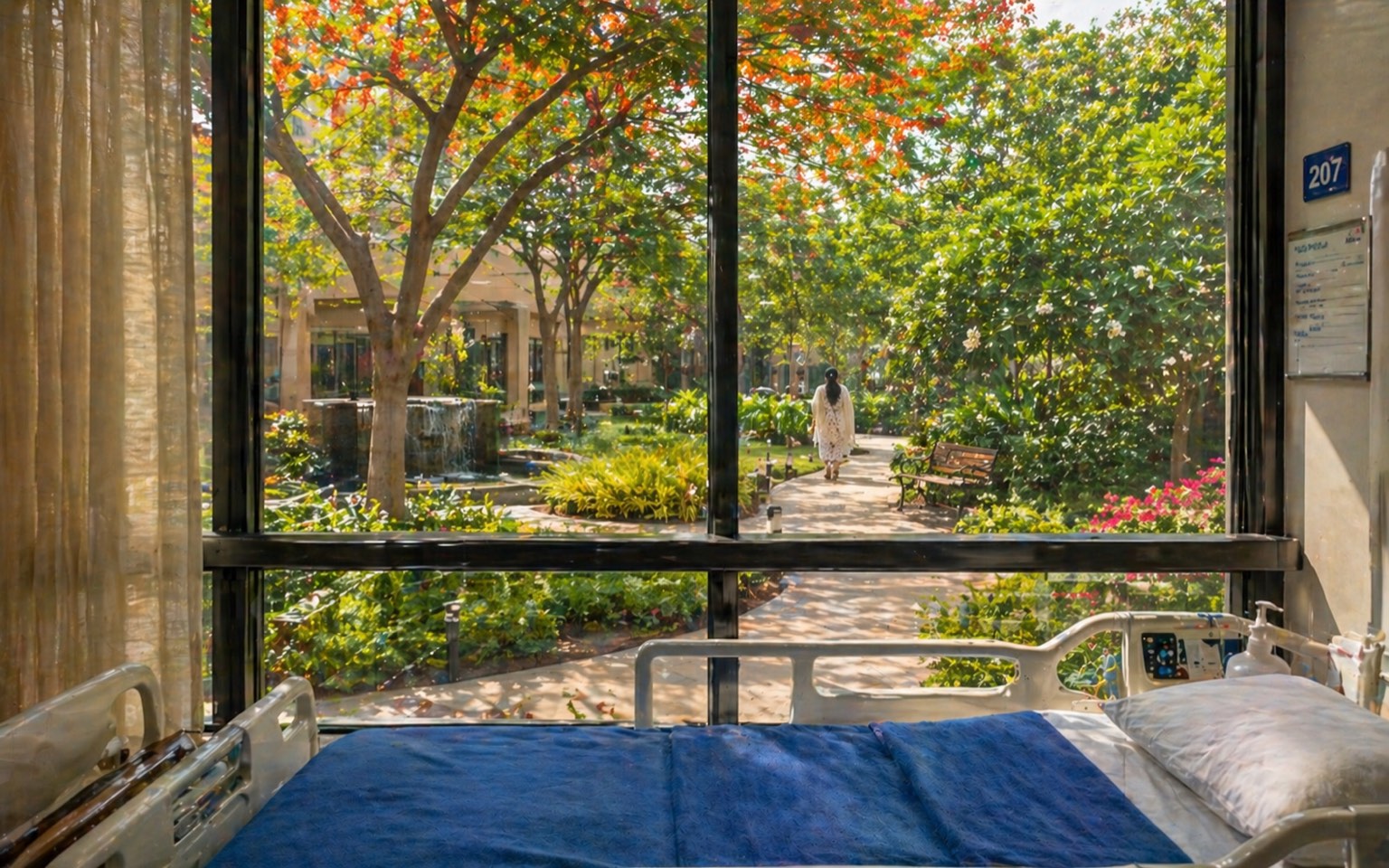
Biophilic & Healing Environments for Healthcare in India
An Architect's Working Reference — Roger Ulrich's Restorative Theory, Stephen Kellert's 14 Patterns of Biophilic Design, Therapeutic Gardens, Hospital Courtyards, Patient-Room Nature Views, End-of-Life Space, Indian Planting Palette, and the Biophilic Healthcare Toolkit
Biophilic design — the discipline of integrating natural elements into the built environment to support human well-being — is the natural extension of the evidence-based design tradition that began with Roger Ulrich's 1984 view-through-a-window study. While EBD focuses on outcomes — reduced length of stay, lower medication use, better sleep — biophilic design focuses on the mechanism by which built environments either support or stress human physiology. The biophilia hypothesis, articulated by Edward O. Wilson in 1984, proposes that humans have an innate affinity for nature shaped by evolutionary history; the design implication is that built environments deprived of natural cues impose a cumulative stress that healing environments cannot afford.
This guide is the sixth in the design-focused series and the natural companion to the evidence-based design guide. It assumes the reader has read the pillar regulatory reference, the regulatory deep-dives, and the preceding design articles on clinical adjacencies, OT suite design, ICU/NICU/PICU design, and ED/wayfinding.
The Indian context is uniquely well-suited to biophilic healthcare. The climate supports year-round outdoor presence in temperate and warm-humid zones; the cultural premise of healing already integrates plants, water, and nature (Vastu, Ayurveda, traditional medicine) — making biophilic design an architectural extension of indigenous health philosophy rather than an imported doctrine. The challenge is implementation: most Indian hospitals are built without explicit biophilic provisions, and the result is an institutional architecture that contradicts the cultural premise on which Indian healing rests.
"The hospital that heals is the hospital that opens onto a garden, that admits the morning sun, that lets the patient see a tree." — Charles Correa (1930–2015), architect, paraphrased from a 1990s lecture at CEPT
"If we are to design healing environments, we must first acknowledge that healing is what bodies do, not what buildings do. The building's task is to remove the obstacles to healing — to which natural light, vegetation, and silence belong as much as plumbing and oxygen." — Stephen Kellert (1943–2016), social ecologist, paraphrased from Biophilic Design (Kellert, Heerwagen & Mador, 2008)
1. The Biophilia Hypothesis — Wilson, Ulrich, Kellert
The intellectual foundation of biophilic design has three contributors:
| Thinker | Contribution | Implication for Healthcare |
|---|---|---|
| Edward O. Wilson (1984, Biophilia) | Hypothesises innate human affinity for living systems, shaped by evolution | Buildings without nature impose adaptive stress |
| Roger Ulrich (1984 onward, "psychoevolutionary theory of restorative environments") | Empirically demonstrates nature views reduce stress, accelerate recovery | Architectural decisions affect clinical outcomes |
| Stephen Kellert (with Heerwagen, Mador 2008, Biophilic Design) | Codifies 14 patterns through which biophilic design operates | Practical translation framework |
| Rachel & Stephen Kaplan (1989, The Experience of Nature) | Attention Restoration Theory — nature restores directed attention | Hospital staff fatigue + patient cognitive recovery |
The combined framework: human well-being requires regular contact with natural systems; built environments either support or impede this; healthcare buildings, where well-being is the explicit objective, have a special obligation to design biophilically.
2. The 14 Patterns of Biophilic Design (Kellert / Browning et al.)
Browning, Ryan, and Clancy's 14 Patterns of Biophilic Design (Terrapin Bright Green, 2014) operationalises the framework. The patterns translate into specific architectural decisions.
Nature-in-the-space patterns
| # | Pattern | Hospital Application |
|---|---|---|
| 1 | Visual connection with nature | Window views to courtyards, gardens, sky |
| 2 | Non-visual connection with nature | Bird sounds, water sounds, fragrance from gardens |
| 3 | Non-rhythmic sensory stimuli | Wind through leaves, leaf shadow on wall |
| 4 | Thermal & airflow variability | Operable windows, courtyards with breeze |
| 5 | Presence of water | Fountains, water features, ponds, courtyards |
| 6 | Dynamic & diffuse light | Daylight changing through day, dappled light |
| 7 | Connection with natural systems | Visible weather, seasons, plant cycles |
Natural analogues patterns
| # | Pattern | Hospital Application |
|---|---|---|
| 8 | Biomorphic forms & patterns | Curved walls, organic forms, leaf-pattern textiles |
| 9 | Material connection with nature | Wood, stone, bamboo, clay (in non-clinical zones) |
| 10 | Complexity & order | Fractal patterns, natural texture, hierarchical detail |
Nature-of-the-space patterns
| # | Pattern | Hospital Application |
|---|---|---|
| 11 | Prospect | Long sightlines, atrium overlook, viewing balcony |
| 12 | Refuge | Alcoves, family lounge, prayer room, contemplative space |
| 13 | Mystery | Curving corridor with reveal, garden through arch |
| 14 | Risk / peril | (Limited use in healthcare; controlled — high atrium with rail) |
The architect's biophilic strategy assigns each pattern a specific application in the hospital programme. Not every pattern needs to be in every space — the strategy distributes them deliberately.
3. Therapeutic Gardens — The Architectural Heart of Biophilic Healthcare
The therapeutic garden is the most architecturally consequential biophilic feature in a hospital. Categories:
| Garden Type | Function | Architectural Specification |
|---|---|---|
| Restorative garden (general) | Patient and family relaxation | Visible from IPD, accessible by patient, seating, shade, plant variety |
| Sensory garden | Stimulation across senses for diverse populations | Fragrant plants, water, varied textures, accessible paths |
| Children's garden | Paediatric recovery | Play area, water play (controlled), child-scaled plants |
| Dementia / memory garden | Cognitive support | Loop-only paths (no dead-ends), familiar planting, way-back orientation |
| Palliative / hospice garden | End-of-life dignity | Quiet, contemplative; bed-accessible; family seating |
| Staff garden | Staff respite | Adjacent to staff lounge; private; not patient-overlooked |
| Healing courtyard | Internal — accessed from corridors | Daylight to interior, ventilation, view from clinical |
| Roof garden | Top-floor — accessible from IPD | Elevated; view; structural-loaded |
Design specifications for therapeutic gardens
| Element | Specification |
|---|---|
| Visibility from patient rooms | Direct sight from IPD windows preferred; secondary access if not direct |
| Patient access | Bed-accessible (wheelchair / stretcher) for at least one route |
| Path width | ≥ 1.5 m for wheelchair turn |
| Path surface | Non-slip; stable; not loose gravel |
| Seating frequency | Every 10–15 m; varied (bench, single chair, family group) |
| Shade | At least 50% of seating shaded |
| Water feature | Visual + audible; designed for low maintenance |
| Plants | Native or naturalised; non-toxic; non-allergenic; low-maintenance preferred |
| Edible / fragrant | Tulasi, mint, rosemary, lemon — engages patients |
| Wind protection | Hedge or wall on prevailing-wind side |
| Lighting | Soft, warm, low-glare; safety lighting on paths |
| Maintenance access | Service path for gardener; tool storage |
| Religious / cultural element | Tulasi (Hindu), rose (Persian-Islamic-Mughal), lotus (multi-faith) |
4. Hospital Courtyards — A Climate-Indigenous Strategy
The courtyard is uniquely valuable in Indian healthcare. Vernacular Indian architecture is courtyard-dominant — havelis, nalukettus, agraharams — and the climatic logic translates directly to hospital design:
| Courtyard Function | Hospital Application |
|---|---|
| Daylight to interior rooms | Wards / consultation / corridor on inner ring |
| Cross-ventilation | Stack effect in warm-humid; passive cooling |
| Visual relief | Room window opens to courtyard |
| Patient outdoor space | Bed-rolled patient access |
| Family gathering | Larger family groups in shaded outdoor |
| Religious / contemplative | Tulasi, simple altar (multi-faith) |
| Acoustic insulation | Courtyard isolated from street noise |
| Identity / wayfinding | Courtyard as orientation point |
Architectural typologies
| Type | Configuration | Pros | Cons |
|---|---|---|---|
| Single courtyard | One central court | Daylight to all rooms; orientation | Programme constraints; single-storey or low-rise |
| Multiple courtyards | Ward-cluster courtyards | Privacy per ward; varied gardens | More glazing; complex circulation |
| Atrium-courtyard | Glazed-roof internal court | Daylight regardless of season; conditioned | Higher mechanical cost; no fresh air |
| Roof courtyard | Top-floor open court | Above noise; view; sky | Limited size; structural |
| Cascading courtyards | Multiple at different floors | 3D nature integration; daylight to many floors | Structural complexity |
Sample courtyard sizing for 100-bed hospital
| Element | Recommendation |
|---|---|
| Number of courtyards | 2–3 |
| Total courtyard area | 8–15% of footprint |
| Minimum dimension | 9 × 9 m for daylight to surrounding rooms |
| Wing-spacing rule | If 2-side rooms surround courtyard, courtyard width = floor-to-floor height × 2 minimum |
| Planting density | 30–40% greenery (rest paving for accessibility) |
| Tree species | 1–3 mature trees per courtyard for shade |
The courtyard adds approximately 8–15% to footprint vs no-courtyard but reduces lift/electrical/HVAC demand by improving daylight and ventilation. Net cost is typically neutral to slightly positive over operational lifetime.
5. Patient-Room Nature Views — The Ulrich Translation
Every patient-room window is a clinical instrument. Specifications:
| Element | Specification |
|---|---|
| Window size | ≥ 12% WWR (window-to-wall ratio) for IPD; ≥ 10% ICU |
| Window orientation | South or east preferred (warmth in winter, morning sun); shaded west; unshaded north for stable daylight |
| View content priority | Vegetation > water > sky > distant landscape > city activity > wall |
| View depth | At least 6–10 m to nearest feature; longer preferred |
| View height | Sill at 0.6–0.9 m so patient can see while in bed |
| Operability | At least one operable casement (with restrictor) for fresh air |
| Solar control | External shading sized for climate |
| Glazing | Low-E preferred; clear or lightly tinted (35–55% VLT) |
| Window framing | Slim frame; minimise visual obstruction |
Architectural strategy when view is constrained (urban tight site):
- Internal courtyard view substitute
- Atrium overlook
- Roof-garden view
- Living wall outside window
- Floral courtyard with bench
- Sky-only view (sky alone has demonstrated benefit, less than vegetation)
A view of "any nature" outperforms a view of "no nature." Even small interventions — a single mature tree planted to be visible from IPD — have outsized clinical impact.
6. Indoor Plants and Living Walls
Indoor biophilic interventions complement (do not substitute for) outdoor and view biophilic strategy.
| Indoor Element | Hospital Application | Notes |
|---|---|---|
| Potted plants | Lobby, OPD waiting, family lounge | Easy; reduces VOCs; cleaning protocol |
| Living wall | Lobby, atrium, large waiting | High visual impact; maintenance-intensive; not in clinical |
| Atrium tree | Atrium centrepiece | Mature feature; structural support |
| Window-box garden | Patient room (single rooms) | Personal; family-tendable |
| Aquarium | Lobby, paediatric waiting | Calming; maintenance |
| Indoor herb garden | Family kitchen, paediatric ward | Edible; therapeutic |
| Vertical garden | Corridor accent | Acoustic + visual benefit |
| Window-shelf plants | Standardised provision in IPD/ICU rooms (low-maintenance) | Patient choice on care |
Plant species — clinically appropriate:
- Low-allergen, low-pollen
- Non-toxic to humans
- Robust to low-light
- Low water demand
- Easy to clean
- No mould-prone media
Common Indian appropriate species: Aglaonema, Sansevieria, Pothos, Spider plant (Chlorophytum), Money plant, ZZ plant, Rubber plant, Areca palm, Bamboo palm, Boston fern.
What NOT to install in clinical zones:
- High-pollen (lilies in oncology)
- Rose / strongly fragrant (some patient sensitivities)
- Fungal-prone soil (immunocompromised)
- Brittle / shedding (cleanliness)
- Cactus / spiky (paediatric, dementia safety)
7. Indian Planting Palette by Climate Zone
The architect's plant selection respects climate. Indigenous and climate-adapted species perform best.
Warm-humid (Mumbai, Goa, Kochi, Chennai coast)
| Tree (mature) | Shrub | Ground cover |
|---|---|---|
| Rain tree (Samanea saman) | Hibiscus | Lawn (Cynodon) |
| Indian almond (Terminalia catappa) | Allamanda | Wedelia |
| Ashoka (Saraca asoca) | Tabernaemontana | Grass varieties |
| Plumeria (Plumeria) | Bougainvillea | Spider lily |
Composite (Delhi, Bengaluru, Hyderabad, Pune)
| Tree | Shrub | Ground cover |
|---|---|---|
| Neem (Azadirachta indica) | Lantana (controlled) | Lawn |
| Gulmohar (Delonix regia) | Hamelia patens | Vinca |
| Amaltas (Cassia fistula) | Bougainvillea | Mondo grass |
| Banyan (Ficus) | Tecoma stans | — |
Hot-dry (Jodhpur, Jaisalmer, Ahmedabad)
| Tree | Shrub | Ground cover |
|---|---|---|
| Khejri (Prosopis cineraria) | Rohira | Cynodon |
| Jal (Salvadora persica) | Aerva | Aizoon |
| Gunda (Cordia rothii) | Capparis | — |
Cold (Shimla, Manali, Srinagar)
| Tree | Shrub | Ground cover |
|---|---|---|
| Deodar (Cedrus deodara) | Rhododendron | Lawn |
| Walnut (Juglans) | Juniper | Daphne |
| Apple (Malus) | Lavender | Periwinkle |
The architect's deliverable: a planting plan keyed to the hospital plot's climate zone, with species, mature size, water demand, and maintenance frequency. The planting plan integrates with the architectural drawings — landscape consultant collaborates from concept stage.
8. End-of-Life and Palliative Spaces
The hospital is not only where life is preserved; it is where life ends. The architecture of dying — palliative care, end-of-life care, family bereavement — has specific biophilic requirements that often go unaddressed.
| Palliative Architectural Element | Specification |
|---|---|
| Single room (not multi-bed) | Privacy at end-of-life |
| Garden access | Direct from room or via short corridor |
| Outdoor terrace / balcony | Where building permits |
| Family overnight (large) | Multiple family stay |
| Family kitchen | Cooking comfort food |
| Religious / spiritual space | Adjacent; multi-faith |
| Music / quiet space | For meditation, prayer |
| Bereavement room | Family receiving consolation |
| Dignified body-handling | Body removal route does not cross other patients |
| Soft natural light | No harsh institutional fluorescence |
| Materials | Wood, stone, soft textile (where infection control permits) |
The palliative/hospice unit should be one of the most biophilically rich spaces in the hospital. It is also one of the most often overlooked.
9. Common Biophilic Implementation Gaps
| # | Gap | Mitigation |
|---|---|---|
| 1 | No courtyard or garden in hospital programme | Allocate at concept stage |
| 2 | Patient-room window views to wall / parking | Plot orientation; courtyard substitute |
| 3 | Indoor plants absent | Standard planting in lobby, OPD, IPD wing |
| 4 | Lobby plants but clinical zones bare | Distribute throughout |
| 5 | Western planting (non-native, water-intensive) | Climate-zone species |
| 6 | No water feature | Even small fountain in lobby |
| 7 | Acoustic — silence-only, no nature sound | Consider water sound, bird-friendly courtyard |
| 8 | Lighting all-fluorescent / clinical | Circadian, dimmable, lamps |
| 9 | Materials all hard / clinical | Wood / stone in lobby, IPD, family areas |
| 10 | No therapeutic garden access for inpatients | Bed-accessible path |
| 11 | Children's spaces lack outdoor connection | Paediatric garden / play |
| 12 | Palliative care lacks biophilic focus | Specialised palliative unit |
| 13 | Staff have no nature respite | Staff garden / lounge with view |
| 14 | Atrium without vegetation | Mature tree / living wall |
| 15 | Building turns its back to garden | Re-orient programme to garden |
10. The Architect's Biophilic Healthcare Toolkit
| # | Step | Output |
|---|---|---|
| 1 | Site analysis — climate, existing trees, sun, wind, view | Site biophilic audit |
| 2 | Programme review — identify biophilic-priority spaces | Priority schedule |
| 3 | Courtyard placement — number, size, accessibility | Courtyard plan |
| 4 | Patient-room orientation — view, daylight | Plan adjustments |
| 5 | Therapeutic garden — type and location | Landscape brief |
| 6 | Atrium / internal courtyard with nature | Architectural feature |
| 7 | Indoor plant strategy — locations, species | Indoor planting plan |
| 8 | Material palette — wood, stone, natural texture in non-clinical | Material schedule |
| 9 | Lighting — circadian, dimmable | Lighting scheme |
| 10 | Acoustic — natural sounds where appropriate | Acoustic strategy |
| 11 | Palliative / hospice biophilic priority | Palliative design |
| 12 | Staff respite — garden / lounge | Staff biophilic provision |
| 13 | Maintenance plan — landscape, plants | Operational handover |
| 14 | Post-occupancy evaluation — patient, family, staff feedback | POE schedule |
References
- Browning, W.D., Ryan, C.O. and Clancy, J.O. (2014) 14 Patterns of Biophilic Design. New York: Terrapin Bright Green.
- Cooper Marcus, C. and Barnes, M. (1999) Healing Gardens: Therapeutic Benefits and Design Recommendations. New York: Wiley.
- Cooper Marcus, C. and Sachs, N. (2014) Therapeutic Landscapes: An Evidence-Based Approach to Designing Healing Gardens and Restorative Outdoor Spaces. Hoboken: Wiley.
- Edelstein, E.A. (2008) 'Building health', HERD, 1(2), pp. 54–59.
- Gillis, K. and Gatersleben, B. (2015) 'A review of psychological literature on the health and wellbeing benefits of biophilic design', Buildings, 5(3), pp. 948–963.
- Heerwagen, J. and Hase, B. (2001) 'Building biophilia: connecting people to nature', Environmental Design + Construction, March, pp. 30–36.
- Joye, Y. and van den Berg, A. (2011) 'Is love for green in our genes? A critical analysis of evolutionary assumptions in restorative environments research', Urban Forestry & Urban Greening, 10(4), pp. 261–268.
- Kaplan, R. and Kaplan, S. (1989) The Experience of Nature: A Psychological Perspective. Cambridge: Cambridge University Press.
- Kellert, S.R. (2008) 'Dimensions, elements, and attributes of biophilic design', in Kellert, S.R., Heerwagen, J. and Mador, M. (eds.) Biophilic Design: The Theory, Science and Practice of Bringing Buildings to Life. Hoboken: Wiley.
- Kellert, S.R., Heerwagen, J. and Mador, M. (eds.) (2008) Biophilic Design. Hoboken: Wiley.
- Marcus, C.C. and Sachs, N.A. (2013) Therapeutic Landscapes. Hoboken: Wiley.
- Park, S.H. and Mattson, R.H. (2009) 'Therapeutic influences of plants in hospital rooms on surgical recovery', HortScience, 44(1), pp. 102–105.
- Rai, B. (2018) Indoor Plants for Indian Conditions. New Delhi: ICAR.
- Söderlund, J. and Newman, P. (2015) 'Biophilic architecture: a review of the rationale and outcomes', AIMS Environmental Science, 2(4), pp. 950–969.
- Ulrich, R.S. (1984) 'View through a window may influence recovery from surgery', Science, 224, pp. 420–421.
- Ulrich, R.S. (1991) 'Effects of interior design on wellness: theory and recent scientific research', Journal of Health Care Interior Design, 3, pp. 97–109.
- Ulrich, R.S. (1999) 'Effects of gardens on health outcomes: theory and research', in Cooper Marcus, C. and Barnes, M. (eds.) Healing Gardens. New York: Wiley, pp. 27–86.
- Wilson, E.O. (1984) Biophilia. Cambridge, MA: Harvard University Press.
Author's Note: Biophilic design is the natural cultural fit for Indian healthcare — climate, traditional medicine, and architectural heritage all support the integration of nature into healing environments. The Indian healthcare sector under-implements biophilic design largely because the architectural brief does not name it, not because clients oppose it. The architect's task is to build the biophilic case at the brief stage and design biophilic architecture as a primary commitment, not a finishing touch. Subsequent guides go deeper on services architecture (HVAC and medical infrastructure) where biophilic and clinical priorities intersect.
Disclaimer: This article is for informational and educational purposes only and does not constitute professional architectural, landscape, or clinical advice. Biophilic design depends on specific climate, patient population, and project context and must be assessed project-by-project. Studio Matrx, its authors, and contributors accept no liability for decisions made on the basis of the information in this guide.
Export this guide
Related Tools — Try Free
Cross-Ventilation Analyzer
Estimate airflow and air changes per hour (ACH) from room size, window areas, layout, and local wind — with NBC 2016 Part 8 compliance check.
Ventilation CalculatorRainwater Tank Sizer
How big should your rainwater tank be? Computes annual harvest, recommended tank capacity in litres, water-bill savings, and payback — for 10 Indian cities.
RWH CalculatorSun Path Analyzer
See the sun's exact path across your home or plot in AR — sunrise, sunset, solar noon, solstices.
AR Analyzer