
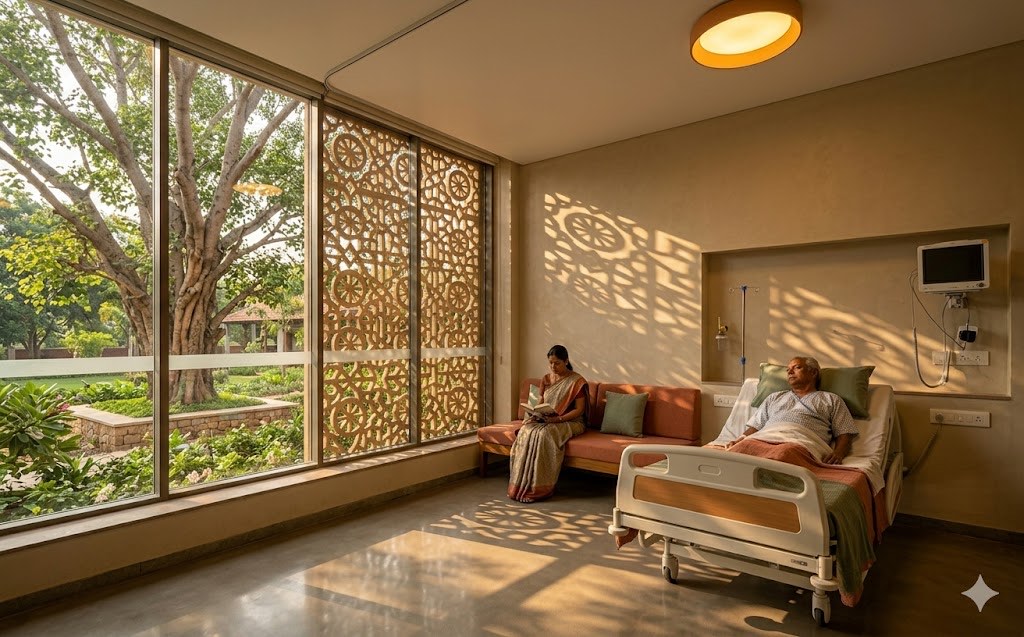
The Architecture of Recovery: Evidence-Based Design in Contemporary Indian Healthcare
An Architect's Front-Door Reference — EBD Foundations · Biophilic + Circadian + Acoustic + Social Pillars · Indian Cultural Context · Studio Matrx Tool Stack
Hospital architecture in the 20th century was driven by a single dominant logic — clinical efficiency. Hospitals were conceived as "machines for healing": sterile corridors maximised for service-trolley turning circles, windowless rooms optimised for HVAC sealing, finishes selected for chemical resistance over psychological warmth. The patient was, in this model, a body to be processed. The architecture was a logistics problem to solve.
That paradigm is now empirically obsolete. Three decades of research from the Center for Health Design, peer-reviewed work in HERD and Science, and accumulated post-occupancy evaluations of thousands of hospital projects worldwide have established a different conclusion: the built environment is itself a clinical instrument. Patients heal faster in rooms with views of nature. Sleep recovers in spaces lit on circadian schedules. Wound healing accelerates when noise is controlled. Family presence lowers post-operative complications. None of this is decoration; all of it is dose-response biology mediated by architecture.
Evidence-Based Design (EBD) is the framework that translates this research into design decisions. Just as clinicians practice evidence-based medicine — selecting interventions on the basis of randomised trials, cohort studies, and meta-analyses — architects practising EBD select formal, material, and spatial decisions on the basis of credible research that ties them to measurable patient outcomes. The window-sill height is no longer aesthetic; it is dose-controlled. The wall STC rating is no longer code-minimum; it is therapeutic. The CCT of the patient-room luminaire is no longer specification boilerplate; it is circadian medicine.
This guide is the front-door reference for Indian architects approaching healthcare commissions through the EBD lens. It is the philosophical and practical framing that sits above the deeper Studio Matrx healthcare guides — Biophilic & Healing Environments, Hospital Façade & Daylight Design, Healthcare HVAC, and the regulatory references. Its position is specific: healthcare architecture in contemporary India must reject the imported "machine for healing" model and instead synthesise EBD evidence with vernacular wisdom (the courtyard, the jali, the verandah) and statutory frameworks (NABH, FGI 2018, WELL v2, ECBC). Architects who adopt this stance produce hospitals that perform clinically, satisfy regulators, and read as architecturally serious. Architects who shortcut produce buildings that function as throughput machines and fail their patients in ways no clinical staff can reverse.
"View through a window may influence recovery from surgery." — Roger Ulrich, Science 224(4647), 1984. The single sentence that founded modern Evidence-Based Design.
"The hospital that pretends architecture is incidental to medicine has not understood medicine. The patient's body knows the difference between a window and a wall, between 35 dB and 60 dB, between 6500 K and 2700 K — even when the patient cannot articulate it." — Ar. Amogh N P
1. What is Evidence-Based Design?
Evidence-Based Design is the deliberate practice of basing built-environment decisions on credible, peer-reviewed research about clinical and operational outcomes. The framework was formalised by the Center for Health Design (CHD) in the early 2000s, codified in Roger Ulrich and colleagues' 2008 review in HERD: Health Environments Research & Design Journal, and is now embedded in the WELL Building Standard v2 and the Facility Guidelines Institute (FGI) 2018 Guidelines for Design and Construction of Hospitals.
Four characteristics distinguish EBD from generic "best practice":
- Outcome-anchored. Every design decision must trace back to a measurable patient, family, or staff outcome — length of stay, analgesic consumption, fall rates, infection rates, staff retention, HCAHPS scores.
- Evidence-graded. EBD distinguishes between randomised controlled trials, cohort studies, post-occupancy evaluations, and expert opinion. Higher grades earn higher confidence in design specifications.
- Context-sensitive. EBD evidence generated in US/European cohorts must be tested for Indian applicability. Family-presence norms, climate, regulatory regime, and case-mix differ; the architect translates rather than transposes.
- Continuously updated. The CHD evidence base is a living document. Architects practising EBD subscribe to the literature rather than freezing on a specification snapshot.
| EBD Element | Evidence Anchor | Design Translation | Indian Standard |
|---|---|---|---|
| Single-bed rooms | Ulrich et al. 2008 (HERD) — lower infection, fewer transfers, family presence | 100% single rooms in new-build acute wards where budget permits; cohort-of-2 minimum | NABH 5th Ed. encourages but does not mandate |
| Nature view from bed | Ulrich 1984 (Science) — −0.74 days LOS, 30–40% less analgesic use | Bed-head orientation toward window, sill ≤ 750 mm, focal tree in view | No numeric standard |
| Daylight access | Joseph 2006; Walch et al. 2005 — 22% lower analgesic, faster discharge in mood disorders | DF ≥ 2% over patient bed; East/SE for morning sun | No numeric standard |
| Acoustic privacy | Berglund et al. 1999 (WHO); FGI 2018 §1.2-5.1.1.1 | STC ≥ 45 patient-room to corridor; STC ≥ 50 consultation; ambient ≤ 45 dBA day, ≤ 35 night | IS 1950 (general); FGI as de facto |
| Circadian lighting | Brainard 2001; Lucas 2014; WELL v2 L03 | Tunable LED; EML ≥ 200 daytime; EML < 50 night | No numeric standard |
| Family accommodation | Ulrich et al. 2008; Indian cultural norm | Dedicated zone in patient room, 1.5–2.0 m² per attendant | NABH encourages |
The architect's task is to translate this evidence into project-specific design moves, calibrated against the four pillars below. Each pillar maps to one of the Studio Matrx interactive design tools — the Healing View Impact Calculator, Circadian Light Meter, Acoustic Privacy Visualizer, and Brise-Soleil Visualizer — which permit dose-response simulation before construction.

2. The Biophilic Connection: Nature as a Clinical Instrument
The most-cited single piece of EBD research is Roger Ulrich's 1984 study in Science comparing post-cholecystectomy patients in rooms with a view of trees against patients facing a brick wall. The tree-view group was discharged 0.74 days earlier on average, requested 30–40% less moderate-strong analgesic on post-op days 2–5, and reported lower minor-complaint frequency to nurses. The cohort was small (n=46) but the effect size was large and the methodology rigorous; the study has been replicated and extended dozens of times, most notably by Park & Mattson (2008) which substituted potted plants for the tree view and found similar magnitude effects on pain perception and blood pressure.

For the Indian context, this evidence base translates into specific architectural moves:
- Strategic fenestration. The patient lies in bed for 80–95% of the inpatient stay. The bed-head window is the dominant daylight source, the dominant view source, and (in passively-ventilated wards) the dominant air source. Window sill height ≤ 750 mm AFFL with a clear sightline to a "focal element" — a mature tree, a healing garden, a courtyard, the horizon — preserves the Ulrich evidence base. Sill heights above 1000 mm (still common in cost-engineered projects) reduce the patient to a passive recipient of the artificial environment; the evidence base for that is recovery delay.
- Biomorphic forms. Where direct nature view is impossible (interior wards, stacked plans), evidence supports indirect biophilic cues — patterns drawn from nature. CNC-milled jali screens with fractal geometries (Sierpinski, leaf-vein, Voronoi), wallpaper at the ward entry with sun-dappled forest motifs, and ceiling articulation that breaks the monotonous gypsum plane all reduce cognitive load. Joye (2007) and Salingaros (2017) establish the cognitive basis: human visual processing is optimised for the fractal density (D ≈ 1.3–1.5) found in temperate forest canopies and the human face.
- Material authenticity. Plastic laminates, vinyl flooring, and acrylic paint dominate Indian healthcare specification not because they are clinically superior — they are not — but because they are cheap and procurement-comfortable. EBD evidence supports natural-feeling materials (wood, wool, linen, terracotta, stone, microcement) for their lower thermal shock and tactile authenticity, where compliance with infection-control protocols permits. The compromise — anti-microbial coating on real wood, wood-look porcelain tiles in high-touch zones — preserves clinical performance without sacrificing biophilic warmth.

The Studio Matrx Healing View Impact Calculator quantifies the projected analgesic, length-of-stay, and HRV recovery benefits of view quality and daylight factor for a given patient room. The deeper reference for the full biophilic palette is the Biophilic Intelligence guide and the Biophilic & Healing Environments in Healthcare reference.
"The architecture of healing must speak the language the patient's nervous system already understands. Trees, dappled light, the sound of water — these are not aesthetic flourishes; they are the vocabulary of parasympathetic recovery." — Ar. Charles Correa (1930–2015), paraphrased
3. Circadian Synchronisation: The Biology of Light
The human body is regulated by a circadian rhythm — a 24-hour internal cycle of cortisol, melatonin, body temperature, and alertness driven by the suprachiasmatic nucleus (SCN) of the hypothalamus and entrained primarily by light striking the retina. The discovery by Brainard et al. (2001) and Thapan et al. (2001) of a non-rod, non-cone photoreceptor system — the intrinsically photosensitive retinal ganglion cells (ipRGCs) containing melanopsin — clarified the mechanism: blue-shifted light at ~480 nm strongly suppresses melatonin via the ipRGC pathway; warm-shifted light below 3000 K does not.
This makes the colour temperature and intensity of patient-room lighting a clinical instrument. Lucas et al. (2014) in Trends in Neurosciences established the modern framework: the relevant metric is not photopic lux (which weights for the photopic luminous efficiency function peak at 555 nm) but melanopic lux or mEDI (melanopic equivalent daylight illuminance), weighted for the melanopsin action spectrum. The WELL Building Standard v2 Concept L03 (Circadian Lighting Design) codifies the requirement: ≥ 200 EML at the workplane during daytime hours, with shift to lower CCT and lower intensity in the evening.
Failure modes in Indian healthcare lighting are pervasive:
- Static cool-white luminaires (5000–6500 K) running all night in patient corridors and nurse stations, suppressing melatonin throughout the rest cycle.
- High CCT in patient rooms after 21:00, delaying sleep onset and reducing slow-wave sleep proportion.
- Inadequate daytime intensity in interior wards (often 100–150 lux on the ward floor when ≥ 300 lux at the bed is required for circadian entrainment).
- Flickering fluorescent fixtures in older clinics, which produce light-driven discomfort and contribute to "ICU psychosis" — the disorientation, sleep-cycle collapse, and delirium that affects 30–80% of ICU patients in 24×7 environments without circadian cues.
| Time Phase | Recommended CCT | Recommended EML at bed | Biological Goal |
|---|---|---|---|
| 06:00–10:00 | 4000–5000 K rising | ≥ 150, rising to 250 | Cortisol awakening response |
| 10:00–16:00 | 5500–6500 K | ≥ 250 | Inhibit melatonin, sustain alertness |
| 16:00–18:00 | 4000–5000 K | 150–250 | Combat post-lunch dip; prepare wind-down |
| 18:00–21:00 | 2700–3500 K | 50–150 | Begin melatonin secretion |
| 21:00–06:00 | 1800–2700 K | < 50 | Preserve melatonin; deep sleep |

The Studio Matrx Circadian Light Meter computes EML, melatonin suppression, and the relative-alertness curve for any combination of time-of-day and intensity. For envelope-driven daylight (which is the cheapest and most powerful circadian intervention), see the Hospital Façade & Daylight Design guide.

4. Acoustic Privacy and the "Quiet Revolution"
Hospital noise is, by every published measurement, out of compliance with WHO recommendations. Berglund et al. (1999) in the WHO Guidelines for Community Noise set the recommended hospital noise targets at ≤ 30 dBA at the bed-head during the night and ≤ 35 dBA daytime. Busch-Vishniac et al. (2005) measured 50 hospitals across multiple countries and found average daytime levels of 57 dBA, peaks of 90 dBA, and night-time medians 10–20 dB above WHO target. Indian urban hospitals on highway-adjacent sites typically run worse — façade-incident noise of 70–80 dBA daytime is common in metro contexts.
The biological cost is substantial:
- Sleep fragmentation. Each peak above 50 dBA produces an EEG arousal whether or not the patient consciously wakes; cumulative arousals reduce slow-wave sleep, the phase responsible for tissue repair and immune function consolidation.
- Cortisol elevation. Continuous noise above 45 dBA correlates with chronically elevated salivary cortisol, an independent predictor of slowed wound healing and length of stay.
- Speech privacy failure. Conversations in semi-private rooms or at corridor nurse stations frequently exceed the ≤ 5 dB signal-to-noise ratio required for confidential clinical exchange. NABH 5th Edition mandates patient privacy as a quality requirement; intelligible speech leakage is the most common failure mode.
The architectural intervention is the wall Sound Transmission Class (STC), codified by ASTM E413, with healthcare-specific thresholds in FGI 2018 §1.2-5.1.1.1: STC ≥ 45 patient-room to corridor, STC ≥ 50 consultation/exam room, STC ≥ 55 confidential consultation and sleep-study suites. IS 1950 provides the Indian Standard reference for sound insulation; NABH defers to it without numeric specification.
| Assembly | Lab STC | Field NIC | Application |
|---|---|---|---|
| GI stud + 12 mm GWB each side, no insulation | 33 | ~28 | Economy fit-out only |
| 115 mm brick + plaster | 40 | ~35 | Standard Indian half-brick partition |
| GI stud + 2×12 mm GWB each side + glass wool | 48 | ~43 | FGI patient-room baseline |
| Staggered stud + double GWB + glass wool | 52 | ~47 | FGI consultation-room |
| Resilient channel + double GWB + glass wool | 58 | ~53 | Confidential consultation; sleep study |

The Studio Matrx Acoustic Privacy (STC) Visualizer simulates received SPL after attenuation and checks against FGI / IS 1950 / NABH thresholds for specific source-noise scenarios. Field NIC routinely runs ~5 dB below lab STC due to flanking through plenums, doors, and gaps; the architect specifies the seal detail, the door STC, and the return-air boot, not just the wall lab rating.
5. Designing for the Family: The Social Support Factor
Western healthcare architecture, codified in the "patient-centred care" frameworks of the 1990s, addresses family presence as a permitted accommodation. Indian healthcare practice treats family presence as a structural assumption: the patient is virtually never alone, the attendant performs significant non-clinical care work (toileting, feeding, repositioning), and family economic and decision-making roles are continuous through the inpatient stay.
The architectural response is the family-attendant zone — a dedicated portion of every patient room (1.5–2.0 m² per attendant where space permits) with ergonomic seating that converts to a sleep surface, a charging point, secured personal-belongings storage, and direct sight-line to the patient. The attendant zone does not encroach on the clinical zone (the ≥ 1200 mm clear strip from bed-head to far bed-side that staff require for coding events and equipment handling); the spatial discipline is to provide both without compromising either.

Flagel et al. (2014) and the broader EBD evidence base support family presence as a measurable contributor to outcomes: reduced anxiety on validated scales, lower delirium incidence in elderly patients, improved adherence at discharge. The Indian extension is cultural: dignity is preserved when the family is treated as a planned occupant, not tolerated as overflow.
"In our country, the family is the first nurse, the first translator, the first counsellor. The patient room that ignores this is designed for somebody else's society." — Dr Devi Shetty (b. 1953), Narayana Health, paraphrased
6. The Studio Matrx Tool Stack
The four tools released alongside this guide allow the architect to dose-control the EBD interventions before any construction commitment:
- Healing View Impact Calculator — projects the analgesic, length-of-stay, and HRV recovery benefits of view quality and daylight factor against the Ulrich 1984 / Park & Mattson 2008 / CHD evidence base.
- Circadian Light Meter — computes CCT, melanopic lux, melatonin suppression, and the relative-alertness curve through the day, calibrated against WELL v2 L03, CIE S 026:2018, Brainard 2001, and Lucas et al. 2014.
- Acoustic Privacy (STC) Visualizer — simulates received SPL through India-relevant wall assemblies (115 mm brick, GI stud, staggered stud, resilient channel) against FGI 2018 / IS 1950 / NABH thresholds.
- Brise-Soleil Visualizer — computes the cut-off angle of horizontal louvre arrays for ECBC-compliant façade shading; critical for managing the daylight-glare trade-off in patient rooms and clinical reading rooms.
The intent is not to substitute simulation for clinical judgement; it is to surface the dose-response relationship visually so the architect, the medical superintendent, and the project board can negotiate evidence-based trade-offs (a smaller patient-room footprint vs a deeper window with a focal-tree view; a cheaper GI-stud partition vs a staggered-stud assembly that meets FGI consultation-room privacy) on shared, quantitative ground.
7. From "Machine for Healing" to "Architecture of Recovery"
The shift this guide proposes is small in language but large in practice. The "machine for healing" model treats architecture as a logistic backdrop optimised for clinical throughput; the "architecture of recovery" model treats the building as a clinical instrument whose every element — sill height, partition STC, luminaire CCT, attendant-zone footprint — has a measurable contribution to patient outcomes that can be designed deliberately.
Indian healthcare is at the appropriate inflection point for this shift. NABH 5th Edition is converging on EBD principles even where it does not specify numeric thresholds. WELL v2 certification is being pursued by leading Indian hospital groups. The regulatory headroom exists. The evidence base exists. The interactive tools to dose-control interventions exist.
What remains is the architect's commitment to design not for the building permit but for the patient discharged faster, the family attendant who slept, the nurse who completed her shift without compassion fatigue. That is the architecture of recovery.
References (Harvard)
1. Ulrich, R.S. (1984) 'View through a window may influence recovery from surgery', Science, 224(4647), pp. 420–421.
2. Ulrich, R.S., Zimring, C., Zhu, X., DuBose, J., Seo, H.B., Choi, Y.S., Quan, X. & Joseph, A. (2008) 'A review of the research literature on evidence-based healthcare design', HERD: Health Environments Research & Design Journal, 1(3), pp. 61–125.
3. Park, S.H. & Mattson, R.H. (2008) 'Effects of flowering and foliage plants in hospital rooms on patients recovering from abdominal surgery', HortTechnology, 18(4), pp. 563–568.
4. Brainard, G.C., Hanifin, J.P., Greeson, J.M., Byrne, B., Glickman, G., Gerner, E. & Rollag, M.D. (2001) 'Action spectrum for melatonin regulation in humans: evidence for a novel circadian photoreceptor', Journal of Neuroscience, 21(16), pp. 6405–6412.
5. Thapan, K., Arendt, J. & Skene, D.J. (2001) 'An action spectrum for melatonin suppression: evidence for a novel non-rod, non-cone photoreceptor system in humans', Journal of Physiology, 535(1), pp. 261–267.
6. Lucas, R.J. et al. (2014) 'Measuring and using light in the melanopsin age', Trends in Neurosciences, 37(1), pp. 1–9.
7. Berglund, B., Lindvall, T. & Schwela, D.H. (eds.) (1999) Guidelines for Community Noise. Geneva: World Health Organization.
8. Busch-Vishniac, I.J., West, J.E., Barnhill, C., Hunter, T., Orellana, D. & Chivukula, R. (2005) 'Noise levels in Johns Hopkins Hospital', Journal of the Acoustical Society of America, 118(6), pp. 3629–3645.
9. Joseph, A. (2006) The Impact of Light on Outcomes in Healthcare Settings. Concord, CA: Center for Health Design Issue Paper #2.
10. Walch, J.M., Rabin, B.S., Day, R., Williams, J.N., Choi, K. & Kang, J.D. (2005) 'The effect of sunlight on postoperative analgesic medication use', Psychosomatic Medicine, 67(1), pp. 156–163.
11. International WELL Building Institute (2020) WELL v2: Light, Concept L03 — Circadian Lighting Design. New York: IWBI.
12. Facility Guidelines Institute (2018) Guidelines for Design and Construction of Hospitals. St. Louis, MO: FGI.
13. NABH (2020) Standards for Hospitals, 5th Edition. New Delhi: Quality Council of India.
14. Joye, Y. (2007) 'Architectural lessons from environmental psychology: the case of biophilic architecture', Review of General Psychology, 11(4), pp. 305–328.
Author's Note: Evidence-Based Design is the framework that lets architects practising healthcare commissions in India hold their work to the same epistemic standard the clinicians inside the building hold their treatment decisions. The author's intention with this guide is to support architects who insist on the dose-response framing — who size the window for the analgesic-reduction effect, the partition for the speech-privacy threshold, the luminaire for the melatonin-suppression curve, and the attendant zone for the cultural reality of Indian inpatient care — and who use the Studio Matrx interactive tools to validate before construction. The series will continue with deeper applications of EBD to specific facility types and clinical departments.
Disclaimer: This article is for informational and educational purposes only. It does not constitute clinical, regulatory, or professional architectural advice. Hospital design depends on site, programme, statutory regime, and applicable amendments — all of which must be confirmed with the relevant authorities (NABH, state CEA, AERB where applicable, FGI/WELL where pursued, and qualified design and clinical consultants). Effect sizes and thresholds cited are indicative; practitioners must verify against current literature and applicable standards before any binding decision. Studio Matrx, its authors, and contributors accept no liability for decisions based on this guide.
Export this guide
Related Tools — Try Free
Acoustic Privacy (STC) Visualizer
Indian healthcare acoustic visualizer — compare wall assemblies and noise sources, see received SPL after STC attenuation, and check FGI 2018 / IS 1950 / NABH speech-privacy compliance with live dual-canvas waveform.
Acoustic ToolCircadian Light Meter
Patient-centric circadian lighting visualizer for Indian healthcare design — time-of-day × intensity → CCT, melanopic lux (EML / mEDI), melatonin suppression, and an alertness curve. Calibrated against WELL v2 L03 Circadian Lighting Design, CIE S 026:2018, Brainard 2001, and Lucas et al. 2014.
Circadian ToolHealing View Impact Calculator
Evidence-Based Design dashboard quantifying the recovery impact of nature view + daylight factor on analgesic use, length of stay, and HCAHPS patient-experience uplift. Calibrated against Ulrich 1984 (Science), Park & Mattson 2008, and the CHD EBD evidence base.
EBD Calculator