
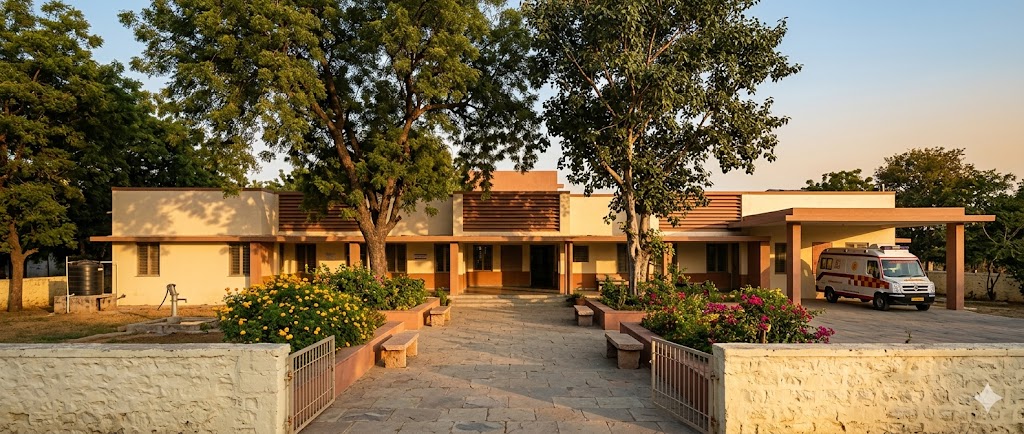
IPHS 2022 — Public Health Facility Design in India
An Architect's Working Reference — HWC, PHC, CHC, SDH, District Hospital · Catchment Norms by Geography · Ayushman Bharat Integration · Standardised Schedules · Climate-Responsive Construction · Telemedicine · NQAS · Workforce Norms · Hub-and-Spoke District Network Design
The Indian Public Health Standards 2022 (IPHS) are the largest single body of healthcare facility-design guidance in India. They govern the design of every government healthcare facility from the 150-square-metre Sub-Health Centre serving 3,000 villagers to the 25,000-square-metre 500-bed District Hospital serving a 25-lakh district population. Five tiers, half a million facilities, more than a billion beneficiaries, and one architectural framework — IPHS is not a niche subject for the architect interested in public-sector commission. It is the architectural infrastructure of Indian healthcare itself, and the typology in which the country's public-health ambition is translated into bricks, mortar, climate response, and service delivery.
This guide is a facility-type deep-dive in the Studio Matrx healthcare architecture series. It assumes the reader has read the pillar regulatory reference, is familiar with NBC 2016 Group C, and understands the basic typology of Indian healthcare practice. Here we focus on what is specific to IPHS-governed public health facilities — the five-tier hierarchy and its catchment-based logic, the Ayushman Bharat programme overlay that has reframed the architectural brief since 2018, the standardised schedules of accommodation that define each tier, the climate-responsive design tradition that good government hospital architects have developed across India, the workforce-norms-driven space implications, the telemedicine integration that has transformed primary care access, the NQAS and Kayakalp quality programmes that drive operational standards, the hub-and-spoke district network logic that makes a single facility part of a larger system, and the failure modes that recur across Indian government healthcare projects.
The position this guide takes is specific: government healthcare architecture in India is the most consequential typology a public-health-minded architect can engage with. The PHC in a tribal block of Madhya Pradesh that opens on time, with reliable services, with a labour room that meets LaQshya standards, with a wellness hall where the village women learn yoga and the village men learn diabetes screening, with a CHO who can teleconsult a specialist, with a garden where the staff and patients can sit — that PHC will outlive every private hospital in the city, will deliver more total maternal-mortality reduction than any tertiary cancer hospital, and will cost less than the parking allocation of a corporate medical college. This is the typology where the architect's social return on investment is measurably highest, and where the architectural craft must be most disciplined.
"Public health architecture is not minor architecture for poor people. It is major architecture for the country. We have spent forty years pretending otherwise. The next forty must do better." — Dr. K. Sujatha Rao (b. 1955), former Union Health Secretary, paraphrased from a 2017 lecture
"A District Hospital is the architectural test of whether a state government takes its citizens seriously. The state cannot govern those it cannot heal." — Justice K. Subba Rao (1902–1976), former Chief Justice of India, paraphrased
1. Why IPHS is its Own Typology
IPHS-governed facilities are unlike private healthcare facilities in five fundamental ways, and the architectural brief follows.
- Catchment-based, not market-based. A private hospital serves whoever can pay; an IPHS facility serves a defined geographic population. The catchment is fixed at design time, the bed count and staffing follow from the catchment, and the building is sized accordingly. This is closer to a school or a postal facility than to a market-driven hospital.
- Standardised schedules of accommodation. IPHS prescribes a tier-wise schedule of rooms with specified areas. A PHC has 4 inpatient beds, 2 MO consultation rooms, 1 labour room, 1 lab, 1 pharmacy — these numbers are not negotiable. State PWD and CPWD provide standardised drawings derived from the IPHS schedule. The architect's contribution is the climate response, the site response, the staff-quarters integration, and the construction-system selection — not the basic schedule.
- Workforce norms drive room counts. The number of MO consultation rooms is set by the number of medical officers prescribed for that tier. The number of labour-room beds is set by expected delivery load. The number of inpatient beds is set by catchment-population norms. The architect cannot add a programme that has no staff allocation, and cannot remove a programme that has staff allocated.
- Hub-and-spoke network logic. No IPHS facility is designed as a standalone. Every PHC is the spoke of a CHC; every CHC is the spoke of a SDH or DH; every DH connects to a tertiary medical college or AIIMS. Patient referral, drug supply, epidemiological surveillance, and ASHA/CHO supervision flow up and down this network. The architect designs a node, not a building.
- Operational logic over institutional logic. IPHS facilities operate continuously for decades, with staff transfers, equipment upgrades, programme additions (LaQshya 2017, MusQan 2021, AB-HWC upgrade 2018+), and quality-programme enrolments (NQAS, Kayakalp). The building must support 30–50 years of operational evolution, not just deliver to a 5-year stable programme.
The composite effect is that IPHS architecture is a public-infrastructure architecture, more closely related to schools, post offices, and railway stations than to private hospitals. The brief is given by the schedule; the architect's craft is in the climate, the construction, the dignity, and the public face of the facility.
2. The Five-Tier Facility Hierarchy
IPHS 2022 organises the public health system into five tiers. Each tier has a defined catchment, programme, infrastructure schedule, and staffing allocation.

Tier 1 — Health & Wellness Centre / Sub-Health Centre (HWC/SHC). The community-level interface. 3,000–5,000 catchment in plains, 3,000 in hilly. Out-patient only, no beds. Staffed by a Community Health Officer (CHO; B.Sc. Nursing or BAMS), an Auxiliary Nurse Midwife (ANM), and 1–2 ASHA workers. The HWC delivers the 12 service packages of Comprehensive Primary Health Care: immunisation, antenatal, normal delivery (planned, by ANM), child health, family planning, communicable disease, NCD screening (diabetes, hypertension, three common cancers), basic emergency, mental health, ophthalmic, ENT, oral health. The HWC is the largest single sub-tier of Indian healthcare — 155,000+ facilities, being progressively upgraded to AB-HWC standard with yoga / wellness hall, NCD screening corner, and e-Sanjeevani teleconsultation hub.
Tier 2 — Primary Health Centre (PHC). The first tier with medical-officer staffing. 20,000–30,000 catchment. PHCs come in two configurations: 24×7 (with 4–6 inpatient beds, on-site MO and CHO quarters, normal delivery capability) and day-only (no beds, OPD only). Staffed by 1–2 Medical Officers, 3–5 Staff Nurses, lab tech, pharmacist, and support. PHC is the architectural workhorse of the Indian public health system; about 30,000 facilities nationally. The IPHS 2022 PHC schedule is roughly 450–600 m².
Tier 3 — Community Health Centre (CHC). The First Referral Unit (FRU) of the network. 80,000–1,20,000 catchment. CHC is a 30-bed inpatient facility with operation theatre, labour suite, basic lab and X-ray, blood storage unit, and a 4-specialist core (general surgeon, OBG, paediatrician, physician). CHCs deliver the bulk of LSCS (caesarean section) and complex obstetric care in rural India. About 5,500 facilities nationally. IPHS CHC schedule is 1,500–2,000 m².
Tier 4 — Sub-Divisional Hospital (SDH) / Sub-District Hospital. The intermediate hub between CHC and DH. 5–6 lakh catchment. 50–100 beds. Multi-specialty operation theatre, ICU, NICU, CT scanner, blood bank. Many states use this tier under different names — Taluk Hospital (Karnataka, Kerala), Sub-District Hospital (UP, MP), Sub-Divisional Hospital (West Bengal, Odisha). About 1,250 facilities nationally. IPHS SDH schedule is 5,000–8,000 m².
Tier 5 — District Hospital (DH). The apex of the district public health network. 10–25 lakh catchment (one DH per district). 100, 200, 300, or 500+ beds depending on district population. All major specialties plus super-specialty access (cath lab, dialysis, cancer day-care, NICU/PICU, blood bank with component separation). About 770 facilities nationally — one per district. IPHS DH schedule is 15,000–35,000 m² depending on bed count.
Above the DH: Medical college hospitals, regional cancer centres, specialty national institutes (AIIMS, PGIMER, JIPMER, NIMHANS), and specialty programme facilities (state cancer institute, state TB institute). These are not IPHS-governed in the strict sense; they have their own enabling statutes and design briefs. The DH is the highest IPHS tier.
3. Catchment Norms and Geographic Modifiers
IPHS catchment norms vary by geography. The plains norm is the baseline; hilly, tribal, desert, and island geographies use lower thresholds reflecting access difficulty.

Working catchment table:
| Tier | Plains | Hilly / Tribal / Desert | Urban | Site Area Indication |
|---|---|---|---|---|
| HWC / SHC | 5,000 | 3,000 | 10,000 | 200–400 m² |
| PHC | 30,000 | 20,000 | 50,000 | 0.5–1.0 acre |
| CHC | 1,20,000 | 80,000 | 2,00,000 | 2–3 acres |
| SDH | 5–6 lakh | 3 lakh | 5 lakh | 5–8 acres |
| DH | 10–25 lakh | 5–10 lakh | 10–25 lakh | 10–25 acres |
Geographic modifier rules (IPHS 2022 working framework):
- Hilly / Tribal / Desert (factor 0.6–0.7). Lower catchment acknowledges access difficulty. Travel time, not population density, drives placement. A village 8 km from the nearest PHC by motorable road is closer than a village 4 km away by foot-only path; the IPHS placement algorithm respects this.
- Aspirational District (NITI Aayog list of 112 districts). Higher infrastructure provisioning under PM Aspirational Districts Programme; PHC may be upgraded to PHC-Plus with additional services (basic emergency capability, expanded lab, ECG, expanded pharmacy).
- Urban Health Mission (NUHM) HWC. Higher catchment (10,000) reflects urban population density. Smaller plot acceptable; vertical / multi-storey configuration common in tier-1 cities. Urban PHCs are increasingly co-located with municipal services or in dedicated NUHM buildings.
- Coastal and island (Andaman, Lakshadweep, parts of Odisha and West Bengal). IPHS provides exemptions; standalone facilities at lower catchment with strong telemedicine link. Equipment provisioning is enhanced (no time for emergency referral to mainland).
- Left-Wing Extremism (LWE) affected districts. Special infrastructure provisioning under Special Central Assistance; security-aware design (fencing, staff quarters integrated, ambulance access protected). About 90 districts across Jharkhand, Chhattisgarh, Odisha, Andhra Pradesh, Maharashtra, MP, Bihar, Telangana.
- High-altitude (above 2,500 m). Special climatic provisioning under IPHS High-Altitude addendum; thermal-mass-heavy construction, smaller window-to-wall ratio, oxygen-supply provisioning, glass-wool insulation.
4. The Ayushman Bharat Programme Stack
IPHS is the infrastructure baseline. Layered on top are the programmatic frameworks of Ayushman Bharat (2018+), which have reframed how IPHS facilities are operated and, increasingly, how they are designed.

Layer 1 — IPHS 2022. The foundation: tier-wise schedules of accommodation, staffing, equipment.
Layer 2 — AB-HWC (Ayushman Bharat Health & Wellness Centre). The 2018 Comprehensive Primary Health Care reframing of the Sub-Health Centre and PHC. Twelve service packages, NCD screening (diabetes, hypertension, three common cancers), wellness hall for yoga and group education, e-Sanjeevani teleconsultation, expanded pharmacy with 100+ essential drugs, pulse oximetry and basic point-of-care diagnostics. The architectural upgrade kit is standardised — most existing SHCs and PHCs are being upgraded to AB-HWC with a wellness hall extension, a teleconsultation room, an expanded pharmacy, and an NCD screening corner.
Layer 3 — AB-PMJAY (Pradhan Mantri Jan Arogya Yojana). National Health Insurance providing ₹5 lakh / family / year for secondary and tertiary inpatient care. Empanels both government and private hospitals. Empanelment standards drive infrastructure quality at the empanelled facility — most district hospitals are PMJAY-empanelled, and the empanelment audit examines infrastructure compliance with both IPHS and an empanelment-specific standard.
Layer 4 — PM-ABHIM (Pradhan Mantri Atmanirbhar Bharat Health Infrastructure Mission). Central scheme financing critical-care blocks at every district hospital, integrated public health labs at every district, and selected upgrades to tertiary capacity. Architecturally consequential at the DH tier — most new DH critical-care blocks are PM-ABHIM funded.
Apex — National Health Policy 2017 + UHC commitment. Universal Health Coverage trajectory; reduce out-of-pocket expenditure; SDG 3 (Health). The policy framework that IPHS infrastructure is delivering against.
The architect's read: a government PHC commission today is at the intersection of IPHS (the schedule), AB-HWC (the wellness and teleconsultation overlay), and (if applicable to the catchment) NUHM, NHM, or aspirational-district enhancements. A government DH commission is at the intersection of IPHS (the bed-strength schedule), PMJAY empanelment standards, and PM-ABHIM critical-care block. Reading all of these at concept stage is the architect's first deliverable — without it, the design is partially compliant and the post-construction upgrades are inevitable.
5. The HWC / Sub-Health Centre — Schedule of Accommodation
The HWC is the architecturally smallest tier but the most numerous. Designed well, it is a meaningful village-level public space; designed poorly, it is a single-room asphalt-roof shed that the village resents.
HWC schedule (IPHS 2022):
| Element | Specification |
|---|---|
| Reception / Registration / Records | 12 m²; with seating for 8–10 patients waiting |
| CHO consultation + examination | 14 m²; with curtained examination area; sink |
| ANM consultation | 10 m²; antenatal, immunisation work |
| Pharmacy + cold chain | 12 m²; ILR (ice-lined refrigerator) for vaccines; 100+ essential drugs |
| Wellness hall / group education | 30–40 m²; for yoga, NCD education, group antenatal sessions |
| NCD screening corner | 8 m²; integrated with consultation or separate; for diabetes, hypertension, oral cancer screening |
| Teleconsultation room | 8 m²; e-Sanjeevani-capable; computer + camera + privacy |
| Toilet (M / F / disabled) | 8 m²; water-supplied |
| CHO quarters (in remote areas) | 30–50 m²; bedroom + living + kitchen + WC; ANM separate |
| Verandah | 20–30 m²; shaded; primary waiting in tropical climate |
| Outdoor | Garden, group education space, tubewell / handpump for water |
Total built-up: 150–250 m². With staff quarters: 200–400 m².

The wellness hall is the AB-HWC differentiator. Pre-2018 SHCs had no wellness hall. The 2018 upgrade adds 30–40 m² of multi-purpose hall used in the morning for yoga (community), in the afternoon for NCD-education group sessions, and in the evening for ASHA training meetings. Architecturally the wellness hall is at the heart of the HWC's community-trust building; design it as the building's signature space, not as the leftover space.
Construction system. Most HWCs are built by state PWD using local-contractor-friendly systems: load-bearing brick or stone masonry, RCC roof slab, ceramic-tile floor, oil-bound distemper walls. Modular and prefab options are emerging — Madhya Pradesh, Telangana, and Tamil Nadu have piloted prefab HWC kits with 15–30 day construction times — but the dominant model remains conventional masonry. The architect's contribution is the climate response and the verandah.
6. The PHC — 24×7 vs Day-Only
The PHC is the architectural unit with the most variation in IPHS practice — 24×7 PHCs (with inpatient capability and on-site staff quarters) and day-only PHCs (out-patient only) coexist within the same state, sometimes in adjacent blocks.

24×7 PHC schedule:
| Element | Specification |
|---|---|
| Reception + records | 14 m² |
| MO Consultation × 2 | 12 m² each; with curtained examination area; sink |
| AYUSH room | 12 m²; for AYUSH practitioner if posted |
| Lab | 14 m²; 14 essential tests per IPHS list; sink |
| Pharmacy | 12 m²; EDL + cold chain |
| Dressing / Injection | 12 m²; minor procedures; sink |
| Immunisation | 12 m²; UIP cold chain |
| Counselling / Tele-medicine | 8 m²; e-Sanjeevani specialist consultation hub |
| Labour Room (LaQshya) | 15 m²; 2-bed; newborn warmer; eclampsia bay |
| Inpatient Ward | 36 m²; 4 beds; 9 m²/bed (IPHS); male + female with curtain or partition |
| Toilet block | 16 m²; M / F / disabled / staff |
| MO Quarters (24×7 only) | 80 m²; 2-BR + living + kitchen |
| Staff Nurse Quarters (24×7 only) | 60 m² × 2; 1-BR units |
| Records / store | 14 m² |
| BMW holding (cooled) | 8 m²; for 24-hour generation |
| DG + plant | 15 m² |
| Wellness / yoga hall (HWC integration) | 30 m² |
Total built-up (24×7 PHC): 450–600 m². With quarters: 600–800 m².

Day-only PHC subtraction:
- No labour room (deliveries referred to nearest 24×7 facility)
- No inpatient ward (or smaller observation-only)
- No on-site staff quarters
- Reduced BMW holding
- No 24×7 ambulance bay
Day-only PHC: 300–400 m² typical.
The verandah principle. Indian PHCs typically have 60–120 patients per OPD-day. Indoor waiting cannot accommodate this; the verandah is the working waiting space. A well-designed PHC has a deep (3–4 m) shaded verandah on at least two sides, with seating, fans, and water access. This is a climate-and-culture response that costs little and contributes much. CPWD and most state PWDs include verandahs in their standardised PHC drawings; insist on it where missing.
The staff-quarters integration question. 24×7 PHC requires on-site staff quarters by IPHS norm — a Medical Officer, two staff nurses, and the CHO are expected to be available throughout the night. Quarters integration drives the site-area requirement (1 acre rather than 0.5 acre) and the construction cost (an extra 200–300 m² of residential space). Many states have under-provisioned this in past decades, leading to absentee staff and de-facto-day-only operation of nominally 24×7 PHCs. The architect's contribution is to insist on quarters at concept stage and to design them as dignified housing rather than warehousing.
7. The CHC — First Referral Unit
The CHC is the architectural breakpoint at which the building must contain a fully-functional surgical service. Below the CHC tier, surgery is referred up; at and above CHC, the facility delivers LSCS (caesarean), basic surgical procedures, and obstetric emergency response on-site.

CHC schedule (FRU, 30-bed):
| Functional Block | Components | Approximate Area |
|---|---|---|
| OPD Wing | Reception, surgeon OPD, physician OPD, OBG OPD, paed OPD, AYUSH OPD, dental, waiting | 280 m² |
| Diagnostics | Pathology lab, X-ray (AERB Type-2), USG (PNDT registered), ECG | 200 m² |
| Surgical Suite | OT (general + LSCS-capable), scrub + sterile prep, labour room (LaQshya), NBSU, recovery | 260 m² |
| Emergency | Triage + 2-bay, resuscitation, observation 4-bay | 180 m² |
| Inpatient Wards | Male ward (10 beds), female ward (10 beds), maternity (6 beds), paediatric (4 beds) | 360 m² |
| Service | Blood storage unit, BMW holding (cooled), DG + plant, kitchen, laundry, mortuary | 200 m² |
| Staff Quarters | MO × 2, nurse × 6, support staff (separate block recommended) | 280 m² |
| Outdoor | Ambulance bay, garden, parking, tubewell | 200 m² |
| Total built-up | 1,500–2,000 m² |

The blood-storage-unit bottleneck. A CHC operating as a genuine FRU must have a Blood Storage Unit (BSU) — a refrigerated facility for storing blood components received from the district blood bank. Without a BSU, post-partum haemorrhage management is severely compromised. The architectural footprint is small (8–12 m²) but the cold chain is demanding; many CHCs lack a functional BSU due to inconsistent power supply or absent staff training. The architect's contribution is the cold-room with backup-power-conditioned infrastructure; the operational response is the State Blood Transfusion Council training programme.
The OT-and-labour-room adjacency. The CHC OT and labour room must be adjacent — emergency LSCS conversion from labour to surgery must take less than 10 minutes. Many older CHCs have the OT and labour room on different floors or in different blocks; new CHC construction should locate both on the same floor, with the OT scrubbing area opening directly into the labour room corridor.
The maternity wing. A 30-bed CHC typically has 6 maternity beds + 4 paediatric beds + 20 medical/surgical beds. The maternity wing is on the OT-labour-room floor, with the NICU/SNCU adjacent (Newborn Stabilisation Unit, MusQan-compliant). This bundling — OT + Labour Room + NICU + Maternity Ward + Paediatric Ward on one floor — is the IPHS CHC architectural signature.
8. The SDH and DH — From Sub-District to District
The SDH (Sub-Divisional Hospital, 50–100 beds) and DH (District Hospital, 100–500+ beds) operate at full hospital scale, with the architectural complexity that follows. The IPHS schedules become more detailed and more variable at these tiers.

SDH (Sub-Divisional Hospital) — 100-bed working configuration:
| Functional Layer | Components |
|---|---|
| Public + Diagnostics | OPD (8 specialty consultation rooms), pharmacy, pathology lab, X-ray, USG, ECG, optional CT |
| Critical Care Floor | Emergency department (8-bay), 2-OT suite, 6-bed ICU, 4-bed HDU, labour suite (LaQshya), 8-cot NICU/SNCU |
| Inpatient — 100 beds | Medical (30), surgical (25), OBG (20), paediatric (15), specialty (10) |
| Support | CSSD, blood storage unit, mortuary, BMW + ETP, plant, kitchen, laundry, records |
| Staff quarters | Specialists × 8, MO × 8, nurses × 30 (separate block) |
| Total built-up | 5,000–8,000 m² |
DH (District Hospital) — 200-bed working configuration:
| Functional Layer | Components |
|---|---|
| Public + Diagnostics | Multi-specialty OPD, pharmacy, full pathology lab, CT, X-ray, USG, mammography, cath lab (PM-ABHIM), dialysis (4–8 stations), AYUSH OPD |
| Critical Care Floor | ED (10–15 bay, 24×7), 4–6 OT suite, 10–16 ICU/HDU, labour suite, 12–20 NICU/SNCU, paediatric ICU |
| Inpatient — 200 beds | Medical (60), surgical (50), OBG (30), paediatric (20), specialty (20), isolation (10 AIIR-capable) |
| Support | CSSD, blood bank with component separation, mortuary, BMW + ETP, plant, kitchen, laundry, stores, records |
| Staff quarters | Specialists × 20, MO × 15, nurses × 100, support × 200 (in adjacent residential block) |
| Total built-up | 15,000–25,000 m² |

The PM-ABHIM critical-care block. Most DHs are receiving a 50–100 bed critical-care block under the PM-ABHIM scheme — additional ICU, HDU, isolation, and infectious-disease wing capacity. Architecturally this is typically a vertical extension or adjacent-block addition, with 100% backup power and pandemic-capable air handling. New DH commissions today should plan for this block from concept; existing DHs are receiving it as an add-on construction.
The Integrated Public Health Lab. Every district will have an Integrated Public Health Lab (IPHL) under PM-ABHIM, doing molecular diagnostics, BSL-2/3 work for outbreak response, and routine pathology. Architecturally a 200–400 m² annex; sited at or near the DH for shared support; AERB and IBSC clearances required.
The DH as district hub. Beyond serving its own catchment, the DH is the network hub for 4–8 CHCs and 30–50 PHCs. Telemedicine consultation, drug supply, training, epidemiological surveillance, and referral all flow through the DH. The architect should design DH not as a standalone hospital but as a network node — with reception, training facility, telemedicine hub, central drug warehouse, and ambulance-coordination centre as integral programmes.
9. The Hub-and-Spoke District Network
No IPHS facility is designed as a standalone. Every facility is part of a network, and the architect's read of the brief includes the network position.

A typical Indian district network (15–25 lakh population):
- 1 District Hospital at the district headquarters (the hub)
- 4–8 Community Health Centres (sub-district hubs)
- 30–50 Primary Health Centres distributed by catchment population
- 300–500 Health & Wellness Centres / Sub-Health Centres at village level
Total facilities per district: 350–600. The architect designing a single PHC is designing 1 of 30–50 in a district. The architect designing a CHC is designing 1 of 4–8. Each new facility should integrate with the existing network — referral protocols, drug-supply chain, telemedicine link to specialists at higher tiers, ambulance coordination — and the integration is partly an architectural matter (telemedicine room equipped, ambulance bay sized, drug-supply receiving area).
Network principles:
- Patient referral up the network is the dominant flow. PHC refers complex cases to CHC; CHC refers complex cases to SDH/DH; DH refers super-specialty cases to medical college / AIIMS.
- Drug supply down the network flows from the state-warehouse → district drug store → CHC drug store → PHC pharmacy → SHC pharmacy. Architecturally each tier has a drug-receiving area and storage.
- Epidemiological surveillance up the network flows from ASHA → ANM → CHO → MO → MO-CHC → CMHO at district. Architecturally, the data-entry workstation at every tier is now a programme requirement.
- Telemedicine across the network runs e-Sanjeevani: PHC MO to specialist at DH; CHO at HWC to MO at PHC; specialist at DH to super-specialist at AIIMS. Architecturally a teleconsultation room with privacy, camera, and reliable internet at every tier.
The architect's contribution to network strength. A new PHC commission is an opportunity to strengthen the network. The teleconsultation room should be specified to working standard (good internet, lighting, microphone, privacy) — many PHC teleconsultation rooms across India are functionally non-operational because the architectural specification was inadequate. The drug-supply receiving area should accept the monthly bulk drop without disrupting OPD. The ambulance bay should be sized for the 108-Service ambulance (typically a Tata Winger or Force Traveller) and provide a sheltered transfer point. These are small details that determine whether the PHC functions as a network node or as an isolated outpost.
10. Climate-Responsive Construction — India's Five Climate Zones
IPHS facilities are built across India's five climate zones — hot-dry (Rajasthan, Gujarat), hot-humid (coastal), composite (north Indian plains, Punjab, Delhi, UP), warm-humid (south Indian coast, Bengal, north-east), cold (Himalayan hill states). The IPHS schedule is climate-neutral; the architect's response is climate-specific.
Climate-zone design guidance for IPHS facilities:
| Climate Zone | Key Strategies | IPHS-Compatible Detailing |
|---|---|---|
| Hot-Dry (Rajasthan, Gujarat, parts of MP) | Thermal mass; courtyards; shading; minimal WWR (15–20%); high-albedo roof; evaporative cooling | 450 mm thick exterior masonry; deep verandahs; jaali screens; courtyard plan; rooftop lime wash |
| Hot-Humid (Kerala, coastal AP, TN, Goa, coastal Maharashtra) | Cross ventilation; raised plinth; deep overhangs; light walls; minimum thermal mass; large WWR (30–40%); louvred shading | Single-banked plan; pitched roof with vented attic; full-height openings; verandah on prevailing-wind side |
| Composite (Delhi, UP, Punjab, Haryana, north MP, Bihar, Jharkhand) | Mixed-mode operation (winter heating + summer cooling); WWR 20–25%; courtyard plan; thermal mass moderate; passive solar in winter | Brick masonry; courtyard plan; south-facing rooms with overhang; double-glazed windows in cold-belt parts |
| Warm-Humid (West Bengal, Odisha, north-east, Assam) | Cross ventilation primary; high humidity tolerance; raised floor against flooding; light wall; large overhang; pitched roof | Bamboo or RCC frame; raised plinth (especially monsoon flood zones); pitched corrugated-sheet roof with attic ventilation |
| Cold (Ladakh, Himachal hills, Sikkim, Arunachal, J&K, Uttarakhand high) | Maximum thermal mass; passive solar (south-facing); minimum WWR (10–15%); compact plan; double glazing; insulated roof | Stone masonry 600 mm; small windows on north / east; large solar windows on south; insulated roof; trombe wall |
The standardised-drawing tension. State PWD and CPWD provide standardised PHC, CHC, and DH drawings. These are pan-Indian by design and therefore climate-neutral by default. The architect's task is to adapt the standardised drawing to the climate — adjusting WWR, adding verandahs, modifying plan orientation, specifying envelope materials. A climate-responsive PHC in Jaisalmer should not be the same building as a climate-responsive PHC in Kolhapur, even if both follow the IPHS schedule.
The architect's deliverable: a climate response note attached to the project brief, identifying the climate zone, the dominant strategy, and the modifications to the standardised drawing required to deliver the strategy. CPWD increasingly accepts climate-modified versions of its standardised drawings; State PWDs vary in flexibility.
"India does not have one climate. It has thirty. The IPHS schedule does not specify climate; the architect does. A PHC that looks the same in Ladakh and in Kerala has been designed by neither." — Ar. Kamu Iyer (1933–2020), Bombay architect, paraphrased from a 2007 lecture on regional architecture
11. Modular and Prefab Construction — The Quick-Build Trajectory
The IPHS upgrade trajectory (155,000 SHCs to AB-HWC, 30,000 PHCs to expanded service, 5,500 CHCs to FRU-strengthened) represents one of the largest healthcare construction programmes in the world. Conventional masonry construction at this scale is delivery-constrained. Modular and prefab construction options have therefore expanded substantially since 2018.
Construction system options for IPHS facilities:
| System | Speed | Cost | Climate Suitability | Lifecycle | Tier Suitability |
|---|---|---|---|---|---|
| Conventional masonry (RCC + brick) | 9–18 months for PHC | Baseline | All zones | 50+ years | All tiers; default |
| Pre-engineered steel frame (PEB) | 4–6 months | 1.0–1.2× | Hot-humid; cold (insulated) | 30–40 years | CHC; SDH/DH wings |
| Modular prefab (steel + sandwich panel) | 30–90 days | 1.1–1.4× | Hot-dry; cold | 20–30 years | HWC; PHC |
| Container-based | 30–60 days | 1.0× | All; insulation needed | 15–25 years | HWC; emergency |
| Hybrid (RCC frame + prefab infill) | 6–9 months | 1.1× | All | 40+ years | PHC; CHC |
| 3D-printed concrete (emerging) | 30–45 days | 0.9–1.1× | Hot-dry tested | 30+ years (TBD) | HWC pilot only |
The Madhya Pradesh and Telangana pilots (2020–2023) demonstrated 200+ HWC delivered in 30–60 days using modular prefab kits manufactured in regional factories and assembled on-site. The cost premium was modest (10–15% over conventional); the speed advantage was decisive in monsoon-constrained construction calendars. CPWD and several state PWDs are now scaling these.

The architect's role in modular delivery. Modular construction is system-driven; the architect's contribution is the site response (foundation, plinth, drainage, climate adaptation), the connection to existing services (water, power, sewage), the staff-quarters integration (typically conventional construction), and the public face of the facility (verandah, signage, landscape). A purely-modular HWC without site response will look like a shipping container in a field; a modular HWC with site response can be a dignified village facility.
Lifecycle vs first-cost. Modular structures have shorter lifecycles than conventional masonry (20–30 years vs 50+). For HWCs that may be re-tiered or re-sited as catchment patterns evolve, this is acceptable; for DHs that are expected to operate for 50+ years, conventional construction remains preferred.
12. Workforce Norms — How Staffing Drives Spatial Programme
IPHS prescribes staffing norms by tier. The number of staff drives the number of consultation rooms, examination spaces, duty rooms, and quarters. Architects designing IPHS facilities should read the staffing schedule with the spatial schedule.
Working staffing-to-space implications:
| Staff Category | Spatial Implication |
|---|---|
| Each Medical Officer | 1 consultation room (12 m²) + share of duty room |
| Each specialist (CHC+) | 1 OPD consultation room + share of duty room + on-call quarters at CHC and 24×7 facilities |
| Each Staff Nurse | Share of nurse duty station; share of nurse quarters (24×7 facility) |
| Each Lab Technician | Lab workstation; lab equipment space |
| Each ANM | Examination corner; immunisation cold-chain workstation |
| Each CHO | Consultation + examination room + storage; share of CHO quarters (HWC) |
| Each ASHA | Outreach area; meeting space (shared with wellness hall typically) |
| Each Pharmacist | Pharmacy counter + dispensing space |
| Each Support staff | Locker space; shared duty room |
The "vacancy as architecture" problem. IPHS facilities frequently operate with vacant staff positions — a PHC nominally staffed by 2 MOs may operate with 1 MO and a contractual CHO. The architecture should be sized for the full staffing schedule, not the current staffing reality, because the operational gap is intended to be closed by progressive recruitment. A PHC with 1 MO consultation room because "we only have 1 MO right now" will not accommodate the second MO when posted.
The training programme overlay. Every HWC trains ASHAs; every PHC trains village-level workers; every CHC and DH trains nurses, MOs, and specialists. Training space is a recurring IPHS requirement that architects often under-provision. A 30-bed CHC should have a training hall (40–60 m²) with seating for 20, audio-visual equipment, and break-out space. A DH training facility may be 200–400 m² with classroom, library, and accommodation.
13. Telemedicine and the e-Sanjeevani Integration
e-Sanjeevani — India's national telemedicine platform — has transformed primary care access since its 2019 launch. Architecturally, it requires reliable infrastructure at every tier of the network.
Teleconsultation room — schedule:
| Element | Specification |
|---|---|
| Room area | 8–12 m²; private; soundproofed to STC ≥ 45 |
| Computer + camera | High-definition camera (1080p min); good audio (USB headset or directional mic) |
| Lighting | Even, glare-free, daylight-supplemented; no backlighting from window |
| Acoustic | Door with seal; carpet or acoustic ceiling; no fan noise |
| Internet | Reliable broadband (10+ Mbps stable); 4G backup |
| Power | UPS-backed for the workstation |
| Privacy | Patient-and-family screen; no walk-through traffic |
The PHC-to-DH-specialist consultation flow. A PHC MO with a complex case opens e-Sanjeevani, types in the patient details, and is matched to a specialist at the DH or a higher-tier facility. The specialist reviews the case via video call, examines the patient via the camera, and provides advice. Architecturally the PHC needs the teleconsultation room; the DH needs a specialist consultation hub (typically a quiet office attached to the specialist's workstation).
The HWC-to-PHC consultation flow. A CHO at the HWC, with no MO physically present, opens e-Sanjeevani and connects to the MO at the catchment PHC. The MO reviews the case, examines via camera, and prescribes. This is the primary clinical workflow at AB-HWC. Architecturally the HWC teleconsultation room is the most-used clinical space in the building.
The architect's contribution. Many e-Sanjeevani rooms across India are functionally compromised by inadequate architectural specification — placed in noisy corridors, with backlit windows, with poor internet, without privacy. A well-designed teleconsultation room is a small, simple architectural contribution that has measurable clinical impact.

14. NQAS, Kayakalp, and Quality-Programme Architecture
Beyond IPHS infrastructure compliance, government healthcare facilities are now increasingly evaluated against operational quality programmes — NQAS (National Quality Assurance Standards) and Kayakalp (cleanliness and hygiene). These have architectural implications.
NQAS (National Quality Assurance Standards). A 70-section standard for government healthcare facilities, including service delivery, patient rights, infrastructure, support services, clinical services, infection control, quality management, outcome. Architects working on NQAS-targeted projects should review the infrastructure section (signage, accessibility, privacy, infection control, BMW management) at preliminary design. NQAS certification is a quality-bonus marker but is not yet mandatory for IPHS funding.
Kayakalp. A cleanliness and hygiene award programme covering hospital hygiene, infection control, support services, health-worker hygiene, sanitary facilities, environment-of-care, hospital gardens, and hospital outreach. Many states use Kayakalp scoring as the operational quality metric. Architecturally, the garden, the outdoor environment, and the facility's public-face cleanliness are part of the brief.
LaQshya, MusQan, MAA, SUMAN. These are programmatic quality overlays specific to maternal and child health, covered in detail in the Maternity & Women's Hospital Design guide. All apply to IPHS facilities (CHC, SDH, DH) with maternal-child services.
The architect's read. NQAS, Kayakalp, and the maternal-child programmes are operational, not infrastructural; the architect cannot deliver them but can support them. The design should make the quality programmes easy — clear signage zones, accessible sanitary facilities, visible BMW segregation, garden integration, infection-control surface specifications. A facility designed with quality programmes in mind scores better even before staff training begins.
15. Common Failure Modes — IPHS Facility Specific
A pattern audit of stalled or under-performing IPHS projects reveals recurring failures:
| # | Failure Mode | Root Cause | Consequence | Prevention |
|---|---|---|---|---|
| 1 | Climate-neutral standardised drawing applied unmodified | PWD process; architect uninvolved | Building uncomfortable in extreme zones; staff-retention failure | Climate response note from concept |
| 2 | Verandah omitted to "save area" | Cost-driven decision | OPD waiting outside facility in sun/rain | Verandah non-negotiable in tropical zones |
| 3 | No MO / staff quarters at 24×7 PHC | Land or budget issue | De-facto day-only operation | Quarters at concept; resist value-engineering |
| 4 | Labour room not adjacent to OT in CHC | Vertical-stacking site issue | LSCS conversion delay; maternal-mortality risk | OT + LR + NICU on same floor |
| 5 | Blood storage unit absent at FRU CHC | "Will add later" | PPH management compromised | BSU at concept |
| 6 | Teleconsultation room under-specified | "Generic small room" | Teleconsultation operationally non-functional | Specification at preliminary design |
| 7 | Pharmacy cold chain absent | Equipment underbudget | Vaccines spoil; UIP delivery fails | Cold chain at preliminary design |
| 8 | NICU / SNCU not MusQan-compliant at CHC | MusQan requirements overlooked | Quality programme failure | KMC area in NICU layout |
| 9 | Wellness / yoga hall absent at AB-HWC | Pre-2018 design imported | AB-HWC certification fails | Wellness hall in HWC schedule |
| 10 | BMW holding not cooled | Equipment underbudget | BMW spillover; SPCB notice | Cooled BMW from concept |
| 11 | Mortuary access through public corridor | Site constraint | Body removal visible to patients | Service-side mortuary access |
| 12 | Ambulance bay undersized for 108-service ambulance | Generic bay sizing | Ambulance has no shelter; transfer in rain | 108-spec ambulance bay |
| 13 | NCD screening corner absent | Pre-2018 design | AB-HWC programme cannot deliver | NCD corner in HWC schedule |
| 14 | Plot inadequate for staff quarters | Site selection error | Staff quarters cannot be added later | Site selection with quarters in scope |
| 15 | Solar / water harvesting absent | "Optional" designation | Operational cost burden; ESG failure | Solar PV + RWH at concept |
| 16 | PNDT / AERB approvals not sequenced | "We'll handle them later" | USG / X-ray cannot be commissioned | PNDT + AERB at concept |
| 17 | Disability access non-compliant | Harmonised Guidelines overlooked | NQAS audit fails; statutory non-compliance | Accessibility from concept |
| 18 | District network position not in design | Standalone design mindset | Building isolated from network functions | Network position in brief |
16. Pre-Design Audit Framework for IPHS Facility Briefs
A 14-question audit at concept stage. Three or more "no" answers indicate the brief is not ready for design.
| # | Audit Question | Why It Matters | Required Output |
|---|---|---|---|
| 1 | Is the IPHS tier fixed (HWC / PHC / CHC / SDH / DH)? | Drives schedule and footprint | Tier declaration |
| 2 | Is the catchment population verified and the geographic modifier applied? | Drives bed count and area | Catchment compliance map |
| 3 | Is the AB-HWC overlay in scope (HWC and PHC)? | Wellness hall, NCD corner, e-Sanjeevani | AB-HWC scope note |
| 4 | Is 24×7 vs day-only declared (PHC)? | Drives quarters and labour room | Operational declaration |
| 5 | Is the staff schedule final (specialists, MOs, nurses, support)? | Drives consultation rooms, quarters | Staffing-to-space map |
| 6 | Is the climate zone identified and response strategy defined? | Drives envelope and orientation | Climate response note |
| 7 | Is FRU status confirmed (CHC) — OT + LR + BSU + NICU? | The architectural minimum for FRU | FRU compliance check |
| 8 | Is PM-ABHIM critical-care block in scope (DH)? | 50–100 bed extension | ABHIM provisioning |
| 9 | Is the integrated public health lab in scope (DH)? | 200–400 m² annex | IPHL note |
| 10 | Is the network position declared (hub-spoke role)? | Drives drug-supply, telemedicine, ambulance scope | Network role declaration |
| 11 | Is the construction system selected (conventional / modular / prefab / hybrid)? | Drives delivery calendar | Construction system note |
| 12 | Is the staff quarters provisioning sufficient (24×7 facilities)? | De-facto operational continuity | Quarters declaration |
| 13 | Is solar PV + rainwater harvesting in scope (operational sustainability)? | Recurring cost reduction | Sustainability note |
| 14 | Are LaQshya / MusQan / MAA programmes provisioned (where applicable)? | Quality programme architecture | Programme overlay note |
17. The Architect's IPHS-Specific Compliance Deliverables
Beyond general healthcare deliverables (see pillar reference), the IPHS-specific deliverables are:
| # | Deliverable | Recipient | Stage |
|---|---|---|---|
| 1 | IPHS tier declaration with catchment compliance map | State Health Department / NHM | Concept |
| 2 | AB-HWC upgrade plan (if applicable) | NHM / State HWC cell | Concept |
| 3 | Staffing-to-space cross-reference | NHM | Concept |
| 4 | Climate response note | State PWD / NHM | Concept |
| 5 | Standardised drawing adaptation set | State PWD | Preliminary |
| 6 | Network position declaration (hub-spoke role) | NHM / State Health | Preliminary |
| 7 | FRU compliance check (CHC) — OT + LR + BSU + NICU layout | NHM | Preliminary |
| 8 | PM-ABHIM critical-care block (DH) | NHM / ABHIM cell | Preliminary |
| 9 | LaQshya labour room layout | State Quality Cell | Detailed |
| 10 | MusQan NICU/SNCU layout with KMC area | State Quality Cell | Detailed |
| 11 | Teleconsultation room specification | NHM / e-Sanjeevani team | Detailed |
| 12 | NCD screening corner layout | NHM | Detailed |
| 13 | AYUSH OPD provision | State AYUSH | Detailed |
| 14 | Solar PV + rainwater harvesting plan | State PWD / Renewable cell | Detailed |
| 15 | Staff quarters layout (24×7 facilities) | State PWD | Detailed |
| 16 | Mortuary, BMW, ETP, blood storage layouts | SPCB / NHM | Detailed |
| 17 | Construction system selection (conventional/modular/prefab/hybrid) note | State PWD | Preliminary |
| 18 | NQAS / Kayakalp readiness check | NHM Quality Cell | Pre-handover |
"The discipline of IPHS architecture is the discipline of public-mindedness. The PHC is not a commission; it is a contribution. The architect who treats it as a small commission produces small architecture; the architect who treats it as a contribution produces work that lasts." — Ar. Christopher Charles Benninger (1942–2024), Pune architect, paraphrased from a 2018 talk on government healthcare projects
References
- Bureau of Indian Standards (2016) National Building Code of India 2016, Part 4 — Fire and Life Safety; Part 8 — Building Services. New Delhi: BIS.
- Central Public Works Department (2020) Standard Drawings for Sub Health Centres and Primary Health Centres. New Delhi: CPWD.
- Government of India (2018) Pradhan Mantri Jan Arogya Yojana — Operational Guidelines. New Delhi: National Health Authority.
- Government of India (2018) Ayushman Bharat Health & Wellness Centre — Operational Guidelines for CPHC. New Delhi: MoHFW.
- Government of India (2021) Pradhan Mantri Atmanirbhar Bharat Health Infrastructure Mission (PM-ABHIM) — Operational Guidelines. New Delhi: MoHFW.
- Indian Public Health Standards (2022) Indian Public Health Standards 2022 — Sub Health Centre, Primary Health Centre, Community Health Centre, Sub-Divisional Hospital, District Hospital — Five Volumes. New Delhi: Ministry of Health and Family Welfare.
- Indian Public Health Standards (2012) Indian Public Health Standards (Revised) — for Sub-Centres, PHCs, CHCs, Sub-District and District Hospitals. New Delhi: MoHFW.
- Iyer, K. (2007) Boombay: From Precincts to Sprawl. Mumbai: Popular Prakashan.
- Mahal, A., Karan, A.K. and Engelgau, M. (2010) The Economic Implications of Non-Communicable Disease for India. Washington DC: World Bank.
- Ministry of Health and Family Welfare (2014) National Health Policy 2014 (Draft). New Delhi: MoHFW.
- Ministry of Health and Family Welfare (2017) National Health Policy 2017. New Delhi: MoHFW.
- Ministry of Health and Family Welfare (2017) Operational Guidelines — Comprehensive Primary Health Care through Health & Wellness Centres. New Delhi: MoHFW.
- Ministry of Health and Family Welfare (2017) LaQshya — Labour Room Quality Improvement Initiative: Guidelines. New Delhi: MoHFW.
- Ministry of Health and Family Welfare (2019) eSanjeevani — National Telemedicine Service: Operational Guidelines. New Delhi: MoHFW.
- Ministry of Health and Family Welfare (2020) National Quality Assurance Standards (NQAS) for Public Health Facilities. New Delhi: MoHFW.
- Ministry of Health and Family Welfare (2021) MusQan — Child-Friendly Hospital Initiative: Operational Guidelines. New Delhi: MoHFW.
- NITI Aayog (2018) Strategy for New India @75 — Health Sector Strategy. New Delhi: NITI Aayog, Government of India.
- NITI Aayog (2018) Healthy States, Progressive India: Health Index. New Delhi: NITI Aayog.
- Patel, V., Parikh, R., Nandraj, S., Balasubramaniam, P., Narayan, K., Paul, V.K., et al. (2015) 'Assuring health coverage for all in India', The Lancet, 386(10011), pp. 2422–2435.
- Planning Commission (2011) High Level Expert Group Report on Universal Health Coverage for India. New Delhi: Planning Commission of India.
- Rao, K.S. (2017) Do We Care? India's Health System. New Delhi: Oxford University Press.
- Sundararaman, T. and Muraleedharan, V.R. (2015) 'Falling sick, paying the price', Economic & Political Weekly, 50(11), pp. 67–76.
- World Health Organization (2008) Closing the Gap in a Generation: Health Equity Through Action on the Social Determinants of Health. Geneva: WHO Commission on Social Determinants of Health.
- World Health Organization (2018) Astana Declaration on Primary Health Care. Geneva: WHO.
- World Health Organization (2020) Building the Economic Case for Primary Health Care: A Scoping Review. Geneva: WHO.
Author's Note: IPHS architecture is the typology in which the largest number of Indians experience the largest amount of professional architecture in their lifetime. The 5,000-population catchment of an HWC means that across 155,000 facilities, somewhere between 700 million and 1 billion Indians use an IPHS facility at least once a year. The architectural quality of these buildings — their climate response, their dignity, their public face, their operational support — is a public good of the highest order. The author's intention with this guide is to support the architects who choose to work on these commissions, who treat them with the seriousness they deserve, and who build the contemporary Indian tradition of public-health architecture forward. The series will continue with deeper guides on specific tiers (HWC design, PHC architectural-and-construction systems, CHC FRU implementation, DH master-planning) and on the climate-zone-specific responses.
Disclaimer: This article is for informational and educational purposes only. It does not constitute legal, regulatory, clinical, or professional architectural advice. IPHS facility design depends on site, state, facility tier, scope, catchment, climate zone, and applicable amendments at the time of design — all of which must be confirmed with the relevant statutory authorities (state health department, NHM cell, NMA where applicable, state PWD), the AERB (for radiology), and qualified clinical and design consultants for the specific project. IPHS schedule references, area minimums, staffing norms, and infrastructure specifications cited are indicative and subject to change. IPHS is periodically revised; AB-HWC, NQAS, Kayakalp, LaQshya, MusQan, MAA, SUMAN, and PM-ABHIM operational guidelines are also periodically updated; practitioners must verify current notifications against the project state and city before any binding design or construction commitment. State PWDs and CPWD provide official standardised drawings; the architect should reference the latest standardised drawing and adapt to the climate and site, not substitute. Studio Matrx, its authors, and its contributors accept no liability for decisions made on the basis of the information contained in this guide, and recommend independent verification with the state health department, the NHM cell, the state PWD, and qualified public-health and design consultants before any binding project decision.
Export this guide
Related Tools — Try Free
Brise-Soleil Visualizer
Interactive horizontal-louvre cut-off angle calculator — sun altitude, louvre depth, and spacing inputs with a live shadow preview. Computes θ = arctan(spacing/depth) for façade shading, ECBC envelope compliance, hospital daylight design, and tropical sun-control detailing.
Sun Shading ToolCross-Ventilation Analyzer
Estimate airflow and air changes per hour (ACH) from room size, window areas, layout, and local wind — with NBC 2016 Part 8 compliance check.
Ventilation CalculatorAcoustic Privacy (STC) Visualizer
Indian healthcare acoustic visualizer — compare wall assemblies and noise sources, see received SPL after STC attenuation, and check FGI 2018 / IS 1950 / NABH speech-privacy compliance with live dual-canvas waveform.
Acoustic Tool