
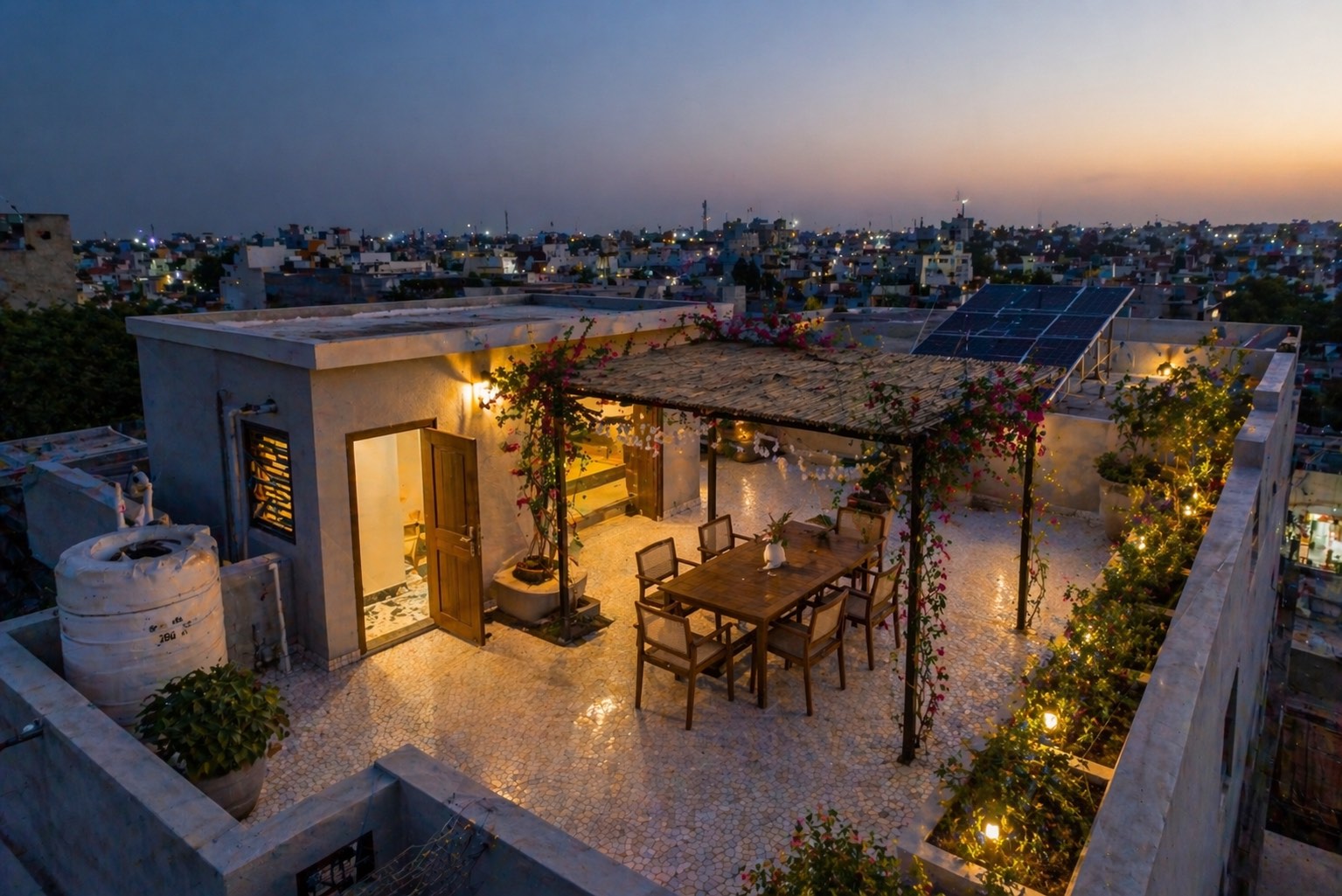
Terrace Planning — Structural and Functional Considerations
A Professional Guide to Designing Indian Residential Terraces for Use, Durability, and Beauty
In the architecture of the Indian home, the terrace is the forgotten floor. It is the floor every home has, the floor that delivers the most outdoor square footage per rupee in compact urban plots, the floor that can host the rainwater harvesting tank and the solar PV array and the morning tea spot and the children's cricket practice and the Saturday evening party. And yet, in most Indian homes, it is the floor that was designed as if it were leftover — a flat slab topped with perfunctory china-mosaic, a parapet thrown up to 900 mm (below the NBC 2016 safe minimum), one water outlet that clogs within a monsoon, and no thought to zoning, loading, or the uses it will actually be called to serve.
This guide treats the terrace as a primary design element. It covers the structural basis (what the slab must carry, how to size reinforcement, what loads to anticipate), the waterproofing build-up (the seven-layer section that stands or falls with attention to detail), drainage and slope (required by NBC 2016 Part 9 and habitually neglected), parapet design (NBC 1,050 mm minimum, with aesthetic and safety options), the zoning of functions across the terrace plan, solar PV integration, rainwater harvesting from the terrace, gardens (containers, raised beds, green roofs), access from the house, microclimate (pergolas, shading, wind management), and a consolidated catalogue of failure modes that repeat in residential practice.
"The roof is the forgotten elevation. Get the roof wrong and you have undone whatever the walls did right." — Charles Correa (1930–2015)
1. What the Terrace is For
Before structure or finish, decide what the terrace is for. The functional programme determines loading, zoning, and priorities.
Eight Common Terrace Uses in Indian Homes
| Use | Frequency | Loading implication |
|---|---|---|
| Informal family gathering (tea, evening sit-out) | Daily | Light foot traffic; furniture |
| Formal entertaining (parties, festivals) | Monthly | Higher live load concentration |
| Children's play space | Weekly | Safety rails; impact-resistant surface |
| Gardening (containers / raised beds) | Ongoing | Point loads from planters; drainage |
| Clothesline (practical necessity) | Daily | Moisture management |
| Solar PV / water heating | Permanent | Structural loading + anchor points |
| Rainwater harvesting reservoir | Permanent | Tank load + plumbing |
| Yoga / meditation | Daily (if active) | Smooth, level surface |
| Puja or ritual space (some traditions) | Frequent | Clean, low-traffic zone |
| Guest sleep-out (hot nights) | Seasonal | Smooth floor + shade + privacy |
A single terrace can accommodate six or seven of these simultaneously if zoned well. A terrace planned for only one function — or worse, for none — squanders the opportunity.
The Functional Rule
Decide the functional programme at Stage 2 (site + brief) of planning, not Stage 6 (construction drawings). A terrace whose purposes are known from the start is engineered differently — different slab thickness, different waterproofing strategy, different parapet, different anchor provisions — than a terrace whose uses emerge post-occupancy. The cost of retrofitting a terrace for a heavy garden or a solar array is 3–5× the cost of providing for it at construction.
2. Structural Loading — What the Slab Must Carry
Load Categories
Terrace slabs must be designed for the sum of five load categories (IS 875 Part 1 and Part 2; NBC 2016 Part 6):
| Load category | Description | Typical value (kg/m²) |
|---|---|---|
| Self-weight (dead load) | Slab + screed + finish | 350–500 |
| Terrace build-up (superimposed dead) | Waterproofing + insulation + tiles | 60–120 |
| Live load — general | Occupants, furniture | 150–300 |
| Live load — heavy garden | Wet soil + plants | 300–600 |
| Live load — equipment | Water tank, AC, solar | variable, concentrated |
| Wind load | Uplift on canopies, pergolas | 30–60 kg/m² |
| Seismic | Proportional to dead + live | IS 1893 |
Live Load Specification for Terraces
IS 875 Part 2:1987 specifies:
| Terrace type | Live load (kg/m²) |
|---|---|
| Inaccessible (maintenance only) | 75 |
| Accessible — general residential | 150 |
| Accessible with light access (tea, garden) | 200 |
| Accessible with gatherings | 300 |
| Accessible with heavy garden / bulk storage | 400–600 |
| Accessible with roof pool / tank | 1,000+ (concentrated) |
A residential terrace designed for "occasional gatherings" at 200 kg/m² live is adequate for normal use but fails under a large garden (400+ kg/m²) or a heavy water tank placed mid-span. Specify the live load at the brief stage to match the intended use.
Slab Thickness
For a typical residential terrace with 3.5 m–4.5 m clear span and 200 kg/m² live load:
| Clear span (m) | Slab thickness (mm) | Reinforcement (TMT) |
|---|---|---|
| 3.0 | 125 | 8 mm @ 150 c/c both ways |
| 3.5 | 135 | 10 mm @ 150 c/c main; 8 mm @ 200 c/c dist |
| 4.0 | 150 | 10 mm @ 125 c/c main; 8 mm @ 150 c/c dist |
| 4.5 | 165 | 12 mm @ 150 c/c main; 10 mm @ 200 c/c dist |
| 5.0 | 180 | 12 mm @ 125 c/c; distribution 10 mm @ 150 c/c |
| 5.5 | 200 | Consider secondary beam |
Grade of concrete: M25 minimum for exposed terraces (IS 456:2000 exposure category "severe" for structures exposed to rain). Cover: 25 mm minimum from top reinforcement face to exposed surface (for corrosion protection under monsoon exposure).
Point Loads
Point loads deserve separate attention:
- Water tank (2,000 L, 2 × 1.5 × 0.8 m filled): ~2,000 kg concentrated in 3 m² → 670 kg/m² local. Requires a stiffened support pad or secondary beam directly under the tank.
- Solar PV (12 panels, 3 kW): ~230 kg total distributed over 20 m² + mounting structure 50 kg = 14 kg/m² average; no special provision for modern roof PV.
- Heavy planters (0.6 × 1.5 m filled with soil): ~400 kg each = 500 kg/m² local. Plan planter positions over beams, not mid-span of slabs.
Structural Consultation
For any terrace intended for:
- Heavy gardens (continuous planters > 500 kg/m²)
- Green roofs (intensive type, > 400 kg/m²)
- Pools or water features > 500 L
- Roof structures (pergolas, cabins, machine rooms)
Involve a structural consultant at the planning stage. Retrofitting additional loading onto an existing slab typically requires strengthening — steel beams bolted under the slab, or RCC jacket — at 5–10× the cost of providing for the load at construction.
3. The Seven-Layer Build-Up — Waterproofing Done Right

The terrace build-up — the sequence of layers from structural slab to walking surface — is where most residential terrace failures originate. A well-built terrace follows a consistent seven-layer logic.
The Seven Functional Layers
| Layer | Function | Material | Thickness |
|---|---|---|---|
| 1. Structural slab | Load-bearing | RCC M25 grade | 125–200 mm per span |
| 2. Base screed with slope | Level + slope to drains | Cement:sand 1:4 | 15–25 mm |
| 3. Thermal insulation | Reduces heat gain | XPS 40 mm, brick-bat coba, or EPS | 40–100 mm |
| 4. Waterproofing membrane | Water barrier | APP-modified bitumen, liquid PU, or cementitious crystalline | 3–5 mm |
| 5. Protection board | Shields waterproofing from damage | Fibre-cement or high-density polystyrene | 6–8 mm |
| 6. Screed | Final slope + finish bed | Cement:sand 1:4 | 20–50 mm |
| 7. Finish | Walking surface | Ceramic tile / vitrified / IPS / china mosaic | 10–25 mm |
Total build-up: 220–320 mm above the structural slab. This must be accounted for in planning — a terrace wall detail drops by the build-up thickness, parapet height dimensions are measured from the finish surface, and drainage outlets are placed below the finish.
Order Matters
The sequence above (insulation BELOW waterproofing) is the "warm roof" configuration. An inverted sequence (waterproofing below insulation) produces a "cold roof" or "inverted roof" — possible but more demanding. The warm roof is the default for Indian residential; it puts insulation at the thermal interface and waterproofing at the water interface.
Waterproofing Systems
Three systems dominate Indian residential practice:
1. APP-modified bitumen (torch-applied) — Pre-fabricated 3–5 mm bitumen sheets welded (by propane torch) to the substrate. Most common in India. Cost: ₹120–200 per m². Service life: 15–20 years.
2. Liquid applied — polyurethane (PU) — Seamless coating applied in 2–3 coats; flexible; handles substrate movement. Cost: ₹250–400 per m². Service life: 20–25 years.
3. Cementitious crystalline — Chemical that crystallises in concrete pores; integral to the slab. Cost: ₹80–150 per m². Service life: matches concrete lifetime but brittle (cracks if substrate moves). Best as a secondary layer beneath a bitumen or PU membrane.
IS 3067:1988 (Code of Practice for General Design Details and Preparatory Work for Damp-Proofing and Waterproofing of Buildings) and IS 6494:1988 (Code of Practice for Waterproofing of Underground Water Reservoirs and Swimming Pools) govern construction details. Critical provisions:
- Turn-up at parapet: 300 mm minimum up the parapet wall; waterproofing wraps around the corner
- Drain collars: Waterproofing drapes into and over the drain inlet
- Expansion joint treatment: Separate piece of membrane over every structural joint
- Penetrations (pipes, conduits): Waterproofing wrapped around each penetration with puddle flange
The Pond Test
Before applying the protection board and subsequent layers, fill the entire terrace with 50 mm of water and leave for 48 hours. Any leak — a drop from the ceiling below, a damp patch on any wall — fails the test and must be repaired before proceeding. The pond test is mandatory per IS 3067. Indian residential projects routinely skip it; the leak shows up six months later during the first heavy monsoon.
4. Drainage and Slope
Slope Requirement
NBC 2016 Part 9 and IS 2527 require a minimum slope of 1:80 (12.5 mm fall per metre) on any flat terrace, towards designated drain outlets. Common failures:
- No slope designed — flat terrace pools water; water finds micro-depressions; standing water seeps through tile grout over months
- Insufficient slope (< 1:100) — water moves slowly, settles in dips from construction tolerance
- Slope in wrong direction — water flows towards parapet rather than drain; ponds at the wall-floor junction
The slope is built into the screed, not relied upon from the slab. A properly cast slab is level (by tolerance); the screed creates the slope deliberately and precisely.
Drainage Capacity
Number of rain-water outlets (RWOs) required per NBC 2016 Part 9:
| Roof area | Minimum RWOs |
|---|---|
| Up to 40 m² | 1 |
| 40–80 m² | 2 |
| 80–150 m² | 3 |
| 150–200 m² | 4 |
| Above 200 m² | 5+ |
Each RWO must be sized for the local peak rainfall intensity. For most Indian cities (peak intensity 150 mm/hr during heavy monsoon):
Required RWO diameter = √(4 × A × i / (π × v)) where A = roof area per RWO (m²), i = rainfall intensity (m/s = 150/3,600,000 = 4.17×10⁻⁵), v = water velocity at outlet (1–2 m/s).
For A = 50 m², required RWO = √(4 × 50 × 4.17×10⁻⁵ / (π × 1.5)) = ~75 mm. Typical residential RWOs are 100–150 mm, providing 2–3× safety factor — appropriate given debris accumulation (leaves, monsoon silt).
RWO Positioning
- Place RWOs at the lowest points of the slope
- Never directly at corners (harder to achieve slope from all directions towards corner)
- Place at least 300 mm from parapet (clearance for waterproofing turn-up + access)
- Protect with leaf guards or vortex breakers (prevent clogging by leaves)
- Include emergency overflow scuppers — 50 mm above main RWO level, through parapet wall, for the case where main RWO clogs
Downpipe
Downpipes conduct water from RWO to ground or to RWH tank. Specifications:
- Material: UPVC or GI; 100–150 mm diameter typical
- Support: brackets at 2.5 m intervals maximum
- Connection to RWH: via a first-flush diverter (see Rainwater Harvesting Guide and the Rainwater Tank Sizer)
- Connection to ground: splash pad + connection to storm drain
5. Parapet Design — Safety and Aesthetics

NBC 2016 Part 3 requires a parapet or guard rail of minimum 1,050 mm height on any accessible roof. Three parapet options dominate Indian practice.
1. Solid Masonry Parapet
Description: A wall — typically 230 mm brick or 100–150 mm RCC — rising from the terrace slab. Coping stone (stone, pre-cast concrete, or tile) caps the top to shed water and prevent slow erosion.
Specifications:
- Height 1,050 mm minimum above finished terrace
- Thickness: 230 mm brick (traditional) or 150 mm RCC (modern)
- Coping: 75 mm pre-cast concrete or granite stone, with slight outward slope for drip
- Weep holes: every 2 m to drain water trapped behind coping
- Waterproofing turn-up: 300 mm minimum up the parapet wall, continuing the terrace membrane
Cost: ₹4,500–7,000 per linear metre (including finish both sides)
Pros: Privacy, structural heft, blocks wind, durable
Cons: Blocks view, feels constraining, reduces cross-ventilation at terrace level
2. Railing (Glass / Metal)
Description: A low kerb (100–200 mm RCC) with a railing (glass panel or metal balustrade) above, reaching 1,050 mm total height.
Specifications:
- Kerb: 100–150 mm RCC cast with slab; waterproofing turns up over it
- Railing: 10–12 mm toughened glass panels OR stainless steel posts with horizontal / vertical members
- Gap between elements: < 100 mm (child-safety sphere test)
- Handrail cap: necessary on glass for finger-hold and cleaning
- Wind load: compute per IS 875 Part 3; for exposed high-rise, detailed analysis required
Cost: ₹8,000–18,000 per linear metre (glass more expensive)
Pros: Open views, airy feel, allows wind through
Cons: Higher cost, maintenance (glass cleaning), wind-exposed residents may feel insecure
3. Planter-Integrated Parapet
Description: A linear planter runs the full edge of the terrace. The outer wall of the planter serves as the 1,050 mm barrier; the inner edge has a low rail to prevent falls into the planter.
Specifications:
- Outer planter wall: 150 mm RCC, height 1,050 mm from terrace finish
- Planter depth: 600 mm (width) × 400–600 mm (soil depth)
- Inner rail: 200–400 mm low rail to prevent toe-stub or fall into planter
- Waterproofing: dedicated planter membrane + drainage mat at planter base; separate from terrace floor waterproofing
- Structural load: 300–600 kg/m² in planter zone — verify slab capacity
- Integrated irrigation: drip system with automatic timer
Cost: ₹12,000–25,000 per linear metre (includes planter waterproofing + drainage)
Pros: Biophilic, cools by evapotranspiration, provides privacy, shade, wind filter
Cons: Structural load premium, ongoing garden maintenance, substantial initial cost
Parapet Selection Matrix
| Priority | Recommended parapet |
|---|---|
| Maximum view, budget-moderate | Glass or metal railing |
| Privacy from neighbouring buildings | Solid masonry |
| Biophilic / cooling / aesthetic | Planter-integrated |
| Premium aesthetic | Glass + planter hybrid (planters define zones within terrace) |
| Budget-constrained | Solid masonry (cheapest, proven, safe) |
| High-rise / wind-exposed | Solid masonry (also for safety in strong wind) |
Coping Detail
The coping — the topmost element of a masonry parapet — is not decorative. It prevents water from running down the parapet wall and staining the facade below. Good coping:
- Projects 30–50 mm past both faces of the parapet (drip course)
- Slopes slightly outward (towards the street, not towards the terrace)
- Material: dense stone (granite, basalt) OR concrete with integral waterproofer; never porous stone (sandstone, limestone) which absorbs moisture
- Set on waterproofing-compatible adhesive; no steel pins directly into coping (corrosion)
6. Zoning the Terrace — Functional Layout

A terrace is not a single space; it is a plan with zones. Good zoning reflects sun path, activity type, service adjacency, and service access.
Five Zones Typically Accommodated
1. Circulation zone — stair access to the terrace; mumty (small rain-shelter over stair head) essential for monsoon access; adjacent storage cabin if space permits.
2. Utility zone — clothesline (daily necessity); water tank; washing area; RWH filter unit; service tap. Best placed near the stair (minimises carrying distance) and on the shaded or less-visible side (clothesline is not the terrace's hero).
3. Garden zone — raised-bed planters, potted trees, vertical trellis on the parapet. Best placed on the east or south side for morning sun; paired with drip irrigation and a service tap.
4. Entertaining zone — the central usable space with furniture, pergola overhead, perhaps an outdoor kitchen or grill. The hero of the terrace plan.
5. Solar + water zone — PV panels, solar water heater, overhead water tank. Best placed on the south or southwest (maximum sun exposure), minimising shading from garden or pergola.
Zone Placement Principles
- Garden east — morning sun for plants, afternoon shade from parapet (if west-facing)
- Solar south — unshaded year-round; panel panels tilted at latitude ± 15°
- Utility west or shaded — less visible; close to stair for carrying access
- Entertainment centre — pergola-shaded; access from multiple sides
- Circulation corner — stair head in one corner; frees remaining area
Integration With Downstairs
The terrace connects to the top-floor interior. That connection should be:
- Direct stair access — no locked door that shuts off the terrace as "upstairs' private area"; ideally the stair lands in a lobby near the master bedroom or family area
- Mumty + weather shelter — the stair top must be weather-sheltered; a 2 × 2 m mumty covers stair head, provides rain shelter for entry, and can double as a small store
- Visual connection — if possible, design the top-floor landing with a window facing the terrace (a preview / sightline to the outdoor space)
- Utility runs — electrical, water, sewage pipes that serve the terrace must route through the interior; plan these at construction
7. Solar PV on the Terrace
For any Indian home with a grid electricity bill > ₹3,000 per month, rooftop solar PV has become cost-effective. The terrace is the obvious installation location.
System Sizing
| System size | Area required (approx) | Daily generation (kWh/day) | Residential suitability |
|---|---|---|---|
| 1 kW | 7 m² | 4 | Small home, apartment roof |
| 2 kW | 14 m² | 8 | 2–3 BHK |
| 3 kW | 20 m² | 12 | 3–4 BHK |
| 5 kW | 35 m² | 20 | 4+ BHK or joint family |
Rule of thumb: 1 kW of PV produces ~4–5 kWh/day in India (varies 3.5 kWh in Jammu, 5.5 kWh in Rajasthan).
Installation Considerations
- Orientation: panels tilt towards south; angle = latitude ± 10° (shallower in summer, steeper in winter; 15° is a good year-round compromise in tropical/subtropical India)
- Shading: any shading on any panel reduces the entire string output disproportionately; ensure no parapets, trees, or neighbouring buildings shade the array for more than 1 hour on any winter day
- Wind loading: IS 875 Part 3; mounting must handle uplift; use ballasted mount (no roof penetration) OR bolt-through-waterproofing with properly sealed penetrations
- Inverter location: typically in utility zone or on the floor below; accessible for maintenance
- Net metering connection: application to state discom; 2–4 week approval process
Cost and Payback (2026 estimates)
| Item | Cost |
|---|---|
| 3 kW system complete (panels + inverter + mounting + net meter) | ₹1.4–1.8 lakh |
| Annual generation | 4,300 kWh |
| Saved (avoided tariff @ ₹7.50/kWh) | ₹32,000/year |
| Payback | 4.4–5.6 years |
| Service life | 25 years |
Solar PV is now one of the highest-ROI home investments available in India. The barrier is typically space (a compact 30×40 terrace may only accommodate 2–3 kW, not the 5 kW the home could use).
8. Rainwater Harvesting from the Terrace
The terrace is the catchment area for residential rainwater harvesting. A 52 m² terrace in Bengaluru (970 mm annual rainfall, 0.85 runoff coefficient for RCC) produces approximately 43,000 L per year — enough to offset 4–6 months of household water for a 4-person family.
The Rainwater Tank Sizer computes the optimal tank capacity for any combination of roof area, city, household size, and water tariff. The Rainwater Harvesting guide provides the full system context.
Integration at Terrace Level
- First-flush diverter at the downpipe — diverts the dirty first 2 mm/m² of each rain event away from the tank
- Filter unit on the terrace before downpipe (or at ground, before the tank) — sand + gravel + activated charcoal
- Tank — on the terrace (overhead) for gravity feed, OR on the ground (with pump back up). Terrace tanks add roughly 2,000 kg (2,000 L full) to slab load — plan for this structurally.
- Overflow — to ground-level recharge pit, not to storm drain (maximises groundwater recharge)
- Maintenance access — filter + tank must be accessible from the terrace for quarterly cleaning
9. Gardens — Containers, Raised Beds, Green Roofs
Three Garden Approaches
1. Container garden — potted plants on the terrace floor. Easiest, most flexible, no structural modifications.
- Pot sizes: 18 inch diameter × 15 inch deep for shrubs; 24 inch for small trees
- Self-watering pots with reservoir (reduces watering from daily to weekly)
- Saucer plate or terracotta drainage plate under each pot (prevents staining)
- Concentrated load: a 24 inch pot with wet soil weighs ~80 kg; position over beams where possible
- Weight on slab: ~50 kg per pot = 25–40 kg/m² average for a container garden
2. Raised bed — a linear planter built into the terrace (typically along the parapet as part of a planter-integrated parapet, or as a freestanding low wall with soil). More ambitious than containers.
- Depth: 400–600 mm soil for shrubs and small ornamentals; 600–800 mm for food crops
- Drainage: gravel base + drainage mat + perforated drain pipe to RWO
- Waterproofing: dedicated bed-bottom waterproofing separate from terrace waterproofing (raised bed is its own pond)
- Weight: 400–600 kg/m² in the planter zone — requires structural verification
- Irrigation: drip system with timer is essential (hand-watering 10+ m of bed daily is unsustainable)
3. Green roof (extensive / intensive) — the full terrace surface (or a large portion of it) becomes a living garden.
| Green roof type | Substrate depth | Weight (kg/m², wet) | Plant types |
|---|---|---|---|
| Extensive | 75–150 mm | 150–250 | Sedums, grasses, herbs (low maintenance) |
| Intensive | 300–800 mm | 400–800 | Shrubs, small trees (requires gardening) |
Green roofs deliver substantial benefits — insulation, stormwater retention, biodiversity, amenity — but they are serious design undertakings:
- Slab must carry 2–3× the load of a standard terrace
- Specialised waterproofing with root barrier (TPO membranes preferred)
- Integrated drainage: drainage mat + filter fabric + substrate
- Irrigation: usually sub-surface drip
- Maintenance: twice-yearly weeding and pruning for extensive; more intensive for large-plant varieties
- Cost: ₹2,500–5,000 per m² initial (extensive); ₹8,000–15,000 per m² (intensive)
For most Indian residences, container gardens are the practical default, with occasional raised beds along the parapet. Green roofs are a premium choice for villas with committed garden maintenance.
Plant Selection for Indian Terraces
| Climate | Recommended plants (container / raised bed) |
|---|---|
| Hot-Dry | Cacti, succulents, bougainvillea, hibiscus, neem (small), drumstick |
| Warm-Humid | Banana, papaya, coconut (small varieties), hibiscus, tuberose |
| Composite (Bengaluru) | Most Indian ornamentals: jasmine, rose, tulsi, curry leaf, lemon |
| Cold (Shimla) | Geranium, petunia, marigold, dahlia, apple saplings |
Avoid: trees that grow > 4 m (root damage + weight); plants requiring heavy fertiliser (runoff stains); plants prone to pest outbreaks in your climate.
10. Pergolas, Shading, and Microclimate
A flat terrace in Indian summer is inhospitable — solar radiation on the surface reaches 800+ W/m², and air temperature 2–3 °C above ambient due to radiation from heated surfaces. Shading is the primary tool for making the terrace useful in daytime.
Shading Options
| Option | Coverage | Cost | Permanence |
|---|---|---|---|
| Pergola (bamboo / timber + creepers) | Selective (dappled) | ₹800–2,500 /m² | Permanent but refreshable |
| Pergola (steel + fabric) | Adjustable | ₹1,500–4,000 /m² | Semi-permanent |
| Retractable awning | Selective | ₹2,500–6,000 /m² | Flexible |
| Umbrella (garden umbrella) | Focused | ₹3,000–15,000 per umbrella | Movable |
| Shade sail (fabric tensioned) | Large area | ₹1,500–3,500 /m² | Semi-permanent |
| Integrated roof canopy | Full | ₹4,000–10,000 /m² | Permanent |
Pergola with vines is the classic Indian solution — aesthetic, seasonal (deciduous vine gives shade in summer, bare branches allow winter sun), and improves with age. Popular vines: bougainvillea (showy), jasmine (fragrant), grape (edible), clematis (delicate).
Microclimate Management
Beyond direct shade, several strategies manage terrace microclimate:
- Light-coloured surfaces — white or pale china-mosaic; Solar Reflectance Index > 75 keeps surface cool
- Planters — transpiration from plants cools adjacent air by 1–3 °C; a continuous planted edge meaningfully tempers the terrace climate
- Water feature — a 500 × 500 mm reflecting pool or small fountain provides evaporative cooling (works in hot-dry; less effective in warm-humid)
- Pergola with deciduous vine — summer shade, winter sun — the classic bioclimatic move
- Wind break — bamboo or cane screen on the exposed face; reduces peak wind while allowing breeze through
11. Common Failure Modes
A catalogue of failures that recur in Indian residential terrace construction:
Structural Failures
| Failure | Cause | Prevention |
|---|---|---|
| Slab cracks at mid-span | Live load exceeds design; unexpected heavy garden or tank | Specify live load at brief; structural verification |
| Deflection at parapet corner | Point load from water tank placed mid-span | Place tanks over beams or columns |
| Slab sag over time | Inadequate reinforcement; poor compaction | Design per IS 456; proper curing |
Waterproofing Failures
| Failure | Cause | Prevention |
|---|---|---|
| Leak at parapet-slab junction | Waterproofing turn-up inadequate (< 300 mm) | Always turn up 300 mm with continuous detail |
| Leak at drain collar | Drain not wrapped in membrane | Waterproofing drapes into drain and 50 mm below |
| Efflorescence on ceiling below | Water ingress through cracks or grout joints | Pond-test before commissioning; repair any leaks immediately |
| Tile lift-up in monsoon | Water penetrating grout, freezing not applicable, capillary action at edges | Water-permeable grout; joint sealant at perimeters |
| Waterproofing damaged during subsequent work | Workers installing AC, planters, or solar walk on exposed membrane | Protection board placed immediately after waterproofing |
Drainage Failures
| Failure | Cause | Prevention |
|---|---|---|
| Standing water / ponding | Slope not built into screed; slope toward wrong direction | Design slope explicitly; test with water before finish |
| Drain blockage (monsoon) | Leaves, silt, debris accumulate | Quarterly inspection; vortex breakers; gratings |
| Roof overflow in heavy rain | Insufficient RWOs or inadequate pipe size | Provide 2× the calculated minimum RWOs |
| Water splashes onto parapet | Weep holes missing in parapet; coping non-performing | Weep holes every 2 m; coping projects past parapet |
Parapet Failures
| Failure | Cause | Prevention |
|---|---|---|
| Coping stones loose | Improper anchoring; thermal expansion | Use stainless-steel dowels; leave movement joints |
| Cracking of parapet wall | Differential movement; no expansion joints | Expansion joints every 4 m in long runs |
| Efflorescence / staining on parapet | Water running down without drip detail | Coping with 40 mm overhang + drip groove |
Garden Failures
| Failure | Cause | Prevention |
|---|---|---|
| Planter-bottom waterproofing fails | Ad-hoc waterproofing; no root barrier | Dedicated TPO or EPDM with root barrier |
| Drain chokes (garden zone) | Soil, roots, leaves clog drain | Filter fabric at drain; regular inspection |
| Plant death (heat, drought) | Over-ambitious plants; irrigation failure | Choose climate-appropriate plants; automatic drip |
12. Worked Example — 52 m² Bengaluru Terrace
A complete terrace plan for the 30×40 ft (112 m²) Bengaluru home from the Compact Urban Home guide.
Brief
- Family of 5 (eventually 7 when in-laws join)
- Usable outdoor space priority
- Morning yoga + evening tea as key uses
- 3 kW solar PV desired
- 2,000 L overhead water tank
- Rainwater harvesting tank (underground, but filter on terrace)
- Clothesline (essential, Indian practical necessity)
Structural Design
- RCC slab 150 mm M25, 4.0 m max clear span; reinforced 10 mm @ 125 c/c main + 8 mm @ 150 c/c distribution
- Live load design: 300 kg/m² (accessible residential with gatherings)
- Point load for water tank: 2,500 kg over 3 m² = 833 kg/m² — positioned over central beam, reinforced locally with 12 mm bars
- Solar PV: 230 kg distributed over 20 m² — negligible local reinforcement
Build-Up (seven layers, bottom to top)
1. RCC slab 150 mm (structure)
2. Base screed 20 mm with primary slope towards drain
3. Insulation: 50 mm XPS over slab (reduces top-floor heat gain 60 %)
4. Waterproofing: 4 mm APP-modified bitumen, torch-applied
5. Protection board: 6 mm fibre-cement
6. Screed: 30 mm with final slope 1:80
7. Finish: white china-mosaic (SRI 75) in entertaining + utility zones; granite flagstone (flamed) in garden zone
Zoning (per the [terrace-zoning-plan.svg] diagram)
| Zone | Area (m²) | Location | Features |
|---|---|---|---|
| Circulation + mumty | 10 | NW corner | Stair head + rain shelter + storage |
| Utility | 10 | W edge | Clothesline + water tank + RWH filter + service tap |
| Garden | 10 | NE / E | Raised bed + container plants + drip irrigation |
| Entertaining | 15 | Centre | Pergola + table + seating |
| Solar PV | 7 | S / SW | 3 kW (12 panels) |
Total 52 m², fully utilised.
Parapet
- Main parapet: 150 mm RCC with 1,050 mm height; china-mosaic finish; granite coping with drip
- Garden zone: planter-integrated parapet (600 mm wide raised bed becomes the exterior wall)
- Entertainment zone: standard solid parapet; modest views through NE corner
- Solar zone: low kerb only (600 mm) where panels flush-mount onto the slab surface (no visual fall risk because panels block the edge)
Drainage
- 3 RWOs (100 mm diameter) at low points: SW corner, NW corner, E edge
- Emergency overflow scupper at 50 mm above main RWO level in parapet, one per RWO
- Single downpipe to ground, diverting to RWH tank at basement (under stilt)
Cost Estimate (Bengaluru 2026)
| Item | Cost (₹) |
|---|---|
| Waterproofing (52 m²) at ₹180/m² | 9,360 |
| Insulation XPS 50 mm at ₹300/m² | 15,600 |
| Finish (china-mosaic + granite) mixed at ₹500/m² | 26,000 |
| Parapet + coping 30 lin.m at ₹5,500/m | 1,65,000 |
| Pergola (5 × 3 m) steel + timber | 85,000 |
| Drip irrigation + planters + garden | 40,000 |
| Solar 3 kW | 1,60,000 |
| 2,000 L water tank + plumbing | 25,000 |
| Drain + downpipe + RWH integration | 35,000 |
| Misc + finishes | 30,000 |
| Total | ~5,90,000 |
For a terrace that hosts solar PV (recovering its cost in 5 years), a daily-use outdoor room, a garden, a clothesline, and RWH — this represents perhaps ₹11,000 per m² of functional outdoor space, roughly 20 per cent of the cost per m² of enclosed interior space. The terrace is, by a considerable margin, the cheapest high-quality outdoor space a compact-plot Indian home can deliver.
References
- Bureau of Indian Standards (1987) IS 875 (Part 2):1987 — Code of Practice for Design Loads (other than Earthquake) for Buildings and Structures — Imposed Loads. New Delhi: BIS.
- Bureau of Indian Standards (1988) IS 3067:1988 — Code of Practice for General Design Details and Preparatory Work for Damp-Proofing and Waterproofing of Buildings. New Delhi: BIS.
- Bureau of Indian Standards (1988) IS 6494:1988 — Code of Practice for Waterproofing of Underground Water Reservoirs and Swimming Pools. New Delhi: BIS.
- Bureau of Indian Standards (2000) IS 456:2000 — Plain and Reinforced Concrete — Code of Practice. New Delhi: BIS.
- Bureau of Indian Standards (2015) IS 875 (Part 3):2015 — Wind Loads. New Delhi: BIS.
- Bureau of Indian Standards (2016) SP 7:2016 — National Building Code of India 2016, Part 6 (Structural Design), Part 9 (Plumbing Services). New Delhi: BIS.
- Ashby, M.F. (2016) Materials Selection in Mechanical Design. 5th edn. Oxford: Butterworth-Heinemann.
- Ching, F.D.K. (2020) Building Construction Illustrated. 6th edn. Hoboken: John Wiley & Sons.
- Correa, C. (1985) The New Landscape: Urbanisation in the Third World. Mumbai: Book Society of India.
- Doshi, B.V. (2011) Paths Uncharted. Ahmedabad: Vastu Shilpa Foundation.
- Dunnett, N. and Kingsbury, N. (2008) Planting Green Roofs and Living Walls. 2nd edn. Portland: Timber Press.
- Environment Design Guide (2010) Green Roofs: Benefits, Design, and Construction. Melbourne: Australian Institute of Architects.
- Getter, K.L. and Rowe, D.B. (2006) 'The role of extensive green roofs in sustainable development', HortScience, 41(5), pp. 1276–1285.
- IEA (2022) Renewables 2022 — Analysis and Forecast to 2027. Paris: International Energy Agency. (For solar PV economic figures.)
- Jaiswal, K., Bansal, A.K. and Khurmi, N. (2019) 'Cool roof technologies for residential buildings in Indian climate zones', Building and Environment, 153, pp. 109–121.
- MNRE (2023) Rooftop Solar Programme Phase II. New Delhi: Ministry of New and Renewable Energy, Government of India.
- Oberndorfer, E. et al. (2007) 'Green roofs as urban ecosystems: ecological structures, functions, and services', BioScience, 57(10), pp. 823–833.
- Peck, S.W., Callaghan, C., Kuhn, M.E. and Bass, B. (1999) Greenbacks from Green Roofs: Forging a New Industry in Canada. Ottawa: Canada Mortgage and Housing Corporation.
- Santamouris, M. (Ed.) (2006) Advances in Passive Cooling. London: Earthscan.
- Synnefa, A., Santamouris, M. and Akbari, H. (2007) 'Estimating the effect of using cool coatings on energy loads and thermal comfort in residential buildings in various climatic conditions', Energy and Buildings, 39(11), pp. 1167–1174.
- Thukral, D. (2017) Roof and Terrace Gardening in India: A Practical Guide. New Delhi: MacMillan.
Author's Note: The terrace is the most neglected and most reclaimable element of the Indian residential home. It is designed last (if at all), receives the least attention in detail drawings, and is routinely botched in construction — and yet it is often the element that yields the highest satisfaction per rupee of invested design effort. The numbers in this guide — the seven-layer build-up, the 1:80 slope, the 1,050 mm parapet, the 300 mm waterproofing turn-up, the IS 3067 pond test — are not controversial; they are settled practice. What is less settled is the commitment to actually implement them. A terrace that survives twenty years of Indian monsoon without leak is a terrace that followed these rules; one that leaks in year three is one that departed from them. The guide is a restatement of those rules plus the functional-planning toolkit that makes the terrace worth building well.
Disclaimer: This article is for informational and educational purposes only. It does not constitute professional architectural, structural, or waterproofing engineering advice. Terrace design and construction must be undertaken by qualified architects, structural engineers, and licenced waterproofing contractors in accordance with NBC 2016, IS 456, IS 875, IS 3067, IS 6494, and all applicable local bye-laws. Solar PV installations require MNRE-empanelled installers and state discom net-metering approval. Studio Matrx, its authors, and its contributors accept no liability for decisions made on the basis of the information contained in this guide.
Export this guide
Related Tools — Try Free
Rainwater Tank Sizer
How big should your rainwater tank be? Computes annual harvest, recommended tank capacity in litres, water-bill savings, and payback — for 10 Indian cities.
RWH CalculatorCross-Ventilation Analyzer
Estimate airflow and air changes per hour (ACH) from room size, window areas, layout, and local wind — with NBC 2016 Part 8 compliance check.
Ventilation CalculatorApartment Furniture Size Chart
Standard furniture dimensions for Indian apartments — sofas, beds, tables, dining, storage.
Reference Chart