
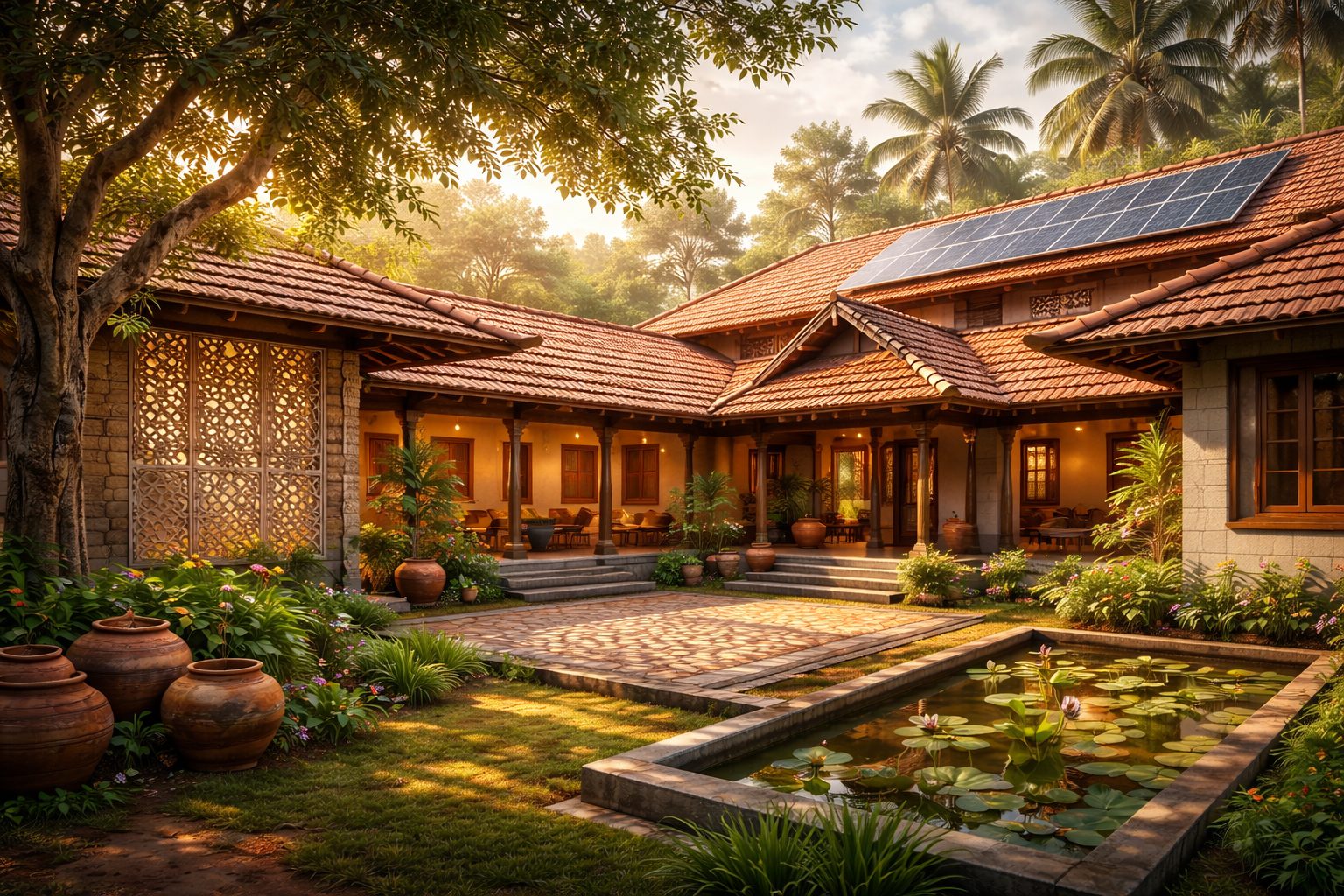
Sustainable Home Design in India
A Practical Guide to Climate, Craft, and Conscience in the Indian Home
There is a question that quietly shapes every Indian family's life, though we rarely name it: what does it mean, in this country, in this climate, in this century, to build a home? For most of us, the answer has become unthinking — four concrete walls, a flat RCC slab, tiled floors, an air conditioner or two, and the hope that the EMIs will end before the building begins to age. It is a recipe we have accepted almost without asking whether it suits us, or whether it is kind to the land it stands on.
It is not. India is urbanising faster than almost any society in history — the McKinsey Global Institute estimates that 600 million of us will live in cities by 2031 — and our construction sector already swallows close to 40% of the country's total energy. Every cement bag, every steel rod, every glazed window we install today carries a bill that our children, and their children, will be asked to pay. How we design our homes is no longer a question of taste. It is a question of conscience.
And here is the quiet, astonishing thing: India already knows how to do this. We have known for a thousand years. The stepwells of Gujarat, the jaalis of Rajasthan, the courtyards of Tamil Nadu's agraharam houses, the sloping tiled roofs of Kerala's nalukettu — every one of them is a masterclass in climate-responsive, material-wise, community-rooted design. We did not forget this wisdom because it stopped working. We forgot it because, somewhere along the way, we were told concrete was modern and courtyards were quaint. Charles Correa said it gently but firmly: "open-to-sky spaces are the most important element in Indian architecture." We unlearned him. It is time to remember.
This guide is an attempt at that remembering. It is a practical look at what sustainable home design means in the Indian residential context — the principles, the precedents, the contemporary examples, the honest challenges, and the policy landscape — written not as a policy paper but as a conversation between people who care about homes.
So what does "sustainable home design" actually mean?
Strip away the jargon and the rating-system acronyms and the answer is simple: a sustainable home is one that treats the earth, the people who live in it, and the people who built it, with basic decency. It uses less energy than it needs to. It drinks water carefully. It chooses materials that do not bleed the planet to be born. It keeps its occupants cool in May and warm in January without demanding a second salary in electricity bills. And — this part gets forgotten — it remains affordable enough that ordinary families, not just wealthy ones, can actually live in it.
Formally, these ideas are codified through rating systems like GRIHA (Green Rating for Integrated Habitat Assessment), developed by TERI and the Ministry of New and Renewable Energy, and the internationally recognised LEED, administered by the US Green Building Council. But ratings are only a scaffolding. The real work happens earlier — in the first sketch, the first orientation decision, the first honest conversation with a client about what they truly need a home to do for them.
"Buildings are responsible for approximately one-third of global final energy consumption and nearly 40% of total direct and indirect CO₂ emissions." — International Energy Agency, 2019
In the Indian context, the work spans passive solar design, natural ventilation, rainwater harvesting, low-embodied-energy materials, rooftop solar, thoughtful waste management, and landscapes that remember what a neem tree is for. It also spans something less often named: social sustainability. A house that is green but only the rich can afford is not, in the full sense of the word, sustainable.
Our grandparents knew
Long before anyone earned a GRIHA star or a LEED plaque, Indian master builders were quietly solving problems that our best software still struggles with. The traditional Indian home was, without ever naming itself so, a sustainable design machine — shaped over centuries to fit a specific sky, a specific soil, a specific way of life.
In the blast-furnace summers of the Thar Desert, the havelis of Jaisalmer and Shekhawati stood behind thick sandstone walls that absorbed the day's fury and released it slowly through the cool of the night — thermal mass, centuries before the term existed. Their jaali screens, carved stone as delicate as lace, were natural air conditioners, breaking the desert wind into soft currents and dappling the sunlight into patterns you could read by. Architect and urban planner Revathi Kamath, in her writings on vernacular architecture, put it beautifully: traditional builders "understood the physics of heat, wind, and water intuitively, and encoded that knowledge in building typologies passed down through generations."
In Kerala, the nalukettu — four wings folded around a central open courtyard, the nadumuttam — did something magical: it let the house breathe. Hot air rose out of the courtyard, cool air was drawn in from shaded colonnades, and the whole structure hummed with a gentle, ceaseless circulation. Sloping tiled roofs shed the monsoon with grace. Generous eaves shielded walls and windows from both sun and rain. The materials were laterite, responsibly-harvested timber, and clay tiles — all low in embodied energy, all endlessly recyclable, all local enough that building a house supported the village rather than draining it.
The wadas of Maharashtra, the havelis of Gujarat, the Bengali thakur dalan — each one carries the same wisdom: the central courtyard as climate moderator, social space, and spiritual axis. And then there was Laurie Baker, the gentle British-Indian architect who spent most of his life in Kerala building homes ordinary families could afford, using rat-trap bond brickwork, filler slab roofs, and whatever the land around him offered. His homes used up to 40% less material than conventional construction, and the world noticed — not because they were cheap, but because they were beautiful.
"The best architecture is the one that serves the largest number of people in the most sensitive way with the least possible resources." — Laurie Baker
The principles, in plain language
1. Let the building do the work
The cheapest unit of energy is the one you never had to buy. Passive design begins with the simplest decision of all — which way does the house face? In most of India, orienting a home with its longer axis running east-west captures gentle winter sun while turning its shoulder to the brutal western afternoon. The Climate Consultant software from UCLA's Energy Design Tools Group is widely used by Indian architects to read local climate data and tailor strategies for each of India's five climatic zones — hot-dry, warm-humid, composite, cold, and temperate.
Cross-ventilation and stack ventilation, done well, can keep a house comfortable for most of the year without touching an AC switch. TERI's research shows that well-designed naturally ventilated homes in India's composite climate zone maintain thermal comfort for 70–80% of the year, cutting energy consumption by 30–50% compared to fully air-conditioned homes. That is not a marginal saving. That is a transformed electricity bill.
2. Choose materials as if they mattered (because they do)
Every material carries a memory of its own making — the energy burned to mine it, fire it, ship it, lift it into place. That memory is called embodied energy, and it is one of the most consequential decisions in home construction. Manufacturing one tonne of Portland cement releases roughly 0.8 tonnes of CO₂, making cement the third-largest industrial contributor to global greenhouse gas emissions. Alternatives with dramatically lower embodied energy exist and are available in India today: compressed earth blocks, fly-ash bricks, reclaimed stone, bamboo, engineered timber.
The table below, drawn from Indian Green Building Council data and the University of Bath's Inventory of Carbon and Energy, tells the story at a glance.
| Material | Embodied Energy (MJ/kg) | CO₂ Equivalent (kg/kg) | Sustainability |
|---|---|---|---|
| Portland Cement (OPC) | 5.6 | 0.83 | Low |
| Fly-Ash Brick | 1.4 | 0.14 | High |
| Compressed Earth Block | 0.45 | 0.03 | Very High |
| Burnt Clay Brick | 3.0 | 0.24 | Moderate |
| Bamboo (engineered) | 0.5 | 0.01 | Very High |
| Recycled Steel | 9.5 | 0.43 | Moderate |
| Laterite Stone | 0.2 | 0.02 | Very High |
Source: Indian Green Building Council (IGBC) Material Data, 2020; Hammond & Jones, Inventory of Carbon & Energy (ICE), University of Bath, 2011.
3. Treat water like the treasure it is
India is running out of water, and we all know it even when we refuse to say it. Groundwater tables are falling across the country, and the municipal tanker has become a familiar feature of city life. A sustainable home is not allowed to pretend this away. Rainwater harvesting, greywater recycling, and water-efficient fixtures have to be standard equipment, not showroom extras. The National Building Code of India (NBC 2016) makes rainwater harvesting mandatory for new residential buildings above a certain plot size in water-stressed cities, though enforcement is uneven. The arithmetic is compelling: a well-designed rooftop harvesting system in a city like Bengaluru — which receives around 970 mm of rain a year — can yield 50,000 to 80,000 litres per 1,000 sq ft of roof, every year. That is enough to meaningfully untether a home from the municipal supply.
4. Put the sun to work
The price of solar photovoltaic panels has fallen by over 90% between 2010 and 2023 — one of the most dramatic cost declines in industrial history. Rooftop solar, once the domain of eco-enthusiasts, is now simple financial common sense. India's National Solar Mission, launched in 2010, set ambitious capacity targets, and net metering policies in most states let homeowners export surplus power and earn credits. A 3 kWp rooftop system — roughly ₹1.5–2 lakh after subsidies — generates 4,000–4,500 units of electricity a year in peninsular India, enough to cover a significant share of an average household's needs. For most families, the panels pay for themselves in five to seven years, and then quietly hand them free electricity for another twenty.
"India has the potential to be the world's first major economy to achieve sustainable development through renewable energy. The homes we build today will determine whether we honour or betray that potential." — R. K. Pachauri, Former Chair, IPCC
Homes that are already doing it right
The Auroville Earth Institute in Pondicherry has, since 1989, quietly trained thousands of builders and architects from across the world in compressed earth block technology, earth plaster, and vaulted roofs inspired by Nubian architecture. The homes built at Auroville make a case that is hard to argue with: ultra-low-carbon construction can also be breathtakingly beautiful, deeply comfortable, and entirely suited to India's warm-humid climate. If you have ever walked into one on a May afternoon, you already know.
In Haryana, the Institute for Rural Research and Development (IRRAD) took the idea into the space where it matters most — affordable housing. Using fly-ash blocks, filler slab roofs, and passive cooling, their Sustainable Affordable Housing project built homes 20–25% cheaper than conventional RCC construction while keeping indoor temperatures 4–6 °C lower in peak summer. Cheaper, cooler, greener. The trilemma, turned into a solved problem.
And in the high-design end of the market, architects like Khozema Chitalwala and Sanjay Puri have been proving that sustainability and architectural distinction are not at odds. Sanjay Puri's Sand Dunes Residence in Rajasthan — winner of the WAN Sustainable Buildings Award — uses a series of stepped walls and terraces aligned with prevailing winds to keep the house naturally ventilated year-round. Air conditioning, in most seasons, is simply not needed. It is a reminder that passive design, done with care, is as much a gift to the eye as to the climate.
The honest ledger: what works, what still hurts
What sustainable design gives back
The strongest argument, for most families, turns out to be financial. Upfront costs can run 5–15% higher depending on the choices made, but lifecycle numbers almost always come out ahead. GRIHA-rated buildings in India consistently deliver 30–50% lower energy bills and 20–40% lower water bills, with payback periods of five to seven years on efficiency investments. After that, the savings simply compound — year after year, decade after decade, quietly.
The non-financial gifts are harder to price but easier to feel. A well-designed passive home holds its temperature gently; it does not swing from oven to icebox every time someone touches the AC remote. Studies in hot-dry climatic zones show measurably higher thermal comfort satisfaction and lower rates of heat-related illness among residents of passive solar homes compared with residents of conventional apartments. Your body, it turns out, notices.
There is a civic dividend too. Homes with rooftop solar, battery storage, rainwater tanks, and composting systems are resilient homes. They cope with the power cuts, water shortages, and waste collection failures that are, let us be honest, still part of daily life in much of urban India. This matters especially in semi-urban and rural settings, where "self-sufficient home" is not an aesthetic — it is a necessity.
Zoom all the way out, and the picture is even clearer. India has committed, under the Paris Agreement, to reducing the emissions intensity of its GDP by 45% by 2030. The building sector represents the single largest cost-effective opportunity to get there. Every sustainable home built is a small, stubborn contribution to a promise made on behalf of all of us.
Where it still hurts
Pretending the path is smooth would be disrespectful to everyone who has actually walked it. The first barrier is the one everyone names: upfront cost. Lifecycle maths may favour sustainability, but Indian construction finance is dominated by short-term thinking, and most homebuyers — especially in the mass market — are acutely sensitive to initial outlay. Green mortgages with preferential interest rates, standard in markets like the UK and Australia, are only just beginning to appear here. SBI and a few others have started offering modest concessions. It is a start. It is not yet enough.
The second barrier is deeper and rarely discussed: skilled labour. Passive house construction, earth building, bamboo work, and advanced waterproofing all require specialised hands, and those hands are scarce in almost every Indian city. Our construction trades are structurally disadvantaged — low wages, informal employment, almost no training infrastructure. No amount of client enthusiasm can fix this without sustained investment from the state. If we want sustainable homes at scale, we will have to first build the people who can build them.
And then there is regulation. Many of India's building bye-laws and development control regulations were drafted in the 1970s and 1980s, and some of their provisions actively work against sustainable design — setback rules that prevent optimal solar orientation, floor-space-index calculations that penalise double-height spaces and internal courtyards, height restrictions that hamstring natural ventilation. The rules we wrote before we understood the climate are now standing in the way of the climate solutions we need. They can be rewritten. They must be.
| Dimension | What it gives back | Where it still hurts |
|---|---|---|
| Financial | 30–50% lower energy bills; long-term lifecycle savings | Higher upfront cost (5–15%); green finance still scarce |
| Comfort | Stable indoor temperatures; cleaner air | Asks occupants to adapt their habits |
| Environment | Lower carbon footprint; real water conservation | Some "green" products still carry hidden embodied energy |
| Skill & Labour | Creates dignified green jobs | Acute shortage of trained craftspeople |
| Policy | NBC 2016 and ENS provide a framework | Outdated bye-laws, uneven enforcement |
| Social | Thermal equity; community resilience | Still out of reach for most low-income families |
What the rest of the world is teaching, and what India can teach back
Internationally, the gold standard for energy-efficient homes is the Passivhaus standard, developed in Germany by Dr Wolfgang Feist. Passivhaus-certified buildings use up to 90% less heating and cooling energy than conventional ones. The standard was originally written for cold European climates, but its core principles — airtight envelope, superinsulation, heat-recovery ventilation, careful solar gain — are being adapted for tropical and subtropical climates through the Passive House Institute's Tropical Passivhaus work, which has real promise in coastal Indian cities.
"The greenest building is the one that is already built. But when we must build new, let us build as if the planet's health depends on it — because it does." — Carl Elefante, Former President, AIA
Singapore offers perhaps the most instructive parallel for India. Its climate is close to ours along the coasts, and its Building and Construction Authority has mandated Green Mark certification for all new buildings above a certain size since 2008. The result is a built environment that has been transformed in a single generation. Australia's NatHERS (Nationwide House Energy Rating Scheme) offers another useful reference. India's GRIHA, by contrast, remains largely voluntary, and its uptake in the residential sector has been modest. Making GRIHA or an equivalent mandatory for all new residential buildings above 500 sq mt — as the IGBC has recommended — would be transformative. It is the single policy lever that could move the most, soonest.
What needs to change, and who needs to change it
There has been real progress. India's Energy Conservation Building Code (ECBC) was extended to residential buildings in 2017 through the Eco-Niwas Samhita (ENS), which sets minimum energy performance standards for new residential buildings with ten or more units. It is a meaningful beginning. But beginnings are not endings, and implementation is uneven — most building departments and Urban Local Bodies still do not incorporate ENS compliance into their approval processes in any serious way.
A full policy package for turning India's residential construction sector toward sustainability would need, at minimum, to do six things:
- Make GRIHA or an equivalent mandatory for all new residential buildings above a defined size
- Create green mortgage incentives through public-sector banks
- Rewrite building bye-laws so they reward rather than punish sustainable design
- Invest seriously in vocational training for sustainable construction trades
- Run honest public awareness campaigns to shift consumer demand
- Enforce what is already on the books
The Centre for Science and Environment (CSE) has been making exactly this argument for years, most fully in its landmark report "India's Green Buildings: Turning Potential into Reality" (CSE, 2019). It deserves to be read and acted on.
A house is a promise
Sustainable home design is not a trend, and it is not a luxury. It is a return — to our own climate, our own materials, our own wisdom — carried forward with tools and science our grandparents could only have dreamed of. The vernacular tradition gives us the intuitions. Material science, renewable energy, and digital design tools give us the precision. What is missing is only the will: from governments, developers, architects, and families alike, to make sustainability the default and not the exception.
The stakes could not be higher. India will build more floor space in the next twenty years than any other country on earth. The decisions being made right now — in design offices, in municipal chambers, in bank boardrooms, in living rooms across the country — will decide whether that construction wave becomes a climate catastrophe, or a gift the rest of the world learns from. A house, in the end, is a promise: to the people who live in it, to the land it stands on, and to the future that will inherit it. It is still in our hands to make that promise a kind one.
"Architecture is not just about buildings. It is about civilisation. And civilisation, in the end, is measured by how wisely we have used the earth that was given to us." — B. V. Doshi, Pritzker Laureate, 2018
References:
- Baker, L. (1986). Mud: Toward an Architecture in India. Laurie Baker Archive, Thiruvananthapuram.
- Bureau of Energy Efficiency, Government of India (2022). Annual Report 2021–22. New Delhi: BEE.
- Centre for Science and Environment (2012). Rainwater Harvesting and Augmentation of Groundwater: A Manual for Urban Areas. New Delhi: CSE.
- Centre for Science and Environment (2019). India's Green Buildings: Turning Potential into Reality. New Delhi: CSE.
- Hammond, G. & Jones, C. (2011). Inventory of Carbon & Energy (ICE), Version 2.0. University of Bath.
- International Energy Agency (2019). Global Status Report for Buildings and Construction. Paris: IEA.
- McKinsey Global Institute (2010). India's Urban Awakening: Building Inclusive Cities, Sustaining Economic Growth.
- Ministry of New and Renewable Energy, Government of India (2023). Annual Report 2022–23.
- TERI (2012). Energy Efficiency in Buildings. New Delhi: TERI Press.
- TERI (2021). India Energy Outlook 2021. New Delhi: TERI Press.
- TERI-GRIHA (2022). Annual Report 2021–22. New Delhi: GRIHA Council.
- World Resources Institute (2019) — cited for global construction data.
Export this guide
Related Tools — Try Free