
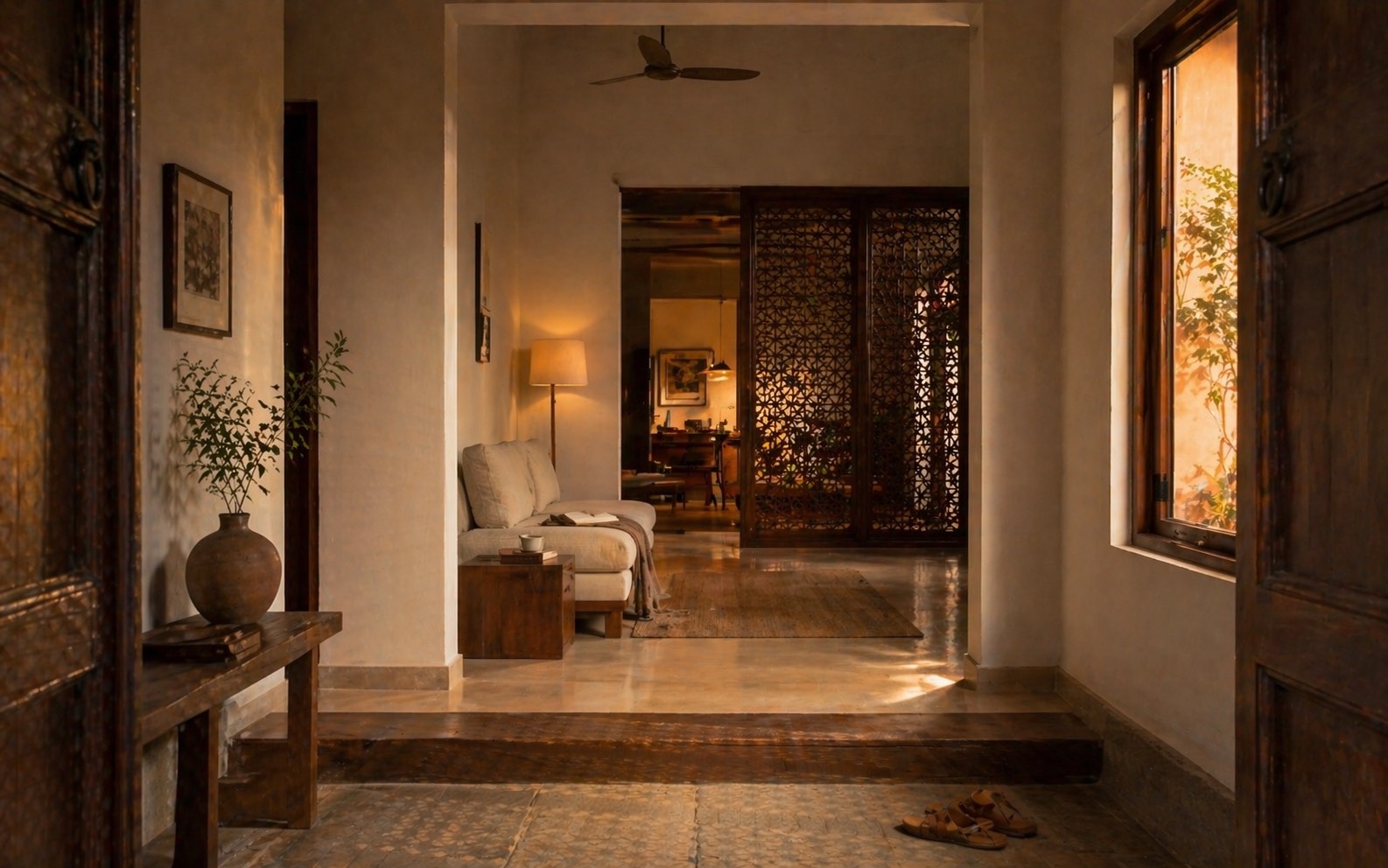
Space Zoning in Indian Homes — Public vs Private Areas
Privacy Gradients, Sightlines, and the Cultural Logic of Indian Domestic Space
Every home has a politics. The question of who enters which room, who sees which room, who uses which room at what hour, and who is kept out of which room — this question is what zoning resolves. In Indian domestic architecture, the politics of zoning has been a refined art for a long time, because the Indian household has always been more than a nuclear unit. Multi-generational living, servants, guests, tradespeople, delivery agents, ritual officiants, festival visitors — every layer of Indian domestic life generates a category of person who belongs in some parts of the house and not in others. Good zoning is what enables all these layers to coexist without friction.
Modern apartment planning has largely lost this sophistication. The open-plan Western model that dominates contemporary Indian residential design assumes a nuclear family in a nuclear house — and then doesn't know what to do when grandparents move in, when festival guests arrive, when a domestic worker needs to enter without crossing the drawing room, when a teenager wants acoustic privacy from a television at 11 pm. The result is a generation of homes that feel subtly wrong in ways that their occupants can articulate but their designers often cannot.
This guide is a technical reconstruction of Indian residential zoning: how to think about it, how to lay it out, how to test it. The guide draws on three bodies of knowledge — the architectural literature on domestic zoning (Alexander, Ching, Rapoport), the anthropological literature on Indian household structure (Lawrence, Kent, Shah), and the proxemics tradition started by Edward Hall — to produce a workable synthesis for contemporary Indian practice.
"A house is a theatre; the rooms are acts; the zones are scenes. A well-zoned house allows each scene to play without interrupting the next." — Adapted from Rapoport (1969), House Form and Culture
1. Why Zoning Matters — Four Kinds of Privacy
"Privacy" in domestic design is a bundle of different things that non-architects often conflate. Zoning resolves them by giving each its own set of tools.
The Four Privacies
| Type | What it is | Zoning tool |
|---|---|---|
| Visual privacy | Not being seen through a sightline | Physical barriers, offset corridors, screen walls |
| Acoustic privacy | Not being heard; not hearing others | Wall mass, room separation, corridor buffering |
| Olfactory privacy | Cooking smells, toilet smells not reaching other zones | Exhaust systems, door closures, spatial separation |
| Circulation privacy | Not being in the way of household traffic | Separate circulation paths for different users |
A bedroom that is acoustically private (walls are 230 mm brick) may still suffer from visual privacy failure (door opens directly onto living room). A kitchen with separate exhaust may still have olfactory failure (smells leak through the dining-room door when opened). Good zoning addresses all four simultaneously, because failure in any one degrades the experience of the room.
Why Privacy Matters Functionally, Not Just Culturally
Privacy is not a cultural preference — it is a psychological necessity, established in the proxemics research of Edward Hall (Hall, 1966) and in environment-behaviour research (Altman, 1975; Zeisel, 2006). The consequences of inadequate privacy include:
- Elevated baseline stress / sympathetic nervous-system activation (measurable via cortisol)
- Reduced restorative sleep quality in bedrooms with inadequate acoustic isolation
- Higher conflict rates in multi-generational households that lack zone separation
- Cognitive task impairment in work-from-home setups without visual privacy
Privacy is, in other words, a health and productivity issue as much as a cultural one. Designing for it is not luxury; designing without it is neglect.
"When people talk of privacy, they often mean four different things at once. The architect's job is to give each of them what they actually need." — Edward T. Hall (1914–2009), proxemics researcher
2. The Four-Zone Model
The canonical framework for residential zoning in Indian practice divides the house into four zones:

Zone Definitions
| Zone | Name | Who belongs | What goes here |
|---|---|---|---|
| Zone 1 | Public | Guests, tradespeople at entry | Entry, foyer, living room, formal dining, guest bedroom, front verandah |
| Zone 2 | Semi-public | Extended family, close friends | Family room, informal dining, study, staircase lobby, interior courtyard |
| Zone 3 | Private | Resident family | Master bedroom, children's bedrooms, attached baths, puja, personal terrace |
| Zone 4 | Service | Domestic workers, delivery, service | Kitchen, utility, servant quarters, service entry, storage |
The four-zone model is the foundation of Indian residential zoning, reflected explicitly in SP 41 functional requirements (BIS, 1987) and implicitly in every good plan.
How the Zones Interact
The four zones are not rigid — they interact at specific interfaces, each with its own rules:
- Public ↔ Semi-public — fluid interface; a guest may be invited into the family room if intimacy grows. Architecturally, often the same continuous space, with spatial or treatment cues marking the transition.
- Semi-public ↔ Private — selective interface; family members move through, guests don't. Architecturally, a transitional corridor or a hinge room (lobby, study).
- Private ↔ Private — bedroom-to-bedroom. Acoustically separated but not visually; shared corridor OK.
- Service ↔ Public — should not interact directly. Service circulation runs parallel. The kitchen is the single legitimate bridge.
- Service ↔ Private — minimal direct contact. Servants should not need to pass through private zones.
The Privacy Gradient
When the plan is laid out well, a visitor experiences a graduated sequence of increasing privacy:
Street → Gate → Driveway → Entry porch → Shoe removal → Foyer → Living (Public) → Family (Semi-public) → Corridor → Bedrooms (Private)
Each step is a privacy threshold. Good plans make these transitions explicit through spatial cues (change of ceiling height, change of floor material, turning of direction, constriction then expansion). Bad plans put the bedroom corridor directly off the living room without spatial mediation, collapsing the gradient and producing the common modern-apartment feeling of "bedrooms are too exposed."
3. The Worked Example — A Well-Zoned 3BHK

The plan above is a worked 3BHK apartment with all four zones clearly articulated. Key features:
- Public zone occupies the front half: entry, living, formal dining. This is the zone guests see.
- Semi-public zone sits centrally: family room + puja room + transitional corridor. This is the hinge.
- Private zone is distributed to the right (bedrooms) and left (guest room / study). Bedrooms are set back from the public zone by the full depth of the semi-public hinge.
- Service zone runs along the bottom edge: kitchen (connected to dining for function), utility, common baths, servant access. The service entry is distinct from the main entry.
Read the Plan as Four Parallel Tracks
Three circulation tracks coexist without crossing:
1. Guest track: Main entry → foyer → living → (returns same way)
2. Family track: Main entry → foyer → living → family room → bedrooms (via corridor hinge)
3. Service track: Service entry → kitchen → utility (separate from guest/family movement)
The tracks share the kitchen-dining interface (the hinge point where food crosses from service to social) but do not otherwise overlap. This is the zoning logic the traditional Indian courtyard house achieved at its best — and what good modern plans recover.
Why This Works
1. A guest in the living room sees only the living room. The bedroom corridor is not visible (the family room wall breaks the sightline).
2. A servant entering at service entry reaches the kitchen without crossing any social zone.
3. The puja room is in the NE quadrant (traditional Vastu) and accessible from the semi-public family zone, where morning rituals naturally occur.
4. The master bedroom has a privacy buffer (corridor) from the most social space (living).
5. Bedroom-to-bedroom walls are on non-shared axes — avoiding the "two beds sharing a wall" acoustic problem.
6. The kitchen is a two-access-point room — social (via dining) and service (via utility) — the only room in the plan designed to straddle zones.
4. Sightline Management
One of the most underappreciated elements of zoning is sightline management — controlling what a person standing or sitting at any given position can see. A plan is zoned well only if the sightline test passes.

The Sightline Test
1. Mark the likely positions of a visitor on the plan — typically: standing at the front door, seated in the living room, seated at formal dining.
2. From each position, trace all unobstructed sightlines to other parts of the plan.
3. List every private-zone or service-zone space visible from any visitor position.
4. Zero tolerance: no bedroom interior, no master-bed, no bathroom door, no kitchen mess, no servant zone should be visible from a visitor position.
Common Sightline Failures
| Failure | Typical cause | Fix |
|---|---|---|
| Bedroom interior visible from living | Corridor doorway directly opposite living seating | Offset corridor entrance; add screen wall |
| Master bed visible through open bedroom door | Bed centred on door axis | Relocate door to corner; or redirect bed |
| Kitchen mess visible from dining | Open-plan with no sight-break | Raised counter / screen / half-wall between dining and kitchen |
| Toilet door visible from dining | Compact plans with corridor opening off dining | Add alcove; relocate toilet |
| Servant quarters visible from living | No service corridor | Reorganise service zone behind a wall |
| Neighbour's interior visible from window | Unshaded window facing adjacent unit | Frosted glass; translucent film; jali; curtain |
Treatment of Transitional Thresholds
Even when sightlines pass, zoning can be strengthened by marking transitions:
- Foyer threshold — change of floor material (stone at entry, tile or wood beyond); change of ceiling height (lower at entry, taller in living); change of light (brighter ambient outside, softer inside).
- Semi-public → Private — arch, portal, step-up, or doorway. The doorway does not need to be a literal door; a change of passage width or a half-wall can do.
- Service entry — mat, rack, hand-wash basin at entry. Service workers should have a functional place to transition.
These small architectural gestures are what convert a plan from functional to felt — the sort of subtle spatial differentiation that makes a home feel like a sequence of rooms rather than an open warehouse.
"The threshold is the place where one thing becomes another. Every good home is a sequence of thresholds." — Christopher Alexander, A Pattern Language (1977)
5. The Indian Privacy Gradient — Why It Differs from Western Models
Western residential design traditionally works with a simple public-private binary: entry and living room on one side, bedrooms on the other. Indian domestic architecture has developed a more nuanced gradient, for reasons that reward examination.
Why the Indian Gradient is Finer
Four factors shape the finer Indian gradient:
1. Multi-generational occupancy. A household of grandparents + parents + children needs at minimum a three-tier zone structure: elder private, parent private, young-adult private — plus the social zone. The Western two-tier (public-private) collapses this into one generic "bedroom" category.
2. Extended hospitality tradition. Guests arriving unannounced, staying for tea, staying for meals, staying for days — this is an active Indian domestic practice. The formal dining room, guest bedroom, separate puja room all serve this. Western homes rarely sustain this pattern.
3. Domestic workers. Most Indian middle-income and above households have daily, often live-in domestic workers. The service-zone circulation is architecturally necessary to allow them to work without crossing social spaces — something not replicated in equivalent Western homes.
4. Ritual practices. Puja (daily ritual), festival preparations (bulk cooking, elaborate decoration), life-cycle events (birth, marriage, death rituals) — each requires dedicated spatial accommodation with specific privacy requirements. Puja space is not just semi-public in Indian homes; it is a distinct category.
The Traditional Response
Historical Indian typologies developed specific architectural devices to manage this finer gradient:
| Device | Zone function | Traditional example |
|---|---|---|
| Chabutara / Thinnai | Outer public threshold; social gatherings, visitors received without entering the house | Rajasthani haveli, Tamil agraharam |
| Deori / Dehli | Shoe-removal, visitor vetting, entry into the domestic proper | North Indian courtyards |
| Aangan / Nadumuttam | Central courtyard, family + close-guest zone, ritual space | Kerala nalukettu, Gujarati pol |
| Bethak / Diwan Khana | Formal male-guest receiving room | Haveli, zamindari homes |
| Zenana / Antahpura | Private women's quarters | Mughal and pre-Mughal north India |
| Rasoi ghar / Koodam | Kitchen and service zone, separated from social spaces | Ubiquitous across regions |
| Devasthan / Puja ghar | Ritual space, private but elevated within the home | Ubiquitous |
Modern apartment planning has compressed these distinctions into rough equivalents: chabutara becomes lobby, aangan becomes family room, bethak becomes living room, zenana becomes bedrooms, devasthan becomes puja room or cupboard. Much is lost in the translation, but the underlying logic of the gradient survives — and good contemporary practice revives as much as apartment constraints permit.
6. Zoning Across Apartment Typologies
Zoning strategy varies significantly by apartment size. The four-zone model scales down but never disappears.
1BHK (45–60 m²)
The smallest apartments collapse zones 1 and 2 into a single living-dining-kitchen continuum. The single bedroom is Zone 3. Service (Zone 4) is essentially the kitchen counter and utility niche.
| Zone | In a 1BHK |
|---|---|
| Public / Semi-public | Combined living-dining-kitchen open plan |
| Private | The single bedroom (+ attached bath) |
| Service | Kitchen-utility strip |
Zoning moves at this scale: door to bedroom not visible from front door; tall headboard wall shields bed from visitor sightlines; kitchen is in a niche with a half-wall breakfast counter, not fully open to living; attached bath door angled away from living sightlines.
2BHK (60–90 m²)
The two-bedroom apartment can articulate zones more clearly. Living separates from bedroom zone via a short corridor or foyer hinge. Service zone is distinct (kitchen + utility room).
Key zoning moves:
- Master bedroom buffered from living (corridor or study between)
- Second bedroom for children, guests, or WFH office — flexible zoning
- Kitchen-dining continuous but with visual screen from main living
- Service entry if possible; otherwise main entry used for both (compromise)
3BHK (90–130 m²)
The classic Indian middle-income typology. All four zones articulate fully. Worked example in Section 3 above.
4BHK / Villa (130 m² +)
Larger typologies allow elaboration of the gradient — formal vs informal dining, separate puja room, dedicated study, guest suite with independent access, servant quarters with separate staircase.
Key zoning moves at villa scale:
- Formal public zone (guest-only) separated from family-public zone
- Elder parents' suite on ground floor (age-in-place)
- Children's zone on upper floor (acoustic separation)
- Service zone with independent staircase (servant circulation to kitchen on any floor)
- Private terrace, garden, pool each sit in their own zone class
Villa-Scale Zoning Matrix
| Zone | Ground floor | First floor | Terrace level |
|---|---|---|---|
| Public | Entry, drawing, formal dining, guest suite | Family lounge (if second living), informal dining | Entertaining terrace |
| Semi-public | Family room, library, home office | Study, landing | Covered seating |
| Private | Elder parents' suite | Master, children's bedrooms | Private terrace |
| Service | Kitchen, utility, storage | Service lift landing | Drying area |
7. Multi-Generational Household Zoning
Multi-generational living is the most demanding zoning challenge in Indian residential design. A typical household may include:
- Grandparents (Zone 3A, requiring ground-floor accessibility, proximity to puja)
- Parents (Zone 3B, requiring privacy from both generations)
- Children / young adults (Zone 3C, requiring acoustic independence)
- Occasional live-in relatives (Zone 3D, requiring flexible guest space)
- Daily domestic workers (Zone 4, requiring service-only access)
Each sub-zone has its own privacy requirements and its own functional needs.
Grandparent Zoning
Principles:
- Ground-floor location. Stairs become impossible with knee or hip issues; life events (fall, illness) require step-free access.
- Attached bathroom. Shared bathroom access at age 70+ is a fall risk at night. Attached bath with grab-bars is the accessibility standard.
- Proximity to puja. Morning ritual is a daily practice; walking to a distant puja room becomes impossible when mobility declines.
- Visual connection to family zone. Grandparents should see and hear the family, not feel isolated. A semi-open door arrangement or glass-panel partition serves this.
- Independent controls. AC, lighting, fan — accessible from the bed.
Children / Young-Adult Zoning
Principles:
- Acoustic separation from parents' bedroom. Teen bedtimes differ from adult ones; music/TV/call audio spills cross walls without mass.
- Study space within or adjacent. A study desk in the bedroom, or a shared study between sibling rooms, serves academic work.
- Flexibility over time. A 12-year-old's room and a 22-year-old's room have different needs; design for evolution (movable furniture, non-prescriptive built-ins).
- Daylight and view. Teenagers and young adults spend substantial hours in their bedrooms; north-light studies, views to greenery, and personal windows matter more than they do for the generic bedroom.
Domestic Worker Zoning
Principles:
- Separate service entry where possible.
- Direct service-to-kitchen access without passing through social zones.
- Dedicated bathroom (servant quarters) — a dignity issue, not just functional.
- Acoustic buffer between servant sleeping space and family bedrooms — live-in workers' early-morning activity shouldn't disturb family sleep.
- Visual separation of servant drying area, utility space — these shouldn't be visible from family zones.
The Modern Apartment Problem
Most Indian apartments are not designed for multi-generational occupancy. They have two or three bedrooms of similar proportions, no designated elder suite, no accessible attached bathroom, and no separate service access. When a family's parents move in, the apartment is stressed beyond its zoning capacity — and the stresses produce the recurring complaints of multi-generational households in apartment living.
The architect who designs for this reality — explicitly, at the brief stage — is designing for a substantially different plan than the generic modern apartment. Ground-floor bedrooms, attached accessible baths, independent circulation to kitchen, acoustic wall upgrades, puja proximity — these become defining design moves rather than afterthoughts.
"The Indian home has always been a house for three generations. When we design it as if it were a house for one, we fail the generations at both ends." — Paraphrased design-writing observation
8. Acoustic Zoning — Wall Mass and Sound Privacy
Acoustic privacy is the most frequently neglected zoning dimension. Walls that pass visual and spatial zoning may fail acoustic zoning — and the failure only shows at night, when the TV in the living room wakes a sleeping child, or when a phone conversation in the master bedroom is audible in the child's room.
Sound Transmission Class (STC) — What Walls Actually Do
| Wall Type | STC Rating | Conversation audibility |
|---|---|---|
| 75 mm hollow gypsum | 28–32 | Clearly audible |
| 115 mm brick plastered both sides | 42 | Audible but unintelligible |
| 150 mm brick plastered both sides | 47 | Muffled; only raised voices audible |
| 230 mm brick plastered both sides | 52 | Essentially inaudible |
| 230 mm brick + 50 mm cavity + 115 mm brick | 58–62 | Complete privacy |
| 150 mm AAC plastered both sides | 45 | Similar to 150 brick |
| Double gypsum with insulation | 48–55 | Depends on fill |
Acoustic Zoning Targets
| Wall between | Target STC |
|---|---|
| Bedroom and bedroom (same house) | ≥ 47 |
| Bedroom and living | ≥ 52 |
| Bedroom and kitchen | ≥ 52 |
| Bedroom and bathroom (same user) | ≥ 45 |
| Bedroom and bathroom (different user) | ≥ 52 |
| Living and kitchen | ≥ 42 |
| Between units (party wall in apartments) | ≥ 55 (regulatory in some states) |
Acoustic Zoning Mistakes
Shared wall between two bedrooms, with bed-heads on the shared wall. Bedtime conversations, TV audio, even turning-in-sleep sounds cross easily. Rule: beds should never back onto a wall shared with another bedroom. Place wardrobes on shared walls instead — wardrobes add mass and break the sound path at the bed headboard.
Bathroom wet-wall shared with a neighbouring bedroom. Shower noise, WC flushing, plumbing noise — all carry. Rule: wet walls stack over wet walls, not against bedrooms.
Kitchen exhaust duct running through a bedroom soffit. Motor vibration transmits. Rule: run exhaust ducts through service or common-area soffits only.
Single 115 mm wall between master and a young child's room. STC 42 means all conversation is audible. Rule: upgrade to 150 mm; add wardrobes on both sides of the wall.
Cost of Acoustic Upgrade
Upgrading a wall from 115 mm brick (STC 42) to 230 mm brick (STC 52) adds approximately ₹180–250 per linear metre of wall at current Indian material costs (labour + material). Over a 100 m² apartment with ~40 m of internal walls, the full upgrade costs ₹7,200–10,000 — a rounding error in total project cost, for a substantial comfort gain. Yet apartment developers routinely use 115 mm internal walls to save this small amount, at the cost of the product's lifetime acoustic quality.
9. Puja, Ritual, and Symbolic Zoning
The puja room is a category of its own — simultaneously private (intimate ritual space) and symbolically central (cosmologically oriented, visible in family life). Its zoning requires particular care.
Puja Room Placement Rules
Traditional (Vastu):
- Ideal direction: NE quadrant of the home
- The deity faces East or West (user faces East or West when seated)
- Should be on the ground floor; avoid puja above or below bedrooms/toilets
- Not adjacent to WC, not above or below WC
- Enter without crossing the kitchen
Functional (modern practice):
- Accessible in the morning hours from where the family sleeps
- Quiet location — not abutting a TV wall
- Well-ventilated (incense, camphor, oil lamps require air movement)
- Space for at least two seated users; storage for ritual items
- Clear sightline to the deity, without the room being a thoroughfare
Practical Zoning Decisions
In 1BHK and 2BHK apartments, the dedicated puja room is often infeasible. Alternatives:
- Puja niche — a 0.6 × 0.6 m alcove in the living/dining wall, with folding doors that close for privacy
- Puja shelf — a mounted wall piece with task lighting, located near the kitchen or in a central circulation spine
- Puja cupboard — a tall cabinet with internal shelving, doors closed during non-ritual hours
In 3BHK and larger, a dedicated room is usually possible. Typical sizes: 1.5 × 1.5 m to 2 × 2 m — adequate for intimate family ritual, with an aisle for seating.
Symbolic Zoning
The puja room is sometimes the only "symbolic" zoned space in a modern Indian apartment — but the principle extends to other elements:
- The verandah / chabutara equivalent — a symbolically public outdoor threshold; even in an apartment, a 2 × 1 m covered seating niche near the entry recovers something of this
- The hall of family photographs — typically a semi-public corridor wall where family history is displayed; a deliberate placement decision
- The wedding / family crest — in some communities, a family marker plaque displayed at the entry threshold
Even when not tied to explicit ritual, these symbolic markers reinforce zoning by giving each zone its own character and identity.
"The puja corner in a modern Indian home is a fold in space — the sacred nested into the secular. It proves that zoning is not just functional but poetic." — Adapted from Correa (1985)
10. Verification — Testing the Zoning of a Plan
Zoning is tested by three operational checks that an architect can run on any plan.
Test 1 — The Sightline Test
Covered in Section 4 above. Stand (mentally or physically) at every likely visitor position. Trace sightlines. Private zones should not be visible. This catches 60 per cent of zoning failures.
Test 2 — The Circulation Test
Pick any two rooms in the plan. Count the number of rooms traversed to get from one to the other.
| Trip | Acceptable room traversal |
|---|---|
| Front door → any room | 1 (foyer) + destination |
| Kitchen → master bedroom | Via corridor only; 0 room traversals |
| Master bedroom → kitchen | Via corridor only; 0 room traversals |
| Servant entry → kitchen | 0 (direct) |
| Bedroom → another bedroom (same household) | Via corridor only |
| Main entry → service yard | NEVER via kitchen or bedroom |
If any trip requires crossing a functional room (i.e., using a room as a passage), the plan has a zoning failure.
Test 3 — The Acoustic Wall-Inventory Test
Tabulate every wall in the plan. For each, note:
- What is on each side?
- What's the wall thickness and material?
- What's the estimated STC?
- Does it meet the target for that wall-adjacency?
Walls that fail are flagged for upgrade. Walls that pass are documented. This test takes 30 minutes for a 3BHK and catches acoustic surprises before construction.
The Handover Test
Two months after the family moves in, conduct a short user survey (can be a conversation):
- Do guests see into bedrooms from the living? (Visual zoning)
- Can conversations in the living be heard in the bedrooms? (Acoustic zoning)
- Does kitchen smell reach the bedrooms? (Olfactory zoning)
- Does the servant disturb your morning meetings? (Circulation zoning)
Each "yes" points to a zoning failure that, if caught at plan stage, would have been free to fix. Systematic handover surveys across a practice reveal which zoning failures recur — and become the basis for office-wide design standards.
11. NBC, SP 41, and Vastu — Regulatory and Traditional References
Zoning is shaped by both contemporary codes and traditional prescriptions.
NBC 2016 and SP 41 Provisions
NBC 2016 Part 8 and SP 41 do not mandate specific zoning but establish room standards that enable zoning. Key provisions:
| Provision | Source | Implication |
|---|---|---|
| Minimum room sizes (Section 6) | NBC 2016 Part 8; SP 41 | Ensures rooms have room for zoning flexibility |
| Minimum opening areas (Section 6) | NBC 2016 Part 8 | Enables daylight / ventilation zoning |
| Staircase and corridor widths | NBC 2016 Part 4 | Allows circulation separation |
| Fire compartmentation | NBC 2016 Part 4 | Indirectly zones service + bedroom from living |
| Accessible room provisions | NBC 2016 Part 3; Harmonised Guidelines 2016 | Enables accessible elder zoning |
Vastu Directional Assignments
Traditional Vastu prescribes room-by-zone location:
| Room | Ideal quadrant (Vastu) | Functional rationale |
|---|---|---|
| Entrance | NE, E, N | Morning sun; auspicious |
| Puja | NE | Cool, quiet, shaded from harsh afternoon sun |
| Kitchen | SE | SE wind carries cooking aromas away from bedrooms |
| Master bedroom | SW, S | Warmest quadrant (winter); protected from N cold wind |
| Children's bedroom | W, NW | Cooler evening quadrant |
| Guest bedroom | NW | Transient use; cooler; less heat exposure |
| Study | N, NE | Steady N-light; cooler; focus-supporting |
| Toilet | NW, W | Away from NE; functional utility placement |
| Storage | SW | Darkest quadrant; least solar exposure |
| Courtyard / open space | Centre (Brahmasthan) | Core of the plan; thermal chimney |
Most of these prescriptions have functional rationales derived from solar orientation, wind, and traditional use patterns — which is why they survive under modern scrutiny. An architect need not be a Vastu believer to recognise that putting the kitchen in the SE (wind carries cooking air out), the master bedroom in the SW (protected from both afternoon sun and north winter winds), and the study in the N (steady diffuse light) is good architecture.
When Vastu and Modern Rules Conflict
Most conflicts resolve themselves when examined. Occasional irreconcilable cases:
- When Vastu wants entry NE but NE faces a busy street with no buffer space
- When the plot is narrow, ensuring "kitchen SE" also forces "living N" (which is cool but loses SW winter warmth)
- When the plot's best view is in the SW (the direction traditionally avoided for major openings)
In these cases, the architect should frame the trade-off with data and let the client choose. Vastu should not be dismissed nor rigidly enforced — it's a cultural input that deserves respect and negotiation.
12. Zoning Failures — Case Studies
Case A — The Open-Plan Apartment That Collapsed the Gradient
Plan description: Contemporary 3BHK, open-plan living-dining-kitchen, master bedroom opening directly off the dining area.
Failure: When guests are seated in the living-dining, they see directly into the master bedroom corridor when its door is opened. The cook preparing food is visible from the dining table. No privacy gradient between public and private; no service separation.
Fix: Add a foyer-lobby hinge between dining and bedroom corridor — either a 2.0 × 1.5 m passage, or a screen wall with an offset door that breaks the sightline. Cost: modest partition work, no structural changes.
Case B — The 2BHK With Two Beds Sharing a Wall
Plan description: Compact 2BHK, master bedroom and second bedroom share a 115 mm internal wall, both beds placed with headboards on the shared wall.
Failure: STC ≈ 42; conversation is audible; adult parent voice wakes child at night. The homeowner complained, retrofitted wardrobes on both sides of the wall, which improved the situation but did not fully solve it.
Fix at design stage: Upgrade the shared wall to 150 mm brick; orient beds so neither headboard is on the shared wall. Cost: 10,000 additional.
Case C — The Bungalow With No Service Entry
Plan description: 2,500 sq ft independent house; beautiful architectural moves, but the only entry to the kitchen is through the dining room.
Failure: Domestic worker carrying vegetables must cross the dining area at breakfast; delivery of sacks of rice is a visible and noisy event. The family's social meals are interrupted.
Fix at design stage: Service staircase at rear of house with direct kitchen access. Cost: additional footprint, but trivial against the project scale.
Case D — The Apartment Without Puja Space
Plan description: Modern 3BHK, no puja room in the programme brief.
Failure: Family's daily morning puja happens in a corner of the dining room, with incense smoke drifting into the open-plan living area, and a foldable shrine that's inadequate for festival-scale use.
Fix at design stage: Either insist the brief include a puja niche, or create a 1.2 × 1.5 m alcove near the NE corner of the plan, with a task-lit shelving system and folding doors.
Pattern Across Cases
Every zoning failure above was preventable at the brief or Stage-3 bubble-diagram stage. None required expensive structural intervention if caught early. The cost of fixing zoning failures after construction is 5–20 times the cost of preventing them at the plan stage. The architect's role — and the value architects add — is largely in catching these failures at the right moment.
"You cannot fix a plan with finishes. What the plan gets right or wrong is what the home is." — Rahul Mehrotra
References
- Alexander, C., Ishikawa, S. and Silverstein, M. (1977) A Pattern Language: Towns, Buildings, Construction. New York: Oxford University Press.
- Altman, I. (1975) The Environment and Social Behavior: Privacy, Personal Space, Territory, and Crowding. Monterey: Brooks/Cole.
- Bureau of Indian Standards (1987) SP 41 (S&T):1987 — Handbook on Functional Requirements of Buildings (other than Industrial Buildings). New Delhi: BIS.
- Bureau of Indian Standards (2016) SP 7:2016 — National Building Code of India 2016. New Delhi: BIS.
- Ching, F.D.K. (2015) Architecture: Form, Space, and Order. 4th edn. Hoboken: John Wiley & Sons.
- Correa, C. (1985) The New Landscape: Urbanisation in the Third World. Mumbai: Book Society of India.
- Desai, M. (2005) Traditional Architecture: House Form of the Islamic Community of Bohras in Gujarat. Ahmedabad: Centre for Environmental Planning and Technology.
- Doshi, B.V. (2011) Paths Uncharted. Ahmedabad: Vastu Shilpa Foundation.
- Government of India, Ministry of Social Justice and Empowerment (2016) Harmonised Guidelines and Space Standards for Barrier-Free Built Environment for Persons with Disabilities and Elderly Persons. New Delhi: MoSJE.
- Hall, E.T. (1959) The Silent Language. New York: Doubleday.
- Hall, E.T. (1966) The Hidden Dimension. New York: Doubleday.
- Kent, S. (Ed.) (1990) Domestic Architecture and the Use of Space: An Interdisciplinary Cross-Cultural Study. Cambridge: Cambridge University Press.
- Lawrence, R.J. (1987) Housing, Dwellings and Homes: Design Theory, Research and Practice. Chichester: John Wiley & Sons.
- Lang, J. (2002) A Concise History of Modern Architecture in India. New Delhi: Permanent Black.
- Mehrotra, R. (2011) Architecture in India Since 1990. Ahmedabad: Pictor Publishing.
- Neufert, E. and Neufert, P. (2012) Architects' Data. 4th edn. Oxford: Wiley-Blackwell.
- Rapoport, A. (1969) House Form and Culture. Englewood Cliffs: Prentice-Hall.
- Rapoport, A. (1990) The Meaning of the Built Environment: A Nonverbal Communication Approach. Tucson: University of Arizona Press.
- Rewal, R. (2002) Humane Habitat at Low Cost. New Delhi: Raj Rewal Associates.
- Rybczynski, W. (1986) Home: A Short History of an Idea. New York: Viking Penguin.
- Shah, A.M. (1998) The Family in India: Critical Essays. New Delhi: Orient Longman.
- Sobti, M.P. (2012) The Space in the Land: Housing, Community, and Urban Ambience in Contemporary India. Ahmedabad: Mapin Publishing.
- Vastu Shilpa Consultants (2004) Vastu Shilpa: An Introduction. Ahmedabad: VSC.
- Volwahsen, A. (2001) Cosmic Architecture in India: The Astronomical Monuments of Maharaja Jai Singh II. Munich: Prestel.
- Zeisel, J. (2006) Inquiry by Design: Environment/Behavior/Neuroscience in Architecture, Interiors, Landscape, and Planning. Revised edn. New York: W. W. Norton.
Author's Note: Zoning is one of the two or three most consequential decisions an architect makes on a residential project. It is also the decision most often treated as an afterthought — something that "works itself out" during the plan-making process. The consistent observation from professional practice is that zoning failures are neither culturally subtle nor aesthetically trivial; they produce homes that feel wrong in ways the occupants can feel but not articulate. The framework in this guide — the four zones, the privacy gradient, the sightline test, the three privacies — is drawn from traditional Indian practice, modern architectural literature, and the environment-behaviour research tradition. It is offered as a checklist, not a formula: every plan will have its own specific zoning demands.
Disclaimer: This article is for informational and educational purposes only. It does not constitute professional architectural advice. Residential zoning decisions must be undertaken by qualified architects in accordance with the Indian Standards, National Building Code, local bye-laws, and the specific needs of each household. Studio Matrx, its authors, and its contributors accept no liability for decisions made on the basis of the information contained in this guide.
Export this guide
Related Tools — Try Free
Cross-Ventilation Analyzer
Estimate airflow and air changes per hour (ACH) from room size, window areas, layout, and local wind — with NBC 2016 Part 8 compliance check.
Ventilation CalculatorApartment Interior Planning Checklist
51-item checklist across structural, ceiling, lighting, furniture, storage, electrical, kitchen, bathroom.
ChecklistApartment Furniture Size Chart
Standard furniture dimensions for Indian apartments — sofas, beds, tables, dining, storage.
Reference Chart