
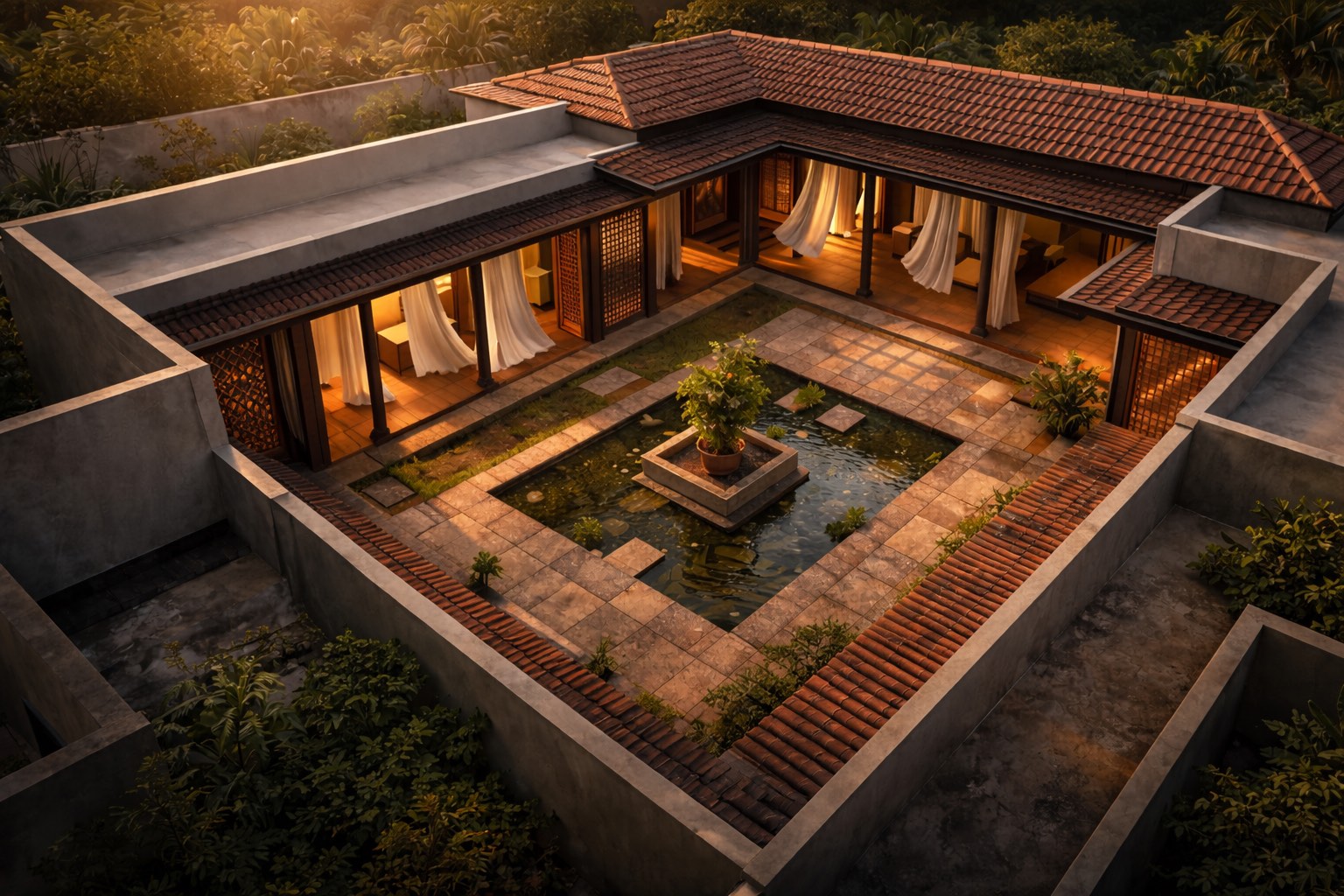
Space Planning Principles for Indian Homes
Room Adjacencies, Circulation, and Climate-Responsive Design — A Comprehensive Guide
Space is not emptiness — it is the medium in which life takes shape. The arrangement of rooms, the width of a corridor, the depth of a verandah, the placement of a window relative to the prevailing breeze — these are not technical minutiae. They are the decisions that determine whether a home feels generous or cramped, cool or stifling, private or exposed, connected or isolated.
In India, space planning carries an additional layer of complexity that Western textbooks rarely address. The Indian home must accommodate multi-generational living, cultural rituals that require specific spatial configurations, a climate that ranges from the searing heat of the Thar to the biting cold of Ladakh, cooking practices that generate intense heat and aroma, a deep tradition of hospitality that demands dedicated guest accommodation, and a privacy gradient far more nuanced than the simple public-private binary of Western residential design.
This guide examines the principles of space planning for Indian residential architecture — room adjacencies, circulation, zoning, and climate-responsive design — drawing on the National Building Code, Indian Standards, climate science, and the extraordinary spatial intelligence embedded in India's traditional building typologies.
"In a warm climate, the most important architectural element is the open-to-sky space." — Charles Correa (1930–2015), architect, from The New Landscape (Correa, 1985)
1. Zoning: The Four-Zone Model for Indian Homes
Indian residential planning operates on a four-zone model that reflects the nuanced privacy gradient of Indian domestic life. Unlike the simple public-private binary of Western homes, the Indian home requires a finer gradation — and the quality of the spatial plan is largely determined by how cleanly these zones are separated while remaining functionally connected.
Zone 1 — Public (outward-facing, near entrance):
Living room, formal dining, entrance foyer, porch, guest bedroom (in larger homes), verandah facing street or garden.
Zone 2 — Semi-Public / Transition:
Family room, informal dining, courtyard (aangan), internal verandah, staircase lobby, study/library.
Zone 3 — Private (inward, away from street):
Master bedroom, children's bedrooms, attached bathrooms, puja room, personal terrace/balcony.
Zone 4 — Service (separate circulation):
Kitchen (bridging semi-public and service zones), utility/wash, servant quarters, store rooms, garage, service entry/staircase.
The Privacy Gradient
The plan should establish a clear sequence of increasing privacy:
Street → Gate → Pathway → Shoe removal → Main door → Foyer → Living (Public) → Courtyard/Passage (Semi-Public) → Family Room → Bedrooms (Private)
Service zones run parallel with independent circulation, connecting to the kitchen and external entry without crossing the public-private axis. A visitor standing in the living room should never have a direct sightline into the bedroom corridor. A delivery person at the service entrance should reach the kitchen without passing through the living room. These are not luxuries — they are the spatial logic that makes a home function with dignity for all its occupants (Rapoport, 1969).
"A room is not a room without natural light." — Louis Kahn (1901–1974), architect
2. Room Adjacencies: What Goes Where and Why
Room Adjacency Matrix for Indian Residential Design
| Room Pair | Relationship | Priority | Rationale |
|---|---|---|---|
| Living — Dining | Adjacent / Open | Essential | Social continuity; entertainment flow; visual connection |
| Kitchen — Dining | Adjacent | Essential | Food service; supervision; Indian kitchens produce strong aromas — door or screen separation preferred |
| Kitchen — Utility/Wash | Adjacent | Essential | Wet services alignment; plumbing economy; servant access |
| Kitchen — Service Entry | Adjacent | High | Grocery delivery; waste disposal; servant circulation without crossing living areas |
| Master Bedroom — Attached Bath | Directly connected | Essential | Privacy, convenience |
| Master Bedroom — Puja Room | Adjacent / Near | High | Morning ritual access; many families want puja in NE per Vastu |
| Children's Bedroom — Common Bath | Near | High | Shared facility; parental supervision |
| Bedroom — Bedroom | Acoustically separated | High | Sound privacy between bedrooms; avoid thin shared walls |
| Living — Entrance/Foyer | Directly connected | Essential | Guest reception and arrival |
| Living — Verandah/Balcony | Adjacent | High | Indoor-outdoor connection; climate buffer |
| Servant Quarter — Kitchen | Near via service corridor | High | Service access without crossing private zones |
| Servant Quarter — Bedrooms | Separated | Essential | Privacy and acoustic isolation |
| WC/Toilet — Kitchen | Separated | Essential | Hygiene; no shared walls; plumbing can be back-to-back but not directly adjacent |
| WC/Toilet — Dining | Separated | Essential | Hygiene and sensory separation |
| Puja Room — WC/Toilet | Separated | High | Ritual purity norms in traditional households |
| Garage — Main Entrance | Near but separated | High | Convenience; acoustic and fume separation |
| Study/Office — Living | Near but separate | Medium | Quiet work with social accessibility |
| Store Room — Kitchen | Adjacent | High | Pantry function; dry goods and bulk storage |
3. Circulation Standards
Circulation — corridors, staircases, doorways, and ramps — is the connective tissue of a building. In Indian homes, where multiple generations and domestic staff share the space, circulation must be generous enough for dignity and safety while remaining economical enough to not consume the built area.
Circulation Dimensions per NBC 2016
| Element | NBC 2016 Minimum | Universal Design Standard | Best Practice |
|---|---|---|---|
| Internal corridor width | 1.0 m | 1.2 m (wheelchair passage) | 1.2–1.5 m |
| External corridor / verandah | 1.2 m | 1.5 m | 1.5–1.8 m |
| Main entrance door width | 900 mm | 1000 mm | 1.0–1.2 m |
| Internal door width | 750 mm | 900 mm | 800–900 mm |
| Staircase width (house) | 1.0 m | 1.2 m | 1.0–1.2 m |
| Staircase width (apartment) | 1.25 m | 1.5 m | 1.5 m |
| Tread depth | 250 mm min | 280 mm min | 280–300 mm |
| Riser height | 190 mm max | 150 mm max | 150–175 mm |
| Riser-tread formula | 2R + T = 600–640 mm | -- | 2R + T = 600 mm ideal |
| Headroom (stair) | 2.2 m min | 2.2 m | 2.4 m |
| Ramp gradient | 1:12 max | 1:12 max (1:20 preferred) | 1:15 to 1:20 |
| Ramp width | 1.5 m | 1.8 m | 1.5–1.8 m |
| Wheelchair turning radius | -- | 1.5 m diameter | 1.5 m |
Source: NBC 2016, Part 3 (Bureau of Indian Standards, 2016); IS 3362:1977.
Circulation Patterns
| Pattern | Character | Best For | Indian Example |
|---|---|---|---|
| Linear (spine corridor) | Rooms along a single axis; efficient but can be dark | Row houses, narrow urban plots | Chettinad houses with courtyards punctuating the linear axis |
| Radial (from central point) | Rooms radiate from staircase or core; compact | Apartment buildings, compact houses | Central-core apartment design |
| Central Hall | Rooms around a multi-functional hall; reduces pure corridor area | Colonial and post-colonial Indian house type | Bungalow with central living hall |
| Courtyard-based | Peripheral circulation along covered verandah around courtyard | Hot-dry and composite climates; traditional houses | Haveli, nalukettu, wada |
| Double-loaded corridor | Central corridor with rooms on both sides; maximum efficiency (70–80%) | Mass housing, apartment blocks | Standard 2-BHK/3-BHK apartment plans |
| Single-loaded corridor | Rooms on one side; excellent cross-ventilation (55–65% efficiency) | Premium housing, institutional | Gallery-access apartments in warm-humid climates |
"The home should be the treasure chest of living." — Le Corbusier (1887–1965), architect, from Towards a New Architecture (Le Corbusier, 1923)
4. Ventilation and Daylighting
NBC 2016 Ventilation and Daylighting Requirements
| Room Type | Min. Window-to-Floor Ratio (Light) | Min. Ventilation Opening | Notes |
|---|---|---|---|
| Habitable rooms (living, bedroom) | 1/10 (10%) of floor area | 1/10 (10%) of floor area | Openable area, not total glazed area |
| Kitchen | 1/10 (10%) | 1/10 (10%) + exhaust | Mechanical exhaust additionally recommended |
| Bathroom | -- | 0.3 sq m minimum | If no window, mechanical ventilation required |
| WC | -- | 0.3 sq m minimum | Can be mechanically ventilated |
| Staircase (common) | 1.0 sq m per floor | Natural or mechanical | Smoke ventilation at top: 1.0 sq m min |
Source: NBC 2016, Part 8 — Building Services; IS 3362:1977 (Bureau of Indian Standards, 1977).
Cross-Ventilation Principles
Wind-driven ventilation requires openings on at least two sides — windward inlet, leeward outlet. IS 3362 recommends that the outlet area should be 1.25 to 1.5 times the inlet area for optimal airflow. The effective room depth for cross-ventilation is approximately five times the ceiling height — about 14–15 m for standard Indian residential ceiling heights (Koenigsberger et al., 1973).
Key design strategies:
- Inlet at body level (0.6–1.8 m from floor) for occupant comfort
- Wing walls (perpendicular fins at window edges) redirect wind and can enhance ventilation by 30–40%
- Casement windows capture more wind than sliding windows — they act as scoops when opened
- Stack-effect ventilation through courtyards, stairwells, and clerestory windows provides airflow even in the absence of wind
Ventilation by building type:
- Individual house: Cross-ventilation on all sides; courtyard for stack effect
- Row house: Front-to-back ventilation only; light wells and internal courtyards critical
- Apartment (single-loaded): Excellent cross-ventilation; corridor side + opposite facade
- Apartment (double-loaded): Cross-ventilation difficult; relies on corner units, indentations, or ventilation shafts
"It is the architect's job to make the client aware of his real needs, his real wants, and the possibilities of the site and the climate." — Hassan Fathy (1900–1989), architect, from Architecture for the Poor (Fathy, 1973)
5. Climate-Responsive Design Strategies
India's five climate zones demand fundamentally different spatial responses. A plan that works beautifully in Bengaluru's temperate climate will fail in Jodhpur's searing heat or Srinagar's prolonged cold.
Climate-Responsive Strategies by Zone
| Parameter | Hot-Dry | Warm-Humid | Composite | Temperate | Cold |
|---|---|---|---|---|---|
| Orientation (long axis) | E–W; minimise E/W exposure | E–W; maximise wind capture | E–W; adaptable facades | Flexible; slight N–S | E–W; maximise S for solar gain |
| Wall thickness | 300–450 mm (high thermal mass) | 150–230 mm (low mass) | 230–350 mm (medium) | 200–230 mm | 350–450 mm (high insulation) |
| Window-Wall Ratio | 10–15% (N/S); minimal E/W | 25–40% (for ventilation) | 15–25% (N/S); 10% E/W | 25–35% | 15–20% (larger on S); minimise N |
| Shading devices | Deep chajjas (900 mm+), jalis, recessed windows | Wide overhangs (1.2 m+), louvers, operable screens | Adjustable louvers, pergolas, seasonal screens | Moderate overhangs (600 mm) | Minimal on S (allow winter sun); deep on E/W |
| Ventilation | Night ventilation; closed during day; evaporative cooling | Maximum cross-ventilation; continuous air movement | Seasonal switching | Natural ventilation year-round | Minimal; heat recovery; double glazing |
| Roof design | Heavy insulated; double roof with air gap | Pitched, ventilated; reflective; large overhangs | Insulated; accessible terrace with shading | Standard pitched; moderate insulation | Heavily insulated; steep (snow); solar-oriented |
| Courtyard | Central with water feature for evaporative cooling | Less effective (humidity); use open verandahs | Seasonal adaptation (cover in monsoon) | Optional garden courtyard | Enclosed atrium (glazed) for solar gain |
| Material palette | Sandstone, lime, adobe, mud brick, terracotta | Laterite, brick, timber, bamboo, tile roof | Brick, RCC, stone, adaptable envelope | Brick, stone, timber | Stone, timber, rammed earth, heavy insulation |
Sources: Krishan et al. (2001); Koenigsberger et al. (1973); Givoni (1969); Bansal and Minke (1988).
Orientation Recommendations
| Climate Zone | North Facade | South Facade | East Facade | West Facade |
|---|---|---|---|---|
| Hot-Dry | Living/bedrooms (diffused light) | Protected openings with deep chajjas | Limited; morning sun acceptable | Minimal openings; maximum shading; buffer spaces |
| Warm-Humid | Open for ventilation | Open with overhangs for rain | Moderate with shading | Protected; louvers for evening ventilation |
| Composite | Open; primary living facade | Controlled with adjustable shading | Moderate with vegetation | Maximum protection; service spaces as buffer |
| Temperate | Open, balanced glazing | Open, moderate shading | Open, morning sun welcome | Moderate protection |
| Cold | Minimal openings; insulated; wind buffer | Maximum glazing for solar heat gain | Moderate | Minimal; insulated |
General principle: Living rooms prefer N or NE orientation (diffused, glare-free light in the Northern Hemisphere). Kitchens prefer SE or E (morning sun, avoid afternoon heat). Bedrooms prefer N, NE, or E (avoid west for sleeping comfort). Bathrooms and utilities can occupy the W or SW, serving as thermal buffers against afternoon sun (IS 7662, Parts 1–3).
6. The Courtyard: India's Climate Machine
The courtyard is not merely a spatial device — it is a thermodynamic engine that has regulated indoor comfort in Indian homes for millennia. Understanding its physics is essential for any architect working in hot-dry or composite climates.
The Thermal Cycle
Daytime: The courtyard receives direct sun; air heats and rises (stack effect), pulling cooler air from shaded surrounding rooms through low-level openings. Rooms remain relatively cool as the courtyard exhausts hot air upward.
Evening: As exterior temperature drops, courtyard surfaces — which have lower thermal mass than surrounding walls — cool faster. Temperature between courtyard and rooms begins to equalise.
Night: The courtyard radiates stored heat to the clear night sky through long-wave radiation. Being open to sky, it has an unobstructed radiation path. Courtyard air temperature can drop 4–6 degrees C below ambient. This cool air, being denser, pools at the bottom of the courtyard and seeps into adjacent rooms through low-level openings.
Early morning: The courtyard contains the coolest air pool — this is why traditional Indian homes use the courtyard for morning activities: puja, yoga, washing, breakfast.
Courtyard Design Parameters
- Aspect ratio (height:width): 1:1 to 1:3 optimal for hot-dry climates (deeper courtyards provide more self-shading)
- Water features: Fountains or pools add evaporative cooling, reducing air temperature by 5–8 degrees C in hot-dry climates; counterproductive in humid climates
- Planting: Deciduous trees provide seasonal shading; tulsi (sacred basil) is traditional and aromatic
- Floor surface: Light-coloured stone or lime for reduced heat absorption in hot climates; dark surfaces for cold climates (heat gain)
"Why do we copy the West when our own traditions have far better solutions for our climate?" — Laurie Baker (1917–2007), architect
7. Traditional Indian Spatial Typologies and Modern Interpretations
India's traditional building typologies are not museum pieces — they are repositories of spatial intelligence refined over centuries. Their principles remain directly applicable to contemporary design.
| Traditional Element | Historical Form | Modern Interpretation |
|---|---|---|
| Courtyard (Aangan/Chowk) | Open-to-sky central space in haveli/wada/nalukettu; rooms arranged peripherally | Atrium in apartment lobbies; double-height living with skylight; light well in row housing; internal garden in villa |
| Verandah (Thinnai/Charupadi) | Covered semi-open transition, 1.5–3.0 m deep | Deep balconies (1.5–2.0 m); covered terraces; loggia; sit-out with jali screen |
| Jali Screen | Perforated stone/wood screen; 30–50% porosity; ventilation with visual privacy | Perforated concrete/GRC/terracotta screens; laser-cut metal panels; parametric facade elements |
| Thinnai (Front Platform) | Raised entrance platform for informal gathering (Tamil Nadu) | Entrance deck; community seating at apartment entrance; front porch with built-in seating |
| Tulsi Vrindavan | Sacred basil planter in courtyard centre | Indoor planting zone with skylight; biophilic courtyard feature; green wall |
| Osari (Corridor) | Peripheral covered circulation connecting courtyards (Chettinad) | Internal circulation gallery with skylights; corridor as linear library/display |
| Nalukettu (Four-Block) | Four buildings around central courtyard with steep-pitched roof (Kerala) | Four-wing apartment complex around landscaped courtyard; contemporary villa with central void |
| Walled Compound | Perimeter wall with controlled entry | Gated community boundary; layered landscape screening; privacy gradient through planting |
The Verandah: India's Most Important Spatial Element
The verandah — known variously as thinnai, charupadi, otta, baramda, or barsati across India's regions — is arguably the most important climate-responsive element in Indian residential architecture.
Thermal functions: Shades the wall behind it (reducing solar gain by 50–70%); creates a buffer zone 3–8 degrees C cooler than exposed exterior; allows doors and windows to remain open for ventilation without rain entry; radiative cooling surface at night.
Spatial functions: Transition between public exterior and private interior; semi-open social space; extends living area without full enclosure cost; sleeping area in hot seasons.
Design parameters: Depth 1.5–2.5 m minimum for effective shading; south or southeast orientation preferred; floor raised 450–600 mm traditionally (flood protection, social signaling); railing or screen (jali, louver, balustrade) for ventilation with partial privacy (Dili, Naseer and Varghese, 2010).
8. Anthropometric Data for Indian Homes
Indian anthropometric dimensions differ from Western standards, and these differences must inform every spatial decision — from counter heights to door dimensions.
| Dimension | Indian Standard | Western Standard | Design Implication |
|---|---|---|---|
| Average male height | 1650–1700 mm | 1750–1800 mm | Lower reach heights for shelving, switches |
| Average female height | 1520–1570 mm | 1620–1670 mm | Kitchen counter and sink height critical |
| Kitchen counter height | 800–850 mm | 900–920 mm | Indian cooking posture (chapati rolling, grinding) demands lower surfaces |
| Dining table height | 720–750 mm | 740–760 mm | Floor-sitting dining (chauki): 250–350 mm — still common in many regions |
| Door height | 2000–2100 mm | 2100–2400 mm | NBC minimum 2000 mm |
| Ceiling height (min) | 2750 mm (NBC) | 2400 mm (typical) | Indian preference for 3.0–3.6 m for thermal comfort and spatial grandeur |
| Step riser | 150–175 mm | 175–190 mm | Indian standards slightly more conservative for safety |
| Step tread | 275–300 mm | 250–280 mm | Wider tread preferred in Indian practice |
| Bathroom basin height | 750–800 mm | 800–860 mm | Adjusted for Indian stature |
| Wardrobe shelf max reach | 1800 mm | 1900–2000 mm | Based on 5th percentile female reach |
| Bed height | 450–500 mm (cot); floor-level | 500–600 mm | Cultural variation: many regions prefer low beds or floor sleeping |
| Shoe rack at entrance | 150–300 mm from floor | -- | Universal Indian requirement; not addressed in Western standards |
Sources: Neufert and Neufert (2012); Indian anthropometric data from NIN/ICMR studies; SP 41 (S&T):1987 — Handbook on Functional Requirements of Buildings.
9. Open Plan vs Compartmented: The Indian Resolution
Western architectural discourse has long championed the open plan. Indian residential design, however, maintains a more nuanced position — and for good reason.
| Aspect | Western Open-Plan | Indian Preference | Design Resolution |
|---|---|---|---|
| Kitchen | Fully open island kitchen | Semi-open or closed; strong cooking aromas must be contained | Semi-open with service window/hatch; sliding partition; chimney hood essential if open |
| Privacy | Fewer walls; visual connectivity | Acoustic and visual privacy between zones; multi-generational living | Open social zone; compartmented private zone |
| Guest reception | Guests in same living space | Separate formal reception in many homes; guests should not see into kitchen/bedrooms | Foyer/living positioned to shield private zones from sightlines |
| Ceiling height | 2.4–2.7 m standard | 3.0–3.6 m preferred (thermal comfort, spatial grandeur) | Higher in open-plan areas; can drop in intimate zones |
| Shoes | Often worn indoors | Removed at entrance universally | Dedicated shoe zone at foyer with storage |
| Service circulation | No separate circulation | Separate service entry and corridor | Service access independent of guest/family circulation |
| Climate | Centrally heated/cooled | Selective room cooling (fan or AC) | Compartments allow zone-by-zone climate control; more energy-efficient |
The modern Indian resolution is a hybrid plan: open living-dining-family in the social zone (Zone 1–2), compartmented bedrooms and service areas in the private and service zones (Zone 3–4). The kitchen occupies the hinge point — semi-open to the dining/living with the ability to close via sliding screen or partition, and fully open to the utility/service corridor on the opposite side.
"A building is not just a place to live or work. It is a way of seeing the world and a way of being in the world." — B.V. Doshi (1927–2023), architect, Pritzker Prize laureate
10. Jali and Screen Design: Ventilation with Privacy
The jali — perforated screen in stone, wood, concrete, or metal — is India's most sophisticated response to the dual need for ventilation and privacy. Its physics are worth understanding.
Performance characteristics (at 40% porosity):
- Reduces air velocity by approximately 40–50% while maintaining ventilation
- Provides 60–80% visual privacy depending on pattern and viewing angle
- Reduces direct solar radiation by 50–70%
- Creates dappled light patterns (aesthetic and functional — reduces glare)
- Wind acceleration through narrow openings increases local air velocity by 20–30% (Venturi effect)
Design parameters:
- Porosity: 30–50% open area for effective ventilation (below 30% = insufficient airflow; above 50% = insufficient privacy)
- Depth/thickness: 50–150 mm creates directional light effects and wind acceleration
- Pattern: Geometric patterns redirect airflow; diagonal patterns scatter direct sightlines
Modern materials: Perforated metal (aluminium, corten steel) with parametric patterns; terracotta jaali blocks (locally made, thermally massive); GRC (Glass Reinforced Concrete) screens; concrete block jaali (cost-effective); bamboo and timber screens (renewable, traditional aesthetic).
"Touch the earth lightly." — Glenn Murcutt (b. 1936), architect, Pritzker Prize laureate, 2002
11. Thermal Mass and Night Cooling
In hot-dry and composite climates, thermal mass is the most effective passive cooling strategy available. High-mass materials (brick, stone, concrete, rammed earth) absorb heat during the day and release it slowly, creating a time lag between peak exterior temperature and peak interior temperature.
- 230 mm brick wall: 6–8 hour time lag
- 450 mm stone wall: 10–12 hour time lag
In Jodhpur, where peak exterior temperature reaches 42–45 degrees C at 2–4 PM, a 450 mm sandstone wall delays the heat peak to midnight — by which time the exterior has cooled to 28–30 degrees C, and night ventilation can flush the stored heat. The cooled mass then serves as a 'cold battery' for the next morning.
Night cooling mechanism:
1. Close building during day (prevent hot air entry)
2. Thermal mass absorbs internal heat gains, keeping interior below external temperature
3. Open building at night when exterior drops below interior
4. Night air flushes stored heat from mass
5. Cooled mass provides comfort through the next day
Effectiveness: Requires a diurnal temperature range of at least 10 degrees C — most effective in hot-dry (Rajasthan, Gujarat) and composite (Delhi, Nagpur) climates. Less effective in warm-humid climates where the small diurnal range (4–6 degrees C) limits the cooling potential (Givoni, 1969; Chandel, Sharma and Marwah, 2016).
References
- Alexander, C., Ishikawa, S. and Silverstein, M. (1977) A Pattern Language: Towns, Buildings, Construction. New York: Oxford University Press.
- Bansal, N.K. and Minke, G. (1988) Climatic Zones and Rural Housing in India. Julich: Kernforschungsanlage Julich.
- Bureau of Indian Standards (1977) IS 3362:1977 — Natural Ventilation of Residential Buildings — Recommendations. New Delhi: BIS.
- Bureau of Indian Standards (various) IS 7662 (Parts 1–3) — Recommendations on Orientation of Buildings. New Delhi: BIS.
- Bureau of Indian Standards (1987) SP 41 (S&T):1987 — Handbook on Functional Requirements of Buildings. New Delhi: BIS.
- Bureau of Indian Standards (2016) SP 7:2016 — National Building Code of India 2016. New Delhi: BIS.
- Bureau of Energy Efficiency (2018) Eco-Niwas Samhita 2018: Energy Conservation Building Code for Residential Buildings. New Delhi: BEE.
- Chandel, S.S., Sharma, V. and Marwah, B.M. (2016) 'Review of energy efficient features in vernacular architecture for improving indoor thermal comfort conditions', Renewable and Sustainable Energy Reviews, 65, pp. 459–477.
- Ching, F.D.K. (2015) Architecture: Form, Space, and Order. 4th edn. Hoboken: John Wiley & Sons.
- Correa, C. (1985) The New Landscape: Urbanisation in the Third World. Mumbai: Book Society of India.
- Dili, A.S., Naseer, M.A. and Varghese, T.Z. (2010) 'Passive environment control system of Kerala vernacular residential architecture for a comfortable indoor environment', Energy and Buildings, 42(6), pp. 917–927.
- Fathy, H. (1973) Architecture for the Poor: An Experiment in Rural Egypt. Chicago: University of Chicago Press.
- Givoni, B. (1969) Man, Climate and Architecture. London: Applied Science Publishers.
- Indraganti, M. (2010) 'Thermal comfort in naturally ventilated apartments in summer: findings from a field study in Hyderabad, India', Applied Energy, 87(3), pp. 866–883.
- Koenigsberger, O.H., Ingersoll, T.G., Mayhew, A. and Szokolay, S.V. (1973) Manual of Tropical Housing and Building: Part 1 — Climatic Design. London: Longman.
- Krishan, A., Baker, N., Yannas, S. and Szokolay, S. (2001) Climate Responsive Architecture: A Design Handbook for Energy Efficient Buildings. New Delhi: Tata McGraw-Hill.
- Le Corbusier (1923) Towards a New Architecture. Translated by F. Etchells (1931). London: John Rodker.
- Manu, S. et al. (2016) 'Field studies of thermal comfort across multiple climate zones for the subcontinent: India Model for Adaptive Comfort (IMAC)', Building and Environment, 98, pp. 55–70.
- Neufert, E. and Neufert, P. (2012) Architects' Data. 4th edn. Oxford: Wiley-Blackwell.
- Rapoport, A. (1969) House Form and Culture. Englewood Cliffs: Prentice-Hall.
Author's Note: This guide draws on published Indian standards (NBC 2016, IS 3362, IS 7662, SP 41, Eco-Niwas Samhita), peer-reviewed climate research, and established references on climate-responsive architecture. Room sizes and adjacency recommendations represent professional best practice synthesised from codes and field experience. Climate strategies are generalised by zone — site-specific conditions (microclimate, urban density, altitude) must be assessed individually. Traditional typology descriptions draw on architectural survey literature; modern interpretations are indicative of contemporary practice.
Disclaimer: This article is for informational and educational purposes only. It does not constitute professional architectural advice. Space planning must be undertaken by qualified architects in accordance with applicable IS codes, local building bye-laws, and NBC 2016 provisions.
Export this guide
Related Tools — Try Free
Apartment vs Villa Interior Planning Guide
Compare ceiling height, structural flexibility, lighting, storage, and services between apartments and villas.
Planning GuideSun Path Analyzer
See the sun's exact path across your home or plot in AR — sunrise, sunset, solar noon, solstices.
AR AnalyzerApartment Interior Planning Checklist
51-item checklist across structural, ceiling, lighting, furniture, storage, electrical, kitchen, bathroom.
Checklist