
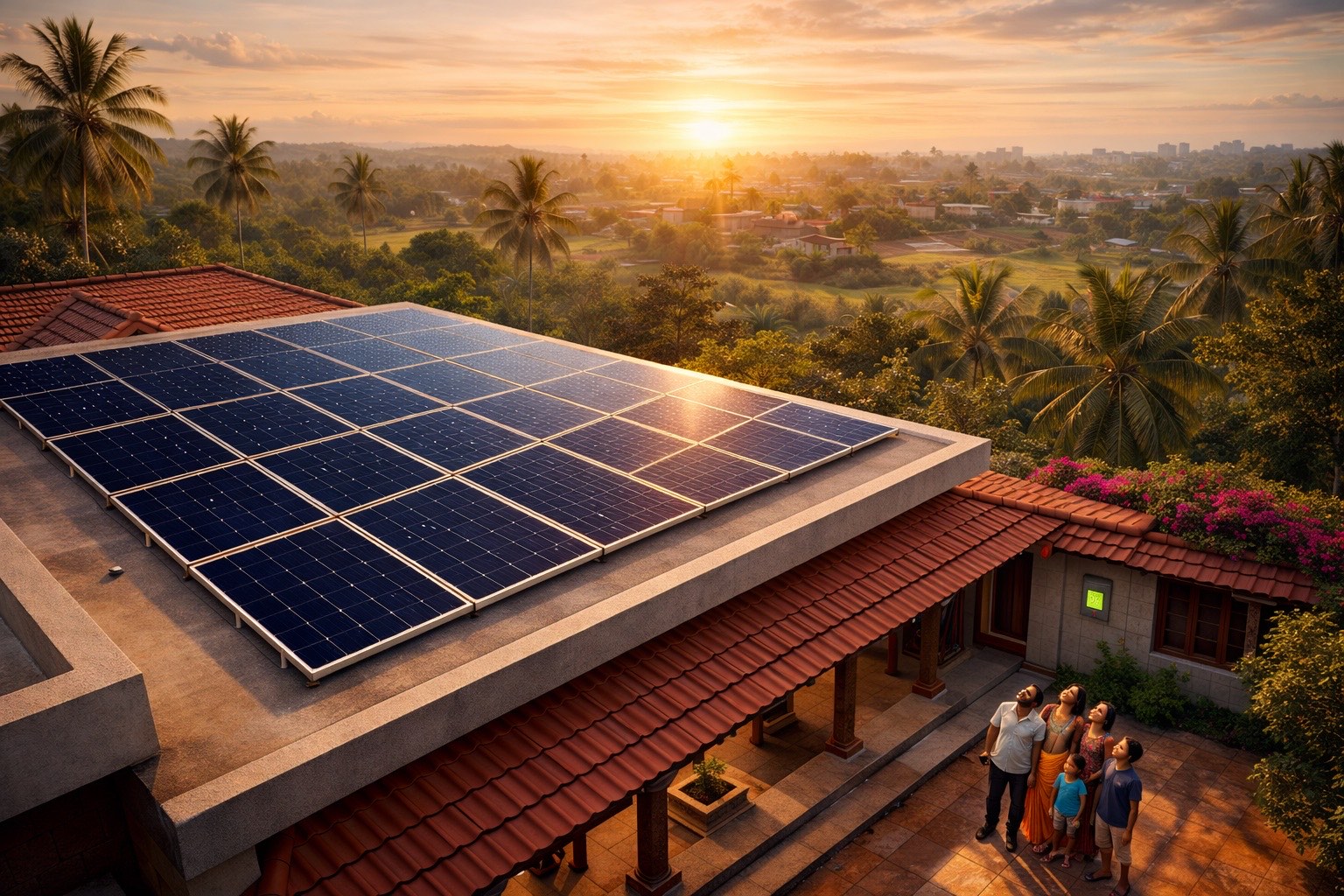
Solar Power for Homes
ROI, Feasibility & the Indian Home Architecture Imperative
India stands at a pivotal junction in its architectural and energy history. With more than 300 million households, a rapidly urbanizing population, and a climate that blesses most of the subcontinent with more than 300 sunny days a year, the case for rooftop solar as a standard feature of Indian home architecture has never been stronger. What was once the preserve of technology enthusiasts or environmentally committed early adopters has, by 2025–26, become a mainstream, financially rational, and increasingly necessary choice for the Indian homeowner.
This article examines solar power for Indian homes through the dual lens of architectural integration and financial viability. It asks: Is solar power truly worth it for the average Indian homeowner? What are the real returns on investment? What are the challenges that architects, contractors, and homeowners must navigate? And what does global experience teach us about getting this right?
1. India at the Solar Crossroads
The numbers are staggering in their optimism. India's solar energy installed capacity crossed 100 GW in January 2025, reaching 132.85 GW by November 2025 — an increase of over 41% compared to November 2024, according to the Ministry of New and Renewable Energy (MNRE). The country now stands third globally in solar power installed capacity, according to IRENA RE Statistics 2025. And yet, in the vast, untapped domain of the residential rooftop, the journey has barely begun.
2. The Indian Solar Context: Why Now?
India's geography is a solar gift. Receiving between 4 to 7 kWh of solar energy per square metre per day across most regions, the country has a theoretical rooftop solar potential estimated at well over 600–800 GW. Yet, as of late 2024, cumulative grid-connected rooftop solar capacity stood at approximately 14.45 GW — barely scratching the surface.
The government has responded with ambition. The flagship PM Surya Ghar: Muft Bijli Yojana (PMSG:MBY), launched in February 2024 with an outlay of ₹75,021 crore, aims to solarise one crore households by FY 2026–27 and provide up to 300 units of free electricity every month to beneficiaries. By December 2025, 23.9 lakh households had installed rooftop solar under this scheme, with 7 GW of clean energy capacity added and subsidies worth ₹13,464.6 crore released, according to PIB India.
"In just one year, more than 800,000 houses were solarised under the PM Surya Ghar scheme — nearly surpassing the total solar growth achieved in the past decade." — Rocky Mountain Institute (RMI), February 2025
Residential consumers accounted for 74% of the 3.2 GW of rooftop solar installed in 2024 alone — an 88% increase over 2023 installations — according to Mercom India's latest report cited by PV Magazine. Gujarat leads nationally with over 29% of total rooftop solar installations, followed by Maharashtra and Rajasthan. This is not merely an energy story. It is an architecture story.
3. Solar and Indian Home Architecture: Integration, Not Afterthought
For decades, solar panels in India were an afterthought — bolted awkwardly onto rooftops after construction, with scant regard for orientation, shading, or structural load. The result was aesthetically jarring and functionally suboptimal. The new wave of solar-aware architecture demands a different philosophy: solar power as a core design principle, not a retrofit.
Indian residential typologies vary enormously, from the compact urban flat to the sprawling bungalow, from the terraced house of North India to the sloped-roof homes of coastal Karnataka and Kerala. Each presents distinct opportunities and constraints for solar integration. In South India, where sloped Mangalorean-tile or Calicut-tile roofs dominate traditional architecture, innovative mounting systems now allow panels to be installed along the slope without altering the roof's character. In Maharashtra and Gujarat, flat-roofed concrete homes provide ideal south-facing real estate for array installation.
Progressive architects in India are now designing with what is called Building-Integrated Photovoltaics (BIPV) — where solar cells are embedded directly into roof tiles, glass facades, and structural canopies rather than placed atop them. While BIPV remains expensive and relatively rare in India, it signals the direction of travel. More immediately relevant is the principle of 'solar-ready' design: homes planned with south-facing roof orientations, minimal shading from trees or neighbouring structures, pre-installed cable conduits, and structural provisions to bear panel loads.
"Architecture is the thoughtful making of space. When a building harvests the energy of the sun, it becomes not just a shelter, but a power plant, a statement of intent, a gift to the future." — Ken Yeang, Malaysian Architect & Pioneer of Bioclimatic Design
The compact urban apartment presents particular challenges. In multi-storey buildings, access to the rooftop is shared and often restricted by housing societies. However, emerging models of community solar — where a shared rooftop array feeds into the building's common electricity pool or is divided among participating flat-owners through net metering — are gaining traction in cities like Bengaluru, Pune, and Ahmedabad.
4. The Financial Case: ROI and Payback Period
4.1 System Costs in 2025–26
The economics of residential solar in India have improved dramatically over the past decade. Panel prices have stabilised after the volatility of 2022–2024, and government subsidies have made the upfront investment significantly more accessible. As of 2025–26, the installed cost of a residential on-grid system (without battery backup) ranges approximately as follows:
| System Size | Typical Use Case | Cost Before Subsidy | Central Subsidy (Approx.) | Net Cost After Subsidy |
|---|---|---|---|---|
| 1 kW | 1 BHK / Small apartment | ₹70,000–₹1,10,000 | ₹30,000 | ₹40,000–₹80,000 |
| 2 kW | 2 BHK home | ₹1,40,000–₹2,00,000 | ₹60,000 | ₹80,000–₹1,40,000 |
| 3 kW | 2–3 BHK home | ₹2,10,000–₹3,30,000 | ₹78,000 | ₹1,32,000–₹2,52,000 |
| 5 kW | Large home / Villa | ₹3,50,000–₹5,00,000 | ₹78,000 (capped) | ₹2,72,000–₹4,22,000 |
Source: Houseyog.com, MNRE Subsidy Guidelines 2024–25. Prices include panels, inverter, structure, and installation. Battery backup or hybrid systems cost 20–30% more.
4.2 Savings and Return on Investment
The financial return on a residential solar investment in India is compelling by any standard. Consider a typical 3 BHK home in a Tier-1 city with a monthly electricity consumption of around 400–500 units, paying ₹7–9 per unit to the DISCOM. A 5 kW on-grid system generating approximately 20–22 units per day would produce 7,200–8,000 units annually. At ₹8 per unit, annual savings amount to ₹57,600–₹64,000.
Most homeowners can expect a payback period of 3 to 5 years for residential rooftop systems, with commercial installations at higher tariff rates recovering costs in as little as 2.5 to 3 years, according to Bridgeway Power's 2026 analysis. Given that quality solar panels carry performance warranties of 25 years and degrade by only about 0.5–0.7% annually — with modern Tier-1 panels warranted to deliver at least 85–89% of their original output in Year 25 — the long-term financial case is extraordinary.
"Solar is a one-time investment that keeps paying you back year after year. With a properly installed system, a homeowner is looking at a lifetime saving of ₹5–6 lakh on a 3 kW system alone." — Houseyog.com, Solar Power for Homes in India, 2026
A real-world illustration from Bridgeway Power (2025) demonstrates this vividly. The Khanna family, residing in a 3 BHK duplex, installed a 6 kW on-grid solar system using high-efficiency bifacial modules. Their net outlay was ₹3,10,000 after subsidies. The system generated 25–27 units per day. Through DISCOM net metering, their annual electricity bill dropped from ₹90,000 to approximately ₹6,000 (just fixed meter charges) — savings of ₹84,000 in the very first year. Their payback period: 3 years and 7 months. The remaining 21+ years represents pure financial return.
| Parameter | Before Solar | After Solar (6 kW System) |
|---|---|---|
| Monthly Electricity Bill (Summer) | ₹12,000 | ~₹500 (fixed charges) |
| Annual Electricity Cost | ₹90,000 | ~₹6,000 |
| Annual Savings | — | ₹84,000 |
| System Cost (After Subsidy) | — | ₹3,10,000 |
| Payback Period | — | 3 years 7 months |
| Lifetime Savings (25 years) | — | ~₹18–20 lakh |
Source: Bridgeway Power, Real Client Case Study, 2025 (Khanna Family, 3BHK Duplex)
4.3 Net Metering: Turning Your Home into a Revenue Generator
A transformative policy tool that has materially improved solar ROI in India is net metering — the facility by which a solar-equipped home can export surplus electricity back to the grid and receive credit on its electricity bill. Under current MNRE and DISCOM regulations, residential consumers with solar systems can register for net metering and have their imported units adjusted against their exported units, often on a one-to-one basis within the billing cycle. This means that a home generating more power on a sunny afternoon than it consumes effectively banks that electricity for use at night or on cloudy days — without the need for expensive battery storage.
Net metering has proven to be one of the most powerful enablers of residential solar adoption globally. In Germany, which pioneered generous feed-in tariffs, over two million households had solar systems by 2020. In Australia, rooftop solar penetration exceeded 30% of households by 2023, largely driven by state-level net metering and feed-in tariff policies. India's net metering policy, while still evolving and inconsistently implemented across states, represents the same pivotal lever.
5. Pros and Cons: An Honest Assessment
5.1 Advantages
The advantages of residential solar in India are multidimensional and profound. Financially, the post-subsidy payback period of 3–5 years on a system with a 20–25 year productive life represents an internal rate of return (IRR) that consistently outperforms fixed deposits, recurring deposits, and even many equity investments on a risk-adjusted basis. With electricity tariffs rising at approximately 5–8% per annum in India, the value of every unit self-generated only increases with time. For Electric Vehicle owners, the benefit is doubly amplified: a home solar system essentially enables zero-cost EV charging, potentially doubling the effective ROI of the solar investment.
Environmentally, a 3 kW residential system generating approximately 4,500 units per year offsets roughly 3.5–4 tonnes of CO₂ annually — equivalent to planting over 150 trees each year. Over the system's lifetime, a single household's solar installation can prevent the emission of approximately 90 tonnes of carbon dioxide. Aggregated across India's one crore target households under PM Surya Ghar, the climate impact is transformative.
Architecturally, solar panels can serve as an additional thermal insulation layer on flat rooftops, reducing the heat load on the building below and improving indoor thermal comfort — particularly valuable in India's tropical climate. Studies have shown that a well-designed solar array on a flat concrete roof can reduce the roof surface temperature by 10–15°C, directly reducing air-conditioning load and creating a positive feedback loop of energy savings.
5.2 Challenges and Cons
Despite the compelling case, significant challenges remain. The most immediate is the upfront capital cost. Even after government subsidy, a 3 kW system costs ₹1,32,000–₹2,52,000 — a sum that is beyond the immediate reach of many middle-income households. While solar loans are now available from over 25 financial institutions including major public and private banks, awareness and uptake of financing options remains limited, particularly in Tier-2 and Tier-3 cities.
Structural and architectural constraints present another class of challenges. Many older urban homes — particularly in dense cities like Mumbai, Delhi, and Kolkata — have flat rooftops that are shared by multiple households or cluttered with water tanks, AC units, and washing lines. Usable rooftop space for solar may be limited, and without coordinated planning, conflict between residents can stymie even willing adopters. For homes with traditional sloped tile roofs, while mounting systems exist, installation can be more complex and expensive.
The quality of installation is a persistent concern. The solar industry in India, though growing rapidly, suffers from a fragmented vendor ecosystem with highly variable quality. Substandard installations using non-MNRE-approved equipment, incorrect wiring, or inadequate mounting structures can significantly impair performance and create safety hazards. The government's insistence on using ALMM-listed (Approved List of Models and Manufacturers) modules for subsidy-eligible systems is an important quality safeguard, but enforcement at the residential level remains uneven.
Grid connectivity and DISCOM cooperation present a further systemic bottleneck. Obtaining net metering connections can be a prolonged bureaucratic exercise in many states, with delays in meter installation, inspection, and approvals extending for months. This administrative friction materially increases the effective payback period and discourages adoption. DISCOMs in some states have also imposed arbitrary caps on net metering capacity, limiting the system sizes eligible for full credit.
| Factor | Advantages | Challenges |
|---|---|---|
| Financial | 3–5 yr payback, 20+ yr returns, hedge vs tariff hikes | High upfront cost, financing awareness gap |
| Environmental | 3.5–4 T CO₂ offset/yr per 3 kW system | Panel disposal/recycling concerns at end-of-life |
| Architectural | Roof insulation benefit, BIPV potential | Structural constraints, limited rooftop access |
| Policy & Grid | Subsidies, net metering, EV synergy | DISCOM delays, inconsistent state policies |
| Quality | ALMM approved vendors available | Fragmented vendors, variable installation quality |
Compiled from multiple sources including MNRE, Bridgeway Power, IEEFA, Houseyog.com, 2025–26.
6. International Perspectives and Lessons for India
India need not reinvent the solar wheel. A wealth of international experience offers instructive models. Germany's Energiewende (Energy Transition) demonstrated that aggressive feed-in tariffs and grid access guarantees could rapidly transform the residential energy landscape, though it also showed the fiscal limits of open-ended subsidy regimes. Australia's rooftop solar boom — driven by falling panel costs and state-level rebates — offers a more market-led parallel, where solar has moved from incentive-dependent to commercially self-sustaining in many markets.
The United States Inflation Reduction Act of 2022, which included a 30% Investment Tax Credit (ITC) for residential solar, demonstrates the power of fiscal incentives at scale. According to the Solar Energy Industries Association (SEIA), US residential solar installations grew by over 40% in 2023 following the ITC expansion, with payback periods in sunbelt states like Texas, California, and Florida falling to 5–7 years even without storage.
"Solar panels on every home is not just an environmental aspiration — it is an economic inevitability. The only question is whether governments accelerate or impede the transition." — Fatih Birol, Executive Director, International Energy Agency (IEA)
China, now the world's largest solar installer with over 600 GW of cumulative capacity, offers a cautionary tale about quality over quantity. Its aggressive domestic solar push in the 2010s created a market flooded with low-cost, substandard panels, leading to widespread performance failures and trust deficits. India would do well to learn from this, prioritising quality certification, domestic manufacturing (already being addressed through the PLI scheme), and post-installation monitoring as pillars of its residential solar programme.
Singapore, despite its small size and dense urban form, has pursued innovative solar integration strategies including floating solar on reservoirs, solar canopies over carparks, and extensive BIPV on public housing (HDB flats). Singapore's HDB Green Towns Programme mandates solar on all eligible public housing rooftops — a model that Indian state housing authorities could adapt for PMAY (Pradhan Mantri Awas Yojana) housing stock.
7. The Architectural Advocacy: Designing Solar into the Indian Home
The single most important architectural intervention that can dramatically accelerate India's residential solar mission is deceptively simple: make solar integration a standard requirement in new residential construction. Just as building codes mandate earthquake resistance in seismic zones or rainwater harvesting in water-stressed regions, solar-readiness provisions — south-facing roof orientation, structural load capacity for panels, pre-installed conduit pathways, and net-metering-ready electrical boards — should be codified into the National Building Code of India.
Indian architects have a professional and moral opportunity here. The Council of Architecture (CoA) and bodies like the Indian Institute of Architects (IIA) can take leadership in mainstreaming solar-aware design through curriculum reform, continuing professional development, and advocacy with state governments. The integration of solar feasibility analysis into the pre-design stage of every residential project, as a routine alongside site analysis and orientation studies, would fundamentally shift how solar is perceived — from a bolt-on extra to an intrinsic element of good architecture.
"The green building movement in India must evolve from a certification exercise to a design philosophy. Solar is not a badge to earn — it is a responsibility to fulfil." — A.P.J. Abdul Kalam, former President of India (paraphrased from his vision for a solar-powered India)
For the existing housing stock — the hundreds of millions of homes already built without solar consideration — the pathway lies in accessible, well-subsidised, and bureaucratically frictionless retrofit programmes. The PM Surya Ghar scheme is a strong beginning, but its success at scale will depend on solving the last-mile challenges: simplifying the subsidy application process, enabling online DISCOM net metering registration, training and certifying a larger pool of quality installers, and making consumer finance seamlessly available at the point of installation.
References:
- Solar Power for Homes in India (2025) – Cost, Setup & ROI — Houseyog.com
- Is Solar Worth It in India 2026? ROI, Payback & Real Numbers — Bridgeway Power
- India Installs 3.2 GW of Rooftop Solar in 2024 — PV Magazine / Mercom India
- 2025 Marks Highest-Ever Renewable Energy Expansion — PIB India / MNRE
- Rooftop Solar Potential of India in 2025 — Aerem Solutions
- Can Rooftop Solar Power India's Cities? — Rocky Mountain Institute (RMI), February 2025
- India's Solar Energy Policies and 2025 Market Outlook — InfoLink Consulting, January 2025
- Unleashing the Residential Rooftop Solar Potential — IEEFA (Institute for Energy Economics)
- India's Solar Momentum — PIB India / MNRE, December 2025
- Ken Yeang on Bioclimatic Design — Various published lectures
- World Energy Outlook — International Energy Agency (IEA) / Fatih Birol
Author's Note: This article was researched and written drawing on publicly available data from government sources (MNRE, PIB India), independent energy research bodies (IEEFA, RMI, PV Magazine), and solar industry practitioners. All financial estimates are indicative and will vary by location, system configuration, local DISCOM tariff, and installer pricing. Homeowners are strongly advised to obtain multiple quotations from MNRE-approved vendors and verify current subsidy structures via the National Portal for Rooftop Solar at solarrooftop.gov.in before making investment decisions.
Disclaimer: This article is for informational and advocacy purposes only. It does not constitute financial or engineering advice.
Export this guide
Related Tools — Try Free
Apartment vs Villa Interior Planning Guide
Compare ceiling height, structural flexibility, lighting, storage, and services between apartments and villas.
Planning GuideMaterial Decision Framework (M-Score)
Score 30+ Indian construction materials across cost, durability, climate fit, maintenance, and sustainability.
MaterialsSun Path Analyzer
See the sun's exact path across your home or plot in AR — sunrise, sunset, solar noon, solstices.
AR Analyzer