
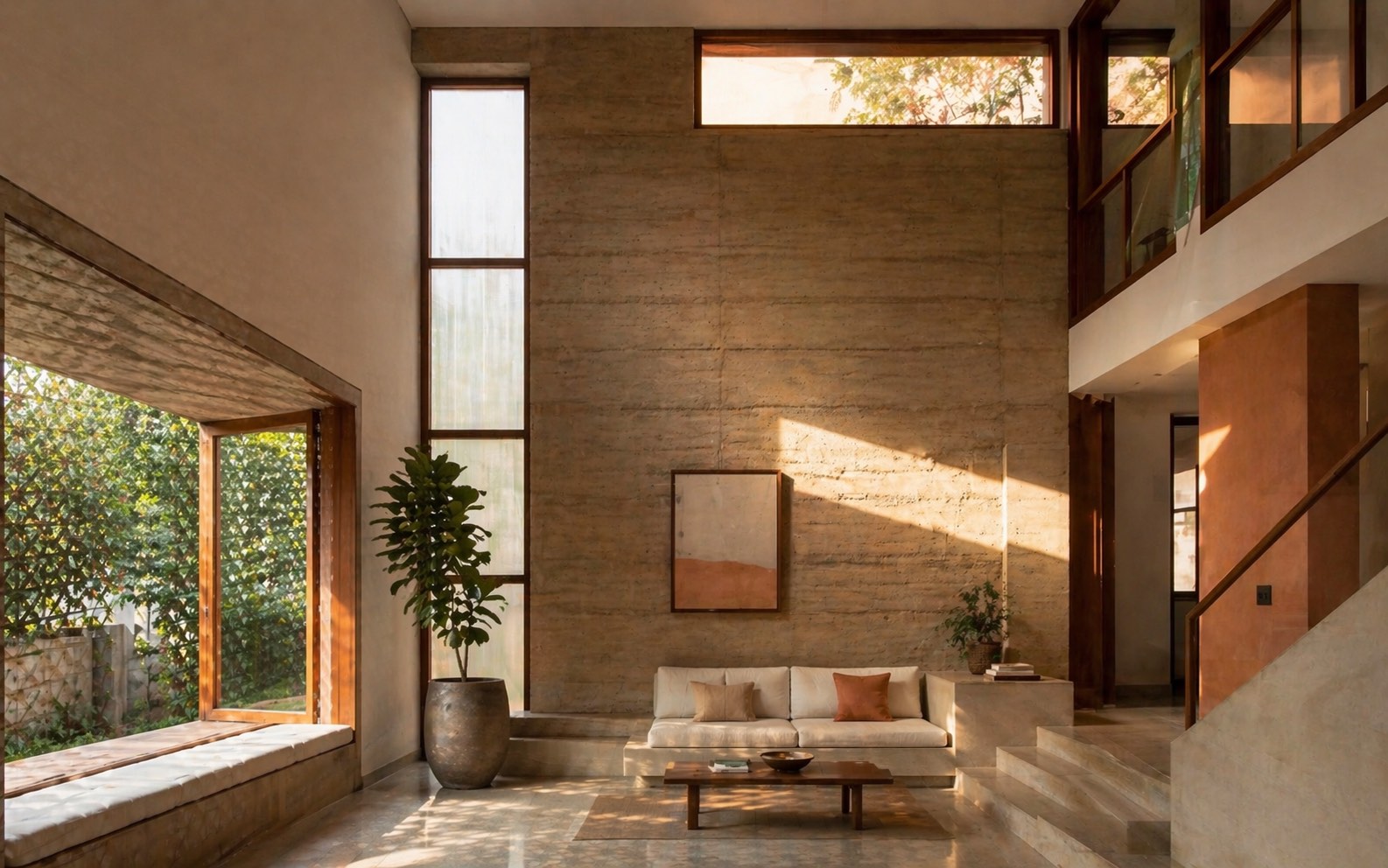
Natural Light Planning for Indian Homes
Orientation, Windows, and Openings — A Professional Guide for Architects
Light is the medium in which architecture is seen. A plan drawn on paper becomes a room only when daylight enters it — grazing walls, pooling on floors, modulating across hours and seasons, registering weather. For all the technical apparatus of daylight engineering, this remains the central reason to design for natural light: the rooms that receive it well are alive in a way that uniformly lit interiors are not. Louis Kahn put it without qualification: "A room is not a room without natural light".
India is, geographically, one of the most generously daylit countries on earth. At 8°–35° N latitude, even the northernmost cities receive useful illumination for 10 hours in midwinter and 13 in midsummer, and the overcast days that depress European daylight design are rare here outside the July–August monsoon. Yet Indian residential design has struggled with light in ways that would have been inexplicable to the builders of the havelis, the nalukettu, the Bengali verandah-house — or to modern masters like B. V. Doshi and Laurie Baker, who built Indian homes that handle light with extraordinary precision. Contemporary apartment construction routinely produces interiors where bedrooms lit to 150 lux at noon require artificial lighting, where kitchens face solid concrete walls, and where living rooms overheat because their glazing has no shading.
This guide reconstructs the toolkit for daylighting Indian residential architecture. It covers the solar geometry that dictates what the sky sends through a given window; the daylight factor (DF) — the universal performance metric enshrined in IS 2440:1975 — and the Littlefair/BRE split-flux formula that computes it; glass and opening properties; horizontal and vertical shading by climate zone (the Olgyay mask method, still the clearest design tool fifty years after its publication); the jali as daylight filter; NBC 2016, ECBC 2017, and Eco-Niwas Samhita provisions; and workflow-level guidance on how to design a daylit home from plan to detail. The companion Daylight Factor Calculator tool implements the DF method; this guide supplies the underlying theory and its regulatory framework.
"A room is not a room without natural light." — Louis Kahn (1901–1974), from the Yale School of Architecture lectures
1. Why Daylight Matters — Health, Energy, Circadian Function
Daylight is not merely bright artificial light. It differs from electric illumination in four respects, each with physiological and architectural consequences.
Spectrum. Daylight is broadly balanced across the visible spectrum, with ultraviolet at the short end and infrared at the long end. Artificial light — even the best LEDs — truncates the spectrum, which alters colour rendering (the Colour Rendering Index is lower for LED than for daylight), obscures subtle material qualities that the eye evolved to read under sunlight, and fails to supply the UV-A and blue-rich wavelengths that regulate human circadian rhythm (Boyce, 2014; Figueiro et al., 2020, Lighting Research and Technology).
Intensity. Outdoor illumination under a CIE overcast sky is 10,000–12,000 lux in India. Under clear post-monsoon sky it exceeds 50,000 lux. Artificial interior lighting is typically 200–500 lux — one to two orders of magnitude dimmer. Even a modestly daylit room at 1 per cent DF delivers 100–120 lux at the work plane from sky alone, comparable to most electric lighting schemes, for free.
Dynamism. Daylight changes hour by hour, season by season, weather by weather. This dynamism is not a design problem — it is the primary aesthetic reason to daylight buildings. Studies of occupant preference consistently find daylit rooms rated more attractive, more conducive to rest and work, and more valued than equivalently-illuminated electric-only rooms (Boyce, 2014; Heschong, 2002).
Circadian signalling. The human circadian clock is entrained primarily by morning blue-rich daylight striking specific retinal photoreceptors (ipRGCs) discovered in 2002. Chronically low morning daylight exposure — the condition of many Indian office workers and apartment dwellers — is linked to sleep fragmentation, mood disorders, and metabolic disruption (Figueiro et al., 2020). Architects designing bedrooms in deep single-orientation apartments are, unintentionally, designing for poor sleep.
Daylight Benchmarks for Indian Residential Spaces
| Room Type | Minimum illuminance (lux) | Recommended DF (%) | Source |
|---|---|---|---|
| Living / dining | 150 | 1.0 | IS 3646 Part 1; CIBSE LG1 |
| Bedroom | 100 | 0.5 | CIBSE LG1 residential |
| Kitchen (cooking area) | 300 | 2.0 | IS 3646 Part 2; NKBA |
| Study / home office | 300 | 2.0 | IS 3646 Part 1 |
| Bathroom (grooming) | 200 | 1.0 | IS 3646 Part 1 |
| Circulation / staircase | 100 | 0.5 | NBC 2016 Part 8 |
| Puja room | 150 | 1.0 | Functional recommendation |
DF (Daylight Factor) is defined as the ratio of indoor illuminance at a given point to the simultaneous horizontal outdoor illuminance under CIE overcast sky, expressed as a percentage. A room with 1 per cent DF at the work plane delivers approximately 100–120 lux from a 10,000-lux overcast sky, rising to 500+ lux under clear sky. DF is the central design metric because it is independent of the hour and the weather.
"Architecture is the learned, correct and magnificent play of masses brought together in light." — Le Corbusier (1887–1965), Vers une architecture (1923)
2. Solar Geometry for Indian Latitudes
Indian cities range from 8° N (Trivandrum) to 34° N (Srinagar, Leh). The entire country lies south of the Tropic of Cancer (23.5° N) or bestrides it — meaning the sun passes directly overhead for some latitudes on the summer solstice, and remains high in the sky across the country even at winter solstice. This differs fundamentally from European daylighting, where the winter sun at London (51° N) never rises above 15° and daylight is persistently overcast.
Solar Altitude at Solar Noon — Major Indian Cities
| City | Latitude | Summer solstice (22 Jun) | Equinox (Mar / Sep) | Winter solstice (22 Dec) |
|---|---|---|---|---|
| Trivandrum | 8.5° N | 81.5° (directly overhead-ish, N of zenith) | 81.5° | 58.0° |
| Bengaluru | 13.0° N | 76.5° | 77.0° | 53.5° |
| Hyderabad | 17.4° N | 83.9° | 72.6° | 49.1° |
| Mumbai | 19.1° N | 85.6° | 70.9° | 47.4° |
| Ahmedabad | 23.0° N | 89.5° | 67.0° | 43.5° |
| Kolkata | 22.6° N | 89.1° | 67.4° | 43.9° |
| Delhi | 28.6° N | 84.9° | 61.4° | 37.9° |
| Chandigarh | 30.7° N | 82.8° | 59.3° | 35.8° |
| Srinagar | 34.1° N | 79.4° | 55.9° | 32.4° |
(Solar altitude β at solar noon = 90° − |latitude − declination|. δ = +23.45° (Jun), 0° (Mar/Sep), −23.45° (Dec).)

Several design consequences follow directly from these numbers.
The south facade is the most predictable and the most controllable. South-facing windows receive sun year-round in the northern half of India, and for part of the year in the southern half. The sun is high in summer (above 80° for most Indian cities), making horizontal shading devices extremely effective — a modest chajja can block all summer direct sun while admitting low winter sun for passive heating. The geometry is a gift.
The east and west facades are the hardest to shade. Morning and evening sun is low (altitude 10°–30°) and comes from a shifting azimuth through the season. Horizontal shading fails — the sun simply passes beneath the chajja. Vertical fins help partially but are architecturally difficult to integrate. The honest answer for E/W glazing in hot-dry and warm-humid climates is to minimise it.
The north facade receives no direct sun from March to September in all but the deepest southern latitudes. What it does receive is diffuse sky light — stable, glare-free, and ideal for workspaces. The traditional studios of artists and architects have always preferred north light for this reason, and the north-facing drafting table is a legitimate design move for a study or a puja room.
Near the Tropic of Cancer (Mumbai, Ahmedabad, Kolkata), the sun passes directly overhead or slightly north of zenith at summer noon. This creates a uniquely Indian condition: N-facing rooms may receive direct overhead sun for a few weeks around summer solstice, and S-facing rooms receive nearly vertical sun that horizontal shading handles almost trivially. Designers working in Gujarat and West Bengal should explicitly model this (any sun-path tool, or the Sun Path Analyzer, shows it clearly).
Solar Altitude by Orientation and Time
Below is a simplified table for Delhi (28.6° N) showing the typical altitude/azimuth windows for design decisions:
| Orientation | Summer morning | Summer noon | Summer evening | Winter noon |
|---|---|---|---|---|
| South | Low sun, E-side | β = 85°, directly above | Low sun, W-side | β = 38°, direct entry |
| North | None direct | None direct (sun N-side briefly ±5 wks) | None direct | None direct |
| East | β = 10–45°, azim E/NE | Side only | None | β = 10–30°, E/SE azim |
| West | None | Side only | β = 10–45°, azim W/NW | β = 10–30°, W/SW azim |
The implication for room programming: kitchens and active-daytime rooms on the east; living/family spaces on the south (with shading); studies on the north; bedrooms where morning light is welcome on the east, and where afternoon heat must be avoided from the west.
"The sun does not realise how wonderful it is until after a room is made." — Louis Kahn
3. The Daylight Factor — The Universal Metric
The Daylight Factor (DF) is the ratio of horizontal illuminance at an interior reference point to simultaneous outdoor horizontal illuminance under a standard CIE overcast sky, expressed as a percentage:
``
DF = (E_indoor / E_outdoor) × 100 %
`
DF is climate-independent, time-independent, and weather-independent by construction. A room that delivers 1 per cent DF does so whether the outdoor illumination is 10,000 lux (dull overcast) or 100,000 lux (clear noon) — the interior illuminance scales proportionally. This abstraction is what makes DF the universal language of daylighting (Littlefair, 1996; CIBSE, 2014).
DF is the Sum of Three Components

DF is composed of three contributions (Littlefair, 1996):
1. Sky Component (SC) — direct light reaching the reference point from the visible patch of sky through the window.
2. Externally Reflected Component (ERC) — light that reaches the reference point after reflecting off external surfaces (opposite buildings, ground, landscaping).
3. Internally Reflected Component (IRC) — light that enters through the window and reaches the reference point after one or more bounces off interior walls, ceilings, and floors.
Total DF = SC + ERC + IRC. In a typical Indian residential room with mid-range reflectances, IRC contributes 30–50 per cent of total DF. This is why pale interior finishes matter so much — they amplify every other design decision.
The Littlefair / BRE Formula for Average DF
The Building Research Establishment (UK), in work synthesised by Littlefair (1996), derived a practical formula for the room-average DF from a single window:
`
DF_avg = (T · A_w · θ) / (A_total · (1 − R²))
`
where:
- T = glass transmittance (dimensionless, 0–1)
- A_w = net glazed area (m²)
- θ = visible sky angle from reference point (degrees, 0–180)
- A_total = total internal surface area of the room (m²)
- R = area-weighted mean interior reflectance (dimensionless, 0–1)
This formula is adopted by IS 2440:1975 and is the basis of the Daylight Factor Calculator. Its simplicity is deceptive — it captures the essential physics of diffuse-sky illumination with surprising accuracy for rectangular rooms with a single window wall.
Worked Example: Living Room, Delhi
Consider a 5.0 × 4.0 × 3.0 m living room with a 2.0 × 1.5 m (3 m²) window on one short wall. Room opposite is a neighbouring building 10 m away at the same height — visible sky angle θ ≈ 50°. Interior finishes: white ceiling (R = 0.75), light pastel walls (R = 0.50), mid-tone tile floor (R = 0.25). Glass: 6 mm clear, T = 0.85.
Area-weighted mean R:
- Ceiling 5 × 4 = 20 m² × 0.75 = 15.00
- Floor 20 m² × 0.25 = 5.00
- Walls 2 × (5 × 3) + 2 × (4 × 3) = 54 m² × 0.50 = 27.00
- Total internal surface A_total = 20 + 20 + 54 = 94 m². Weighted sum = 47.00. R = 47.00 / 94 = 0.50.
A_w × T × θ = 3 × 0.85 × 50 = 127.5
Denominator = 94 × (1 − 0.50²) = 94 × 0.75 = 70.5
DF_avg = 127.5 / 70.5 = 1.81 per cent
This comfortably clears the CIBSE LG10 recommendation of 1.0 per cent for a living room. At a Delhi overcast noon illuminance of 10,000 lux, the room averages 181 lux at work plane — adequate for reading, comfortably above the 150 lux benchmark.
Now darken the walls to a traditional mid-tone brown (R = 0.25) and recompute:
- Weighted sum = 15 + 5 + 54 × 0.25 = 33.50. R = 33.50 / 94 = 0.356.
- Denominator = 94 × (1 − 0.356²) = 94 × 0.874 = 82.2.
- DF_avg = 127.5 / 82.2 = 1.55 per cent.
A 30 per cent reduction in average DF from wall colour alone. This is what "pale interior finishes" buys.
DF Benchmarks
| DF range | Daylight quality |
|---|---|
| < 0.5 % | Inadequate; electric lighting required most of day |
| 0.5–1.0 % | Minimal; acceptable for circulation and low-demand rooms |
| 1.0–2.0 % | Adequate; meets most residential benchmarks |
| 2.0–5.0 % | Good to excellent; task-grade daylight |
| > 5.0 % | Risk of glare, heat gain, and washout; typically over-glazed |
Higher is not always better. A room with 6 per cent DF typically has excessive solar heat gain, glare, and uneven illumination (bright window wall, dark opposite wall). The sweet spot for Indian residential design is 1.5–3.0 per cent at work plane across the primary task area.
"Too much light in a house is as harsh as too much sugar in a dish." — Tadao Ando (b. 1941), Pritzker Prize 1995
4. Window-to-Floor Area Ratio — The NBC Prescriptive Rule
The Daylight Factor is the performance metric. The Window-to-Floor Area Ratio (WFR) is the prescriptive rule — a simple minimum ratio between window area and floor area, stated in NBC 2016 Part 8 Section 1 and enforced at plan-sanction stage by municipal authorities.
NBC 2016 Part 8 Section 1 — Minimum Openings
| Room Type | Minimum window area (% of floor area) |
|---|---|
| Habitable rooms (living, bedroom, kitchen, dining) | 10 % |
| Bathroom and water closet | 5 % |
| Staircase and corridor | 7.5 % |
A 20 m² living room requires a minimum 2.0 m² window. WFR is binary — either the drawing shows it or it doesn't, and plans are rejected at DCR scrutiny if they fall short.
WFR vs DF — The Two Tests
WFR and DF are complementary, not redundant. A room can satisfy WFR but fail DF (deep room, heavy external obstruction, north-facing with no diffuse exposure), and it can satisfy DF but technically fail WFR (shallow room, light shaft compensating for small window). In a well-governed design process, both must pass:
| Test | What it measures | Pass criterion |
|---|---|---|
| WFR | Prescriptive opening size | ≥ NBC 2016 Part 8 minima |
| DF | Performance illuminance | Meet room-type benchmark from IS 2440 / CIBSE LG10 |
| WWR | Heat gain / shading | Meet ECBC 2017 / Eco-Niwas Samhita limits |
Window-to-Wall Ratio — The ECBC Rule
The Window-to-Wall Ratio (WWR) — the fraction of the external wall that is glazed — governs heat gain, not daylight. ECBC 2017 sets WWR upper bounds by climate zone:
| Climate Zone | Eco-Niwas Samhita max WWR |
|---|---|
| Hot-Dry | 0.25 (25 %) |
| Warm-Humid | 0.35 (35 %) |
| Composite | 0.30 (30 %) |
| Moderate | 0.35 (35 %) |
| Cold | 0.30 (30 %) |
Exceeding these requires compensating performance through high-efficiency glazing (Solar Heat Gain Coefficient lowered, U-value lowered), shading, or active cooling compensation. Above 40 per cent WWR without aggressive shading, solar heat gain becomes the dominant building load even in composite climates (BEE, 2018).
5. Glass — Transmittance, SHGC, and Coating Options
The choice of glass dictates how much light and heat come through the window.
Glass Types and Optical Properties
| Glass Type | Visible Transmittance (T) | Solar Heat Gain Coefficient (SHGC) | U-value (W/m²K) | Notes |
|---|---|---|---|---|
| 6 mm clear float (single) | 0.88 | 0.82 | 5.8 | Baseline; maximum light + heat |
| 6 mm tinted (grey/bronze) | 0.50–0.70 | 0.55–0.65 | 5.8 | Heat reduction with modest light loss |
| 6 mm body-tinted (green) | 0.72 | 0.60 | 5.8 | Balanced choice; popular in India |
| 6 mm reflective (solar) | 0.10–0.30 | 0.30–0.40 | 5.8 | Heat-hostile; blocks too much daylight for residential |
| 6 mm hard-coat Low-E | 0.78 | 0.65 | 3.7 | Moderate heat reduction; preserves DF |
| 6-12-6 DGU clear | 0.78 | 0.72 | 2.8 | Thermal isolation; acoustic benefit |
| 6-12-6 DGU with Low-E | 0.70 | 0.40 | 1.8 | Best overall for Indian climates |
| Triple-glazed Low-E | 0.55 | 0.30 | 1.0 | Over-specified for India outside Ladakh |
T (visible light transmittance) and SHGC (fraction of incident solar radiation entering the room) are the two properties that matter. The ideal Indian residential glass has high T, low SHGC — lots of daylight, little heat. The dimensionless ratio T/SHGC (sometimes called the "light-to-solar-gain" ratio, LSG) captures this:
- Clear float: LSG = 0.88 / 0.82 = 1.07
- DGU with Low-E: LSG = 0.70 / 0.40 = 1.75
A good Indian residential glass has LSG ≥ 1.4. Reflective glass with LSG ≈ 0.5 is the worst of both worlds.
The Glass Mistake in Indian Apartments
Two failure modes recur:
The tinted-dark-glass mistake. Developers specify dark reflective glass on south and west facades on the theory that it "keeps heat out." It keeps daylight out as well, and because it often has high surface emissivity on the inside, it actually re-radiates absorbed heat into the interior. Interior DF drops by 40–60 per cent; occupants switch on lights at 11 am.
The single-glazed-everywhere mistake. Plain clear float everywhere, no Low-E, no SHGC management. Summer peak heat gain through south and west windows is extreme, air-conditioning load spikes, and the "daylight" delivered is overwhelming glare rather than useful illumination.
The responsible default for Indian residential design is clear or lightly-tinted Low-E insulated glass on south and west facades, and clear single glazing (or operable Low-E) on shaded or north-facing openings, with SHGC matching ECBC limits.
Interior Reflectance — Reflectance Design
| Surface | Recommended reflectance (R) | Notes |
|---|---|---|
| Ceiling | 0.70–0.85 | White or very pale; matte finish |
| Walls | 0.45–0.65 | Light pastel; avoid matte dark tones on primary surfaces |
| Floor | 0.20–0.40 | Mid-tone is practical; very dark floors suppress IRC |
| Built-in furniture | 0.30–0.60 | Pale wood, white laminate benefit daylight |
| Textiles and upholstery | 0.20–0.40 | Flexible |
The IRC term in the DF formula scales as 1 / (1 − R²), which is highly non-linear. Moving R from 0.35 to 0.55 (mid-tone brown to light pastel) increases the denominator term (1 − R²) from 0.88 to 0.70 — a 20 per cent DF improvement from wall colour alone. In practice, simply painting walls a half-shade lighter is the cheapest daylight retrofit available.
"White walls were never just a stylistic choice — they were a daylighting strategy." — Paraphrased design-theory observation, widely attributed
6. Shading Devices — Horizontal, Vertical, and Hybrid
The purpose of shading is to exclude direct solar radiation at the times when it causes overheating and glare while admitting useful daylight the rest of the year. The canonical design tool is the shading mask, developed by Victor Olgyay (Olgyay, 1963) and still the clearest method fifty years on.
Horizontal Shading (Chajja, Overhang, Louvre)
Horizontal devices work best on south facades in Indian latitudes, because summer sun is high (β = 80°+ at noon in most Indian cities) while winter sun is lower (β = 40°–50°). A well-proportioned chajja blocks summer direct sun entirely while admitting winter sun for passive heating:

The geometric design rule is:
`
P / H = 1 / tan(β_design)
`
where P is the projection depth, H is the window height below the shade, and β_design is the solar altitude at which the shade must block the top of the window. For a south-facing window in Delhi (β_summer_noon ≈ 85°, β_winter_noon ≈ 38°):
- Block summer noon sun: P/H = 1 / tan(85°) = 0.09 — a tiny projection suffices
- Block 60° summer afternoon sun: P/H = 1 / tan(60°) = 0.58
- Winter 38° noon sun allowed through: P/H must be < 1 / tan(38°) = 1.28
So a chajja with P/H ≈ 0.5 — common in colonial and vernacular Indian buildings — shades summer sun and admits winter sun. This is the geometry of the traditional southern chajja, arrived at empirically over centuries.
Vertical Shading (Fin, Louver Blade)
Vertical devices work best on east and west facades, where morning and evening sun is low. A vertical fin aligned with the facade blocks direct sun when the solar azimuth is within the fin's "cutoff" angle. Design guidance (Olgyay, 1963):
| Facade | Typical fin depth / spacing | Cutoff azimuth |
|---|---|---|
| East | 0.5 × window width, spaced at 1.0 × width | Blocks early morning sun (sun E) |
| West | Same geometry | Blocks late afternoon sun (sun W) |
Vertical fins are architecturally heavier than horizontal chajjas. In Indian residential design, the more practical approach on E/W facades is to minimise openings and rely on borrowed daylight from N/S openings.
Hybrid (Egg-Crate, Louvered Screen)
Hybrid shading combines horizontal and vertical elements into a single three-dimensional screen. The jali is an extreme form — a dense grid of small apertures that shades while admitting filtered light. Modern equivalents include perforated metal screens, brise-soleil, and GRC (glass-reinforced concrete) shades.
Shading Effectiveness by Orientation and Climate
| Orientation | Best device | Effectiveness (reduction in direct solar) |
|---|---|---|
| South | Horizontal chajja (P/H ≈ 0.5) | 85–95 % summer; near-zero winter |
| North | Usually no direct sun; minimal shading needed | N/A |
| East / West | Vertical fins or deep jali | 40–60 %; supplement with glazing choice |
| Roof / skylight | Horizontal louvre array | 70–85 %; dependence on angle |
The Jali — India's Hybrid Shading Tradition
The jali is the most sophisticated hybrid shading device in traditional Indian architecture. A perforated stone, wood, or concrete screen with 30–55 per cent porosity, it achieves four things at once:
1. Shades — blocks 50–75 per cent of direct solar radiation depending on porosity and orientation.
2. Ventilates — admits air at reduced velocity; the thermal performance improves because the Venturi effect accelerates the flow through small apertures (Section 10 of the Cross-Ventilation Guide).
3. Diffuses light — the shaded apertures create dappled illumination rather than direct glare.
4. Provides visual privacy — 60–80 per cent one-way visual obstruction from outside-in.
The jali is a single detail that resolves shading, ventilation, and privacy simultaneously — an elegance that modern design has rarely matched. Laurie Baker's work across Kerala is a continuous demonstration that jalis integrate into contemporary Indian homes with ease; the Kundoo houses in Pondicherry extend the tradition into parametric variation (Kundoo, 2020).
"The jaali does for the wall what music does for silence — it makes it audible." — Charles Correa, interview at Mimar 10 (1983)
7. Orientation Strategy by Climate Zone
Daylighting strategy, like ventilation strategy, must be climate-specific.
Daylighting Strategy Matrix
| Climate Zone | Recommended orientation emphasis | WWR range | Shading strategy |
|---|---|---|---|
| Hot-Dry | N (diffuse), S (winter sun), minimise E/W | 20–25 % | Deep chajja S, jali E/W, minimise W glazing |
| Warm-Humid | All sides with moderate opening; prioritise cross-light | 30–40 % | Horizontal chajja + verandah + trees; jali for filtered humid-climate light |
| Composite | S primary, N secondary, shaded E/W | 25–30 % | Chajja S, jali or vertical fin E/W, seasonal operable shading |
| Moderate | Flexible; all orientations usable | 30–40 % | Minimal shading required; avoid direct W in summer |
| Cold | S primary for winter solar gain; N minimal | 20–30 % | Removable shading S (winter heating); operable insulating shade N |
Orientation Heuristics for Room Programming
Starting from the plan, assigning rooms to orientations is the single highest-leverage daylight decision:
| Room | Best orientation (warm-humid) | Best orientation (hot-dry) | Best orientation (composite) |
|---|---|---|---|
| Living / dining | S or E | S (shaded); avoid W | S or SE |
| Master bedroom | E (morning light) or S | N or NE; avoid W | E or S |
| Kitchen | N or E | N (cool); avoid W | N or NE |
| Study / home office | N (stable diffuse) | N | N |
| Puja room | NE (Vastu) + N light | NE | NE |
| Bathroom | N or E | N | N or E |
| Guest bedroom | Any | Flexible | S or N |
| Service (utility, store) | W or S (buffers heat) | S or W | W or S |
The three guiding principles:
1. Put habitable, daytime-occupied rooms on orientations that receive useful daylight (S, N, E), not dead to the plan's climate priorities.
2. Use service spaces (utility, staircase, storage, servant quarters) as thermal buffers on the W and SW facades where they absorb afternoon heat and protect living spaces behind them.
3. Respect the specific value of each orientation — S for controlled sun and heating, N for steady diffuse light, E for morning activation, W usually to be minimised.
8. Window Size, Placement, and Opening Geometry
Sill, Head, and Lintel Heights
| Parameter | Recommended range | Notes |
|---|---|---|
| Sill height (living) | 750–900 mm | Seated view to outside; integrates with furniture |
| Sill height (bedroom) | 900–1200 mm | Privacy, bed headboard clearance |
| Sill height (kitchen) | 900–1100 mm | Above countertop (standard 850 mm) |
| Sill height (bathroom) | 1800 mm minimum | Privacy |
| Window head height | 2100 mm (matching door) or 2400–2700 mm for high-light | |
| Window head-to-ceiling | ≥ 300 mm | Allows air movement; avoids "squashed" appearance |
High head heights dramatically improve daylight penetration. Light enters primarily through the upper portion of a window — the higher the head, the deeper the light reaches into the room. The approximate rule:
`
Effective daylight depth ≈ 2 × window head height above work plane
`
A window with 2.4 m head height above an 0.85 m work plane delivers useful daylight to approximately 3.1 m from the window. A window with 2.1 m head delivers to only 2.5 m. For a 4 m-deep room, the difference between these two head heights is the difference between adequate daylight and a perpetually dim back wall.
Sill Height and View
The sill height controls the occupant's connection to the outside — what architects sometimes call the "view factor." A 900 mm sill frames a seated view at the horizon; a 1200 mm sill restricts view to the sky above street level. For urban apartments facing a busy street, a higher sill can be a deliberate privacy gain; for a garden-facing living room, a low sill is essential.
Window Position Within the Wall
Centre-window placement is common but not always optimal. A window pushed towards one wall corner creates a strong directional light that grazes the adjacent wall, highlighting texture and creating depth. Two windows on the same wall, separated by a pier, produce more uniform illumination than one larger window centred — and often outperform it in DF terms because the light reaches two corners of the room rather than one.
Multiple Small Windows vs One Large Window
Research (Littlefair, 1996; CIBSE, 2014) suggests that for a given total glazed area, two or three smaller windows distributed across a wall outperform one large window in illuminance uniformity. The single-large-window arrangement has a bright spot near the window and dark corners in the back; the distributed arrangement has more even work-plane illumination.
Exception: for bilateral daylighting (windows on two walls), a single generous window on each wall outperforms multiple small ones, because depth penetration from each side matters more than uniformity across any one window wall.
9. Bilateral and Toplighting Strategies
Bilateral (Two-Sided) Daylighting
A room with windows on two walls — particularly opposite walls — is dramatically better lit than a single-sided room. Bilateral daylighting doubles the sky-component contribution and eliminates the dark far-wall problem. It also enables cross-ventilation, so the two strategies tend to support each other.
In Indian apartments, bilateral daylighting is usually achievable only for corner units, which command a price premium for exactly this reason. Middle-unit apartments can often approximate bilateral daylighting by opening interior walls between the living-dining area and a secondary source (balcony, staircase landing, internal courtyard if it exists).
Toplighting (Skylight, Clerestory, Light Shaft)
Toplighting is the highest-yield daylighting strategy per unit of opening area. A 1 m² skylight delivers 2–3 times the interior illuminance of a 1 m² vertical window, because it admits direct overhead sky with minimal obstruction. In Indian residential design, toplighting options include:
- Skylight — horizontal or slightly-pitched roof glazing, typically over a double-height space or staircase; heat gain must be managed aggressively in hot climates (switchable glazing, louvered cover, or integrated shading).
- Clerestory — high vertical window at the top of a wall, often above a double-height space; admits light without direct view and allows stack ventilation (see Cross-Ventilation Guide Section 4).
- Light shaft / well — a vertical open-to-sky shaft serving internal rooms in deep plans; traditional in Gujarati pol-houses and in the original Chandigarh sectoral housing (Baker, 2007).
- Sun-tunnel / light-pipe — a compact reflective tube delivering daylight from a small roof aperture to an interior space; useful for deep-plan bathrooms and utility areas (Elmualim, 2006).
Depth-to-Height Rule for Side Lighting
A practical room-proportion rule (CIBSE LG10, 2014; Moore, 1991):
`
Room depth (from window wall) / Window head height ≤ 2.5
``
A 2.7 m-high ceiling (head ≈ 2.1 m above 0.85 m work plane; usable height above work plane ≈ 2.1 m) supports a maximum room depth of 5.25 m from the window wall for useful single-sided daylighting. Beyond this, the back of the room is a dim zone regardless of window size — and the solution must be bilateral or toplighting, not more glazing on the same wall.
10. Glare Control — Contrast, Veiling Luminance, and Diffusion
Too much daylight in the wrong places is as much a failure as too little. Glare — either disability glare (temporarily blinding) or discomfort glare (persistent visual annoyance) — is caused by excessive contrast between a bright element in the visual field and the general visual scene.
Sources of Residential Glare
| Source | Typical symptom | Mitigation |
|---|---|---|
| Direct sun through window | Disability glare during specific hours | Shading (chajja, louvre); interior blind as backup |
| Bright sky seen through window | Discomfort glare, especially against dark interior | Diffusing curtain; splayed or reveal-deepened opening |
| Reflections off glossy surfaces | Disability glare, particularly at work surfaces | Matte finishes near windows |
| Specular reflection off laptop/TV screens | Task-degrading glare | Orient screens perpendicular to window; use anti-glare matte screens |
| Excessive work-plane/ambient contrast | Eye fatigue | Increase ambient reflectance; add diffuse fill |
Contrast Ratio Rules
The human visual system tolerates luminance ratios:
| Ratio (task : surround : general) | Comfort |
|---|---|
| 1 : 1/3 : 1/10 | Good — standard CIBSE LG10 |
| 1 : 1/5 : 1/20 | Acceptable for shorter durations |
| 1 : 1/10 : 1/40 | Fatigue-inducing after 30 minutes |
Practical residential guidance: avoid placing a dark wall directly opposite a bright window (the contrast ratio at a seated reader's eye can exceed 1:50). A pale opposite wall halves the perceived contrast.
Veiling Luminance — the Drawing-Room Problem
A common residential complaint: "the TV is hard to see during the day." This is veiling luminance — the bright window reflecting onto the TV screen, washing out the image. Fixes:
1. Orient the TV perpendicular to the window rather than directly opposite or directly facing.
2. Use a matte-screen television (LED panels with anti-reflective coatings).
3. Install a layered curtain system that can be partially drawn during TV viewing.
Jali as Glare Diffuser
One of the jali's underappreciated roles is glare control. A solid window opening under a jali produces dappled, pattern-modulated light that is far lower in contrast than direct window light. This is why the traditional Rajasthani haveli interior, despite bright outdoors, feels visually comfortable — the jharokha and jaali break incoming light into hundreds of small, shifted patches that the eye integrates without fatigue.
11. NBC 2016, IS 2440, ECBC, and Eco-Niwas Samhita
IS 2440:1975 — Recommendations for Daylighting of Buildings
IS 2440 is the Indian daylighting standard, published in 1975 and still authoritative. Key provisions:
- Specifies the Daylight Factor as the performance metric.
- Recommends DF ranges by room type (aligned with CIBSE LG10).
- Provides the Littlefair/BRE formula for average DF calculation.
- Tabulates glass transmittance values and interior reflectance targets.
- Recommends shading strategies by climate zone.
IS 2440 is the primary regulatory reference for residential daylighting. It is performance-based and compatible with the prescriptive NBC 2016 WFR rule — both must pass.
NBC 2016 Part 8 — Lighting and Ventilation
NBC 2016 Part 8 Section 1 sets the prescriptive WFR minima (Section 4 above). It also provides guidance on:
- Minimum artificial lighting levels (IS 3646 cross-reference)
- Orientation recommendations (IS 7662 cross-reference)
- Shading device geometry (Appendix)
ECBC 2017 — Energy Conservation Building Code
ECBC 2017 applies to commercial buildings ≥ 1,000 m² and larger residential complexes. For daylighting, it specifies:
- Maximum Window-to-Wall Ratio by climate zone
- Minimum Visible Light Transmittance (VLT) ≥ 0.27 for daylit spaces
- Solar Heat Gain Coefficient (SHGC) limits by orientation and climate zone
Eco-Niwas Samhita 2018 — Residential ECBC
Eco-Niwas Samhita is the residential adaptation of ECBC. It applies to residential buildings on plots ≥ 500 m² and is progressively becoming mandatory for state housing schemes. Provisions:
- WWR limits per climate zone (Section 4 table above)
- SHGC and VLT requirements
- Natural ventilation cross-reference to IS 3362
- Daylight Factor cross-reference to IS 2440
Regulatory Stacking
A well-designed residential building should satisfy:
| Regulation | Applies to | Check |
|---|---|---|
| NBC 2016 Part 8 Section 1 | All buildings | WFR minima per room |
| IS 2440 | All buildings (performance) | DF ≥ room-type benchmark |
| Eco-Niwas Samhita 2018 | Plots ≥ 500 m² | WWR limits; SHGC; VLT |
| ECBC 2017 | Larger developments | As for Eco-Niwas plus commercial |
| Local bye-laws | As notified | Often refer back to NBC |
The Daylight Factor Calculator tool checks all four simultaneously and reports compliance status.
"Design by ignoring code produces bad buildings. Design by code alone produces uninteresting buildings. Design by understanding code produces architecture." — Paraphrased from Christopher Alexander (1936–2022)
12. Designing a Daylit Indian Home — Workflow
A step-by-step workflow for integrating daylighting into residential design:
Stage 1 — Plot and Orientation
1. Obtain site plan and note north direction, adjacencies, and context.
2. Generate sun-path study for the site using the Sun Path Analyzer or ladybug-radiance in Rhino/Grasshopper.
3. Identify primary opening orientations based on climate zone (Section 7).
4. Sketch the plot's open space to maximise south-facing frontage where useful.
Stage 2 — Plan and Room Programming
5. Assign rooms to orientations per the programming matrix.
6. Check room depths against the 2.5 × head-height rule.
7. Identify bilateral-daylighting opportunities (corner rooms, rooms adjoining light shafts).
8. Mark zones needing toplighting (deep interior spaces, staircase).
Stage 3 — Window Sizing and Placement
9. Size windows to meet WFR minima for each habitable room (NBC 2016 Part 8).
10. Verify WWR against Eco-Niwas Samhita maxima per facade.
11. Compute average DF for each habitable room using the Littlefair formula (or the Daylight Factor Calculator).
12. Adjust window head heights upward where room depth requires it.
Stage 4 — Glass and Shading
13. Select glass type per orientation, aiming for LSG ≥ 1.4 on S/W facades.
14. Design horizontal chajjas on S facade; target P/H ≈ 0.5 for year-round balance.
15. Specify jali or vertical fins on E/W if those orientations are open.
16. Check shading effectiveness against design-day sun position.
Stage 5 — Interior Finishes
17. Specify interior reflectances: ceiling ≥ 0.70, walls ≥ 0.45, floor 0.25–0.40.
18. Recompute DF with refined R; iterate if shortfall remains.
19. Identify and mitigate glare risks (view-factor checks for living/study spaces).
Stage 6 — Verify and Document
20. Run a year-round daylighting simulation (Radiance, Ladybug, DIVA) for validation.
21. Document DF compliance per room on architectural drawings for plan approval.
22. Cross-reference to NBC 2016 Part 8, IS 2440, Eco-Niwas Samhita in the approval submission.
Post-Occupancy Monitoring
23. On handover, measure actual illuminance at work plane in each habitable room using a hand-held luxmeter under comparable overcast sky conditions.
24. Compare measured DF to design DF; identify shortfalls and remediation options.
This workflow is the basis on which daylighting is integrated into professional practice. It is iterative — a finding in Stage 5 may send the architect back to Stage 2 — and the Daylight Factor Calculator provides a rapid feedback loop between design change and performance impact.
"A good building is like a good musician — it doesn't fight the room it plays in." — Geoffrey Bawa (1919–2003)
References
- Baker, L. (2007) Architecture for the Peopled Environment: Selected Writings of Laurie Baker. Edited by G. Bhatia. New Delhi: Penguin India.
- Boyce, P.R. (2014) Human Factors in Lighting. 3rd edn. Boca Raton: CRC Press.
- Bureau of Energy Efficiency (2017) Energy Conservation Building Code 2017 (ECBC 2017). New Delhi: BEE, Ministry of Power, Government of India.
- Bureau of Energy Efficiency (2018) Eco-Niwas Samhita 2018: Energy Conservation Building Code for Residential Buildings. New Delhi: BEE, Ministry of Power, Government of India.
- Bureau of Indian Standards (1975) IS 2440:1975 — Guide for Daylighting of Buildings. New Delhi: BIS.
- Bureau of Indian Standards (1987) SP 41 (S&T):1987 — Handbook on Functional Requirements of Buildings. New Delhi: BIS.
- Bureau of Indian Standards (1992) IS 3646 (Part 1):1992 — Code of Practice for Interior Illumination — Part 1: General Requirements and Recommendations for Working Interiors. New Delhi: BIS.
- Bureau of Indian Standards (1994) IS 7662 (Part 1):1994 — Recommendations on Orientation of Buildings — Non-Industrial. New Delhi: BIS.
- Bureau of Indian Standards (2016) SP 7:2016 — National Building Code of India 2016. New Delhi: BIS.
- CIBSE (2014) Lighting Guide LG10: Daylighting — A Guide for Designers. London: Chartered Institution of Building Services Engineers.
- CIE (1994) CIE 110:1994 — Spatial Distribution of Daylight — Luminance Distributions of Various Reference Skies. Vienna: Commission Internationale de l'Éclairage.
- Correa, C. (1983) 'Interview', Mimar: Architecture in Development, 10, pp. 7–15.
- Correa, C. (1985) The New Landscape: Urbanisation in the Third World. Mumbai: Book Society of India.
- Dili, A.S., Naseer, M.A. and Varghese, T.Z. (2010) 'Passive environment control system of Kerala vernacular residential architecture for a comfortable indoor environment', Energy and Buildings, 42(6), pp. 917–927.
- Elmualim, A.A. (2006) 'Effect of damper and heat source on wind catcher natural ventilation performance', Energy and Buildings, 38(8), pp. 939–948.
- Figueiro, M.G., Nagare, R. and Price, L.L.A. (2020) 'Non-visual effects of light: how to use light to promote circadian entrainment and elicit alertness', Lighting Research and Technology, 52(2), pp. 175–192.
- Heschong, L. (2002) 'Daylighting and human performance', ASHRAE Journal, 44(6), pp. 65–67.
- Hopkinson, R.G., Petherbridge, P. and Longmore, J. (1966) Daylighting. London: Heinemann.
- Kahn, L.I. (1991) Writings, Lectures, Interviews. Edited by A. Latour. New York: Rizzoli.
- Koenigsberger, O.H., Ingersoll, T.G., Mayhew, A. and Szokolay, S.V. (1973) Manual of Tropical Housing and Building: Part 1 — Climatic Design. London: Longman.
- Krishan, A., Baker, N., Yannas, S. and Szokolay, S. (Eds.) (2001) Climate Responsive Architecture: A Design Handbook for Energy Efficient Buildings. New Delhi: Tata McGraw-Hill.
- Kundoo, A. (2020) Taking Time. Barcelona: Urbanext.
- Le Corbusier (1923) Vers une architecture. Paris: Éditions Crès. (Translated as Towards a New Architecture. London: John Rodker, 1931.)
- Littlefair, P.J. (1996) Designing with Innovative Daylighting. Garston: Building Research Establishment.
- Manu, S., Shukla, Y., Rawal, R., Thomas, L.E. and de Dear, R. (2016) 'Field studies of thermal comfort across multiple climate zones for the subcontinent: India Model for Adaptive Comfort (IMAC)', Building and Environment, 98, pp. 55–70.
- Moore, F. (1991) Concepts and Practice of Architectural Daylighting. New York: Van Nostrand Reinhold.
- Olgyay, V. (1963) Design with Climate: Bioclimatic Approach to Architectural Regionalism. Princeton: Princeton University Press.
- Ramamurthy, A. and Rao, M.A. (2004) 'An empirical study of daylighting in Indian residential buildings', Indoor and Built Environment, 13(5), pp. 361–370.
- Robbins, C.L. (1986) Daylighting: Design and Analysis. New York: Van Nostrand Reinhold.
- Szokolay, S.V. (2014) Introduction to Architectural Science: The Basis of Sustainable Design. 3rd edn. London: Routledge.
- Tregenza, P. and Wilson, M. (2011) Daylighting: Architecture and Lighting Design. London: Routledge.
Author's Note: The Daylight Factor method as described here (Littlefair/BRE formula adopted in IS 2440:1975) gives a reliable average DF for rectangular rooms with a single window wall. For complex geometries — atria, double-height spaces, internal corridors, asymmetric skylights — hourly simulation in Radiance or DIVA is recommended. The Daylight Factor Calculator tool implements the Littlefair formula and provides NBC, IS, and Eco-Niwas Samhita compliance reporting; the present guide is its theoretical and regulatory foundation.
Disclaimer: This article is for informational and educational purposes only. It does not constitute professional architectural, engineering, or lighting-design advice. Daylighting design for residential buildings must be undertaken by qualified professionals in accordance with the Indian Standards, National Building Code, and local bye-laws cited. Studio Matrx, its authors, and its contributors accept no liability for decisions made on the basis of the information contained in this guide.
Export this guide
Related Tools — Try Free
Cross-Ventilation Analyzer
Estimate airflow and air changes per hour (ACH) from room size, window areas, layout, and local wind — with NBC 2016 Part 8 compliance check.
Ventilation CalculatorApartment Furniture Size Chart
Standard furniture dimensions for Indian apartments — sofas, beds, tables, dining, storage.
Reference ChartApartment Interior Planning Checklist
51-item checklist across structural, ceiling, lighting, furniture, storage, electrical, kitchen, bathroom.
Checklist