
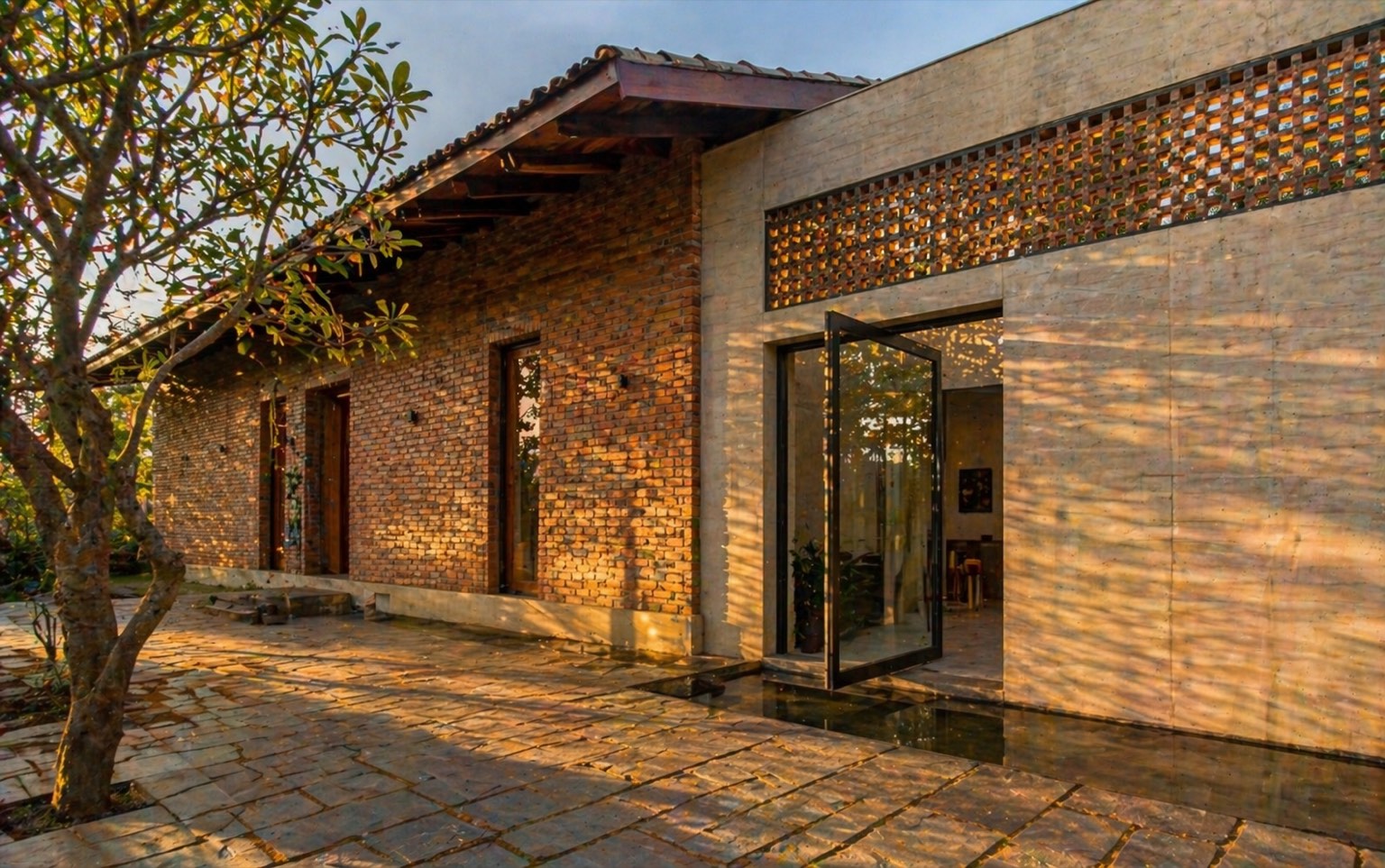
Modern vs Traditional Indian House Architecture
A Comparative Architectural Analysis of Plan, Structure, Envelope, Performance, and Cost
The choice between "modern" and "traditional" is rarely made consciously in contemporary Indian residential practice. Most houses are built by default — a load-bearing brick-and-RCC hybrid, finished in vitrified tile and aluminium-glass fenestration, topped by an open terrace. This default is neither fully modern nor authentically traditional; it is a collage assembled from whatever the local contractor knows, costed by the square-foot market rate, and finalised with almost no architectural debate. The result is a housing stock that performs worse than the traditional it displaced and falls short of the modern it aspires to.
The argument of this guide is that the modern-traditional question is worth making explicit. Each system has genuine strengths; each has demonstrable weaknesses. The serious contemporary Indian architect does not default to one or pastiche the other — they audit each design decision against the comparative performance data and specify the system that actually serves the site, the climate, the program, and the client. This guide provides that audit: a dimension-by-dimension comparison of modern and traditional Indian residential architecture, grounded in building science, cost data, and instrumented performance studies.
The focus throughout is architectural — plan, massing, structure, envelope, performance — not stylistic. The guide does not argue that "traditional looks better" or "modern is more honest." It argues that different design decisions yield different measurable outcomes, and the profession's job is to make those decisions knowingly.
"The problem is not whether to be traditional or modern. The problem is to design a building that works — in its climate, with its materials, for its people. Once you have done that, the adjective takes care of itself." — Charles Correa (1930–2015), from A Place in the Shade (Correa, 2010)
1. Defining "Modern" and "Traditional" in the Indian Context
The words are imprecise. For analytical use, this guide fixes working definitions.
Traditional Indian house: A residential construction inheriting form, structure, and material from regional vernacular tradition. Built with load-bearing masonry (stone, brick, laterite, stabilised mud), timber-framed pitched roof with clay tile (or flat mud-lime roof in arid regions), courtyard-centred plan, thick thermal-mass walls, small-to-medium openings with chajja or jali, locally-sourced materials. Construction period: pre-1947 dominant; revived selectively since 1970.
Modern Indian house: A residential construction using the RCC-frame-and-infill paradigm established by post-Independence professional practice. Reinforced concrete columns and beams support flat RCC slabs; walls are non-structural masonry infill; plan is open or room-based with corridor circulation; openings are large, often aluminium-framed glazing; finishes are vitrified tile, POP, acrylic paint; services are chased into walls and slabs. Construction period: post-1970 dominant across urban India.
Hybrid house (default contemporary): The prevalent urban form — load-bearing 230 mm brick walls with RCC roof slabs; sealed plan without courtyard; large openings; tile finishes; partial HVAC. Neither traditional in performance nor modern in architectural rigour. This is what most Indian houses actually are.
| Attribute | Traditional | Modern | Default Contemporary (Hybrid) |
|---|---|---|---|
| Structural system | Load-bearing masonry | RCC frame + infill | Partial load-bearing + RCC slab |
| Wall material | Stone / brick / laterite / mud (300–600 mm) | Brick or AAC infill (100–200 mm) | Brick infill (230 mm) |
| Roof | Pitched clay tile on timber / flat mud-lime | Flat RCC slab | Flat RCC slab |
| Plan form | Courtyard-centred, room-based | Open or corridor-based | Corridor-based, sealed |
| Opening size | Small, shaded | Large, often unshaded | Medium, partially shaded |
| Services | Surface-run or external | Fully integrated chased | Chased, retrofit-heavy |
| Climate strategy | Passive | Active (AC) dominant | Passive fails; active retrofitted |
| Material sourcing | Regional | Global / pan-Indian | Pan-Indian standardised |
2. Plan Typology and Room Organisation
The defining difference between the two traditions at the plan level is organisational geometry: how rooms relate to each other, to the outdoors, and to the circulation system.
Traditional plan organisation:
- Rooms arranged around one or more courtyards (chowk, nadumuttam, angan)
- Circulation through verandahs and semi-open passages — not corridors
- Progressive threshold hierarchy: street → otla → entry → court → room
- Specific-use rooms (puja, baithak, zenana, bhandaar) with defined locations
- Deep plans possible because the courtyard brings light and air inward
Modern plan organisation:
- Rooms arranged along a corridor or around a common hall
- Open-plan living (kitchen-dining-living continuous) derived from Western post-war housing
- Direct street-to-room transition; minimal threshold hierarchy
- Functional flexibility — rooms labelled by size rather than ritual use
- Shallow plans required because light and air must enter from perimeter openings
| Plan Parameter | Traditional (e.g. nalukettu, haveli) | Modern (post-1970 bungalow / flat) |
|---|---|---|
| Plot depth supported | 15–25 m (deep plans work via courts) | 6–12 m (shallow plans required for daylight) |
| Circulation | Verandah, court, enfilade | Central corridor or open-plan |
| Puja room | Defined, north-east, permanent | Often ad-hoc or cupboard-shrine |
| Kitchen | Separate, often external or court-adjacent | Integrated with dining/living (open-plan) |
| Master suite | Equal status with other bedrooms; near family area | Differentiated, often corner, ensuite bath |
| Privacy gradient | Gradual (5+ thresholds from street to inner room) | Abrupt (door separates public and private) |
| Outdoor space | Internal court + optional rear yard | Front/rear setback, terrace |
| Joint-family accommodation | Native (multi-court, generational wings) | Adapted (multi-bedroom flat or stacked houses) |
| Nuclear-family accommodation | Over-scaled (too many thresholds) | Native fit |
The deeper point: Plan typology is driven by social organisation. The traditional plan was optimised for joint families operating across multiple rooms, threshold-mediated guest reception, and climate-driven use-pattern shifting (sleeping in courtyard in summer, inner rooms in winter). The modern plan is optimised for nuclear-family use, sealed-envelope HVAC comfort, and furniture-driven room labelling. The awkwardness of contemporary Indian houses often traces to a mismatch — modern plan overlaid on persistent traditional social patterns (joint-family eating, house-wide puja, threshold-based guest reception).
3. Structural Systems — Load-Bearing Masonry vs RCC Frame
The most consequential structural shift in 20th-century Indian construction was the transition from load-bearing masonry to RCC frame. This is not a neutral engineering choice — it cascades into plan, elevation, material economy, and seismic behaviour.
| Structural Parameter | Load-Bearing Masonry (Traditional) | RCC Frame (Modern) |
|---|---|---|
| Primary gravity system | Wall carries load to ground | Column carries load to ground |
| Span capability | 3.5–4.5 m typical; 6 m with arch/vault | 6–9 m typical |
| Wall function | Structural + enclosure + thermal | Enclosure + thermal (non-structural) |
| Wall thickness | 300–600 mm for structural performance | 115–230 mm non-structural infill |
| Plan flexibility for alteration | Low — moving walls is structural | High — walls can be moved/removed |
| Foundation system | Continuous strip footing | Isolated or combined column footings |
| Applicable IS codes | IS 1905, IS 2212, IS 6041 | IS 456, IS 13920 (ductile detailing) |
| Typical floors for residential | 1–3 floors | 2–12+ floors (residential range) |
| Seismic behaviour | Brittle unless confined; low ductility | Ductile if properly detailed; high ductility with IS 13920 |
| Construction skill requirement | Skilled mason (abundant) | Skilled mason + steel fixer + concreter + formwork carpenter |
| Construction time (2000 sqft) | 6–9 months | 4–6 months |
| Cost (2026, Bangalore reference) | Rs 1,700–2,300/sqft | Rs 1,800–2,600/sqft |
The plan implications of the structural choice:
A load-bearing masonry house has walls where they must be for structure — typically at room-defining positions (every 3.5–4.5 m). This forces a cellular, room-based plan but also gives each wall genuine material presence (thickness, mass, thermal role). An RCC-frame house has walls wherever the designer wants them (typically 115–230 mm infill), detached from structural necessity — which enables open plans, large column-free rooms, and cantilevered elements, but also loses the thermal benefit of thick mass walls.
The seismic reality: The conventional wisdom that RCC is seismically superior is only true when properly detailed per IS 13920 (ductile detailing). A non-ductile RCC frame (typical in much informal Indian construction) performs worse than a well-built traditional timber-laced masonry wall in seismic events. The 2001 Bhuj, 2005 Kashmir, and 2015 Nepal earthquakes all produced field evidence that IS 13827 / IS 13828-compliant traditional construction (dhajji-dewari, kath-kuni, bhonga) outperformed non-engineered RCC of comparable period (Langenbach, 2009; NCDMA field reports).
4. Wall Construction — Thermal Mass vs Insulation
Wall systems are the single largest contributor to envelope thermal performance. The traditional and modern paradigms represent fundamentally different strategies.
Traditional strategy — high thermal mass:
A thick masonry wall stores daytime heat in its mass, delaying its passage to the interior surface by 8–12 hours (time-lag). Over a diurnal cycle, the interior temperature oscillates at a fraction of the exterior swing (decrement factor 0.1–0.3). This works in climates with large day-night temperature swings (hot-dry, composite) and becomes less effective in constantly-warm-humid climates.
Modern strategy — lower mass with insulation:
A thinner wall with insulating layer (EPS, XPS, PUF, glass wool) resists heat conduction directly, reducing U-value without requiring mass. This works in all climates but especially in mixed or cold climates. Modern Indian construction has largely failed to deploy insulation; the default 230 mm brick + plaster wall is neither high-mass nor insulated.
| Wall System | Thickness | U-value (W/m2K) | Decrement Factor | Time Lag (hrs) | ECBC Compliance | Cost (Rs/m2) |
|---|---|---|---|---|---|---|
| Traditional mud-brick (400 mm) | 400 mm | 1.0–1.4 | 0.15–0.25 | 10–12 | Non-compliant but high-mass compensates | 800–1,400 |
| Traditional sandstone (450 mm) | 450 mm | 1.8–2.2 | 0.20–0.30 | 8–10 | Non-compliant but high-mass compensates | 2,000–3,500 |
| Traditional laterite (300 mm) | 300 mm | 1.5–1.8 | 0.25–0.35 | 6–8 | Non-compliant | 1,000–1,800 |
| Modern default 230 mm brick + plaster | 250 mm | 2.0–2.3 | 0.35–0.45 | 4–5 | Non-compliant | 2,200–3,500 |
| AAC block 200 mm + plaster | 225 mm | 0.65–0.80 | 0.30–0.40 | 5–6 | Non-compliant | 2,400–3,500 |
| Cavity wall (230+50+115 mm) | 400 mm | 1.2–1.4 | 0.25–0.35 | 6–8 | Non-compliant | 3,500–5,000 |
| Cavity wall + 50 mm insulation | 400 mm | 0.45–0.55 | 0.15–0.25 | 5–7 | ECBC-compliant | 4,500–6,500 |
| 230 mm brick + 50 mm XPS external | 300 mm | 0.45–0.50 | 0.20–0.30 | 5–6 | ECBC-compliant | 4,000–5,500 |
| AAC 200 mm + 25 mm EPS | 235 mm | 0.38–0.42 | 0.25–0.35 | 4–5 | ECBC-compliant | 3,500–5,000 |
Sources: Bureau of Energy Efficiency (2018); Reddy and Jagadish (2003); ECBC User Guide (2017).
The honest comparison: An uninsulated 230 mm modern brick wall has worse U-value, worse decrement factor, and worse time-lag than almost every traditional wall listed. A modern insulated cavity wall or AAC-with-insulation system does outperform traditional — but it is rarely specified in Indian residential practice. The default-contemporary Indian house uses the worst of both traditions: thin enough to lose the mass advantage, uninsulated enough to lose the conduction-resistance advantage.
"Use what is available. Use what the local people use. The local building tradition is your starting library — not your final answer, but your starting library." — Laurie Baker (1917–2007), from collected essays (Bhatia, 1991)
5. Roof — Pitched Tile vs Flat Terrace
The roof is the envelope element with the highest solar exposure (sun is overhead for much of the day at Indian latitudes) and the most critical rain-shedding function. The two paradigms differ sharply.
Traditional pitched tile roof (Kerala, Konkan, Bengal, Himachal):
- Steep pitch 30–45 deg sheds monsoon rain efficiently
- Deep eaves protect walls from lashing rain
- Timber rafters + terracotta tile provide air gap — attic space acts as thermal buffer
- Ridge ventilator allows stack exhaust of hot air
- Tile finish: low heat storage, rapid night re-emission
- No occupiable upper surface (except under-roof storage)
Modern flat RCC slab roof:
- Occupiable terrace — adds usable floor plate
- Solar PV, water tanks, service routing on roof
- Mechanical rain drainage via slope + grated outlets
- Direct solar radiation absorbed by slab; requires waterproofing + china mosaic or tile finish for reflectance
- No attic thermal buffer — ceiling is directly under roof slab
- Top-floor thermal performance critical (most heat gain in summer)
| Roof Parameter | Pitched Tile (Traditional) | Flat RCC (Modern) |
|---|---|---|
| Rain shedding | Excellent | Good with slope + waterproofing |
| Usable surface | No | Yes — terrace, PV, services |
| Attic thermal buffer | Yes (crucial benefit) | No (unless insulation added) |
| U-value (finished assembly) | 1.0–1.5 W/m2K (tile + rafter + ceiling) | 3.0–4.5 W/m2K (bare slab) |
| U-value with cool-roof + insulation | n/a — already good | 0.8–1.2 W/m2K achievable |
| Solar reflectance (finish) | 0.30–0.45 (tile) | 0.15–0.25 (bare concrete); 0.65+ (white china mosaic) |
| Internal temperature below roof (peak summer) | 29–33 deg C | 34–40 deg C (bare slab); 30–33 deg C (insulated cool-roof) |
| Maintenance | Tile replacement, re-pointing | Waterproofing recoat every 5–7 yrs |
| Suitable climates | Rainfall > 1500 mm/year | Rainfall < 1000 mm/year (primary); works elsewhere with finish |
| Cost (Rs/m2, 2026) | 1,800–3,000 | 2,500–3,500 (bare); 3,500–5,000 (with cool-roof + insulation) |
The selection logic (from ECBC 2017 and Nayak and Prajapati, 2006):
- In warm-humid high-rainfall zones (Kerala, Konkan, Northeast, Goa), pitched tile outperforms flat slab on both rain-shedding and thermal grounds — and traditional lessons should be followed.
- In hot-dry and composite zones (Rajasthan, Delhi, Punjab), flat slab makes the roof a usable surface — which is a genuine functional gain — but must be specified with cool-roof finish (SRI > 65) and insulation (U ≤ 0.5 W/m2K) to compete thermally with pitched-tile-with-attic.
- The default-contemporary Indian response is flat bare slab, which combines the worst thermal performance of the flat option with none of the benefits of the specified insulated alternative.
6. Openings, Fenestration, and Daylight
Openings mediate the envelope — they are simultaneously the point of greatest heat gain (or loss), the source of daylight, the channel of ventilation, and the visual connection to the outside. The traditional and modern paradigms differ sharply.
| Opening Parameter | Traditional | Modern |
|---|---|---|
| Dominant type | Small shaded opening with chajja, jharokha, jali | Large aluminium-framed glass |
| Typical WWR (window-to-wall ratio) | 10–20% | 30–60% |
| Glazing | Wooden shutter + perforated screen; no glass often | Single or double glazing, frequently low performance |
| Shading | Integral (deep reveal, chajja, jali) | Added retrofit (curtain, blind) |
| Ventilation control | Variable — shutter, louvre, jharokha | Fixed operable portion; mostly sealed for AC |
| Privacy | Jali preserves view-out without view-in | Curtain-dependent |
| SHGC (effective, with shading) | 0.15–0.35 (well-shaded small opening) | 0.45–0.70 (large unshaded glazing) |
| Light entry | Modest but sufficient (courtyard supplements) | High but often glare-prone |
| Night ventilation | Open shutters safely behind jali | Security constraint restricts operation |
| Cost per m2 of opening | Low (wooden shutter) to High (carved jali) | Medium (uPVC) to Very High (thermal-break aluminium + DGU) |
The integrated-shading insight: A traditional opening combines aperture + shade + screen in a single architectural element (the jharokha, the chajja-above-jali, the Goan balcao window with its oyster-shell screen). A modern opening uses a single glass element for the aperture and bolts shading on afterward as curtain, blind, louvre, or roller shade. The retrofit shading never performs as well as integrated shading — because the solar heat has already entered the glass by the time the curtain catches it.
The ECBC glazing compliance path requires small opening or high-specification glass:
- Small unshaded clear single glass (SHGC 0.82): WWR must be ≤ 15% to meet ECBC
- Medium tinted DGU (SHGC 0.45): WWR can be ≤ 35% with shading
- High-performance Low-E DGU (SHGC 0.25): WWR can be ≤ 50% with shading
Traditional small-opening + shade practice naturally achieves ECBC compliance. Modern large-opening-clear-glass practice rarely does without high-specification (and high-cost) glazing.
7. Services Integration — Electrical, Plumbing, HVAC
Services integration is the area where modern construction delivers unambiguous gains over traditional. Traditional Indian houses were designed before electricity, running water, sewered sanitation, telecommunications, or mechanical cooling — all of which are retrofitted to traditional buildings at significant cost and architectural compromise. A modern RCC-frame house anticipates services at design stage and integrates them cleanly.
| Service | Traditional (retrofit) | Modern (integrated) |
|---|---|---|
| Electrical | Surface conduits or casing-capping on thick walls; concealed only at retrofit cost | Concealed from design; chased into 230 mm walls |
| Plumbing — water supply | External riser to roof tank + surface distribution | Chased in partition walls; manifold distribution |
| Plumbing — drainage | External stack on facade | Internal duct shafts; cleaner elevation |
| Sewerage | Septic-and-soak retrofit; limited in dense sites | Sewered connection; internal stack |
| HVAC split AC | Wall-hung outdoor unit on facade; exposed refrigerant line | Duct-provisioned rooms; concealed refrigerant routing; VRF options |
| Lighting | Pendant or retrofit recessed (ceiling mass allows limited options) | Cove, recessed, track — integrated into false ceiling |
| Data / networking | Surface conduit | Structured wiring to patch panel |
| Gas | LPG cylinder + piped via kitchen wall | PNG mains or concealed LPG line with isolation valves |
The honest acknowledgement: A traditional 400 mm mud wall is a nightmare to chase for concealed wiring. Any attempt to integrate modern services into a faithfully-reconstructed traditional house produces either compromise (exposed conduit) or masonry damage (chased-through heritage walls). The contemporary architect working in the traditional idiom must either (a) accept surface-run services and elevate them to architectural quality, or (b) pre-plan masonry chases at construction stage — which means the wall is not truly vernacular anyway.
8. Climate Performance — Instrumented Comparison
Peer-reviewed field studies have compared traditional and modern Indian houses under identical climate conditions. Headline findings:
| Study | Location / Climate | Comparison | Headline Result |
|---|---|---|---|
| Dili, Naseer and Varghese (2010) | Kerala / warm-humid | Traditional nalukettu vs modern RCC house of equal area | Nalukettu interior 2.5–4.5 deg C cooler; 78% thermal-comfort hours vs 52% in RCC |
| Singh, Mahapatra and Atreya (2009) | NE India / warm-humid subtropical | Vernacular timber-bamboo vs modern brick-RCC | Vernacular delivered 80–85% comfort hours vs 55–65% for modern |
| Shastry, Mani and Tenber (2014) | Goa / warm-humid | Traditional laterite house vs modern RCC | Laterite house maintained comfort zone hours 25% longer in peak summer |
| Manu et al. (2016) IMAC | Five climate zones pan-India | Adaptive thermal comfort model | Traditional houses deliver IMAC-compliant conditions without AC; modern houses require AC to reach IMAC band |
| Krishan et al. (2001) | Multi-climate | Passive strategy library | Traditional bioclimatic strategies deliver 60–80% of annual cooling/heating loads for free |
| Rawal, Shukla, Didwania and Manu (2018) | Composite | ECBC envelope compliance survey | Modern Indian residential envelope typically non-compliant with ECBC/ENS — performs worse than ECBC baseline |
The pattern is consistent: instrumented studies show traditional construction outperforming modern default construction in unconditioned thermal comfort across India's climate zones. The caveat — modern construction can outperform traditional, but only when specified with ECBC-compliant envelope (insulation, high-performance glazing, cool-roof finish). Specified to ECBC or better, modern wins; built to default-contemporary standard, traditional wins.
The implication for practice: The contemporary Indian architect cannot rely on the modern paradigm defaulting to good performance. ECBC or ENS compliance is a deliberate specification decision, costing 6–12% of wall and roof envelope cost. Clients who decline this uplift are effectively electing an air-conditioning-dependent house.
9. Seismic and Cyclonic Performance
| Hazard | Traditional Performance | Modern Performance |
|---|---|---|
| Seismic (Zone III) | Moderate — simple masonry at risk; timber-laced (kath-kuni, dhajji-dewari) excellent | Good if IS 13920 ductile detailing followed; poor for non-engineered RCC |
| Seismic (Zones IV–V) | Poor for unconfined masonry; excellent for timber-laced systems per IS 13827/13828 | Good with ductile detailing; catastrophic if non-engineered |
| Cyclonic wind (coastal Zone I/II) | Pitched tile roofs vulnerable to uplift; thatch worst; stone best | Flat RCC slab well-anchored performs well; steep light roofs vulnerable |
| Storm surge / flooding | Raised plinths + flood-tolerant materials traditionally; modern mostly not designed for | Modern plot-level design rarely addresses flood; plinth often inadequate |
| Fire | Masonry excellent; timber roofs vulnerable | Concrete excellent; finishes and furniture drive fire load |
| Hail | Tile roofs vulnerable; slate excellent | RCC slab invulnerable |
The nuanced comparative reading:
Traditional construction in seismic zones IV and V is only safe if built per IS 13827 (earthen buildings) or IS 13828 (low-strength masonry) — both of which require specific detailing (timber bands, vertical reinforcement, corner strengthening). A randomly-built traditional house in a seismic zone is dangerous. A code-compliant traditional house — especially a timber-laced one — is among the safest residential construction on earth.
Modern RCC construction in seismic zones is only safe if built per IS 13920 (ductile detailing of reinforced concrete structures) — which requires specific column confinement, beam-column joint reinforcement, and reinforcement quantities beyond non-ductile detail. A randomly-built modern RCC house in a seismic zone is also dangerous — as the Bhuj 2001 (1,200+ RCC collapses) and Kashmir 2005 (widespread concrete-frame failure in Muzaffarabad) evidence established.
The code compliance is the load-bearing factor, not the paradigm. Traditional built-to-code beats modern built-to-default. Modern built-to-code beats traditional built-to-default.
10. Construction Cost Comparison
A clean apples-to-apples cost comparison is difficult because "traditional" and "modern" span very different specification bands. The table below reports 2026 Indian reference costs for a 2,000 sqft single-storey residence in four representative Indian cities.
| Construction System | Bangalore (Rs/sqft) | Delhi (Rs/sqft) | Mumbai (Rs/sqft) | Jaipur (Rs/sqft) |
|---|---|---|---|---|
| Default-contemporary brick + RCC | 1,800–2,200 | 1,900–2,400 | 2,400–3,200 | 1,700–2,100 |
| RCC frame + AAC infill + default finishes | 1,900–2,400 | 2,000–2,500 | 2,500–3,400 | 1,800–2,300 |
| Modern ECBC-compliant (cavity wall + insulation + DGU + cool-roof) | 2,400–3,100 | 2,600–3,300 | 3,100–4,100 | 2,400–3,000 |
| Traditional revival — stabilised mud block + tile roof | 1,500–2,100 | 1,800–2,400 | — (not typical) | 1,400–1,900 |
| Traditional revival — laterite + tile (Kerala/Konkan) | — (not regional) | — | 2,100–2,800 | — |
| Laurie Baker–style cost-reduced (rat-trap bond, filler slab, exposed brick) | 1,300–1,800 | 1,500–2,000 | 1,900–2,600 | 1,300–1,700 |
| Premium traditional — sandstone + timber + carved jali | 3,500–6,500 | 4,000–7,000 | — | 3,000–6,000 |
Figures reflect 2026 market surveys; include structure, envelope, basic finishes; exclude furniture, HVAC, and premium fit-out.
Three observations from the cost table:
1. Baker-style cost-reduced traditional is consistently the cheapest — demonstrating that traditional paradigm is not inherently expensive. The Centre for Development Studies (Trivandrum) cost-per-sqft in 1971 was 40% below market rate for comparable modern construction (Bhatia, 1991).
2. Modern ECBC-compliant construction costs 15–30% more than default-contemporary but 5–15% less than premium traditional. It is the mid-range cost option with the best thermal performance.
3. Premium traditional construction (carved stone, seasoned timber, skilled artisans) is significantly more expensive than modern — but that premium is paying for artisan labour and material quality, not for the traditional paradigm per se. Compared fairly (unadorned traditional vs unadorned modern), traditional is typically cheaper.
11. Lifecycle, Maintenance, and Embodied Carbon
The conversation shifts character when lifecycle and carbon are added to the comparison.
| Lifecycle Dimension | Traditional | Modern |
|---|---|---|
| Useful life | 100–300+ years (stone, laterite, kath-kuni) | 50–80 years (RCC structural life; carbonation-limited) |
| Annual maintenance (% of construction cost) | 0.5–1.5% | 1.0–2.5% |
| Major rehabilitation interval | 30–50 years (re-roofing, re-pointing) | 15–25 years (waterproofing, plaster repair) |
| Demolition produces | Reusable stone, brick, tile; small waste fraction | Mixed concrete/steel — largely landfill |
| Embodied carbon (kg CO2e/m2 built-up) | 100–250 (mud, laterite, stone) | 400–700 (RCC, brick, AAC infill) |
| Operational carbon over 50 years (unconditioned use) | Low (low cooling load) | High (AC-dependent in default construction) |
| Whole-life carbon over 50 years | 200–500 kg CO2e/m2 | 700–1,400 kg CO2e/m2 |
Sources: Reddy and Jagadish (2003); Ramesh, Prakash and Shukla (2010); Reddy (2009); CEPT Centre for Advanced Studies in Architecture life-cycle studies.
The compounding advantage of traditional construction is time. A stone haveli built in 1780 has amortised its embodied carbon over 250 years; an RCC house built in 2020 will not approach that lifecycle even if maintained perfectly. The per-year carbon cost of traditional construction is therefore a fraction of modern — a fact increasingly material as carbon accounting enters mainstream building regulation.
The modern rejoinder: RCC frame construction enables vertical density (apartments) that traditional load-bearing cannot — and per-household carbon in dense apartment construction may beat per-household carbon in traditional low-rise. The comparison is not symmetrical across all program scales. For dense urban residential (> 4 storeys), modern wins; for low-rise houses on land, traditional wins.
12. The Hybrid House — Best of Both Traditions
The thesis of contemporary Indian practice since 1970 — exemplified by Correa, Doshi, Baker, Raje, Rewal, and their successors — is that the either-or choice is false. The productive path is a hybrid that extracts the best of each tradition deliberately.
| System | Adopt from Traditional | Adopt from Modern |
|---|---|---|
| Plan | Courtyard centre; threshold hierarchy; verandah buffer | Open-plan living-kitchen-dining where family pattern permits; ensuite bathrooms |
| Structure | Load-bearing masonry for 1–2 storey low-rise where regional stone/brick permits | RCC frame for > 2 storey, irregular plan, long spans |
| Wall | Mass wall in hot-dry (300–450 mm stone/brick/stabilised mud) | Cavity wall with insulation for cold, composite |
| Roof | Pitched tile in warm-humid high-rainfall | Flat RCC slab with cool-roof + insulation where terrace functionality matters |
| Openings | Jali, chajja, jharokha for shading and privacy | High-performance DGU + operable systems where climate demands |
| Finishes | Lime plaster (breathable); IPS (durable); Athangudi/Kota stone | Epoxy or polyurethane in wet areas; vitrified where appropriate |
| Services | Surface-run elegant where masonry is revealed | Concealed integrated where partition walls host them |
| Seismic | Timber-laced or confined masonry per IS 13827/13828 in mountain zones | Ductile RCC per IS 13920 in apartment construction |
| Material sourcing | Regional stone, brick, lime, timber | Steel, high-performance glass, insulation, fittings |
The hybrid design process:
1. Start with climate. Choose the passive strategy library (courtyard, mass wall, pitched roof, or their opposites) from the climate zone.
2. Honour the program. If the client's family pattern is joint + ritual-heavy, threshold hierarchy and court help; if nuclear + compact, open plan helps.
3. Choose structure by scale and code. Low-rise on stable ground — masonry is fine and often better; tall or seismic — ductile RCC is better.
4. Specify envelope to performance target. Either thick mass (traditional path) or thin-with-insulation (modern ECBC path) — but not the unspecified default-contemporary middle.
5. Integrate services early. Run them either (a) surface and elevated to architectural quality, or (b) concealed in chased locations planned at construction stage.
6. Source materials by transport distance. Within 500 km reduces both embodied carbon and cost.
This six-step hybrid logic — pragmatic, non-ideological, performance-driven — is what separates the serious contemporary Indian residential architect from both the pastiche-traditionalist and the generic-modernist.
"The best Indian architecture of the last fifty years has neither rejected tradition nor copied it. It has understood tradition as a starting condition and modernism as an instrument — and then got on with the real work, which is building for this climate, this family, this place." — B.V. Doshi (1927–2023), from Paths Uncharted (Doshi, 2012)
References
- Ashraf, K.K. and Belluardo, J. (Eds.) (1998) An Architecture of Independence: The Making of Modern South Asia — Charles Correa, Balkrishna Doshi, Muzharul Islam, Achyut Kanvinde. New York: Architectural League of New York.
- Bhatia, G. (1991) Laurie Baker: Life, Work, Writings. New Delhi: Penguin Viking.
- Bhatt, V. and Scriver, P. (1990) Contemporary Indian Architecture: After the Masters. Ahmedabad: Mapin Publishing.
- Bureau of Energy Efficiency (2017) Energy Conservation Building Code 2017. New Delhi: Ministry of Power, Government of India.
- Bureau of Energy Efficiency (2018) Eco-Niwas Samhita 2018. New Delhi: Ministry of Power.
- Bureau of Indian Standards (1987) IS 1905:1987 — Code of Practice for Structural Use of Unreinforced Masonry. 3rd rev. New Delhi: BIS.
- Bureau of Indian Standards (1993) IS 13827:1993 — Improving Earthquake Resistance of Earthen Buildings. New Delhi: BIS.
- Bureau of Indian Standards (1993) IS 13828:1993 — Improving Earthquake Resistance of Low Strength Masonry Buildings. New Delhi: BIS.
- Bureau of Indian Standards (2000) IS 456:2000 — Plain and Reinforced Concrete — Code of Practice. 4th rev. New Delhi: BIS.
- Bureau of Indian Standards (2016) IS 13920:2016 — Ductile Design and Detailing of Reinforced Concrete Structures Subjected to Seismic Forces — Code of Practice. New Delhi: BIS.
- Bureau of Indian Standards (2016) National Building Code of India 2016 (SP 7:2016). New Delhi: BIS.
- Correa, C. (2010) A Place in the Shade: The New Landscape and Other Essays. New Delhi: Penguin India.
- Curtis, W.J.R. (1988) Balkrishna Doshi: An Architecture for India. New York: Rizzoli.
- Dili, A.S., Naseer, M.A. and Varghese, T.Z. (2010) 'Passive environment control system of Kerala vernacular residential architecture for a comfortable indoor environment: A qualitative and quantitative analysis', Energy and Buildings, 42(6), pp. 917–927.
- Doshi, B.V. (2012) Paths Uncharted. Ahmedabad: Vastu Shilpa Foundation.
- Frampton, K. (1983) 'Towards a Critical Regionalism: Six Points for an Architecture of Resistance', in Foster, H. (Ed.), The Anti-Aesthetic: Essays on Postmodern Culture. Port Townsend: Bay Press, pp. 16–30.
- Khan, H.U. (1987) Charles Correa: Architect in India. London: Concept Media / Mimar.
- Krishan, A., Baker, N., Yannas, S. and Szokolay, S. (2001) Climate Responsive Architecture. New Delhi: Tata McGraw-Hill.
- Lang, J., Desai, M. and Desai, M. (1997) Architecture and Independence: The Search for Identity — India 1880 to 1980. Delhi: Oxford University Press.
- Langenbach, R. (2009) Don't Tear It Down: Preserving the Earthquake Resistant Vernacular Architecture of Kashmir. New Delhi: UNESCO.
- Manu, S., Shukla, Y., Rawal, R., Thomas, L.E. and de Dear, R. (2016) 'Field studies of thermal comfort across multiple climate zones for the subcontinent: India Model for Adaptive Comfort (IMAC)', Building and Environment, 98, pp. 55–70.
- Mehrotra, R. (2011) Architecture in India Since 1990. Mumbai: Pictor / Hatje Cantz.
- Nayak, J.K. and Prajapati, J.A. (2006) Handbook on Energy Conscious Buildings. Mumbai: IIT Bombay / MNRE.
- Prakash, V. (2002) Chandigarh's Le Corbusier: The Struggle for Modernity in Postcolonial India. Seattle: University of Washington Press.
- Ramesh, T., Prakash, R. and Shukla, K.K. (2010) 'Life cycle energy analysis of buildings: An overview', Energy and Buildings, 42(10), pp. 1592–1600.
- Rawal, R., Shukla, Y., Didwania, S. and Manu, S. (2018) 'Residential building envelope performance and code compliance in India', Proceedings of the 10th Windsor Conference, pp. 899–910.
- Reddy, B.V.V. and Jagadish, K.S. (2003) 'Embodied energy of common and alternative building materials and technologies', Energy and Buildings, 35(2), pp. 129–137.
- Scriver, P. and Srivastava, A. (2015) India: Modern Architectures in History. London: Reaktion Books.
- Shastry, V., Mani, M. and Tenber, R. (2014) 'Evaluating thermal comfort and building climatic response in warm-humid climates for vernacular dwellings (Suggi tradition) in Goa', Architectural Science Review, 59(1), pp. 12–28.
- Singh, M.K., Mahapatra, S. and Atreya, S.K. (2009) 'Bioclimatism and vernacular architecture of north-east India', Building and Environment, 44(5), pp. 878–888.
- Tillotson, G.H.R. (1989) The Tradition of Indian Architecture: Continuity, Controversy and Change since 1850. New Haven: Yale University Press.
Author's Note: This guide is deliberately framed as a comparison of two paradigms rather than an advocacy for either. The Indian architectural discourse has spent too long oscillating between nostalgic recovery of tradition and uncritical adoption of Western modernism. Both positions are intellectually cheap. The hard work — which Correa, Doshi, Baker, and their intellectual heirs actually did — is to audit each design decision against climate, program, economics, and material performance, and to build the best hybrid that those criteria allow. This is not compromise; it is method. The data in this guide is offered to support that method, not to settle a style debate that has no productive resolution.
Disclaimer: This article is for informational and educational purposes only. It does not constitute professional architectural or structural engineering advice. The comparative figures for cost, performance, and lifecycle are approximations drawn from published sources as of 2026 and will vary by project, location, and market conditions. Structural and seismic design decisions must be made by qualified engineers with reference to applicable IS codes (IS 456, IS 1905, IS 13828, IS 13920, IS 1893) and local regulations. Studio Matrx, its authors, and its contributors accept no liability for decisions made on the basis of the information contained in this guide.
Export this guide
Related Tools — Try Free
Cross-Ventilation Analyzer
Estimate airflow and air changes per hour (ACH) from room size, window areas, layout, and local wind — with NBC 2016 Part 8 compliance check.
Ventilation CalculatorApartment Furniture Size Chart
Standard furniture dimensions for Indian apartments — sofas, beds, tables, dining, storage.
Reference ChartMonsoon-Readiness Checklist
Pre-rain home audit across 9 categories — terrace, drains, waterproofing, electrical, HVAC, pest, vehicles, documents.
Seasonal Audit