
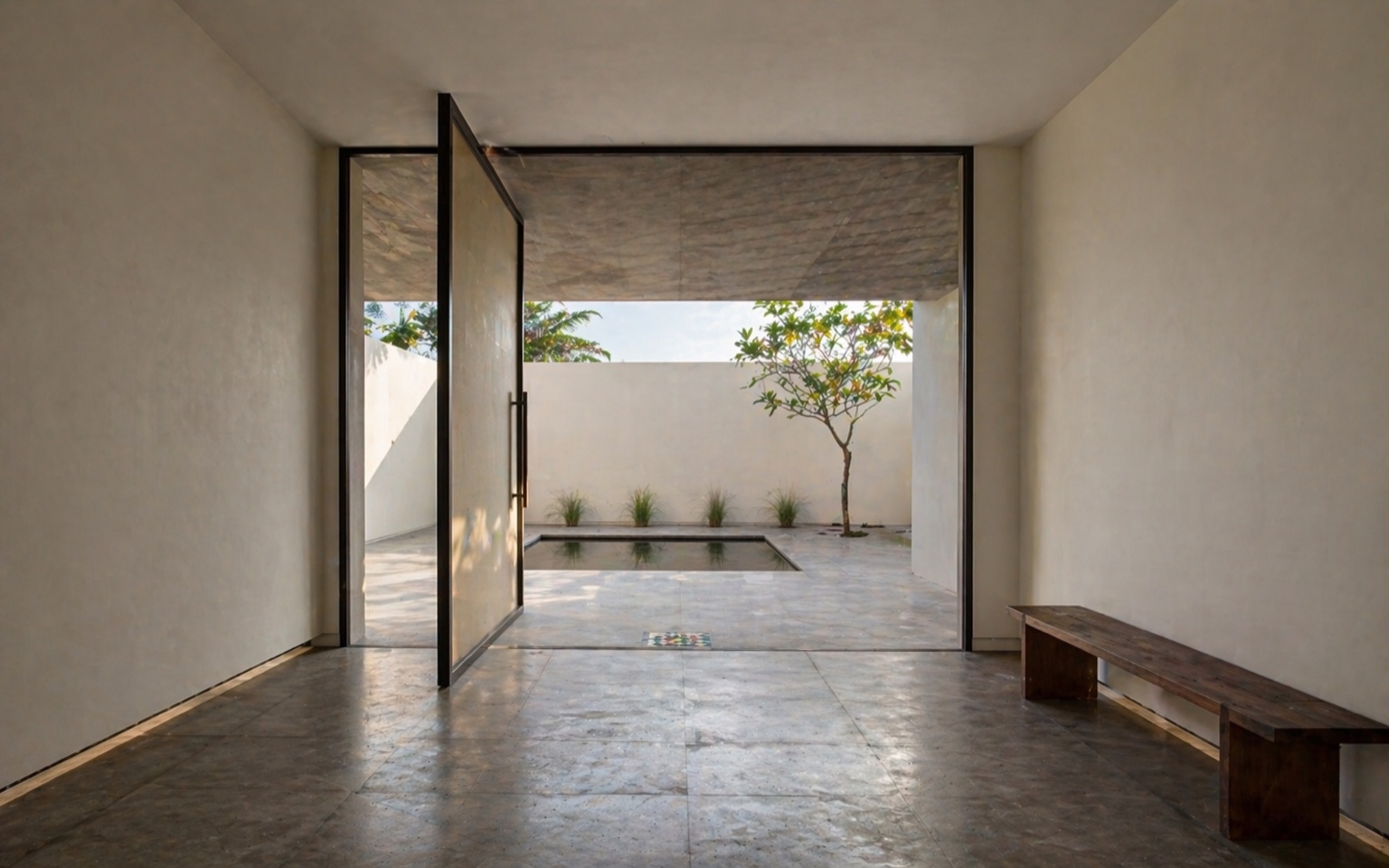
Minimalist Architecture in the Indian Context
An Architectural Critique — Where Restraint Works, Where It Fails, and What an Appropriate Indian Minimalism Looks Like
Minimalism is the most imitated and most misunderstood architectural position in contemporary Indian residential practice. The visual signature — white walls, exposed concrete, frameless glass, uncluttered rooms, invisible fittings — is reproduced thousands of times each year in magazine spreads, Instagram feeds, builder brochures, and 3D renders. The architectural discipline it requires — invisible services, flawless detailing, material monolithism, functional reduction, maintenance capacity, operational discipline — is reproduced perhaps a few dozen times a year by firms with the technical and client capacity to sustain it.
This guide addresses the gap. It is not an endorsement of minimalism or a critique of it, but an examination of what minimalism actually demands as an architectural discipline, how those demands collide with Indian conditions (climatic, programmatic, cultural, economic), when the collision can be productively resolved, and when the attempt degenerates into the minimalist-looking but functionally defeated house that makes up the bulk of claimed minimalist work in India.
The position this guide takes is specific: minimalism in India is neither automatically appropriate nor automatically inappropriate. It is a design discipline that suits certain sites, certain clients, certain climates, and certain programmes — and catastrophically fails others. The serious architect audits the brief against the preconditions of minimalism before committing to the position, and designs accordingly. What this guide provides is that audit framework.
"Less is more." — Ludwig Mies van der Rohe (1886–1969), architect, architectural aphorism widely documented in e.g. Blaser (1977)
"Minimum' could be defined as the perfection that an artefact achieves when it is no longer possible to improve it by subtraction. This is the quality that an object has when every component, every detail, and every junction has been reduced or condensed to the essentials." — John Pawson, from Minimum (Pawson, 1996)
1. Defining Minimalism — An International Inheritance
Architectural minimalism is not a single doctrine but a convergent position articulated across four twentieth-century strands that Indian practice has inherited more or less uncritically.
| Strand | Key Figure(s) | Period | Core Idea |
|---|---|---|---|
| German Modernism — tectonic reduction | Ludwig Mies van der Rohe | 1920s–1960s | Structure expressed; non-structural element minimised; steel, glass, travertine; "less is more" |
| Japanese aesthetics — emptiness and shadow | Junichiro Tanizaki (writer); Tadao Ando (architect); SANAA | 1930s (Tanizaki); 1970s onwards (Ando, SANAA) | Beauty in restraint, shadow, absence; ma (interval); wabi-sabi (patina) |
| Swiss material-essentialism | Peter Zumthor | 1980s–present | Material atmosphere; sensory architecture; radical reduction of formal moves |
| English minimalism | John Pawson; David Chipperfield | 1990s–present | Domestic minimalism; stone, oak, white, water; Buddhist-inflected restraint |
What these strands share:
- Reduction to the essential — removal of any element not strictly required for function, structure, or atmosphere.
- Material monolithism — few materials, each used extensively.
- Visible structure, invisible services — the structure is legible; the electrical, plumbing, HVAC are concealed.
- Flawless detailing — the honesty of minimalism requires joints, tolerances, and finishes that show imperfection mercilessly.
- Quiet atmosphere — the building does not perform or distract; it provides a calm background.
What these strands diverge on (and which the Indian practitioner must choose):
- Warmth vs austerity — Pawson allows oak and limestone warmth; Mies is colder, more industrial.
- Patina vs perfection — Zumthor and Ando embrace aging material; Chipperfield tends toward the pristine.
- Sensuous vs intellectual — Pallasmaa and Zumthor privilege touch, sound, and smell; Mies privileged geometric order.
- Traditional materials vs industrial — Japanese minimalism favours timber, paper, stone; German favours steel, glass, concrete.
"Architecture is not about form, it is about many other things. The light and the use, and the structure, and the shadow, and the smell, and so on. I think form is the easiest to control and also the least interesting." — Peter Zumthor (b. 1943), architect, from Atmospheres (Zumthor, 2006)
2. The Indian Conditions That Challenge Minimalism
Minimalism was articulated in climatic, cultural, and material contexts very different from India's. Imported uncritically, it collides with Indian conditions in ways that the magazine photograph conceals but the lived house exposes.
| Indian Condition | Challenge to Minimalism | Typical Failure Mode |
|---|---|---|
| Dust (urban particulate, construction dust, monsoon tailings) | White surfaces and exposed joints darken rapidly | House looks "dirty" within 3–6 months; client reinstates curtains and covers |
| Monsoon (2000–4000 mm rainfall in 4 months) | Frameless glazing and flush junctions develop mould, stain, leak | Chipped concrete edges, black mould at joints, water marks on walls |
| Humidity (coastal, warm-humid) | Materials fog, timber swells, steel oxidises | Uncontrolled patina mistaken for wabi-sabi; actually substrate damage |
| Joint family + multi-generational living | High occupancy density, variable schedules, many possessions | Minimalist emptiness is impossible; storage crisis within weeks |
| Ritual practice (puja, festivals, guest hospitality) | Requires designated room(s) or surfaces, often decorative | Either compromises minimalism or pushes rituals to hidden rooms |
| Guest reception culture | Furniture must accommodate 5–20 visitors occasionally | Minimalist low-occupancy layout fails guest reception |
| Service visibility (fans, AC, lights, cables) | Minimalism requires invisible services; Indian electrical/plumbing default is surface-run | Compromise: either visible services defeat the aesthetic, or chasing-and-concealment blows the budget |
| Craft abundance (affordable skilled artisans) | Minimalism eschews ornament; Indian craft ecosystem favours expression | Tension: minimalist house built by craftsmen who cannot express — the craft is hidden or suppressed |
| Ant, termite, rat infestation | Minimalist flush details hide pest entry routes | Pest problem develops behind flush cladding — diagnosis is invasive |
| Maintenance labour economics | Minimalism demands continuous cleaning; Indian domestic labour makes this affordable for wealthy, infeasible for middle-class | Minimalism effectively becomes upper-class only |
| Retrofit culture | Indian families continuously modify homes (new AC, new geyser, new fitting); minimalism requires construction-stage finality | Every retrofit defeats minimalist purity |
| Dense urban plots | Party walls, no setback, forced window placements | Minimalist idealised plan (symmetric, volumetric) impossible |
The honest acknowledgement: every one of these challenges is surmountable — but each requires a specific design response. Minimalism is not technically impossible in India; it is conditionally possible and the conditions must be actively engineered. A minimalist Indian house that ignores these challenges is not minimalist — it is a failed attempt at minimalism that will cost twice as much to fix as it did to build.
3. The Honest Question — Is Indian Minimalism Possible?
The preceding section could be read as a disqualification. It is not. Minimalism is possible in India under specific conditions — and has been achieved by a small number of Indian practitioners. The question is whether the conditions can be engineered for a given project.
Conditions under which Indian minimalism is achievable:
1. Climate: Temperate (Bangalore, Pune) or dry (inland Rajasthan, Gujarat) — warm-humid and high-rainfall coastal zones make minimalist details mould and stain within one monsoon.
2. Client: Nuclear family or small household, mature domestic discipline, reduced ritual obligations, capacity to pay for continuous maintenance.
3. Program: Primary residence (not frequent-guest host), < 350 m2 built-up, conventional service demands.
4. Budget: Minimum Rs 4,500–7,000/sqft construction (2026) — minimalism requires premium detailing, not economy.
5. Site: Regular geometry, meaningful plot width (≥ 15 m), climatically mild context, capable of respecting strict axial/volumetric rules.
6. Practice: Team with fastidious detailing discipline, long construction supervision, relationship with skilled fabricators who accept minimalist tolerance.
7. Maintenance: Committed client with either in-house or regular contracted maintenance capable of quarterly deep cleaning.
Conditions under which Indian minimalism fails:
1. Warm-humid coastal climate + unsealed building envelope
2. Joint-family occupancy + frequent guest reception
3. Religious practice requiring dedicated visible space
4. Rs < 3,500/sqft budget (detailing cannot be achieved)
5. Small urban plot (< 12 m width) with forced service routing
6. Client who will retrofit (new fittings, new ACs) without architectural discipline
7. Commercial or investment residence where maintenance is uncertain
An honest taxonomy of claimed "minimalist" Indian houses would likely split 80/20 into the failed-attempt category (the minimalist-looking Instagram house that is actually a maintenance disaster) and the achieved-minimalism category (the small number of serious built works that meet the preconditions).
4. Formal Moves in Indian Minimalist Residential Work
The work that has achieved minimalism in India — Samira Rathod's The Fab India House series, selected Spatial Ideas residences, certain Flying Elephant houses, Serie Architects' residential lineage, Sameep Padora's house portfolio, and the monastery-like work of Zatanna and Ashiesh Shah — converges on a set of formal moves.
| Formal Move | Description | Indian Example(s) |
|---|---|---|
| Single-material monolith | One dominant material carries the building envelope | Samira Rathod The Brick House; Anagram brick houses (minimalist subset) |
| Exposed concrete with disciplined formwork | Board-marked, single-pour finish; no infill plaster | SPASM Gable House; Flying Elephant Residence; Serie Villa Delhi |
| White-wall-and-stone | White rendered wall + single local stone (Kota, basalt, Dholpur) | Spatial Ideas; Matharoo minimalist subset |
| Courtyard as void | Plain open-to-sky court — no plantation, no water, just emptiness | Ashiesh Shah pragmatic minimalism; Zen-influenced work |
| Frameless or minimal-frame glazing | Steel or thermally-broken aluminium in slim profiles | Serie; Chromed Design Studio; premium work |
| Concealed lighting cove + minimal pendant | No exposed bulb; all indirect; architectural lighting designer essential | Premium category — Studio Lotus residential, Chromed |
| Flush door frames (door-height reveals) | Full-height doors aligned with wall plane | Nearly all serious minimalist work |
| Single-plank floor treatment | Uninterrupted IPS, single stone slab, or matching tile | Samira Rathod; Flying Elephant; premium work |
| Service concealment (HVAC, plumbing fully chased) | No visible pipe, no exposed AC, no visible cable | Premium only; cost 40–60% higher than default chasing |
| Minimal furniture — architect-designed | Built-in + architect-commissioned pieces only | Samira Rathod; Ashiesh Shah; Studio Lotus |
| Axial plan | Symmetric or strongly axial — circulation on axis, rooms aligned | Premium single-family; requires plot capacity |
| Long horizontal reveals | Instead of dado lines or trims, recessed reveals define changes | Pawson-inflected Indian minimalism |
The combinatorics: a serious minimalist Indian house deploys typically 7–10 of these moves simultaneously. Deploying 2–3 without the rest produces an inconsistent hybrid — which is the default-contemporary "minimalist-inspired" house.
5. Material Palette — Indian Restraint vs Global Restraint
Minimalism's material palette is narrow by definition. The question is which materials — and at what cost and climatic fit.
| Material | International Minimalist Usage | Indian Minimalist Usage | Indian Climate Fit |
|---|---|---|---|
| White render + white paint | Pawson / Chipperfield staple | Common but vulnerable to staining | Poor in humid/rainy; OK in dry |
| Exposed concrete (fair-face) | Ando; Chipperfield | SPASM, Samira Rathod, Flying Elephant | Good — but requires disciplined pour, especially monsoon |
| Travertine / limestone | Pawson | Rare (cost); substituted by Dholpur or sandstone | Good, moderate staining |
| Kota stone | Not used internationally | Widespread — Samira Rathod, Spatial Ideas | Excellent — robust, regional, restrained |
| Basalt / dark granite | Limited international use | Chromed, Ashiesh Shah; moodier residences | Excellent — minimal staining, monolith-effective |
| Handmade brick (wire-cut or reclaimed) | Pawson; Chipperfield occasionally | Samira Rathod, Anagram minimalist work | Excellent but requires skilled mason |
| Timber (oak, walnut) | Pawson / Ando signature | Teak, Burma teak (reclaimed); less common in strict minimalism | Good but swells in humid |
| IPS (Indian Patent Stone — red oxide) | Not used internationally | Regional Indian minimalism | Excellent — monolithic, low-cost, heritage reference |
| Athangudi tile / handmade terrazzo | Not used internationally | Revived in premium Indian practice | Excellent — dense, stain-resistant, craft-legible |
| Frameless glass | Pawson, Chipperfield, SANAA | Premium Indian work; vulnerable at joints in monsoon | Moderate — careful detailing required |
| Steel (exposed I-section, channel) | Mies, Chipperfield | Serie, Mathew & Ghosh, SPASM subset | Good but requires rust-proofing in coastal |
| White marble | Ancient and modernist | Premium Indian; delicate to staining | Moderate |
| Tadelakt / microcement | Contemporary international | Rare — high craft cost | Good but specialist |
The honest Indian minimalist material position: a palette centred on Kota, IPS, exposed concrete, and one craft element (handmade tile, reclaimed brick, rammed earth) outperforms the imitation of Pawson's travertine-and-oak palette in Indian climate, and is also more honest to Indian material economy. Firms that commit to this position (Samira Rathod being the clearest example) produce work that reads as both minimalist and Indian; firms that imitate Pawson's material list produce work that reads as imitation.
"In making a room, I am always aware that the materials I specify will be touched, smelled, stood on, walked across. The material is never neutral. It must work as hard as the geometry works." — Samira Rathod, from interviews in Matter and Domus India (Padora / Matter, 2018)
6. Leading Practitioners and Their Positions
A short, critical map of the firms most associated with Indian minimalism — and how their positions differ.
| Firm / Architect | Position | Material Signature | Representative Residential Work |
|---|---|---|---|
| Samira Rathod Design Associates (SRDA) | Craft-minimalist; handmade restraint | Handmade brick, Kota, timber, IPS | The Brick House (Wada, 2014); Book House (Khandala, 2018); hospitality projects |
| Spatial Ideas (Aniket Bhagwat) | Landscape-minimalist; built + unbuilt merged | Local stone, white, void | Various Ahmedabad-Vadodara residences |
| SPASM Design (Sanjeev and Sangeeta Merchant) | Concrete-monolith minimalism | Exposed concrete, local stone | House on a Stream; Gable House; Vault Residence |
| Flying Elephant Studio (Rajesh Renganathan) | Concrete-and-landscape minimalism | Exposed concrete, steel, stone | Chennai residences; Bangalore minimalist work |
| Serie Architects (Christopher Lee, K.B. Panchal) | Parametric-adjacent minimalism | Concrete, steel, glass, local stone | Villa in Delhi; Mumbai residences |
| Chromed Design Studio (Nikita and Gaurav Sharma) | Luxe-minimalist; detailing-focused | Stone, timber, stainless steel, concealed lighting | Delhi-NCR residences |
| Sameep Padora sP+a | Critical-minimalism; often more textured | Concrete, stone, handmade tile | Residential work interspersed with institutional |
| Ashiesh Shah | Wabi-sabi-influenced minimalism | IPS, exposed brick, handmade stone, reclaimed timber | Mumbai residences; gallery spaces |
| Zowa / Zowa Design | Material-restraint minimalism | Stone, concrete, steel | Mumbai residences |
| RMA (Rahul Mehrotra) | Regionally-moderated minimalism (not doctrinaire minimalist, but often minimally-inclined) | Stone, brick, concrete | Mehrotra weekend houses; select residences |
| Matharoo Associates | Sculptural-minimal with craft | Concrete, stone, steel | Moving Landscapes residence; Ahmedabad portfolio |
The positions differ on three axes:
1. Material — concrete-forward (SPASM, Serie, Flying Elephant) vs craft-forward (Samira Rathod, Ashiesh Shah) vs stone-forward (Spatial Ideas, Chromed)
2. Austerity level — strict emptiness (Chromed luxe-minimal) vs occupied richness (Samira Rathod, Ashiesh Shah)
3. Atmosphere — cool intellectual (Serie, SPASM) vs warm sensuous (Samira Rathod, RMA, Sameep Padora)
A client selecting a minimalist architect for an Indian residential project is implicitly selecting one of these positions — and the briefing conversation should make that position explicit rather than leaving it to accidental discovery.
7. Performance and Livability — The Trade-offs
Minimalism is rarely discussed in performance terms — which is odd, because the aesthetic decisions drive measurable livability outcomes.
| Performance Dimension | Minimalist Default | Performance Implication |
|---|---|---|
| Solar gain (large glazing) | Large frameless glass typical | High SHGC unless high-spec low-E; thermal performance degrades |
| Thermal mass | Often low (thin walls, concrete monolith without insulation) | Interior temperature swings exceed ECBC expectations |
| Daylight | Generally good (large openings, white walls) | Glare frequent; controlled-glare detailing required |
| Ventilation | Often compromised (large sealed glazing) | Cross-ventilation sacrificed for visual purity |
| Acoustic | Often poor (hard surfaces, no soft furnishings) | Echo, reverberation, speech intelligibility degraded |
| Thermal comfort | AC-dependent usually | Passive cooling sacrificed; energy cost high |
| Humidity management | Concealed services = concealed moisture issues | Mould risk elevated in humid climates |
| Storage | Minimal visible storage | Hidden storage (wardrobes, service rooms) must be generous; else clutter defeats aesthetic |
| Pest control | Flush details hide pest routes | Inspection and remediation more difficult |
| Cleaning | Visible | Every surface is a signal of upkeep |
| Retrofit flexibility | Low | New fixtures, systems, or partitions disrupt the aesthetic irrevocably |
The operational cost of minimalism is not negligible. A minimalist Indian house typically runs 20–40% higher annual operational cost than a conventional house of equal area — driven by AC dependence, cleaning frequency, surface maintenance, and the higher-specification fittings required to sustain the aesthetic. This is rarely disclosed to clients at design stage.
8. Detailing Rigour — What Minimalism Demands Technically
Minimalism is the detailing-heaviest architectural position. The visible simplicity is the product of extraordinary invisible complexity. A minimalist wall–floor junction might require:
- Recessed skirting (15–25 mm reveal)
- Separate plaster lines for wall and floor planes
- Steel angle to define the plane edge
- Stone or IPS detail with hairline tolerance
- Chased cable routes aligned with reveal positions
- Thermal break between adjacent materials
- Waterproofing continuity through the joint
| Detail Type | Conventional Indian House | Minimalist Requirement |
|---|---|---|
| Skirting | 75–100 mm applied skirting, mitred corners | Recessed reveal, no applied element; wall and floor meet in line |
| Door frame | 100 mm applied architrave | Concealed frame; door same plane as wall; tolerance ± 2 mm |
| Window frame | Visible aluminium / UPVC frame | Steel or minimal aluminium; mullion thickness 25–40 mm |
| Cornice / ceiling junction | POP cornice | Shadow gap 10–15 mm; ceiling floats independent of wall |
| Electrical outlet | Surface-mounted or flush with standard plate | Flush plate set into wall so plate lies in wall plane; tolerance matters |
| Switch | Standard plate | Flush or recessed; architectural-grade (high-cost) |
| AC grille | Visible wall-mounted unit | Duct-mounted with slim linear grille recessed into ceiling |
| Fan | Standard ceiling fan | Recessed (problematic), concealed in cove (difficult), or carefully chosen minimal fan |
| Light fitting | Surface or pendant | Concealed cove, linear LED strip, or single architect-specified pendant |
| Curtain / blind | Visible track, rod | Ceiling-recessed curtain pocket; roller blind concealed in architrave |
| Speaker / AV | Wall-mounted | In-ceiling or in-wall flush; cable chased full route |
| Plumbing fixture | Standard tap exposed | Wall-mounted concealed-valve; faucet cartridge hidden |
| Water tank | Visible rooftop | Chased, sunken, or disguised; significant structural implications |
The detailing premium: minimalist detailing adds 25–45% to the fit-out cost of a house versus conventional detailing — and significantly more time at construction stage. This is why minimalism is a class position as much as an aesthetic one.
9. Typological Fit — Where Minimalism Works and Where It Doesn't
Minimalism fits some typologies better than others. The fit is driven by client stability, spatial scale, program simplicity, and climatic context.
| Typology | Minimalism Fit | Reason |
|---|---|---|
| Small urban apartment (< 90 m2) | Poor | Storage needs dominate; services impossible to conceal at that scale |
| Mid-size urban apartment (90–180 m2) | Moderate | Feasible with discipline, but budget usually insufficient |
| Weekend / second home (> 200 m2) | Excellent | Low occupancy; programmed simplicity; maintenance discrete |
| Primary residence, nuclear family (200–350 m2) | Good | Feasible if client matches preconditions |
| Primary residence, joint family (> 350 m2) | Poor | Occupancy dynamics defeat minimalism |
| Hospitality (boutique hotel, villa rental) | Excellent | Programmed simplicity; commercial maintenance capacity |
| Office / professional practice | Excellent | Low occupancy density; commercial cleaning |
| Studio / gallery | Excellent | Background architecture for foreground art |
| Urban row house (6–9 m wide plot) | Moderate | Plot width limits plan clarity; service chasing dominates |
| Row house / villa in master plan (generous plot) | Good | Plot geometry supports axial plan |
| High-density apartment tower (unit-level) | Poor | Unit plan forced by structural grid; minimalism requires flexibility grid does not allow |
The client-typology match is the load-bearing consideration. A minimalist architect commissioned for a joint-family primary residence is being set up to fail — the demands of the program will erode the minimalism within a year, and the architecture will be the scapegoat. The architect's ethical position is to either redirect the client to a less restrictive design position or to explicitly contract with the client for the maintenance regime the aesthetic requires.
10. Common Failure Modes of "Minimalist" Indian Houses
The default-contemporary Indian house labelled "minimalist" — in brochures, magazine features, or Instagram posts — fails in predictable ways. Cataloguing the failure modes is useful both for self-audit and for explaining to clients why their "minimalist" home did not deliver.
| Failure Mode | Cause | Visible Symptom | Fix |
|---|---|---|---|
| Storage crisis | Minimalism demands empty surfaces; Indian families have belongings | Kitchen counter cluttered, living room covered with objects | Designed-in storage at 35–45% of floor plate; not post-hoc |
| Surface mottling in monsoon | White render, inadequate overhangs, small eaves | Grey streaks on facade below drip-line | Specify eaves ≥ 600 mm; use pigmented render or natural stone |
| Mould at flush junctions | Humidity accumulation at invisible joints | Black spots below glazing frames, at floor-wall corners | Ventilated cavity; proper damp-proof course; silicone tooled not troweled |
| Dust darkening of white walls | Indian urban air + white paint | Walls grey within 4–6 months | Shift to off-white; specify washable low-VOC emulsion; re-paint cycle accepted |
| Visible AC (indoor split unit) ruins elevation | Minimal wall + wall-mounted AC | AC dominates view | Duct AC or invisible cassette; 40% cost premium |
| Visible plumbing risers on facade | Plot geometry forces external routing | Pipes on minimal facade | Internal duct shaft; plan from beginning |
| Retrofit fittings break the aesthetic | Client adds bookshelves, new AC | Post-hoc adhesions defeat minimalism | Client agreement and pre-specified retrofit discipline |
| Ant/termite behind flush cladding | Timber trim flush to wall; no inspection line | Infestation; reveal required for remedy | Pre-specify pest-inspection detail even in minimalist work |
| Furniture mismatch | Owner buys conventional furniture post-move-in | Minimalism of architecture + abundance of furniture = visual failure | Architect-specified furniture; part of scope or explicit client-commitment at brief stage |
| Overheating from large glazing | Unshaded glass wall on west or south | AC runs continuously | Deep overhangs; low-SHGC glazing; shading device |
| Insufficient ventilation | Sealed glass-led minimalism | Air feels stagnant | Operable portion in every room; stack ventilation designed |
| Cleaning cost exceeds maintenance budget | High surface-area, high-spec fittings | Dirt accumulates; aesthetic erodes | Ongoing maintenance contract disclosed at design stage |
11. The Critique — Minimalism as a Class Project
An honest architectural examination must address the critique of minimalism as a class position.
The economic argument: minimalism in India is achievable only with (a) a construction budget at least 40% above default market rate, (b) domestic labour continuously available to maintain surface cleanliness that the aesthetic requires, and (c) a discipline of consumption and visual restraint that is itself a cultural capital associated with the upper classes. The aesthetic therefore functions as a class signal — as did modernist purity in mid-twentieth-century America and Europe — and the "minimalist Indian house" is a socioeconomic statement as much as an architectural one.
The cultural argument: India's material cultures are densely ornamented — from Kanjeevaram textiles to Rajasthani jharokhas to Bengali terracotta plaques. Minimalism imports an East-Asian or Northern-European aesthetic that requires explicit suppression of Indian ornament traditions. The suppression can be principled (a critique of over-ornament) or unprincipled (aesthetic imitation of wealthy Western taste) — but it is always a suppression. The architect who chooses minimalism is making a cultural-political choice as well as a formal one.
The craft argument: India's craft ecosystem — skilled masons, carpenters, stone-workers, metal-workers, textile artisans — has historically been sustained by commissions that require craft expression. A minimalist house does not commission craft; it commissions precise production. The long-term consequence, if minimalism dominated Indian commissioning, would be the decay of the craft ecosystem — a consequence that some practitioners (Samira Rathod, Wallmakers, Bijoy Jain) recognise and work against by commissioning craft precisely within minimalist frames.
The response positions:
1. Acknowledge the class dimension and accept it — minimalism is for clients who can afford it; no apology required.
2. Inflect minimalism with craft — Samira Rathod, Ashiesh Shah, Wallmakers position — minimalism frames rather than eliminates craft.
3. Reject minimalism for most Indian projects — Mehrotra's pragmatic position — minimalism is one tool, rarely the right one for the middle-income Indian residential project.
4. Invert the argument — the "default" Indian house (concrete block + plaster + standard finishes) is also an imported aesthetic and also class-coded; minimalism is no more guilty than the default it would replace.
The architectural profession has no obligation to adopt any single response. It has an obligation to think through the question before positioning itself.
12. A Ten-Point Framework for Appropriate Indian Minimalism
A working framework for when and how minimalism can be honestly applied to Indian residential architecture.
| # | Criterion | Decision Rule |
|---|---|---|
| 1 | Climate zone audit | Prefer temperate or dry climate; be cautious in warm-humid coastal; redesign strategy (not abandon position) in composite |
| 2 | Client fit audit | Nuclear family or small household; low guest-reception frequency; maintenance commitment; budget capacity |
| 3 | Program simplicity | Avoid high ritual-visibility programs; separate puja/shrine via screen or dedicated room |
| 4 | Storage pre-design | 35–45% of floor plate reserved for built-in storage (wardrobes, pantries, utility) before visible rooms are sized |
| 5 | Material discipline | Maximum 4 dominant materials; one craft-legible element preserved; regional material preferred over imported |
| 6 | Envelope performance | ECBC-compliant envelope as baseline; shading sized for climate; cross-ventilation retained |
| 7 | Service concealment with inspection access | All services chased, but with specified inspection panels; avoid black-box detailing |
| 8 | Detailing premium accepted | Budget 25–45% detailing premium over conventional; do not under-cost |
| 9 | Maintenance regime contracted | Quarterly surface maintenance; annual structural inspection; disclosed and accepted before commissioning |
| 10 | Retrofit discipline acknowledged | Client agreement on furniture, fittings, and retrofit discipline — written in the brief |
The test is binary: a project that meets all ten criteria can deploy minimalism honestly. A project that fails on three or more is being asked to fit a position that does not fit it. The architect's judgement — not the client's preference or the Instagram inspiration — determines whether the commission proceeds.
This is the hardest professional position in the minimalist conversation: the architect who declines a "minimalist" brief because the conditions do not support it. Few firms are willing to forfeit the commission. Those that do are the firms most likely to produce the minimalism that actually works.
"The forms of Japanese architecture are simple, but the detail is fastidious. When you look at a Japanese tea room, you see an empty space. When you look closer, you see that every tatami mat is within one millimetre of the adjacent one, every post is chamfered, every joint is considered. The ease is not casual. It is expensive." — Junichiro Tanizaki (1886–1965), essayist, paraphrased from In Praise of Shadows (Tanizaki, 1977 English edn.)
"The best house in India is the one that lets its inhabitants live as they wish, without the house insisting on an aesthetic. Minimalism that demands obedience is a beautiful cage. Minimalism that invites discipline — and is chosen freely — is a liberation. Architects should know the difference." — B.V. Doshi (1927–2023), paraphrased from Paths Uncharted (Doshi, 2012)
References
- Ando, T. and Co, F.D. (2008) Tadao Ando: Complete Works, 1975–Today. Köln: Taschen.
- Bertoni, F. (2002) Minimalist Architecture. Basel: Birkhäuser.
- Bhatt, V. and Scriver, P. (1990) Contemporary Indian Architecture: After the Masters. Ahmedabad: Mapin Publishing.
- Blaser, W. (1977) Mies van der Rohe: The Art of Structure. New York: Praeger.
- Bureau of Energy Efficiency (2017) Energy Conservation Building Code 2017. New Delhi: Ministry of Power, Government of India.
- Bureau of Energy Efficiency (2018) Eco-Niwas Samhita 2018. New Delhi: Ministry of Power.
- Chipperfield, D. (2003) David Chipperfield Architects: Architectural Works 1990–2002. Barcelona: Ediciones Polígrafa.
- Correa, C. (2010) A Place in the Shade: The New Landscape and Other Essays. New Delhi: Penguin India.
- Curtis, W.J.R. (2002) Modern Architecture Since 1900. 3rd edn. London: Phaidon.
- Dili, A.S., Naseer, M.A. and Varghese, T.Z. (2010) 'Passive environment control system of Kerala vernacular residential architecture', Energy and Buildings, 42(6), pp. 917–927.
- Doshi, B.V. (2012) Paths Uncharted. Ahmedabad: Vastu Shilpa Foundation.
- Frampton, K. (1983) 'Towards a Critical Regionalism: Six Points for an Architecture of Resistance', in Foster, H. (Ed.), The Anti-Aesthetic. Port Townsend: Bay Press, pp. 16–30.
- Frampton, K. (2020) Modern Architecture: A Critical History. 5th edn. London: Thames & Hudson.
- Futagawa, Y. (Ed.) (various) GA Architect: Peter Zumthor. Tokyo: ADA Edita.
- Jain, B. (2009) Bijoy Jain / Studio Mumbai. 2G No. 46. Barcelona: Editorial Gustavo Gili.
- Koolhaas, R. (1994) S, M, L, XL. New York: Monacelli Press. (counter-position reference)
- Manu, S., Shukla, Y., Rawal, R., Thomas, L.E. and de Dear, R. (2016) 'Field studies of thermal comfort across multiple climate zones for the subcontinent: India Model for Adaptive Comfort (IMAC)', Building and Environment, 98, pp. 55–70.
- Mehrotra, R. (2011) Architecture in India Since 1990. Mumbai: Pictor / Hatje Cantz.
- Padora, S. (2018) In the Name of Housing: A Study of Ten Projects in Mumbai. Mumbai: sP+a Matter.
- Pallasmaa, J. (2005) The Eyes of the Skin: Architecture and the Senses. Chichester: Wiley-Academy.
- Pawson, J. (1996) Minimum. London: Phaidon.
- Pawson, J. (2010) John Pawson: Plain Space. London: Phaidon.
- Rajapaksha, I., Nagai, H. and Okumiya, M. (2003) 'A ventilated courtyard as a passive cooling strategy in the warm humid tropics', Renewable Energy, 28(11), pp. 1755–1778.
- Reddy, B.V.V. and Jagadish, K.S. (2003) 'Embodied energy of common and alternative building materials and technologies', Energy and Buildings, 35(2), pp. 129–137.
- Sacchi, L. (2004) Tokyo: City and Architecture. Milan: Skira.
- Sejima, K. and Nishizawa, R. (2012) SANAA Works 1995–2003. Tokyo: Toto.
- Tanizaki, J. (1977) In Praise of Shadows. Translated by T.J. Harper and E.G. Seidensticker. New Haven: Leete's Island Books. (Japanese original 1933.)
- Tzonis, A. and Lefaivre, L. (2003) Critical Regionalism: Architecture and Identity in a Globalized World. Munich: Prestel.
- Wang, W. (2003) Álvaro Siza: Figures and Configurations — Houses and Housing. New York: Princeton Architectural Press.
- Zumthor, P. (1998) Thinking Architecture. Basel: Birkhäuser.
- Zumthor, P. (2006) Atmospheres: Architectural Environments — Surrounding Objects. Basel: Birkhäuser.
Author's Note: This guide has been deliberately more critical than promotional. Minimalism in India is often advocated with aesthetic conviction but without architectural examination — and the result is the large inventory of half-minimalist houses that neither achieve the aesthetic they claim nor deliver the performance they silently need. The intention here is not to discourage minimalism but to raise the cost of unprincipled adoption. A minimalist Indian house that meets the ten criteria in Section 12 and survives ten Indian monsoons with its aesthetic intact is an architectural achievement; there are perhaps a few hundred of these in the country. A minimalist-looking Indian house that fails three of the criteria and looks shabby within eighteen months is an architectural failure; there are perhaps a hundred thousand of these. The discipline to tell the difference — and to commit or decline accordingly — is what separates serious minimalism from its imitation. The guide is offered in that spirit.
Disclaimer: This article is for informational and educational purposes only. It does not constitute professional architectural advice. The suitability of minimalist architecture for a specific project depends on site, climate, client, programme, and budget factors that must be assessed project-by-project by a qualified architect. Cost, performance, and detailing figures are indicative and will vary by market, contractor capability, and material availability. Studio Matrx, its authors, and its contributors accept no liability for decisions made on the basis of the information contained in this guide.
Export this guide
Related Tools — Try Free
Cross-Ventilation Analyzer
Estimate airflow and air changes per hour (ACH) from room size, window areas, layout, and local wind — with NBC 2016 Part 8 compliance check.
Ventilation CalculatorRainwater Tank Sizer
How big should your rainwater tank be? Computes annual harvest, recommended tank capacity in litres, water-bill savings, and payback — for 10 Indian cities.
RWH CalculatorMonsoon-Readiness Checklist
Pre-rain home audit across 9 categories — terrace, drains, waterproofing, electrical, HVAC, pest, vehicles, documents.
Seasonal Audit