
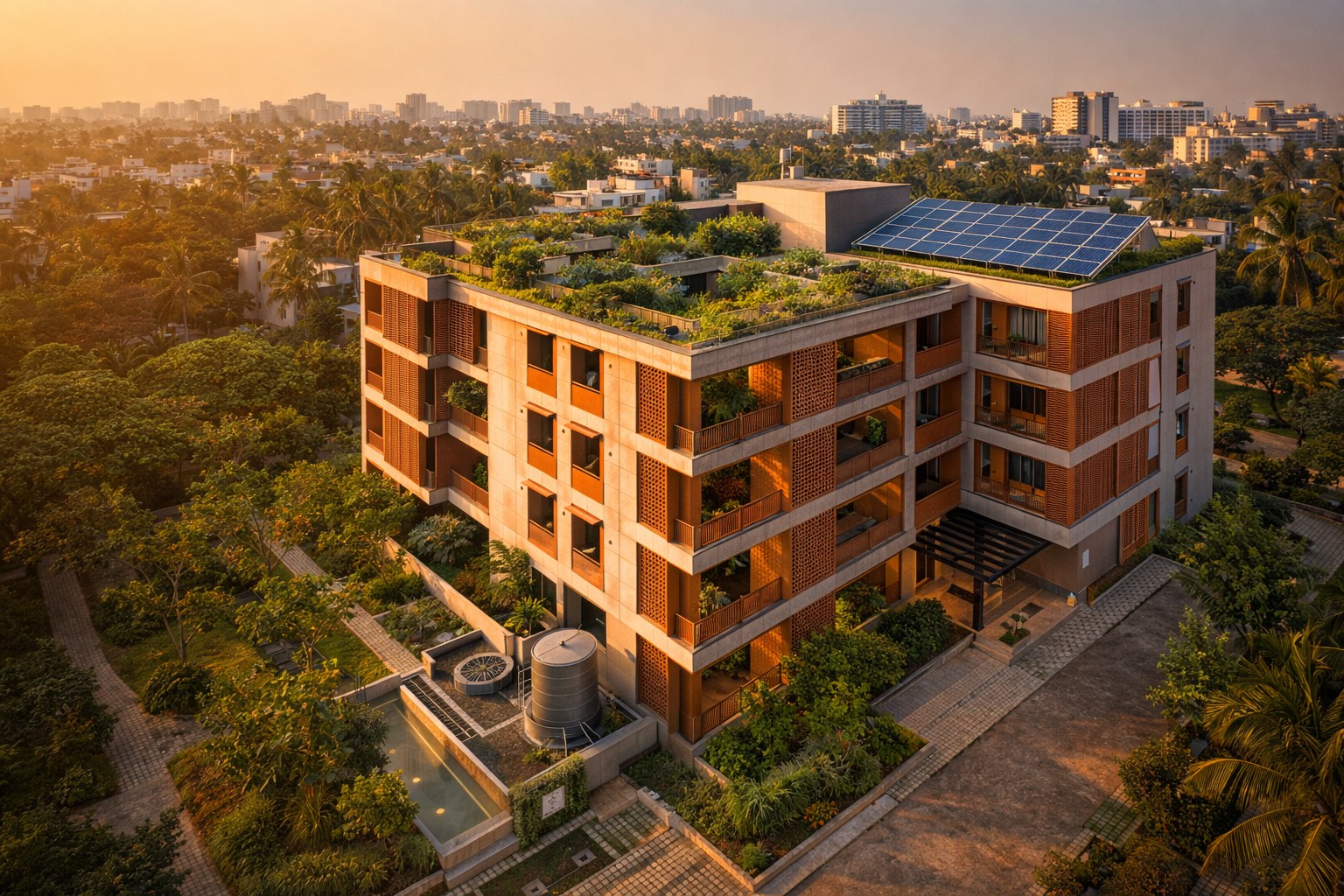
Green Building Certifications in India
IGBC, GRIHA & LEED — A Comprehensive Comparison for Architects, Developers, and Homeowners
India's built environment is at an inflection point. Buildings account for approximately 35–40% of the country's total energy consumption and a comparable share of carbon emissions. With India projected to add over 300 million new housing units and billions of square feet of commercial space in the coming decades, the decisions made today about how these buildings are designed, constructed, and operated will determine whether India meets or misses its climate commitments — including the ambitious goal of net-zero emissions by 2070, declared at COP26 (Ministry of Environment, Forest and Climate Change, 2016).
Green building certification has emerged as the primary market mechanism for translating sustainability aspirations into measurable building performance. India now has the second-largest green building footprint globally — over 10 billion square feet of cumulative registered green building space as of 2024 — a remarkable achievement for a movement that began barely two decades ago (Indian Green Building Council, 2024).
Yet for the individual architect, developer, or homeowner, the landscape of green certification can be bewildering. Three major systems compete and coexist: IGBC (Indian Green Building Council), GRIHA (Green Rating for Integrated Habitat Assessment), and LEED (Leadership in Energy and Environmental Design). Each has its origins, its strengths, its costs, and its appropriate use cases. This guide provides a comprehensive, practical comparison — not to declare a winner, but to help you choose the right certification for your project.
"Design is the first signal of human intention." — William McDonough, architect and co-author of Cradle to Cradle (McDonough and Braungart, 2002)
1. The Three Systems: Origins and Governance
IGBC — Indian Green Building Council
Founded in 2001 as part of the Confederation of Indian Industry (CII), headquartered at the CII-Sohrabji Godrej Green Business Centre in Hyderabad, IGBC has become the most commercially active green building certification body in India. IGBC is a member of the World Green Building Council (WorldGBC) and administers both its own Indian rating systems and the LEED system in India through GBCI (Green Business Certification Inc.).
IGBC offers over 20 rating systems tailored to different building types — Green Homes, Green New Buildings, Green Existing Buildings, Green Interiors, Green Factory Buildings, Green Schools, Green Healthcare, Green Townships, Green Cities, Green Villages, Green Landscapes, and more recently, Net Zero Energy, Water, and Waste ratings.
GRIHA — Green Rating for Integrated Habitat Assessment
Developed by TERI (The Energy and Resources Institute) in collaboration with the Ministry of New and Renewable Energy (MNRE), GRIHA was formally launched in 2007 as India's national green building rating system, endorsed by the Government of India. Headquartered at TERI, New Delhi, GRIHA carries the weight of governmental backing — CPWD (Central Public Works Department) mandates GRIHA 3-star or equivalent for central government buildings.
GRIHA offers several variants: the main GRIHA system for large buildings (>2,500 sq m), GRIHA LD for large developments and townships, SVAGRIHA for small buildings and individual homes (<2,500 sq m), GRIHA for Existing Buildings, and GRIHA for Day Schools.
LEED — Leadership in Energy and Environmental Design
Developed by the U.S. Green Building Council (USGBC) and launched in 2000, LEED is the world's most widely recognised green building certification. India was one of the earliest and most enthusiastic adopters of LEED outside the United States, with entry beginning around 2003–04. India has consistently ranked in the top three countries globally for LEED-certified space outside the US, competing with China and Canada (USGBC, 2023).
LEED in India is administered through GBCI, with IGBC serving as a local facilitator. The current version is LEED v4.1, with LEED v5 in development.
2. Head-to-Head Comparison
IGBC vs GRIHA vs LEED — At a Glance
| Parameter | IGBC | GRIHA | LEED |
|---|---|---|---|
| Founding Body | CII (Confederation of Indian Industry) | TERI + MNRE (Government of India) | USGBC (US Green Building Council) |
| Year Established | 2001 | 2007 | 2000 (India entry ~2003–04) |
| Headquarters | Hyderabad | New Delhi | Washington, DC (India: via IGBC/GBCI) |
| Rating Levels | Certified, Silver, Gold, Platinum | 1 Star to 5 Stars | Certified, Silver, Gold, Platinum |
| Total Registered Projects (India) | 10,000+ | 2,500+ | 2,400+ certified |
| Building Types Covered | 20+ rating systems | 6+ variants | Multiple (BD+C, ID+C, O+M, Homes) |
| Certification Cost Range (INR) | 3–15 lakh | 2–12 lakh | 5–30+ lakh |
| Typical Timeline | 6–12 months | 8–18 months | 8–18 months |
| Government Recognition | Recognised by multiple states | National rating (MNRE endorsed); CPWD mandated | Recognised but not mandated |
| Residential Applicability | IGBC Green Homes (strong; widely used by developers) | SVAGRIHA (individual homes <2,500 sq m) | LEED for Homes (limited use in India) |
| Indian Context Adaptation | Fully Indian | Fully Indian | International, with Regional Priority credits |
| Validity Period | 3–5 years (renewal required) | 5 years | Recertification via LEED O+M |
Sources: IGBC (2024); TERI (2020); USGBC (2023).
"Green buildings are not about spending more, but about spending wisely." — Prem C. Jain, Founding Chairman, IGBC (CII, 2021)
3. IGBC Green Homes — The Residential Standard
IGBC Green Homes is the most widely used green certification for residential projects in India, particularly for apartment complexes and builder-developed housing. The system evaluates projects across six credit categories, with a total of approximately 100 points available.
IGBC Green Homes Credit Categories
| Category | Max Points (approx.) | Key Credits |
|---|---|---|
| Site Selection & Planning | 10 | Local biodiversity preservation, heat island reduction, proximity to amenities, reduced site disturbance |
| Water Efficiency | 16 | Rainwater harvesting, water-efficient fixtures (dual-flush, low-flow), landscape water reduction, water metering |
| Energy Efficiency | 24 | ECBC/ENS compliance, renewable energy (solar), efficient lighting and appliances, energy metering, cool roof |
| Materials & Resources | 14 | Recycled content materials, locally sourced materials (within 400 km), certified wood, construction waste management |
| Indoor Environmental Quality | 12 | Low-VOC paints and adhesives, daylighting, cross-ventilation, thermal comfort, noise control |
| Innovation & Design Process | 8 | IGBC AP on team, exceptional performance beyond credit requirements, innovative strategies |
| Total | ~100 |
Rating Thresholds
| Level | Points Required |
|---|---|
| Certified | 38–44 |
| Silver | 45–51 |
| Gold | 52–59 |
| Platinum | 60+ |
Source: Indian Green Building Council (2023) IGBC Green Homes Rating System. Hyderabad: IGBC/CII.
Mandatory Prerequisites must be met regardless of the target rating level. These include: soil erosion control during construction, minimum 20% reduction in water use over baseline, compliance with ECBC/Eco-Niwas Samhita for energy performance, minimum use of certified or recycled materials, elimination of CFC-based refrigerants, and minimum ventilation per ASHRAE 62.1 or NBC 2016.
4. GRIHA — India's National Rating System
GRIHA evaluates buildings across 34 criteria grouped into 10 sections, with a maximum score of 100 points. Its distinguishing features include a strong emphasis on embodied energy, social aspects, and post-occupancy performance monitoring — reflecting its academic and governmental origins at TERI.
GRIHA Criterion Categories
| Section | No. of Criteria | Max Points (approx.) | Key Criteria |
|---|---|---|---|
| Site Planning | 5 | 14 | Site selection, preserve topography and trees, proximity to public transport, reduce heat island effect |
| Building Planning & Construction | 5 | 12 | Low-impact construction, air and noise pollution control during construction, topsoil preservation |
| Energy — End Use | 5 | 20 | ECBC compliance, optimise building envelope, lighting power density, HVAC efficiency, renewable energy |
| Energy — Embodied | 3 | 8 | Reduce embodied energy of materials, use low-energy alternatives, innovative construction technology |
| Water | 4 | 12 | Reduce landscape water demand, reduce building water use, efficient fixtures, rainwater and wastewater reuse |
| Waste Management | 2 | 6 | Construction waste minimisation, post-occupancy waste segregation and composting |
| Health, Well-being & Comfort | 4 | 12 | Daylighting, indoor air quality (low-VOC), thermal comfort, acoustic comfort |
| Social Aspects | 2 | 4 | Universal accessibility, community engagement and labour welfare |
| Performance Monitoring | 2 | 8 | Building commissioning, post-occupancy energy and water monitoring |
| Innovation | 2 | 4 | Innovative approaches, GRIHA professional on project team |
| Total | 34 | 100 |
Rating Thresholds
| Level | Points Required |
|---|---|
| 1 Star | 25–40 |
| 2 Stars | 41–55 |
| 3 Stars | 56–70 |
| 4 Stars | 71–85 |
| 5 Stars | 86–100 |
Source: TERI (2019) GRIHA Manual. New Delhi: TERI Press.
SVAGRIHA — For Individual Homes
For homeowners building individual homes under 2,500 sq m, SVAGRIHA (Simplified Variant Assessment for GRIHA) offers a streamlined path to green certification. It uses a simplified evaluation framework that retains GRIHA's core principles — energy efficiency, water conservation, material sustainability, and indoor comfort — while reducing the documentation burden to a level manageable for small projects. SVAGRIHA is particularly relevant for the individual homeowner who wants to build green but finds the full GRIHA or IGBC process disproportionate to their project scale.
"Good architecture is inherently sustainable. A building that responds to its climate, its context, and its users will naturally use less energy." — Ashok B. Lall, architect, pioneer of climate-responsive design in India
5. LEED in India — The Global Standard
LEED v4.1 BD+C (Building Design + Construction) evaluates projects across nine credit categories with a maximum of 110 points.
LEED v4.1 BD+C Credit Categories
| Category | Max Points | Key Focus Areas |
|---|---|---|
| Integrative Process | 1 | Early-stage analysis of energy and water systems |
| Location & Transportation | 16 | Proximity to transit, bicycle facilities, reduced parking, site selection |
| Sustainable Sites | 10 | Site assessment, protect habitat, open space, rainwater management, heat island, light pollution |
| Water Efficiency | 11 | Indoor water use reduction, outdoor water reduction, metering, cooling tower water |
| Energy & Atmosphere | 33 | Optimise energy performance, renewable energy, commissioning, refrigerant management |
| Materials & Resources | 13 | LCA, recycled content, regional materials, construction waste management |
| Indoor Environmental Quality | 16 | IAQ, low-emitting materials, daylight, views, thermal comfort, acoustic performance |
| Innovation | 6 | Innovative strategies, LEED AP on team |
| Regional Priority | 4 | Credits addressing regional environmental priorities |
| Total | 110 |
Rating Thresholds
| Level | Points Required |
|---|---|
| Certified | 40–49 |
| Silver | 50–59 |
| Gold | 60–79 |
| Platinum | 80+ |
Source: USGBC (2021) LEED v4.1 BD+C Reference Guide. Washington, DC: USGBC.
When to Choose LEED Over IGBC or GRIHA
LEED is the preferred choice in specific situations:
- Multinational companies with global LEED portfolio mandates (IT campuses, corporate offices)
- Projects seeking international investor recognition — LEED Platinum carries global brand value
- IT/ITES campuses — Infosys, Wipro, TCS, and other Indian IT majors have pursued LEED extensively
- Portfolio consistency for companies with buildings across multiple countries
- Premium residential projects targeting international buyer segments
For most Indian residential projects — particularly individual homes and domestically marketed apartment complexes — IGBC Green Homes or SVAGRIHA offers a more practical, cost-effective, and contextually adapted path to green certification.
6. The Financial Case: Cost, Savings, and Incentives
Cost Premium for Green Certification
One of the most persistent myths about green building is that it is prohibitively expensive. Research consistently demonstrates that the cost premium has decreased significantly over the past decade as green materials and technologies have become mainstream in India.
| Certification Level | Typical Cost Premium Over Conventional | Notes |
|---|---|---|
| Basic Certified / 1-Star | 0–3% | Often cost-neutral with good design integration |
| Silver / 2-Star | 2–5% | Modest investment in efficient fixtures, better insulation |
| Gold / 3-Star | 3–8% | More deliberate envelope design, renewable energy integration |
| Platinum / 4-5 Star | 5–15% | Significant investment in high-performance systems, advanced materials |
| Typical payback period | 3–7 years | Through operational energy and water savings |
Sources: Dwaikat and Ali, 2018; IGBC case studies; TERI publications.
Energy and Water Savings — Certified vs Conventional
| Metric | Typical Savings Range | Basis |
|---|---|---|
| Operational energy savings | 20–40% | IGBC/GRIHA-certified building data |
| Water consumption reduction | 20–30% | Through efficient fixtures, rainwater harvesting, greywater reuse |
| Embodied energy reduction | 10–20% | Through local and recycled materials |
| Carbon emission reduction | 30–50% over building lifecycle | Varies by building type and certification level |
| Indoor comfort improvement | Significant (qualitative) | Better daylighting, ventilation, thermal comfort, low-VOC materials |
Indian Case Studies:
- CII-Sohrabji Godrej Green Business Centre, Hyderabad — India's first LEED Platinum building (2003): 40%+ energy savings and 55% water savings compared to conventional benchmark.
- Infosys campuses (multiple LEED Platinum): Energy Performance Index (EPI) of 75–90 kWh/sq m/year versus typical Indian commercial buildings at 200+ kWh/sq m/year.
- Suzlon One Earth, Pune — LEED Platinum, net-zero energy campus.
"Buildings are the elephant in the room when it comes to climate change." — Ed Mazria, Founder, Architecture 2030
State and City-Level Green Building Incentives
A growing number of Indian states and cities offer tangible incentives for green-certified buildings — from additional FAR (Floor Area Ratio) to property tax rebates and fast-track approvals.
| State / City | Incentive Type | Details |
|---|---|---|
| Noida / Greater Noida (UP) | Extra FAR | 5% additional FAR for green-rated buildings |
| Punjab (GMADA, Mohali) | FAR bonus | Additional FAR for GRIHA/IGBC-rated buildings |
| Andhra Pradesh | Property tax rebate | Reduced property tax for green-certified buildings |
| Kerala | Fast-track clearance | Expedited building permissions for green buildings |
| Maharashtra (PCMC, Pimpri-Chinchwad) | Premium reduction | Reduced development premium for green-certified buildings |
| Telangana | Multiple incentives | Various incentives under state green building policy |
| CPWD (Central Government) | Mandate | GRIHA 3-star or equivalent mandatory for central government buildings |
| Delhi | Mandate for large buildings | Buildings >20,000 sq m must incorporate green features |
| Karnataka (BBMP) | Green building norms | Green building norms under discussion; IGBC partnerships |
Note: Incentives change with policy updates. Verify current status with the respective state or municipal authority before relying on any specific incentive.
7. Eco-Niwas Samhita and ECBC: The Regulatory Baseline
Both IGBC and GRIHA reference India's energy codes as mandatory prerequisites — making the Eco-Niwas Samhita (ENS) and Energy Conservation Building Code (ECBC) essential context for understanding green certification.
| Parameter | ECBC (Commercial) | Eco-Niwas Samhita (Residential) | Relationship to Green Certification |
|---|---|---|---|
| Full Name | Energy Conservation Building Code | Eco-Niwas Samhita (Part I: Building Envelope, 2018; Part II: Electro-Mechanical, 2021) | Both IGBC and GRIHA reference ECBC/ENS as baseline prerequisite |
| Issued By | BEE (Bureau of Energy Efficiency), Ministry of Power | BEE, Ministry of Power | -- |
| Scope | Commercial buildings (>100 kW connected load or >500 sq m) | Residential buildings | -- |
| Key Focus | Building envelope (RETV/SHGC), lighting, HVAC, electrical | Building envelope thermal performance (RETV — Residential Envelope Transmittance Value) | Meeting ENS satisfies the energy prerequisite in IGBC/GRIHA |
| Compliance Status | Mandatory in 17+ states (as of 2024) | Voluntary; state adoption underway | Green certification goes beyond ECBC/ENS — covering water, materials, IAQ, site planning |
Sources: Bureau of Energy Efficiency (2017; 2018; 2021).
The critical distinction: ECBC and ENS address energy performance only. Green certification encompasses a far broader scope — water efficiency, material sustainability, indoor environmental quality, site ecology, waste management, and social aspects. ECBC/ENS compliance is a necessary but not sufficient condition for green certification. A home that meets ENS is energy-efficient; a home that earns IGBC Green Homes or SVAGRIHA certification is comprehensively sustainable.
8. Choosing the Right Certification: A Decision Framework
For Individual Homeowners Building a House
Recommended: SVAGRIHA (GRIHA for Small Buildings)
- Specifically designed for buildings under 2,500 sq m
- Simplified documentation — manageable for individual projects
- Government-endorsed (MNRE)
- Lower certification cost than full IGBC or LEED
- Strong focus on climate-responsive design principles suited to Indian vernacular
Alternative: IGBC Green Homes
- If the homeowner wants wider market recognition (for resale value)
- If the architect is already an IGBC AP (Accredited Professional)
- More commercially recognised than SVAGRIHA
For Apartment Developers
Recommended: IGBC Green Homes
- The industry standard for Indian residential developers
- Strong marketing value — buyers recognise IGBC ratings
- Extensive support network of IGBC APs
- Well-documented process with clear credit paths
Alternative: GRIHA
- For government-funded housing projects (PMAY, state housing boards)
- Where CPWD or state mandates require GRIHA
For Commercial and Institutional Projects
LEED — for MNC clients, IT campuses, and projects with international visibility
IGBC Green New Buildings — for Indian corporate and commercial projects
GRIHA — for government and public-sector buildings
For Projects Seeking the Highest Possible Performance
Consider pursuing Net Zero certification — IGBC now offers Net Zero Energy, Net Zero Water, and Net Zero Waste ratings as add-on certifications. GRIHA's 5-star rating, which requires 86+ points out of 100, represents the highest tier of comprehensive green performance in the Indian national framework.
"India's green building movement has demonstrated that sustainability and economic growth can go hand in hand." — Gurmit Singh Arora, Former Chairman, IGBC
9. The Certification Process: What to Expect
Step-by-Step — IGBC Green Homes
1. Pre-Design: Engage an IGBC Accredited Professional (AP); conduct a preliminary credit assessment to identify achievable credits and target rating level.
2. Registration: Register the project online with IGBC; pay registration fee (INR 25,000–5,00,000 depending on project size).
3. Design Stage Documentation: Compile credit-by-credit documentation — drawings, calculations, specifications, product data sheets — demonstrating compliance with each targeted credit.
4. Design Stage Review: IGBC reviews documentation; provides comments; project team responds and resubmits if needed.
5. Construction Stage Documentation: Compile as-built documentation — site photographs, commissioning reports, material invoices, test certificates.
6. Final Review and Site Visit: IGBC reviews construction documentation and conducts a site inspection.
7. Certification Award: Rating level (Certified / Silver / Gold / Platinum) awarded; certificate issued.
Timeline: 6–12 months from registration to certification (may extend for complex projects or multiple review cycles).
Step-by-Step — GRIHA
1. Registration with GRIHA Secretariat at TERI.
2. Design Evaluation: Documentation submitted per each of the 34 criteria; TERI evaluators review.
3. Construction Evaluation: Site visits during and after construction; as-built documentation review.
4. Final Rating: Star rating (1–5) awarded based on total points.
Timeline: 8–18 months.
10. Green Certification and the Indian Homeowner
For the homeowner, the practical question is not which certification system is 'best' in the abstract — it is which interventions deliver the greatest environmental and financial benefit for their specific home. A green-certified home, regardless of the specific system, typically incorporates:
- Solar panels on the terrace (earning energy credits and reducing electricity bills)
- Rainwater harvesting system (earning water credits and providing water security)
- Low-flow fixtures — dual-flush toilets, aerator taps (20–30% water savings)
- Low-VOC paints and finishes (better indoor air quality, reduced health risk)
- Cross-ventilation and daylighting design (reduced dependence on AC and artificial lighting)
- Locally sourced materials within 400 km (reduced embodied energy and transport emissions)
- Native landscaping with reduced irrigation demand
- Cool roof treatment (reflective coating or tiles reducing roof surface temperature by 10–15 degrees C)
- Construction waste management (segregation and recycling during construction)
- Energy and water metering (enabling monitoring and continuous improvement)
These interventions are not exotic or expensive. Most represent good design practice that Indian vernacular architecture has practised for centuries — now quantified, codified, and certified within a modern framework.
"The greenest building is the one that works with nature, not against it. In India, we have centuries of architectural wisdom that achieved this without any certification." — Sanjay Prakash, architect, SHiFt Studio, pioneer of passive architecture in India
References
- Bureau of Energy Efficiency (2017) Energy Conservation Building Code (ECBC) 2017. New Delhi: BEE, Ministry of Power.
- Bureau of Energy Efficiency (2018) Eco-Niwas Samhita 2018: Part I — Building Envelope. New Delhi: BEE, Ministry of Power.
- Bureau of Energy Efficiency (2021) Eco-Niwas Samhita 2021: Part II — Electro-Mechanical and Renewable Energy Systems. New Delhi: BEE, Ministry of Power.
- Bureau of Indian Standards (2016) SP 7:2016 — National Building Code of India 2016, Part 11: Approach to Sustainability. New Delhi: BIS.
- Confederation of Indian Industry (2021) Green Building Movement in India: A Status Report. New Delhi: CII.
- Dwaikat, L.N. and Ali, K.N. (2018) 'Green buildings cost premium: A review of empirical evidence', Energy and Buildings, 110, pp. 396–403.
- Indian Green Building Council (2023) IGBC Green Homes Rating System — Version 3.0. Hyderabad: IGBC/CII.
- Indian Green Building Council (2024) IGBC Annual Report 2023–24. Hyderabad: IGBC/CII.
- Khosla, R. et al. (2020) 'Building policies for a climate-compatible Indian residential sector', Environmental Research Letters, 15(10), 103002.
- Krishan, A. et al. (2001) Climate Responsive Architecture: A Design Handbook for Energy Efficient Buildings. New Delhi: Tata McGraw-Hill.
- McDonough, W. and Braungart, M. (2002) Cradle to Cradle: Remaking the Way We Make Things. New York: North Point Press.
- Mili, R.K. and Bhargav, S. (2019) 'A review of green building rating systems in India', International Journal of Sustainable Building Technology and Urban Development, 10(2), pp. 68–79.
- Ministry of Environment, Forest and Climate Change (2016) India's Nationally Determined Contributions under the Paris Agreement. New Delhi: MoEFCC.
- RICS (2021) BIM in India: Status, Challenges and Opportunities. London: Royal Institution of Chartered Surveyors.
- Siva, V. et al. (2022) 'Green building certification in developing countries: A critical review with focus on India', Journal of Building Engineering, 52, 104416.
- The Energy and Resources Institute (2019) GRIHA Manual — Volume 1: Introduction to the National Rating System. New Delhi: TERI Press.
- TERI (2020) Green Rating for Integrated Habitat Assessment (GRIHA): An Evaluation Tool for Green Buildings. New Delhi: TERI.
- U.S. Green Building Council (2021) LEED v4.1 BD+C Reference Guide. Washington, DC: USGBC.
- U.S. Green Building Council (2023) Top 10 Countries and Regions for LEED. Washington, DC: USGBC.
- Yeang, K. (2006) Ecodesign: A Manual for Ecological Design. London: Wiley-Academy.
Author's Note: This guide draws on published certification system documentation, government publications, and peer-reviewed research. Green building certification systems are regularly updated — readers should verify current rating system versions, fee structures, and credit requirements directly with IGBC (igbc.in), GRIHA (grihaindia.org), and USGBC (usgbc.org). Statistics on registered/certified projects grow continuously; the figures cited are approximate and based on the latest available data at the time of writing. State and city incentive policies are subject to change — verify current status with the relevant authority.
Disclaimer: This article is for informational and educational purposes only. It does not constitute professional environmental or architectural advice. Green building certification decisions should be made in consultation with accredited professionals (IGBC AP, GRIHA Evaluator, LEED AP) based on project-specific requirements.
Export this guide
Related Tools — Try Free
Apartment vs Villa Interior Planning Guide
Compare ceiling height, structural flexibility, lighting, storage, and services between apartments and villas.
Planning GuideProperty Tax Calculator — 10 Indian Cities
Estimate annual municipal property tax across BBMP / MCD / MCGM / GHMC / GCC / KMC / PMC / AMC / TMC / PCMC — with self-occupied, tenanted, and age-rebate adjustments.
Property TaxMaterial Decision Framework (M-Score)
Score 30+ Indian construction materials across cost, durability, climate fit, maintenance, and sustainability.
Materials