
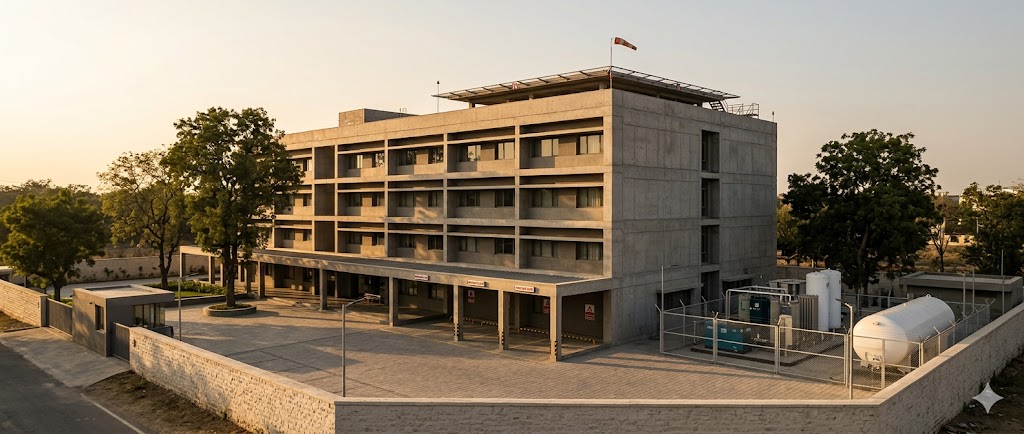
Disaster-Resilient Lifeline Hospital Design in India
An Architect's Working Reference — IS 1893 Seismic with Importance Factor 1.5 · NDMA Hospital Safety Guidelines · Multi-Hazard Site Selection (Earthquake / Cyclone / Flood / Landslide / Tsunami) · Non-Structural Anchoring · Mass Casualty Surge · Critical Lifeline Redundancy · Hospital Safety Index
A hospital is not an ordinary building. An ordinary building, designed to code, protects its occupants by allowing them to evacuate before it collapses; the protection is life-safety. A hospital must do more — it must remain operational during and after the very event that displaces its surrounding city, because that is when the city most needs it. The injured will arrive whether the hospital is ready or not; the question is whether the hospital is the place they can be saved or the place that becomes part of the disaster. This is the lifeline-building principle. It changes the brief at every layer — site selection, structural system, non-structural detailing, mechanical and electrical redundancy, water and oxygen autonomy, mass casualty preparedness, communication continuity. India's catalogue of past disasters — the Bhuj earthquake of 2001 in which several hospitals collapsed precisely when they were most needed, the Kerala floods of 2018 that submerged primary health centres along the Pamba and Periyar, Cyclone Fani of 2019 that tested coastal Odisha's hospital infrastructure, the Latur earthquake of 1993, the Uttarkashi earthquake of 1991, the Sikkim earthquake of 2011, and the Joshimath subsidence of 2023 — has been a series of expensive lessons in what the lifeline brief actually means. The architectural translation of those lessons is the subject of this guide.
This guide is a facility-type deep-dive in the Studio Matrx healthcare architecture series. It assumes the reader has read the pillar regulatory reference, is familiar with NBC 2016 Group C, and understands the basic typology of Indian healthcare practice. Here we focus on what is specific to disaster-resilient hospital design — India's multi-hazard profile and how it varies by site, the IS 1893 importance-factor framework for hospitals, the performance-based design targets that distinguish a lifeline building from an ordinary one, the structural system options and their lifeline performance, the non-structural detailing that constitutes more than 70% of past hospital damage in Indian earthquakes, the mass casualty surge architecture, the critical lifeline redundancies that allow a hospital to operate 72–96 hours fully isolated from external utilities, the WHO/PAHO Hospital Safety Index and how it translates into the Indian regulatory environment, the failure modes that recur across past Indian events, and the pre-design audit framework for the specific brief.
The position this guide takes is specific: the lifeline brief should be the default brief for every Indian hospital project. It is not a specialty add-on for tertiary hospitals; it is the minimum standard the country owes to the next disaster's casualties. The architect who delivers a hospital that survives the earthquake but cannot operate the OT, the architect who specifies a building envelope that survives the cyclone but loses every window, the architect who designs a flood-resilient ground floor but locates the DG room in the basement that floods first — each has produced a building that meets the code but fails the brief. The discipline is to internalise the lifeline brief, demand the small additional commitments at every stage of the design, and refuse the value-engineering compromises that turn a lifeline hospital back into an ordinary one.
"A hospital that fails when its city most needs it is worse than a hospital that was never built — because the city believed it had one. The architect's responsibility is to ensure the belief is justified. This responsibility is not legal; it is moral; and it is non-negotiable." — Dr. P.G. Dhar Chakrabarti (b. 1948), former Executive Director, NIDM and former Secretary, NDMA, paraphrased from a 2017 lecture on hospital safety
"In Bhuj, in Latur, in Uttarkashi, the building that should have saved lives killed people. We never designed our hospitals as the fortresses they need to be. We are still not designing them as fortresses. The next earthquake is coming. The architects must be ahead of it." — Ar. Christopher Charles Benninger (1942–2024), Pune architect, paraphrased from a 2008 talk on hospital safety after the 2001 Bhuj earthquake
1. Why Disaster Resilience is its Own Typology
Six characteristics make a lifeline hospital distinct from an ordinary hospital, and the architectural brief follows from each.
- The hospital must operate during and after the event, not merely survive it. An ordinary building's design objective is life-safety: occupants escape before collapse. A hospital's design objective is Immediate Occupancy (and ideally Operational) at the design event — the OT, ICU, ED, and inpatient wards continue to function. This raises the bar at every level.
- The hazard intensity is uncertain. A hospital may be required to function during the design-basis earthquake (DBE), the maximum considered earthquake (MCE = DBE × 2), or rarer events. Performance-based design — explicitly targeting performance levels across multiple intensities — is the discipline that distinguishes a lifeline hospital from an ordinary one.
- Casualties arrive in surge, not at routine volume. A 200-bed hospital may receive 100+ casualties within 2 hours of a major event, against a routine emergency department capacity of 10–15. The architecture must support a 5–10× surge — through triage forecourt, pre-wired site for tent expansion, mortuary surge capacity, and family-information infrastructure.
- External utilities will fail. Power, municipal water, mobile networks, supply chain — each has a high probability of disruption during disaster. The hospital must operate 72–96 hours fully isolated. Redundancy at every lifeline (power, water, oxygen, comms, sewage, supplies) is part of the architecture.
- Non-structural damage is the dominant failure mode. More than 70% of past Indian hospital damage in earthquakes has been non-structural — equipment displaced, ceilings collapsed, partitions toppled, piping ruptured, shelves emptied. Yet most projects design only the structure with seismic rigour and treat the non-structural as routine. The architectural correction is significant.
- The hospital is a network node, not an island. Inter-hospital MoU, mass casualty distribution protocols, transfer to higher-tier facilities, and helicopter / ambulance logistics make every hospital part of a regional response system. The architecture must enable network operation — helipad, ambulance bays sized for surge, communication continuity with district disaster control.
The composite effect is that disaster resilience is a capability threaded through the entire hospital, not a specialty add-on. The architect who internalises this delivers a hospital that the next disaster's surviving population will turn to with justified confidence.
2. India's Multi-Hazard Profile
Every Indian hospital site faces some combination of seismic, cyclone, flood, landslide, tsunami, and (increasingly) urban-heat hazards. The combination varies materially by location.

Seismic zones (IS 1893:2016). India is divided into four zones based on seismic intensity:
| Zone | Z (effective ground accel) | Geographic spread | Indicative cities |
|---|---|---|---|
| V | 0.36 | Highest hazard | NE states, Bhuj-Kachchh, parts of Uttarakhand, J&K, Andamans |
| IV | 0.24 | High | Delhi NCR, Punjab, Himachal, Sikkim, parts of Bihar, Bombay-Konkan strip |
| III | 0.16 | Moderate | Mumbai, Chennai, Pune, Kolkata, Hyderabad, much of peninsular India |
| II | 0.10 | Low | South-central peninsula |
Importance factor I = 1.5 for hospitals (vs 1.0 for ordinary buildings). The effective design force is therefore 50% higher for a hospital at the same site. This is the single most architecturally consequential clause in IS 1893 for hospital design.
Cyclone zones. The Bay of Bengal coast (West Bengal, Odisha, Andhra Pradesh, Tamil Nadu) is India's primary cyclone belt; the Arabian Sea coast (Gujarat, Maharashtra, Goa, Karnataka, Kerala) has a smaller but rising frequency. IS 875 (Part 3) provides the basic wind speed map; coastal sites typically face 50–55 m/s basic wind speed (3-second gust). Cyclone-resilient design implications: roof anchoring, window glazing (laminated or shutters), porte-cochère and entrance canopy detailing, signage and rooftop equipment anchoring, debris-flight protection.
Flood zones. The Ganga-Brahmaputra plain, Mumbai (Mithi-Powai system), Chennai (Adyar-Cooum), coastal Kerala (Pamba-Periyar), parts of Bihar, Assam, and most river-floodplain locations across India face seasonal flood risk. Hospital plinth must be above the 100-year flood line; basements should be avoided (or fully waterproofed with sump-pump backup); critical equipment should not be in the basement; ETP/STP must remain operational during flood.
Landslide zones. The Himalayan states (Himachal, Uttarakhand, Sikkim, Arunachal, Meghalaya, NE) face significant landslide risk. Joshimath subsidence in 2023 highlighted ground-stability concerns even on long-stable sites. Slope stability assessment per IS 14458, micro-zonation, and avoidance of toe-of-slope sites are part of the brief.
Tsunami zones. Andaman & Nicobar islands, the Tamil Nadu coast, parts of Andhra and Kerala coasts have documented tsunami risk (post-2004 Indian Ocean tsunami). Coastal Regulation Zone management and IS 12251 are the working frameworks; hospitals on tsunami-vulnerable coast should be on elevated plinth or set back from the shoreline.
Combined hazard. Most Indian sites face two or more hazards. Bhuj (Zone V seismic + cyclone-prone Gujarat coast), Bhubaneswar (Zone III seismic + cyclone belt), Mumbai (Zone III + flood + cyclone), Kolkata (Zone III + flood + cyclone) — the design must address all applicable hazards simultaneously, not sequentially.
3. Lifeline Performance Targets
The fundamental difference between an ordinary building and a lifeline hospital is the performance target at each hazard intensity.

The four-by-four performance matrix:
| Hazard Intensity | Ordinary Building | Hospital — Inpatient Wards | Hospital — OT/ICU/ED (Lifeline) |
|---|---|---|---|
| Frequent (50%/50yr) | Operational | Operational | Operational |
| Design-Basis (DBE; 10%/50yr) | Life Safety | Immediate Occupancy | Operational |
| Maximum Considered (MCE; 2%/50yr) | Collapse Prevention | Life Safety | Immediate Occupancy |
| Beyond MCE | Possible collapse | Collapse Prevention | Life Safety |
Performance-level definitions (FEMA / ASCE 41-17):
- Operational — full continuous use; minor cosmetic damage at most.
- Immediate Occupancy — limited damage; primary structural and non-structural systems remain functional; the building is occupiable immediately after the event with no significant repair.
- Life Safety — significant damage; structure remains stable; occupants can evacuate safely.
- Collapse Prevention — heavy damage; structure is on the verge of partial collapse but remains globally stable; evacuation is possible.
The Indian code translation. IS 1893:2016 uses the importance factor I to scale the design force. For hospitals (I = 1.5), the elastic-design earthquake force is 50% higher than for an ordinary building. This is equivalent to designing for a 1.5× larger event — but the code does not explicitly target Operational or Immediate Occupancy performance. The architect/structural engineer must additionally apply performance-based methodology (FEMA 547, ATC-58, ASCE 41-17) to verify Operational performance at DBE for the lifeline tier (OT, ICU, ED).
The NDMA mandate. NDMA Hospital Safety Guidelines 2016 require Immediate Occupancy at DBE for hospitals. This is mandatory for all government hospitals and increasingly contractually required for private hospitals (insurance, accreditation, empanelment).
4. Structural System Selection
Four structural systems dominate Indian hospital construction. Each has different lifeline performance, span flexibility, cost, and Indian deployment pattern.

RCC Special Moment Frame (SMRF) per IS 13920:2016. The default Indian hospital structural system. Reinforced concrete moment frame with ductile detailing (closely-spaced ties, anchorage, joint detailing). Performance: Good in Zones III–V if I = 1.5 is properly applied; achieves Immediate Occupancy at DBE. Span: 6–9 m typical; standard hospital column-grid 7.2 × 7.2 m. Cost: baseline (1.0×). Indian deployment: ~85% of new hospitals; default for buildings ≤ G+6. Working baseline.
Steel SMRF (IS 800 + IS 1893). Steel moment frame with similar ductile detailing. Performance: Excellent — higher ductility than RCC, faster post-event repair. Span: 9–14 m possible (larger column-free spans for OT, ICU). Cost: 1.4–1.7× RCC SMRF. Vibration: needs damping for sensitive equipment (CT/MRI). Indian deployment: ~5% of new hospitals; premium tertiary, speed-build PM-ABHIM critical-care blocks. Best for lifeline tier; premium cost.
RCC Dual System (Shear Wall + Frame). RCC moment frame with shear walls (typically at lift cores, stair cores, end walls). Performance: Excellent — lateral stiffness from walls limits drift, which protects non-structural components. Required for buildings > G+6 in Zones IV–V. Span: 7–10 m typical. Cost: 1.1× RCC SMRF. Vibration: very good. Indian deployment: ~9% of new hospitals; tall tertiary hospitals (G+8 to G+15) in Mumbai, Bengaluru, Pune. Best for tall hospitals.
Base Isolation (Lead Rubber Bearing or Friction Pendulum System). The structure is decoupled from the ground via isolators at the foundation level. Performance: Best in class — Operational at MCE; 10× better non-structural performance than fixed-base; equipment continuity guaranteed. Cost: 1.6–2.2× RCC SMRF + lifecycle inspection. Indian deployment: ~1% of new hospitals; AIIMS Bhopal and Kanchipuram (under construction) are the public-sector flagships. Best for national-critical only.
The architect's read. RCC SMRF or RCC Dual is the working baseline for most Indian hospital projects. Steel for premium / speed-build. Base isolation for national-critical only. The choice should be made at concept stage in consultation with the structural engineer, after a multi-hazard analysis of the site.
Vibration sensitivity for diagnostic equipment. CT scanners require Vibration Criterion VC-A; MRI requires VC-D (most stringent); microsurgery requires VC-B. The structural system selection and the equipment-floor location must be coordinated. Locating an MRI on an upper floor of a steel SMRF building without specific vibration analysis will produce image-quality issues that no amount of post-construction adjustment can fix. The structural-architect-equipment coordination at concept stage is the only solution.
5. Non-Structural Anchoring — The Dominant Failure Mode
Past Indian earthquake events have shown that more than 70% of hospital damage is non-structural. Equipment displaced from anchoring, ceiling collapse, partition toppling, piping rupture, shelving overturning — these failures can render an otherwise-undamaged hospital non-functional. The architectural correction is significant.

Six recurring non-structural failure modes and their working solutions:
| # | Failure Mode | Working Solution | Coordination Stage |
|---|---|---|---|
| 1 | Heavy equipment (CT, MRI, LINAC) displacement | Pre-cast anchor plate or 4-bolt cast-in detail; manufacturer anchor pattern in structural drawings; epoxy anchors as fallback | Concept structural + equipment supplier |
| 2 | Medical-gas piping rupture | Hangers every 2 m max; sway brace every 12 m + at every change of direction; flexible connections at equipment | Detailed MEP |
| 3 | Suspended ceiling collapse | Lateral bracing every 4 m; 50 mm gap from wall (allows movement); heavy fixtures on slab not on ceiling grid | Detailed interior + MEP |
| 4 | Partition toppling | Slab-to-slab studs (not just ceiling-stopped); top track screwed to slab; blocking for heavy mounted items | Detailed interior |
| 5 | Shelving / stored items spillage | Tall shelving (> 1.5 m): anchor top to wall/structure; restraining bars to prevent fall-out of stored items | Detailed interior + FF&E |
| 6 | Mechanical equipment (AHU, chiller, transformer) displacement | Spring isolators with snubbers (limit lateral travel); pad anchored to slab; flexible connections at all duct/pipe interfaces | Detailed MEP |

The 70% rule. A pattern audit of post-Bhuj-2001 hospital damage found that of buildings where the structure remained intact, 70%+ were non-functional within hours due to non-structural failure: medical-gas piping rupture cutting off oxygen to ICU, suspended-ceiling collapse blocking corridors, equipment displacement preventing OT operation, water-line rupture flooding wards. The architectural lesson: non-structural design must match structural design rigour for the hospital to operate post-event.
The seismic detailing supplement. Most Indian hospital projects do not commission a dedicated non-structural seismic-detailing supplement. The structural engineer designs the structure; the architect specifies the interiors; the MEP consultant specifies services; and the equipment supplier supplies equipment. In disaster-resilient hospital design, a dedicated non-structural supplement should integrate the four — typically prepared by the structural engineer with architect coordination, identifying every component requiring seismic anchoring/bracing and the working detail. The supplement is a hospital-specific deliverable; it does not exist for general buildings.
"After Bhuj, we rebuilt our hospitals stronger. The walls held. The beams held. The columns held. But the X-ray fell over. The autoclave moved across the room. The oxygen pipe broke. The ceiling came down. The hospital was a ruin without being a ruin. We had not yet learned that the building is more than its frame." — Ar. R.K. Patel (b. 1955), Ahmedabad architect involved in post-Bhuj reconstruction, paraphrased from a 2010 conference
6. Mass Casualty Surge Architecture
A 200-bed hospital that routinely sees 10–15 emergency presentations per day may receive 100+ casualties within 2 hours of a major event. The architecture must support this 5–10× surge.

Five surge architectures:

1. Triage forecourt. A pre-designated outdoor area immediately adjacent to the emergency department, typically 80–150 m², with floor markings and infrastructure for the four-color START triage protocol (Green walking, Yellow delayed, Red immediate, Black expectant) plus a separate Deceased zone. The forecourt must have shelter (canopy or tent capability), water, electrical outlets, and direct access to the ED. Architectural deliverable: paved area with marked zones, electrical outlets every 6 m, water taps, tent-anchor points.
2. Ambulance arrival. Sheltered drop-off accommodating 3+ ambulances simultaneously, with separate walk-in and ambulance-stretcher routes into the ED. Routine sizing (1 ambulance bay) is inadequate for surge; the working sizing is 3 simultaneous bays plus queue space for 4–6 more.

3. Pre-Wired Site (PWS) for tent expansion. A pre-designated outdoor area, typically 600–1,200 m² adjacent to the hospital, with pre-installed power outlets, water taps, medical-gas stub-outs, sewer connection points, and tent-footprint markings. Allows expansion of 30–60 cot capacity within 4–8 hours of activation. The PWS is the post-COVID baseline for tertiary hospital master planning.

4. Helipad. For mass casualty incidents and tertiary referral, helicopter access is critical. A 25 m × 25 m clear circle for MI-17 / Sea King-class helicopters, on the rooftop of major-tertiary hospitals or on dedicated ground-level helipad at smaller facilities. Helipad design per AAI guidelines + DGCA approval required.
5. Mortuary surge. Routine mortuary capacity (4–8 bodies for a 200-bed hospital) is inadequate for mass casualty surge (16–32+ bodies, see Pandemic Preparedness guide). Outdoor refrigerated container area pre-designated adjacent to mortuary; family last-rites space for cultural rituals; service-side egress for body release.
Family information infrastructure. A 50–100 m² family room near the ED, with seating for 30–50, water, communication infrastructure (whiteboards for casualty status, public-address system, mobile-charging), and mental-health counsellor on call during mass casualty events. This is a soft architectural commitment with significant operational impact during disasters.
7. Critical Lifeline Redundancy — The 72–96 Hour Autonomy Target
A lifeline hospital must operate fully isolated from external utilities for 72–96 hours during the acute phase of a disaster. Each of the six critical lifelines requires architectural planning.

Lifeline 1 — Power. Three-layer redundancy: (a) Grid HT/LT — first to fail; (b) DG sets at n+1 capacity with auto-start < 10 sec, plus 7-day diesel storage on-site; (c) UPS for OT, ICU, lab life-critical loads with no-break transfer and 15-minute minimum runtime. Solar PV optional fourth layer; increasingly part of the post-COVID baseline.
Lifeline 2 — Water. Three-layer redundancy: (a) Municipal supply — first to fail; (b) Rooftop tank with 24-hour capacity, gravity-fed if power out; (c) Underground tank with 5-day storage at 120 L/bed/day baseline (240 L/bed/day for surge). Borewell + RO as fourth layer where feasible (quality test required).
Lifeline 3 — Oxygen. Three-layer redundancy (post-COVID standard): (a) LMO tank, 3,000–10,000 L typical; (b) PSA plant on-site, 500–1,500 LPM; (c) Cylinder bank manifold backup. All three layers are now mandatory for tertiary hospitals receiving PM-ABHIM funding.
Lifeline 4 — Communications. Four-layer redundancy: (a) Landline + broadband; (b) Mobile (4G/5G) — fails first in disaster; (c) Satellite phone (VSAT or BGAN) at MO-in-charge office; (d) VHF / HAM radio for last-resort.
Lifeline 5 — Sewage and BMW. Layered: (a) Municipal sewer; (b) On-site STP (mandatory ≥ 100 beds); (c) Extended BMW holding (5-day capacity vs routine 24-hour); (d) Septic backup if isolation lasts > 7 days.

Lifeline 6 — Logistics / Supplies. (a) Daily resupply — first to fail; (b) On-site stores: 7-day pharmacy stock, 5-day linen, 3-day food; (c) Disaster cache — sealed and audited annually, containing PPE, IV fluids, trauma kits, tents, cots, generator fuel. The disaster cache is a small architectural commitment (40–80 m² secure room) with high operational impact.

The 72–96 hour target. Working international target (NDMA, WHO Hospital Safety Index) is 72 hours; gold-standard target is 96 hours. Beyond 96 hours, even the most resilient hospital depends on external resupply; the architecture is meant to support the acute response window during which the broader disaster-response system mobilises.
8. The Hospital Safety Index — WHO/PAHO Methodology
The WHO/PAHO Hospital Safety Index (HSI), 2nd edition 2015, is the international assessment tool for hospital disaster resilience. It has been adapted for Indian use by NDMA and several state DM authorities. The architect should know the methodology because it provides the assessment framework against which the hospital will be evaluated.

151 indicators across four domains:
Domain 1 — Hazard (21 indicators). Site and environment: geotechnical stability, seismic micro-zonation, liquefaction risk, slope and landslide, flood line / 100-year, coastal storm surge, tsunami inundation, industrial hazards, climate trajectory. Architect's contribution: site selection and the site-suitability report.
Domain 2 — Safety: Structural + Non-structural (76 indicators). Code compliance (IS 1893 + IS 13920); importance factor I=1.5 verification; cyclone wind (IS 875); equipment anchoring; piping bracing; ceiling restraint; partition slab-to-slab; window safety glass; architectural redundancy. Architect's role: dominant. All structural and non-structural detail decisions are owned or coordinated by the architect.
Domain 3 — Lifelines (28 indicators). Critical infrastructure redundancy: power, water, oxygen, communications, sewage, HVAC, vertical transport, fire detection/suppression, medical gas continuity, logistics. Architect's role: site planning and spatial allocation; coordinated with MEP and FPS consultants.
Domain 4 — Functional (26 indicators). Operations and staffing: disaster plan, mass casualty drill, evacuation routes, triage protocol, surge plan, inter-hospital MoU, staff accommodation, family communication, mortuary surge plan. Architect's role: spatial enablers — helipad, family room, tent footprint, staff accommodation.
Score bands:
- A — Safe. Hospital continues operating during and after disaster.
- B — Functional risk. Hospital partially functions; some critical capacity may be lost.
- C — High risk. Hospital likely to fail at design event.
The architect's contribution to score. Domain 2 is dominantly the architect's; it carries roughly 50% weight in the composite score. Improvements in equipment anchoring, ceiling bracing, partition detailing, and window detailing typically yield the largest score improvement per rupee invested. A hospital that scores B can usually be brought to A through Domain 2 improvements without structural retrofit; a hospital that scores C usually requires structural intervention as well.
Indian deployment. NDMA encourages Hospital Safety Index assessment for all major hospitals; some states (Sikkim, Gujarat, Tamil Nadu) have programmatic HSI assessment for state-government hospitals. Empanelment for state government schemes increasingly references HSI scores.
9. Lessons from Past Indian Disaster Events
A pattern audit of past Indian disaster events reveals recurring architectural failures that the contemporary brief should preclude.
Bhuj earthquake 2001 (Zone V, M 7.7). Civil Hospital Bhuj collapsed; multiple smaller facilities damaged. Lessons codified into IS 1893:2002 revision (importance factor I = 1.5 for hospitals), IS 13920 ductile-detailing tightening, and NDMA hospital safety initiative. The single largest hospital-architecture lesson event in modern Indian history.
Latur earthquake 1993 (Zone III at the time, re-zoned later). Multiple PHC and CHC collapses across the affected districts. Lesson: even Zone III sites can experience destructive shaking; importance factor matters; non-engineered masonry construction (still common at that time) is unsuitable for healthcare even in moderate-hazard zones.
Uttarkashi earthquake 1991 (Zone IV/V boundary). Hospital damage in the upper Ganges valley. Lesson: Himalayan hospitals require specific high-altitude detailing (thermal bridging, snow load, seismic in cold environments).
Sikkim earthquake 2011 (Zone IV). Hospital damage in Gangtok and surrounding districts. Lesson: state-level disaster management plans must include hospital-specific protocols; regional PHCs are first-receivers and must be designed accordingly.
Kerala floods 2018 (low seismic, high flood). Multiple PHCs and CHCs along Pamba and Periyar rivers were submerged. Lesson: flood-line elevation is non-negotiable; basement-located equipment is the first to fail; the lifeline brief is multi-hazard, not seismic-only.
Cyclone Fani 2019 (Bay of Bengal, Odisha). Coastal hospital infrastructure tested; SCB Medical College Cuttack and Capital Hospital Bhubaneswar managed surge effectively due to prior cyclone-resilience investment. Lesson: cyclone preparation works when designed-in; rooftop equipment, glazing, and signage are the typical failure points.
Joshimath subsidence 2023 (Himalayan region, slow-onset). Ground subsidence threatened Joshimath town including its hospital; partial evacuation. Lesson: seemingly stable Himalayan ground is not always stable; soil and slope monitoring is part of hospital-site continuing risk management.
The composite lesson. India's disaster catalogue has now produced enough architectural learning to make the lifeline-hospital brief well-defined. The remaining gap is implementation — the discipline of insisting on the brief at every project, refusing the value-engineering compromises, and producing buildings that the next disaster's casualties can rely on.
10. Common Failure Modes — Lifeline Hospital Specific
A pattern audit of past Indian projects reveals recurring failures:
| # | Failure Mode | Root Cause | Consequence | Prevention |
|---|---|---|---|---|
| 1 | Importance factor 1.0 used (not 1.5) | Generic-building structural design | 33% under-designed for seismic | Verify I=1.5 in structural calc at concept |
| 2 | Performance-based check skipped | Code-prescriptive design only | DBE Operational not verified | Performance-based supplement at structural |
| 3 | Equipment anchoring not detailed | Treated as supplier responsibility | Equipment displaces; OT inoperable post-event | Pre-cast anchor plates from concept |
| 4 | Suspended ceiling not laterally braced | Generic ceiling spec | Ceiling collapse blocks corridors | Lateral bracing every 4 m |
| 5 | Medical-gas piping under-braced | Standard plumbing spec | Pipe rupture cuts oxygen | Sway brace at code spacing |
| 6 | Critical equipment in basement | Cost-driven location | Equipment lost in flood | Critical equipment above flood line |
| 7 | DG room in basement | Cost-driven | DG floods; backup power lost when most needed | DG above flood line; ventilated |
| 8 | Single LMO source (no PSA backup) | Pre-COVID brief | LMO supply-chain failure | Three-layer oxygen (LMO + PSA + cylinder) |
| 9 | Triage forecourt not pre-designated | "We'll set up tents if needed" | Mass casualty arrival creates chaos | Pre-marked outdoor triage zone |
| 10 | Pre-wired site for tents not provisioned | Pre-COVID brief | Tent expansion takes 24–48 hours unnecessarily | PWS at concept |
| 11 | Helipad absent at tertiary hospital | "We're not far from airport" | Tertiary referral delayed | Helipad at concept (rooftop for urban) |
| 12 | Mortuary surge not planned | Routine sizing | Body overflow during MCI | Outdoor refrigerated container area pre-designated |
| 13 | Inter-hospital MoU absent | Brief overlooked | Patient transfer ad-hoc during surge | MoU template + space for command function |
| 14 | Staff accommodation absent | Cost-driven | Staff cannot stay-over during multi-day event | On-site dormitory (post-COVID standard) |
| 15 | Hospital Safety Index assessment never performed | Treated as voluntary | Resilience gaps not visible | HSI assessment at design and pre-handover |
| 16 | Cyclone roof anchoring inadequate | Generic NBC spec | Roof failure during cyclone | IS 875 (Part 3) basic-wind-speed verification |
| 17 | Glazing without laminated/safety spec | Cost-driven | Window failure injures patients/staff | Laminated security glazing in cyclone zones |
| 18 | Disaster cache not provisioned | Operational consideration | No PPE, no IV fluids when supply-chain fails | 40–80 m² disaster cache from concept |
| 19 | Non-structural seismic supplement absent | Treated as routine specification | Non-structural damage = 70% post-event | Dedicated non-structural supplement deliverable |
11. Pre-Design Audit Framework for Lifeline Hospital Briefs
A 14-question audit at concept stage. Three or more "no" answers indicate the brief is not lifeline-ready.
| # | Audit Question | Why It Matters | Required Output |
|---|---|---|---|
| 1 | Is the multi-hazard profile assessed for the site? | Hazard combination drives design | Hazard-profile note |
| 2 | Is the importance factor I = 1.5 verified in structural calc? | Code mandate | Structural design verification |
| 3 | Is the performance-based check at DBE done for OT/ICU/ED? | Lifeline tier requirement | Performance-based supplement |
| 4 | Is the structural system selected with vibration sensitivity considered? | CT/MRI image quality + seismic balance | Structural-equipment coordination note |
| 5 | Is the non-structural seismic supplement commissioned? | 70%+ of past damage is non-structural | NS supplement deliverable |
| 6 | Are all critical equipment anchor patterns pre-designed in structural drawings? | Supplier-late changes are disastrous | Cast-in anchor plate plan |
| 7 | Is plinth elevation above 100-year flood line? | Flood-line non-negotiable | Plinth elevation note |
| 8 | Are all critical equipment above flood line (no basement)? | DG, LMO, switchgear, IT | Equipment elevation map |
| 9 | Is the three-layer oxygen system (LMO + PSA + cylinder) provisioned? | Post-COVID standard | Oxygen plan |
| 10 | Is the 72–96 hour autonomy target met across all six lifelines? | Lifeline definition | Lifeline redundancy table |
| 11 | Are mass casualty surge architectures provisioned (triage, ambulance, PWS, helipad, mortuary)? | Surge response | Surge architecture site plan |
| 12 | Is staff accommodation on-site or via partnership? | Multi-day event continuity | Accommodation plan |
| 13 | Is the disaster cache provisioned (40–80 m² secure room)? | Logistics autonomy | Disaster cache spec |
| 14 | Is the WHO/PAHO Hospital Safety Index target declared (A score)? | Assessment framework | HSI target + assessment schedule |
12. The Architect's Lifeline-Hospital-Specific Compliance Deliverables
Beyond general healthcare deliverables (see pillar reference), the lifeline-hospital-specific deliverables are:
| # | Deliverable | Recipient | Stage |
|---|---|---|---|
| 1 | Multi-hazard site analysis | Client / state DM authority | Concept |
| 2 | Site-suitability report (geotechnical + slope + flood + cyclone) | Client / structural | Concept |
| 3 | Structural system selection with performance-based justification | Structural / NDMA | Preliminary |
| 4 | Importance factor I = 1.5 verification | Structural / municipal | Preliminary |
| 5 | DBE Operational verification (lifeline tier) | Structural / NDMA | Detailed |
| 6 | Non-structural seismic detailing supplement | Structural + architect + MEP + interior | Detailed |
| 7 | Equipment anchor plate / pattern plan | Equipment supplier + structural | Detailed |
| 8 | Medical-gas piping bracing schedule | MEP | Detailed |
| 9 | Suspended ceiling lateral bracing plan | Interior + MEP | Detailed |
| 10 | Plinth elevation verification (flood line) | Client / municipal | Preliminary |
| 11 | Critical-equipment elevation map (no basement) | Client / MEP | Preliminary |
| 12 | Three-layer oxygen plan (LMO + PSA + cylinder) | PESO + medical-gas consultant | Detailed |
| 13 | Lifeline redundancy table (six lifelines × three+ layers) | All consultants | Detailed |
| 14 | Mass casualty surge architecture site plan (triage + ambulance + PWS + helipad + mortuary) | Client / state DM | Preliminary |
| 15 | Helipad design with AAI / DGCA compliance | Aviation consultant | Detailed |
| 16 | Pre-Wired Site (PWS) infrastructure plan | MEP + landscape | Detailed |
| 17 | Staff accommodation block | Client | Detailed |
| 18 | Disaster cache room layout | Client | Detailed |
| 19 | WHO/PAHO Hospital Safety Index assessment | NDMA / state DM authority | Pre-handover |
| 20 | Inter-hospital MoU and command-function space | Client / state DM | Detailed |
"Disaster-resilient hospital architecture is not specialty practice. It is the discipline of refusing to design buildings that fail their occupants at the moment of greatest need. The country owes its citizens this discipline; the architects owe it to themselves." — Maj. Gen. Manoj Kumar Bindal (b. 1958), Director, NIDM, paraphrased from a 2021 lecture on critical infrastructure resilience
References
- ASCE (2017) ASCE 41-17 — Seismic Evaluation and Retrofit of Existing Buildings. Reston, VA: American Society of Civil Engineers.
- ASCE (2022) ASCE 7-22 — Minimum Design Loads and Associated Criteria for Buildings and Other Structures. Reston, VA: ASCE.
- Bureau of Indian Standards (2008) IS 14458 (Part 1) — Guidelines for Investigation and Control of Landslides — Selection of Methods. New Delhi: BIS.
- Bureau of Indian Standards (2015) IS 875 (Part 3): 2015 — Code of Practice for Design Loads (Other than Earthquake) for Buildings and Structures, Part 3: Wind Loads. New Delhi: BIS.
- Bureau of Indian Standards (2016) IS 1893 (Part 1): 2016 — Criteria for Earthquake Resistant Design of Structures. New Delhi: BIS.
- Bureau of Indian Standards (2016) IS 13920: 2016 — Ductile Design and Detailing of Reinforced Concrete Structures Subjected to Seismic Forces. New Delhi: BIS.
- Bureau of Indian Standards (2016) National Building Code of India 2016, Part 4 — Fire and Life Safety; Part 8 — Building Services. New Delhi: BIS.
- Bureau of Indian Standards (1998) IS 14653 — Code of Practice for Selection of Sites for Hospitals. New Delhi: BIS.
- Comerio, M.C. (2006) 'Estimating downtime in loss modelling', Earthquake Spectra, 22(2), pp. 349–365.
- FEMA (2003) FEMA 547: Techniques for the Seismic Rehabilitation of Existing Buildings. Washington DC: Federal Emergency Management Agency.
- FEMA (2018) FEMA P-58: Seismic Performance Assessment of Buildings. Washington DC: FEMA.
- Government of India (2005) The Disaster Management Act 2005. New Delhi: National Disaster Management Authority.
- Government of India (2015) Sendai Framework for Disaster Risk Reduction 2015–2030. New Delhi: NDMA (India accession).
- Holmes, W.T. and Burkett, L. (2006) 'Earthquake performance of facilities at Bhuj, Gujarat, India', Earthquake Spectra, 22(S1), pp. S483–S511.
- Jain, S.K. (2003) 'A field-survey based methodology for prioritizing seismic strengthening of buildings — case study of hospitals in Bhuj, Gujarat', Indian Concrete Journal, 77(6), pp. 1117–1124.
- Jain, S.K. and Murty, C.V.R. (2002) 'Lessons learnt from the Bhuj earthquake', Earthquake Engineering and Engineering Vibration, 1(1), pp. 165–180.
- Murty, C.V.R., Goswami, R., Vijayanarayanan, A.R. and Mehta, V.V. (2012) Some Concepts in Earthquake Behaviour of Buildings. Gandhinagar: Gujarat State Disaster Management Authority.
- National Disaster Management Authority (2007) National Policy on Disaster Management. New Delhi: NDMA.
- National Disaster Management Authority (2016) Hospital Safety Guidelines. New Delhi: NDMA, Government of India.
- National Disaster Management Authority (2019) National Disaster Management Plan. New Delhi: NDMA.
- Pan American Health Organization (2010) Safe Hospitals: A Collective Responsibility, A Global Measure of Disaster Reduction. Washington DC: PAHO.
- Pan American Health Organization (2015) Hospital Safety Index — Guide for Evaluators (2nd edn). Washington DC: PAHO/WHO.
- Reitherman, R. (2009) 'A review of recent earthquake-induced hospital damage', Earthquake Engineering Research Institute Newsletter, September.
- World Health Organization (2010) Safe Hospitals: Reducing Risks, Protecting Facilities, Saving Lives. Geneva: WHO.
- World Health Organization (2015) Hospital Safety Index — Guide for Evaluators (2nd edn). Geneva: WHO/PAHO.
Author's Note: Disaster-resilient hospital architecture is the discipline that the country needs most and discusses least. India's disaster catalogue from 1991 forward has provided sufficient evidence to make the lifeline brief well-defined; the implementation gap is now a matter of architectural will. The author's intention with this guide is to support the architects who internalise the lifeline brief, who insist on the importance-factor verification, on the non-structural detailing supplement, on the multi-hazard site selection, on the lifeline redundancy, on the mass casualty architecture, even when the brief is silent on these. The architecture is part of the country's disaster insurance policy, and it is the hardest insurance to retrofit. The series will continue with deeper guides on seismic non-structural detailing specifically, on cyclone-resilient hospital envelope design, on flood-resilient master planning, and on the WHO Hospital Safety Index assessment process.
Disclaimer: This article is for informational and educational purposes only. It does not constitute legal, regulatory, structural, or professional architectural advice. Disaster-resilient hospital design depends on site, multi-hazard profile, facility tier, scope, and applicable amendments at the time of design — all of which must be confirmed with the relevant statutory authorities (state and central NDMA, state DM authority, BIS, AERB where applicable, state PWD, municipal authority, AAI/DGCA for helipad), qualified structural and geotechnical engineers, qualified clinical consultants, and qualified architectural consultants for the specific project. Statute references, structural design specifications, performance-based methodology citations, importance-factor and design-force calculations, and infrastructure norms cited are indicative and subject to change. IS 1893, IS 13920, IS 875, NDMA Hospital Safety Guidelines, ASCE 7, ASCE 41, FEMA P-58, and WHO/PAHO Hospital Safety Index are periodically revised; practitioners must verify current notifications against the project state and city before any binding design or construction commitment. Studio Matrx, its authors, and its contributors accept no liability for decisions made on the basis of the information contained in this guide, and recommend independent verification with NDMA, state DM authority, BIS, qualified structural and geotechnical engineers, AAI/DGCA, and qualified disaster-resilience and design consultants before any binding project decision.
Export this guide
Related Tools — Try Free
Acoustic Privacy (STC) Visualizer
Indian healthcare acoustic visualizer — compare wall assemblies and noise sources, see received SPL after STC attenuation, and check FGI 2018 / IS 1950 / NABH speech-privacy compliance with live dual-canvas waveform.
Acoustic ToolRainwater Tank Sizer
How big should your rainwater tank be? Computes annual harvest, recommended tank capacity in litres, water-bill savings, and payback — for 10 Indian cities.
RWH CalculatorCross-Ventilation Analyzer
Estimate airflow and air changes per hour (ACH) from room size, window areas, layout, and local wind — with NBC 2016 Part 8 compliance check.
Ventilation Calculator