
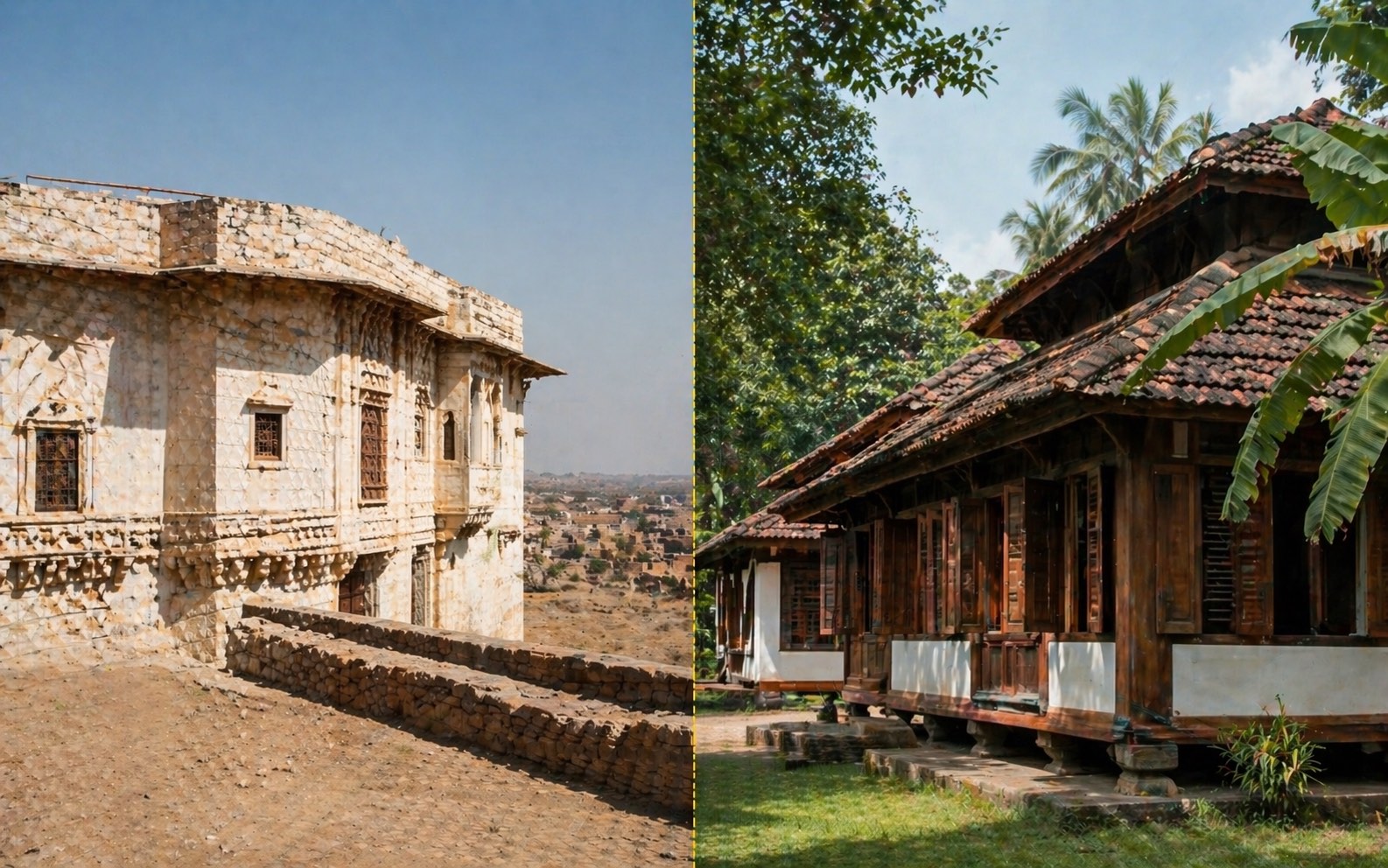
How to Design for the Indian Climate
Hot-Dry, Warm-Humid, Composite, Moderate, and Cold — A Climate-Responsive Design Guide
India is not one climate — it is five. The peak summer in Jodhpur and the monsoon in Kochi and the winter in Srinagar are not variations on a theme; they are fundamentally different engineering problems. Jodhpur in May demands a building that seals against 45 °C dust-laden air and stores the cold of the previous night in heavy walls; Kochi in August demands a building that lets damp air move freely through it at every hour so humidity never has time to settle; Srinagar in January demands a building that seals against −5 °C and captures southern winter sun as heat. The architectural responses are not just different — they are inverted. A thick-walled, small-windowed Jodhpur house is a comfort machine in Rajasthan and a mould trap in Kerala. A large-openinged, stilted Kerala house is a thermal battery running in reverse in Rajasthan.
This guide is an integrated account of climate-responsive residential design for the five Indian climate zones. It covers the thermal comfort science that underpins the whole field (the India Model for Adaptive Comfort, IMAC, which revolutionised how Indian architects think about indoor temperature); the passive strategies that work in each climate and, equally importantly, the ones that fail; the trade-offs between thermal mass and lightweight construction; the role of building form, orientation, and aspect ratio; the specific design of roofs (a subject often under-addressed despite being the largest surface receiving solar radiation); and the legitimate place of active systems when passive alone cannot deliver comfort.
Where adjacent guides (Cross Ventilation, Natural Light Planning, Facade Design, Space Planning Principles) go deep on specific subsystems, this guide is the integration layer — the whole-building climate strategy that sequences those subsystems into a coherent response to each zone.
"In a tropical country, the house is first a device for managing climate and only second a container for living." — B. V. Doshi (1927–2023), Pritzker Prize laureate
1. The Five Climate Zones of India
NBC 2016 Part 11 and ECBC 2017 classify India into five climate zones based on annual mean temperature and annual mean relative humidity, supplemented by dry-bulb temperature ranges and rainfall patterns.

Zone Characteristics at a Glance
| Zone | Peak temp | Peak RH | Diurnal swing | Annual rainfall | Key cities |
|---|---|---|---|---|---|
| Hot-Dry | 40–48 °C | 10–30 % | 15–22 K | 200–700 mm | Jodhpur, Jaipur, Ahmedabad, Delhi, Nagpur |
| Warm-Humid | 32–35 °C | 70–95 % | 4–8 K | 1,200–3,500 mm | Mumbai, Chennai, Kochi, Kolkata, Goa |
| Composite | 38–45 °C summer; 5–12 °C winter | 30–80 % seasonal | 8–18 K | 600–1,500 mm | Bengaluru, Pune, Hyderabad, Bhopal, Lucknow |
| Moderate | 28–32 °C | 40–70 % | 10–14 K | 700–1,200 mm | Bengaluru plateau, Ooty, Kodaikanal, Panchgani |
| Cold | −20 to 20 °C | 20–60 % | 12–18 K | 100–1,500 mm | Shimla, Srinagar, Dharamsala, Leh, Shillong |
What the Zone Assignment Determines
The zone of a project determines, at architectural strategy level, a series of essentially binary decisions:
| Decision | Hot-Dry | Warm-Humid | Composite | Moderate | Cold |
|---|---|---|---|---|---|
| Wall mass | Heavy | Light | Heavy or medium | Light or medium | Heavy (insulated) |
| Window size | Small (5-10% WFR) | Large (25-40% WFR) | Seasonal (shaded) | Medium (20-30% WFR) | Medium S-facing |
| Roof type | Flat, heavy, insulated | Pitched, overhung | Either, with insulation | Pitched or flat | Pitched, insulated |
| Courtyard | Essential | Valuable | Useful | Optional | Glazed (winter garden) |
| Shading | Deep chajjas, jalis | Verandas, overhangs | Both, seasonal | Modest | Minimal (solar gain desired) |
| Thermal mass strategy | Night-flush | Avoid | Seasonal night-flush | Optional | Heat-storage |
| Primary passive cooling | Stack ventilation | Cross ventilation | Seasonal | Cross ventilation | N/A (heat, not cool) |
| AC defensibility | Supplementary only | Often required | Peak summer only | Rarely needed | Opposite: heating |
Every other climate-related decision — material specification, glazing choice, HVAC sizing, roof assembly — flows from these strategic choices. Getting them right in Stage 1 is a force multiplier for the whole project; getting them wrong cannot be compensated later.
2. Thermal Comfort — The Adaptive Model
For four decades, Indian residential design was judged against the ASHRAE 55 static comfort model: indoor temperatures must stay within 23–26 °C year-round, regardless of outdoor conditions or the acclimatisation of the occupants. This imported standard has quietly done enormous damage to Indian architecture, because it forced designers to specify mechanical cooling almost everywhere and de-motivated passive strategies that were perfectly adequate by any rational standard.
The India Model for Adaptive Comfort (IMAC) — the largest field study of Indian thermal comfort ever conducted, covering 16 cities and 6,330 subjects across seasonal visits (Manu, Shukla, Rawal, Thomas and de Dear, 2016) — produced a different and more defensible picture.

Key IMAC Findings
1. The neutral comfort temperature adapts to outdoor running-mean temperature. IMAC formula (naturally-ventilated mode): T_op_neutral = 0.54 × T_running-mean + 12.83 (°C).
2. Indians acclimatised to warm conditions tolerate indoor temperatures of 30–32 °C with mild air movement. No cognitive impairment, no measurable discomfort, when air velocity is 0.6–0.8 m/s.
3. The 80 % acceptability band is ±3.5 K around neutral. In most of India, this band extends from 23 °C (mild winter) to 32 °C (hot summer) as the neutral shifts.
4. Air movement is the single largest comfort lever. Raising indoor air velocity from 0.1 to 0.8 m/s extends upper comfort limit by approximately 2.5 K (de Dear and Brager, 2002).
5. Occupants of naturally-ventilated buildings self-regulate by clothing and behaviour. This produces far wider comfort bands than sedentary office workers in set-point-controlled environments.
The Practical Implication
Setting AC to 24 °C in a Chennai July — when neutral T_op by IMAC is approximately 29 °C — is over-cooling by 5 K. The same occupants, in the same Chennai apartment, with ceiling fans providing 0.8 m/s air movement, would be equally comfortable at 30 °C indoor operative temperature. The energy savings from correcting the set-point are substantial: approximately 6–8 per cent per degree Celsius for most residential air-conditioning (BEE, 2018).
Adaptive Comfort and Architecture
Adaptive comfort science is not a curiosity — it is the justification for climate-responsive design at the whole-building level. If architecture can maintain indoor operative temperature within the IMAC comfort band (which is wide, and climate-responsive), mechanical cooling is unnecessary for most of the Indian year. Only when passive design cannot deliver comfort — peak summer afternoons in Chennai, the July-August humidity in Kochi, the 45 °C extreme in Jodhpur — is mechanical cooling defensible. Even then, supplementary cooling (targeted AC with ceiling fans) is more efficient than full space conditioning.
"We have been mis-designing Indian buildings for fifty years by trying to keep them at 24 °C. The Indian body, the Indian home, the Indian grid — none of them are built for that." — Sameer Maithel, Greentech Knowledge Solutions (paraphrased from Maithel et al., 2020)
3. First Principles of Climate-Responsive Design
Climate-responsive design across all five Indian zones reduces to five first principles:
The Five Principles
1. Minimise heat gain in summer. Solar radiation is the primary source of unwanted heat in hot climates. Architecture can exclude it through orientation, shading, colour, and mass.
2. Maximise heat loss in summer (at night). In climates with diurnal temperature swing, the building must be openable at night to flush accumulated heat.
3. Maximise heat gain in winter (where applicable). In composite and cold climates, winter solar gain is a valuable resource. South-facing openings with removable shading serve this.
4. Manage humidity. In warm-humid climates, moisture is the enemy of thermal comfort (evaporation from skin is compromised at RH > 70 per cent). Architecture addresses humidity by maintaining air movement over skin.
5. Align with air movement. Cross-ventilation and stack ventilation are free cooling; the building form should enable them without fighting prevailing winds.
The Priority Pyramid
Not all five principles apply equally in every climate. The priority hierarchy by zone:
| Priority | Hot-Dry | Warm-Humid | Composite | Cold |
|---|---|---|---|---|
| 1st | Minimise solar gain | Maximise air movement | Balance (seasonal) | Maximise solar gain |
| 2nd | Exploit thermal mass | Minimise solar gain | Minimise solar gain summer | Minimise heat loss |
| 3rd | Night-flush cooling | Avoid thermal mass (humid) | Maximise winter solar gain | Exploit thermal mass (winter) |
| 4th | Minimise evaporation (precious water) | Manage mould/damp | Cross-ventilation | Air-tight envelope |
The priority hierarchy is what produces the inverse strategies across zones. An architect applying hot-dry priorities in a Mumbai plot produces a house that overheats (no airflow) and grows mould (impermeable mass). An architect applying warm-humid priorities in a Jodhpur plot produces a house that cooks under direct sun (no mass) and gusts dust (large openings).
4. Hot-Dry Climate Strategy
Hot-dry climate presents a specific architectural opportunity: the 15–22 K diurnal temperature swing means that night air is substantially cooler than day air. A building with high thermal mass, closed during the day, can store the coolness of the night and release it slowly through the following day, keeping interiors below the peak exterior temperature by 6–10 K even without mechanical cooling.

The Hot-Dry Design Kit
| Element | Specification |
|---|---|
| Wall thickness | 300–450 mm brick, stone, or rammed earth; U-value ≤ 1.0 W/m²K after plaster |
| Roof | Insulated flat slab with cool roof finish (reflective); U-value ≤ 0.5 W/m²K |
| Wall colour | Light (white lime-wash, pale sandstone); SRI ≥ 65 |
| Window-to-floor ratio | 5–10 per cent (NBC minimum), concentrated on N and E; minimal W |
| Shading | Deep chajjas (P/H ≥ 0.7) on S; vertical fins on E and W; jali screens for E/W openings |
| Courtyard | Essential — 15–25 per cent of plot area; water feature for evaporative cooling |
| Ventilation | Stack-dominant; high clerestories paired with low floor-level inlets |
| Thermal mass | High (exterior walls), exposed to interior; store night coolth |
| Operational strategy | Closed daytime, opened at night; night-flush for 4–6 hours |
Worked Example — Jodhpur House
For a 150 m² house in Jodhpur (Hot-Dry, peak 45 °C, diurnal 20 K):
- 450 mm Jodhpur sandstone exterior walls (thermal mass: exposed interior surface)
- Insulated flat roof with 100 mm XPS over slab; white china-mosaic or lime-wash finish (SRI 75)
- Windows 8 per cent WFR; all on N, NE, E — none on W
- Deep chajjas (P/H ≈ 0.8) on all S-facing windows
- Central courtyard 4 × 4 m with a small pool; stack opening 6 m high at the courtyard's highest point
- Night-flush routine: open all perimeter windows and courtyard at 9 pm; close at 7 am
- Supplementary: ceiling fans in every living space; room AC only in master bedroom for July-August peak
Empirical measurements of similar houses (Jain, Chhaya and Bansal, 2013, Energy and Buildings) report peak indoor temperatures of 32–34 °C against 44–45 °C peak exterior — a 10–12 K reduction without active cooling. With a single room AC at 28 °C for peak-of-peak afternoons, the house achieves comfort across the entire summer at roughly one-fourth the energy cost of an uninsulated apartment with AC in every room.
Evaporative Cooling — Hot-Dry's Free Gift
The low humidity of hot-dry climates means evaporation is highly effective. Traditional devices exploit this:
- Khus tatties — vetiver-root screens; water sprayed onto the screen evaporates as wind passes through; delivers 4–8 K cooling at the screen surface
- Courtyard pools — a thin water surface in the courtyard loses heat by evaporation through the hot hours; the cooled water then chills adjacent air
- Clay pot walls (mutki construction) — porous clay vessels embedded in walls; water seeping to the exterior surface evaporates, cooling the wall
These are pre-industrial versions of what is now called direct evaporative cooling — and their thermodynamic effectiveness is documented. Modern equivalents: misting systems, water-wall installations, green walls with irrigation. Evaporative cooling must not be used in warm-humid climates (where adding moisture makes comfort worse); it is strictly a hot-dry tool.
5. Warm-Humid Climate Strategy
Warm-humid climates present the opposite challenge. The diurnal swing is small (4–8 K), so night-flush cooling is only marginally effective — night air is not much cooler than day air. Humidity routinely exceeds 80 per cent, which suppresses evaporative cooling (skin evaporation already fails). Instead, the strategy is to keep air moving at all times, so that convective cooling of skin works, and to prevent humidity from settling in surfaces where it will grow mould or fester.
The Warm-Humid Design Kit
| Element | Specification |
|---|---|
| Wall thickness | 150–230 mm; light material (hollow block, AAC) |
| Roof | Pitched with deep overhangs (≥ 900 mm); reflective underside; ventilated attic |
| Wall colour | Light (but not mandatory — less thermal impact than in hot-dry) |
| Window-to-floor ratio | 25–40 per cent; distributed on multiple facades for cross-flow |
| Shading | Roof overhangs; verandas; trees; vertical louvers for low-angle sun |
| Courtyard | Useful but less critical; a deep veranda may substitute |
| Ventilation | Cross-ventilation (wind-driven); continuous day and night |
| Thermal mass | Minimal — mass holds humid air's heat; lightweight construction preferred |
| Moisture management | Impermeable roof; ventilated foundations; drain details; no mass on ground |
Worked Example — Kochi House
For a 150 m² house in Kochi (Warm-Humid, peak 34 °C, diurnal 5 K, RH 85 per cent):
- 200 mm hollow concrete block walls with external plaster
- Pitched roof at 30° pitch with 1.2 m overhang; 100 mm insulation + ventilated attic space
- Windows 35 per cent WFR; distributed across all elevations for cross-flow
- Deep perimeter verandah (2 m) shading walls year-round
- High floor — 450–600 mm above ground (step access); ventilated plinth for air movement under floor
- Light-coloured polished flooring (discourages mould)
- Ceiling fans in every habitable room; no AC except in master (peak-humidity July-August)
Measured peak indoor in similar houses: 28–30 °C against 34 °C peak outdoor, with good cross-ventilation (Dili, Naseer and Varghese, 2010). The building never feels still — air is always moving. Occupants report comfort, despite high humidity, because of continuous air movement.
Humidity Management
Three strategies:
1. Prevent ingress — pitched roofs keep rainwater off; deep overhangs protect walls; good drainage around foundations
2. Prevent settlement — continuous airflow keeps moisture from standing in corners, under furniture, in wardrobes
3. Allow drying — porous or breathable finishes (lime plaster, traditional IPS) wick moisture out; impermeable waterproof layers trap it
What Fails in Warm-Humid
- Thermal mass (heavy walls) — holds the humid day heat through the night, warming rooms when they should cool
- Sealed envelopes — trap moisture; cause mould within 3–5 years
- East and west glazing without shading — low-angle sun is unmanageable in tropical latitudes
- Carpeting on ground floors — moist carpet is a microbe substrate
- Gypsum partition walls near kitchen / bathroom — absorb moisture, fail within a few monsoons
6. Composite Climate Strategy
The composite climate — most of central and northern India — is both hot-dry in summer and warm-humid in monsoon, with cold dry winters in some cities. The strategy must be seasonally adaptive: the same building must handle a Delhi May (45 °C dry), a July monsoon (32 °C, 85 per cent RH), and a January night (5 °C). This is the hardest climate to design for, and the one that rewards design thinking most.
The Composite Design Kit
| Element | Specification |
|---|---|
| Wall thickness | 230 mm brick (medium mass); insulated cavity wall in high-end work |
| Roof | Insulated flat or pitched; U-value ≤ 0.5 W/m²K |
| Wall colour | Medium (cream, pale terracotta) |
| Window-to-floor ratio | 15–25 per cent; operable; shaded by season |
| Shading | Adjustable — deep chajjas on S (fixed); adjustable blinds/louvers on E and W |
| Courtyard | Essential — functions as thermal chimney in summer, sun-trap in winter |
| Ventilation | Cross-ventilation primary; stack for summer night-flush |
| Thermal mass | Medium (230 mm brick) — stores night coolth, doesn't trap monsoon humidity |
| Seasonal operation | Closed summer day, open summer night, open winter day (solar gain), closed winter night |
The Key Move — Seasonal Adaptability
Unlike hot-dry or warm-humid, composite architecture must shift between strategies across the year. Buildings that do this well have:
- Operable openings on all four orientations (for seasonal selection)
- Adjustable shading (manual or motorised louvers; removable blinds)
- Thermal mass that is accessible to night air (operable clerestories)
- A courtyard that operates as both summer stack and winter solar collector
Worked Example — Bengaluru House
For a 150 m² house in Bengaluru (Composite, peak 34 °C, winter low 14 °C, moderate humidity):
- 230 mm brick walls, plaster-finished; no cavity needed at Bengaluru's moderate peak
- Flat slab roof with 50 mm XPS insulation; white acrylic weatherproofing
- Windows 22 per cent WFR; large on S (winter solar), moderate on E/W with chajjas and jali
- Central courtyard (3 × 3 m) with deciduous tree (dappled shade in summer, bare in winter sun)
- Ceiling fans in every room; no AC installed (Bengaluru's mild climate rarely justifies)
- Solar hot water heating with electric backup (winter water heating dominates residential energy here)
7. Moderate and Cold Climate Strategies
Moderate Climate
Moderate climate cities (Bengaluru plateau, Ooty, Kodaikanal, Pune hills) have mild year-round conditions — peak temperatures rarely above 32 °C, winter lows rarely below 10 °C. The design task is primarily to stay neutral and enable occupancy across a wide band of mild conditions.
Strategy:
- Medium envelope (200–230 mm brick or block)
- Moderate opening area (20–30 per cent WFR); operable for seasonal adjustment
- Minimal shading (summer peak isn't extreme)
- Natural ventilation year-round (moderate wind in these cities)
- Emphasis on weather-tight envelope for monsoon protection
- Thermal mass optional; responds more to microclimate than seasonal extremes
Cold Climate
Cold climate design (Shimla, Srinagar, Shillong, Leh) inverts the tropical architect's reflexes. Here, winter heat loss is the dominant problem, not summer heat gain. Solar gain is a valuable resource in winter; cross-ventilation is a luxury only in short summer.
| Element | Cold Climate Specification |
|---|---|
| Wall thickness | 230–300 mm with 50–100 mm insulation (XPS, mineral wool); U ≤ 0.3 W/m²K |
| Roof | 150–200 mm insulation; U ≤ 0.2 W/m²K; pitched roof (snow shedding in Srinagar, Shimla, Leh) |
| Window-to-floor ratio | 20–30 per cent concentrated on S (winter solar); minimal N |
| Glazing | Double-glazed (DGU) with Low-E; U ≤ 1.8 W/m²K; SHGC ≥ 0.6 on S |
| Shading | Minimal or removable (winter solar gain desired) |
| Air-tightness | ≤ 2 air changes per hour at 50 Pa (n50 test) |
| Heating | Essential — typically hydronic radiator + woodstove + electric |
| Orientation | Long axis E–W; major openings S-facing |
Traditional Himalayan architecture has an excellent vocabulary for these conditions: thick stone-and-timber walls with small deep-set windows, steeply pitched wooden roofs (for snow), south-facing glazed verandahs that serve as thermal buffers and solar collectors, and a winter-use "warm room" around the stove.
8. Thermal Mass vs Lightweight — The Central Material Choice
Thermal mass — the property of building materials to absorb, store, and release heat slowly — is the single most consequential material choice in climate-responsive design. And its effectiveness depends entirely on climate.
What Thermal Mass Does
A 230 mm brick wall has a thermal "time lag" of 6–8 hours and a decrement factor of 0.4 (brick loses 60 per cent of the thermal wave as it passes through). A 450 mm stone wall has a time lag of 10–12 hours and decrement factor of 0.25. These properties mean:
- Peak exterior heat at 2–4 pm reaches the interior surface 6–12 hours later — at 8 pm to midnight
- The amplitude is reduced — a 20 K exterior swing becomes an 8 K interior swing
- If night ventilation is used (evacuating the stored heat), the cycle resets each day
When Thermal Mass Helps
- Hot-Dry climate: the time lag shifts peak indoor heat to night, when exterior has cooled; night-flush evacuates stored heat
- Cold climate (in winter): south-facing mass wall stores solar gain during day, releases at night
When Thermal Mass Hurts
- Warm-Humid climate: diurnal swing is too small (4–8 K) for time-lag strategy; mass stores night heat (still warm) into next day — continuous warming rather than cooling
- When night-flush ventilation is not possible (security-constrained site, high-pollution exterior)
- In un-insulated mass walls — heat loss in winter is severe
Thermal Mass Material Comparison
| Material | Density (kg/m³) | Specific heat (J/kg·K) | Thermal mass (kJ/m²·K, 230 mm wall) |
|---|---|---|---|
| Rammed earth | 1,900 | 900 | 393 |
| Solid brick (fired clay) | 1,800 | 840 | 347 |
| Sandstone | 2,300 | 710 | 376 |
| Concrete (dense) | 2,400 | 900 | 497 |
| AAC block | 600 | 1,000 | 138 |
| Hollow concrete block | 1,100 | 840 | 212 |
| Timber frame + gypsum | 400 | 1,200 | 110 |
The lightweight materials (AAC, hollow block, timber) are not mass-walls — they are insulation-walls. They work well in warm-humid climates (no mass to store heat) but fail in hot-dry (no mass to exploit the diurnal swing).
9. Building Form, Orientation, and Aspect Ratio
At whole-building level, four geometric decisions determine climate response:
1. Long-Axis Orientation
The long axis of the building should run east-west in most Indian climates. This places the long facades facing north and south — the two orientations that are thermally friendly (N for no direct sun year-round; S for controllable high-angle sun that horizontal shading handles). The short facades face east and west, where low-angle morning and evening sun is hardest to shade.
2. Aspect Ratio
The ratio of long to short side. Ideal ranges:
| Climate | Aspect ratio (long:short) | Why |
|---|---|---|
| Hot-Dry | 1.5 : 1 to 2 : 1 | Reduces E/W exposure; enables courtyard in the centre |
| Warm-Humid | 1 : 1 to 1.5 : 1 (wider is better for cross-flow) | Cross-ventilation paths at right angles to long axis |
| Composite | 1.5 : 1 to 1.8 : 1 | Balance |
| Cold | 1.5 : 1 (S-elongated) | Maximises S-exposure for winter solar gain |
3. Compactness (Surface-to-Volume Ratio)
Compact forms (sphere being the most compact, cube next) minimise envelope surface area per interior volume — reducing heat gain in summer and heat loss in winter. But compactness conflicts with cross-ventilation, which needs openings on multiple facades.
Resolution: use a compact primary form with articulated secondary elements. The main building envelope is compact (cube or rectangular); appendages (verandas, balconies, deep window reveals, chhatri-like roof elements) create shading and cross-flow without inflating the main envelope.
4. Storey Height
Ceiling height matters in hot climates. A 3.0 m ceiling stratifies warm air at the top while occupied air at the bottom stays cooler. A 2.4 m ceiling (FSI-pressured apartment standard) mixes warm and occupied air. Traditional Indian residential architecture used 3.0–4.5 m ceilings for exactly this reason. Modern apartment standards compromise this for one-more-floor density.
10. Roofs — The Largest Solar Exposure
The roof receives more solar radiation per unit area than any other building surface. A 150 m² house in Delhi has approximately 150 m² of roof, receiving roughly 600–800 W/m² of incident solar at noon — 90–120 kW of solar gain on the roof alone. An un-insulated RCC roof transmits approximately 30–40 per cent of this heat into the top floor.
Roof Strategies by Climate
| Climate | Roof type | Insulation (top of slab) | Finish |
|---|---|---|---|
| Hot-Dry | Flat RCC | 75–100 mm XPS | White china-mosaic or lime-wash (SRI ≥ 75) |
| Warm-Humid | Pitched (tile, metal, slate) with ventilated attic | 50 mm + ventilation | Natural material colour; overhang ≥ 900 mm |
| Composite | Flat RCC or pitched | 75 mm XPS or 100 mm wool | Light-coloured reflective |
| Moderate | Flat or pitched | 50 mm | Neutral |
| Cold | Pitched with snow overhang | 150–200 mm mineral wool | Dark to absorb winter solar |
Cool Roofs
ECBC 2017 mandates a Solar Reflectance Index (SRI) ≥ 78 on roofs for certain building types in hot-dry and composite climates. Cool roof finishes (white acrylic coating, china mosaic, reflective tile) reduce roof surface temperature by 8–15 K compared with standard finishes, cutting transmitted heat by 20–40 per cent (Synnefa et al., 2007, Energy and Buildings). This is among the cheapest climate interventions — a white acrylic finish costs ₹80–150 per m² and pays back in two summers.
Green Roofs
Green roofs (extensive or intensive) offer insulation and thermal mass through substrate plus evaporative cooling via plants. Effective in all Indian climates but demand:
- Structural capacity (200–400 kg/m² for extensive; 500+ kg/m² for intensive)
- Robust waterproofing (dual-membrane with root barrier)
- Irrigation system in hot-dry and composite (plants die otherwise)
- Maintenance contract (abandoned green roofs become habitat for pests)
Not every project warrants a green roof, but in the right context (a villa with pedestrian terrace access, a warm-humid home where the rainwater is welcome) they are exceptional.
"The roof is the forgotten elevation. Get the roof wrong and you have undone whatever the walls did right." — Charles Correa (1985)
11. The Building Envelope — Integrated Approach
The envelope — the sum of walls, roof, windows, and floors — is what separates the interior climate from the exterior. ECBC 2017 and Eco-Niwas Samhita 2018 specify performance requirements for each component, and the well-designed home meets them collectively through an integrated approach rather than piecemeal.
Envelope U-Values by Climate Zone (Eco-Niwas Samhita 2018)
| Component | Hot-Dry | Warm-Humid | Composite | Cold |
|---|---|---|---|---|
| External wall U (W/m²K) | ≤ 0.85 | ≤ 1.20 | ≤ 0.85 | ≤ 0.40 |
| Roof U (W/m²K) | ≤ 0.50 | ≤ 0.80 | ≤ 0.50 | ≤ 0.30 |
| Window U (W/m²K) | ≤ 3.30 | ≤ 4.00 | ≤ 3.30 | ≤ 2.00 |
| Window SHGC (west/east) | ≤ 0.35 | ≤ 0.40 | ≤ 0.35 | ≥ 0.60 (for winter gain) |
These are upper bounds; good practice goes below them where budget allows. The Biophilic Score Calculator evaluates an envelope's climate performance against Eco-Niwas Samhita.
The Envelope Checklist
For any residential envelope, verify:
1. Wall U-value compliance per climate zone
2. Roof U-value compliance (usually the limiting component)
3. Window U-value and SHGC appropriate for orientation and climate
4. Solar Reflectance Index on roof surface
5. Thermal bridges at junctions (balcony slab, column-wall, sill): continuity of insulation
6. Air-tightness at doors and windows: weather-stripping, caulking
7. Moisture barriers: vapour-permeable on warm side in cold climate; non-permeable in warm-humid
8. Ground-floor thermal break: especially in cold climate, sub-slab insulation
9. Ventilation provisions: operable components in climate-appropriate quantities
12. When Passive Isn't Enough — Hybrid and Active
Even with all the principles applied, there are moments when passive design cannot deliver comfort:
- Jodhpur in May-June peak afternoons (45 °C exterior, 85 per cent WFR not openable due to dust storms)
- Chennai in July-August peak humidity (32 °C, 90 per cent RH, no effective wind)
- Bengaluru in April-May pre-monsoon (high and humid)
- Delhi in June (45 °C exterior, night also hot due to urban heat island)
For these moments, mechanical cooling is defensible. The good design places AC strategically, at the points and times where it yields the largest comfort gain:
The Hybrid Strategy
| Element | Approach |
|---|---|
| Whole-house AC | Almost never justified in Indian residential; expensive and over-conditioned |
| Room AC — master bedroom | Justified for peak summer nights (sleep quality) in hot-dry, composite, warm-humid |
| Room AC — living | Justified for peak evening hours when guests present; intermittent use |
| Ceiling fans | Universal — every habitable room, always |
| Ceiling fan + AC | Most efficient: AC sets the ambient, fan provides the air movement |
| Split vs central | Split for residential, with separate control per room; central for > 4 rooms in same zone |
| Set-point | 26–28 °C with ceiling fan (not 24 °C) — matches IMAC comfort band |
The BEE Star-Rating Discipline
BEE Star-labelled ACs (5-star ISEER ≥ 4.7) deliver roughly 30 per cent more cooling per unit electricity than 3-star ACs. The payback on the ₹8,000–12,000 price differential is 2–3 summers at typical Indian residential use. This is a rational specification almost universally.
The Ceiling Fan as First-Line Comfort
A ceiling fan at medium speed consumes approximately 70 W and delivers air movement equivalent to a 2–3 K drop in effective temperature. Over a 6-hour evening, that is 420 Wh of electricity — roughly ₹2.50 per evening at Indian residential tariffs. A window AC running for the same period at 24 °C consumes 6–9 kWh, roughly ₹50–80. The ceiling fan is the most cost-effective comfort intervention by an order of magnitude, and it scales to IMAC comfort targets without any mechanical cooling.
References
- Bureau of Energy Efficiency (2017) Energy Conservation Building Code 2017 (ECBC 2017). New Delhi: BEE, Ministry of Power, Government of India.
- Bureau of Energy Efficiency (2018) Eco-Niwas Samhita 2018: Energy Conservation Building Code for Residential Buildings. New Delhi: BEE.
- Bureau of Indian Standards (2016) SP 7:2016 — National Building Code of India 2016, Part 11: Approach to Sustainability. New Delhi: BIS.
- Chandel, S.S., Sharma, V. and Marwah, B.M. (2016) 'Review of energy efficient features in vernacular architecture for improving indoor thermal comfort conditions', Renewable and Sustainable Energy Reviews, 65, pp. 459–477.
- Correa, C. (1985) The New Landscape: Urbanisation in the Third World. Mumbai: Book Society of India.
- de Dear, R. and Brager, G. (2002) 'Thermal comfort in naturally ventilated buildings: revisions to ASHRAE Standard 55', Energy and Buildings, 34(6), pp. 549–561.
- Dili, A.S., Naseer, M.A. and Varghese, T.Z. (2010) 'Passive environment control system of Kerala vernacular residential architecture for a comfortable indoor environment', Energy and Buildings, 42(6), pp. 917–927.
- Doshi, B.V. (2011) Paths Uncharted. Ahmedabad: Vastu Shilpa Foundation.
- Fanger, P.O. (1970) Thermal Comfort: Analysis and Applications in Environmental Engineering. Copenhagen: Danish Technical Press.
- Givoni, B. (1969) Man, Climate and Architecture. London: Applied Science Publishers.
- Givoni, B. (1994) Passive and Low Energy Cooling of Buildings. New York: John Wiley & Sons.
- Jain, D., Chhaya, N. and Bansal, N.K. (2013) 'Thermal performance analysis of traditional Rajasthani haveli with a modern dwelling', Energy and Buildings, 60, pp. 1–9.
- Koenigsberger, O.H., Ingersoll, T.G., Mayhew, A. and Szokolay, S.V. (1973) Manual of Tropical Housing and Building: Part 1 — Climatic Design. London: Longman.
- Krishan, A., Baker, N., Yannas, S. and Szokolay, S. (Eds.) (2001) Climate Responsive Architecture: A Design Handbook for Energy Efficient Buildings. New Delhi: Tata McGraw-Hill.
- Maithel, S., Saini, V., Walia, A., Bhanware, P. and Kumar, S. (2020) 'Energy benchmarking for Indian residential buildings', Energy and Buildings, 226, article 110415.
- Manu, S., Shukla, Y., Rawal, R., Thomas, L.E. and de Dear, R. (2016) 'Field studies of thermal comfort across multiple climate zones for the subcontinent: India Model for Adaptive Comfort (IMAC)', Building and Environment, 98, pp. 55–70.
- Nicol, F., Humphreys, M. and Roaf, S. (2012) Adaptive Thermal Comfort: Principles and Practice. London: Routledge.
- Olgyay, V. (1963) Design with Climate: Bioclimatic Approach to Architectural Regionalism. Princeton: Princeton University Press.
- Oke, T.R. (1987) Boundary Layer Climates. 2nd edn. London: Routledge.
- Santamouris, M. (Ed.) (2006) Advances in Passive Cooling. London: Earthscan.
- Santamouris, M. and Kolokotsa, D. (2015) Passive Cooling of Buildings. London: Earthscan.
- Sharma, A. and Saini, R. (2018) 'Passive design features for energy-efficient buildings in composite climate', Renewable and Sustainable Energy Reviews, 82, pp. 1613–1631.
- Singh, M.K., Mahapatra, S. and Atreya, S.K. (2010) 'Thermal performance study and evaluation of comfort temperatures in vernacular buildings of North-East India', Building and Environment, 45(2), pp. 320–329.
- Synnefa, A., Santamouris, M. and Akbari, H. (2007) 'Estimating the effect of using cool coatings on energy loads and thermal comfort in residential buildings in various climatic conditions', Energy and Buildings, 39(11), pp. 1167–1174.
- Szokolay, S.V. (2014) Introduction to Architectural Science: The Basis of Sustainable Design. 3rd edn. London: Routledge.
Author's Note: Climate-responsive design is, more than any other single discipline within architecture, the area where the Indian tradition meets contemporary science most productively. The vernacular buildings described in Section 4 (Jodhpur haveli, Kerala nalukettu) were engineered by generations of iteration to deliver the same performance that modern software (Ladybug, EnergyPlus) now computes. The architect's responsibility is to bridge the two — using the traditions as a library of solutions that deserve contemporary revalidation, and using the science to refine and update those traditions for contemporary materials and constraints. Nothing in this guide is original; everything in it has been known to Indian builders for centuries, to the international climate-architecture community for decades, and to the IMAC research group for a decade. The guide's contribution is synthesis.
Disclaimer: This article is for informational and educational purposes only. It does not constitute professional architectural or engineering advice. Climate-responsive design requires site-specific analysis, compliance with NBC 2016, ECBC 2017, Eco-Niwas Samhita, and local bye-laws. Qualified architects and building services engineers should be engaged for project-specific work. Studio Matrx, its authors, and its contributors accept no liability for decisions made on the basis of the information contained in this guide.
Export this guide
Related Tools — Try Free
Cross-Ventilation Analyzer
Estimate airflow and air changes per hour (ACH) from room size, window areas, layout, and local wind — with NBC 2016 Part 8 compliance check.
Ventilation CalculatorRainwater Tank Sizer
How big should your rainwater tank be? Computes annual harvest, recommended tank capacity in litres, water-bill savings, and payback — for 10 Indian cities.
RWH CalculatorApartment Interior Planning Checklist
51-item checklist across structural, ceiling, lighting, furniture, storage, electrical, kitchen, bathroom.
Checklist