
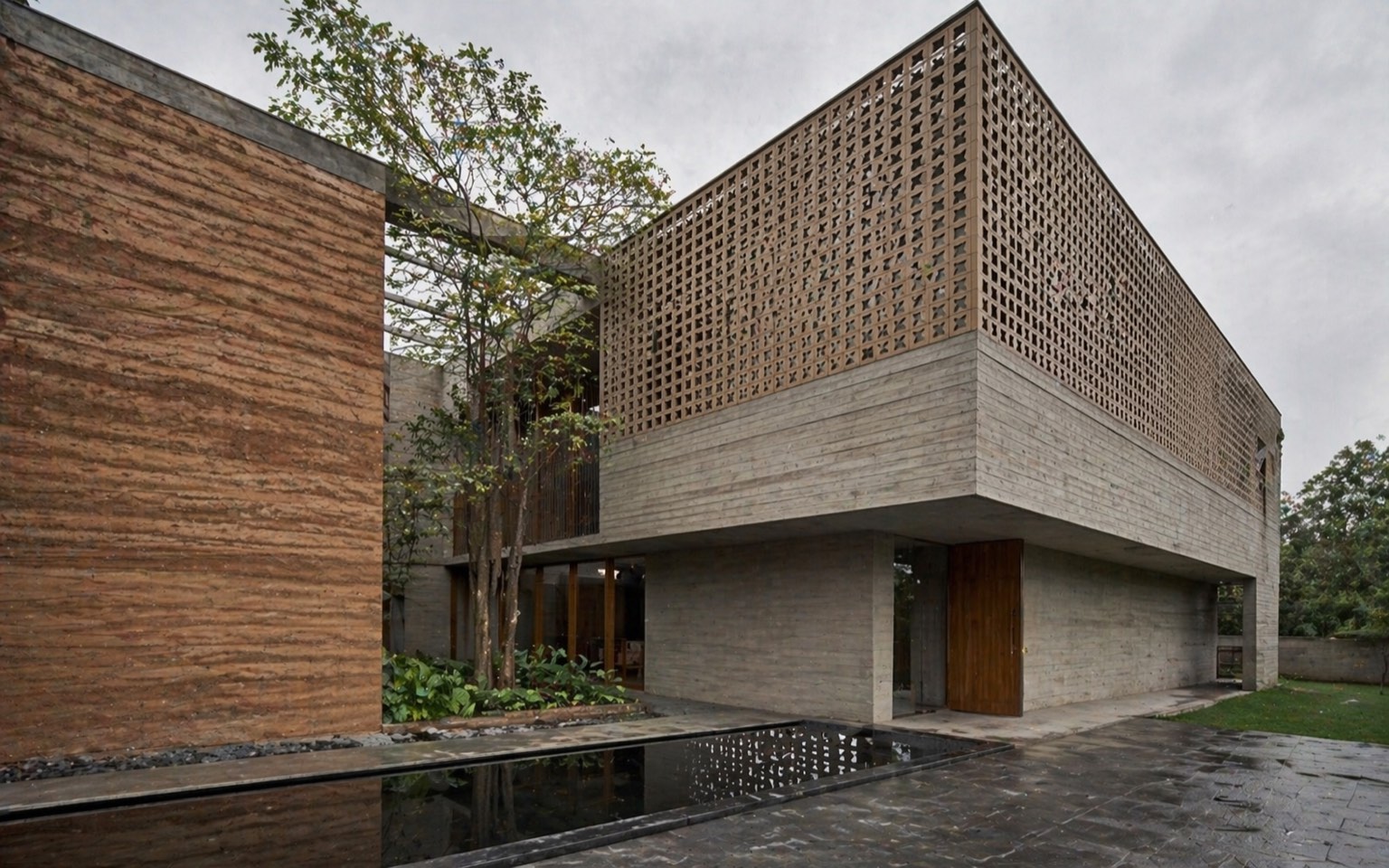
Contemporary Indian Architecture — What Defines It?
A Critical Map of Form, Material, Ideas, and Practices Since 1990
Contemporary Indian architecture begins, for analytical purposes, in 1990 or 1991 — a date chosen not for a specific building or movement but because it marks the economic liberalisation of the Indian economy. Before 1991, architectural practice in India operated within a protectionist economy with limited foreign investment, a small private client base, and a professional culture dominated by public-sector commissions and the shadow of the post-Independence modernist masters. After 1991, private capital, expatriate return, international firms entering the Indian market, rising residential demand, and a younger generation trained in (or exposed to) global schools together produced a different kind of practice — more diverse, more reflexive, more formally ambitious, more uneven.
Thirty-five years later, contemporary Indian architecture is no longer reducible to a single narrative. It is not "Asian modernism." It is not "critical regionalism." It is not "tropical modernism." It is a dispersed field of practices, theories, and built positions — some extending the legacy of Correa and Doshi, others departing sharply, still others operating in parallel universes organised around craft, digital tools, or commercial scale. The question this guide addresses is: what, if anything, holds this field together as contemporary and as Indian? What are the diagnostic features by which an informed observer recognises a work as belonging to this moment and this place?
The guide proceeds by mapping the genealogy, identifying the formal and material vocabularies, positioning the major practices, examining the global theoretical context, and critiquing the blind spots. It is deliberately non-hagiographic. Contemporary Indian architecture has produced work of international significance (Doshi's 2018 Pritzker, multiple Aga Khan awards, sustained international publication) and work of breathtaking mediocrity (the generic builder-developed apartment tower, the gated-colony McMansion). An honest map must admit both.
"The hundred thousand architects now practising in India work across a chasm — some at the level of global formal discourse, most at the level of the default builder product. The task of the next twenty years is to close that chasm, not by exporting the top, but by raising the bottom." — Rahul Mehrotra, paraphrased from Architecture in India Since 1990 (Mehrotra, 2011)
1. Defining "Contemporary" — The 1990 Watershed
Contemporary Indian architecture is conventionally periodised from around 1990 — the year Manit Rastogi founded Morphogenesis, the year Rahul Mehrotra returned from Harvard to set up RMA Architects in Mumbai, the year the Aga Khan Award cycle for Correa's Belapur Housing was completed. More concretely, 1991 marks the liberalisation of the Indian economy (Manmohan Singh's July 1991 budget, the 1992 abolition of the licence raj), and it is the economic shift that most shapes the architectural profession that followed.
Three conditions that 1991 set in motion:
1. Private residential capital, previously trickle-fed, became the dominant commissioning force.
2. Foreign architectural firms (RSP, WOHA, OMA, HOK, Foster, SOM) entered the Indian market, bringing formal and technical vocabularies that local practice responded to.
3. A generation of Indian architects returned from international schools (Mehrotra, Soumitro Ghosh, Rajeev Kathpalia, Samira Rathod, Bijoy Jain, others) with a different theoretical formation than the masters.
| Period | Dominant Client | Dominant Commission Type | Dominant Formal Question |
|---|---|---|---|
| 1947–1970 | State | Institutional, planning, public housing | How should a modern Indian architecture look? |
| 1970–1990 | State + emerging corporate | Housing, campuses, first private residences | How do we reconcile modernism with Indian tradition? |
| 1990–2005 | Private capital + IT sector | Corporate, private residential, tech campus | How does India compete formally with global architecture? |
| 2005–2020 | Diverse — private, public, hospitality, craft-commissioned | Mixed residential, hospitality, high-design institutional | What is the specific architectural language of this moment? |
| 2020–present | Hyper-diverse — digital, sustainable, craft, commercial | Everything from parametric tower to earthen guest-house | Can architectural practice address climate, inequality, and craft simultaneously? |
The distinction from the Masters:
Correa, Doshi, Kanvinde, Raje, Rewal, and Charles Mark Correa (sometimes called the First Generation, or "The Masters") inherited a colonial modernism and transformed it against the pressures of Nehruvian state-building. The Second Generation — roughly architects born between 1955 and 1975 — inherited the Masters and transformed their legacy against the pressures of globalisation, liberalisation, and climate urgency. What defines contemporary Indian architecture is this second transformation.
2. The Genealogy — From the Masters to the Second Generation
No contemporary Indian architect practises in the void. Each is, consciously or not, responding to a genealogy of forms, ideas, and commissions that the First Generation established. The intellectual lineage matters because it predicts what a firm is likely to do — and what it is unlikely to.
| First Generation Master | Key Ideas | Second Generation Inheritors / Responders |
|---|---|---|
| Charles Correa (1930–2015) | Open-to-sky space; sectional design; tropical city; equitable housing | Rahul Mehrotra (RMA), Sanjay Mohe (Mindspace), Hafeez Contractor (commercially); also Morphogenesis (Manit Rastogi) |
| B.V. Doshi (1927–2023) | Cluster courtyard housing; vault; craft; client-participation process | Sen Kapadia, Rajeev Kathpalia (both Sangath alumni); Serie Architects (partly); Matharoo Associates; Studio Mumbai (Bijoy Jain apprenticed elsewhere but absorbs the Doshi atmosphere) |
| Anant Raje (1929–2009) | Monumental brick; courtyard; Kahn-derived order | Bimal Patel (HCP, Ahmedabad); also influences Sameep Padora (sP+a) |
| Raj Rewal (b. 1934) | Urban-scale courtyard cluster; stone tectonics; Mughal-derived proportion | Romi Khosla; Abhimanyu Dalal; Stephane Paumier |
| Achyut Kanvinde (1916–2002) | Brick modernism; institutional campuses; restrained Corbusian inheritance | Sanjay Kanvinde (son, continuing practice); Kanvinde Rai Chowdhury |
| Laurie Baker (1917–2007, UK–Kerala) | Cost-effective construction; craft-recovery; filler slab; exposed brick | Vinod Chandran (COSTFORD); G. Shankar (Habitat Technology Group); partially Revathi and Vasant Kamath (earthen revival) |
The second inheritance — from international schools:
Many Second Generation architects trained at Harvard, Columbia, GSD, AA, MIT, ETH, or Politecnico Milano, and absorbed Frampton's Critical Regionalism, Koolhaas's Delirious New York, Zumthor's material primitivism, or the atmosphere of Peter Zumthor's Atelier. Bijoy Jain (Studio Mumbai) trained at WUSTL and worked with Richard Meier; Rahul Mehrotra trained at Harvard GSD; Sameep Padora trained at Harvard; Soumitro Ghosh (Mathew & Ghosh) trained at Pratt. This cross-formation is what distinguishes the second generation from the first — who trained almost entirely in India (Doshi was apprenticed to Le Corbusier and Kahn, but the apprenticeship was a single exposure, not a formation).
"We do not belong to any school, but we carry schools with us. Le Corbusier left Doshi; Doshi left us; we leave whoever comes next. The chain is interrupted but never broken." — B.V. Doshi, from Paths Uncharted (Doshi, 2012)
3. Formal Characteristics of Contemporary Indian Architecture
What, in formal terms, does contemporary Indian architecture look like? The question resists a single answer — but across the significant built work of the last twenty-five years, a set of recurring formal moves is identifiable. These are not universal, but they are diagnostic: an Indian residential project from this period is more likely than not to deploy at least three of them.
| Formal Move | Description | Representative Examples |
|---|---|---|
| Open-to-sky court / light well | Correa legacy; open court or sectional cut to sky | Anagram, Khosla, SPASM, Architecture BRIO, Mathew & Ghosh |
| Threshold layering | Street → porch → transitional room → court → inner room | Studio Mumbai, Matharoo, sP+a |
| Exposed brick / stone as primary tectonic | Material directly legible; no plaster/paint; fine-grain joint work | RMA, Kumble & Kumble, Biome, Matharoo, Thirdspace |
| Exposed concrete with formwork patterning | Brutalist inheritance modernised; specific shuttering detail | SPASM, Khosla Associates, Flying Elephant, Samira Rathod |
| Water as architectural element | Reflecting pool, step well, trickle, thermal device | Rahul Mehrotra (Hathigaon), Morphogenesis (Pearl Academy), Studio Mumbai |
| Landscape as structure | Planting, topography, microclimate integrated as primary form-giving | Studio Mumbai, Architecture BRIO, Wallmakers |
| Layered facade — jali, louvre, screen | Privacy + shading + light modulation; modernisation of traditional jali | Sanjay Puri, Morphogenesis, Spacematters, Sameep Padora |
| Material monolithism | Single material carried through structure and finish | Wallmakers (mud), Studio Mumbai (stone), Anagram (brick) |
| Craft legibility | Hand-work visible in final surface; apparent imperfection | Studio Mumbai, Bijoy Jain, Samira Rathod, Revathi Kamath |
| Open plan with defined hearth | Modern open-plan living with one sculptural anchor (hearth, tree, stair) | Khosla, SPASM, Anagram |
| Stacked court / sectional ventilation | Vertical court through multiple floors | RMA, Architecture BRIO, Serie |
| Inside-outside dissolution | Sliding glass, deep verandah, continuous floor — "tropical modernism" | Khosla, Architecture BRIO, Morphogenesis, Studio Mumbai |
The meta-observation: Almost none of the moves listed are new — all can be traced to First Generation precedents or international sources. What is contemporary is the combination — the specific mixing, layering, and re-proportioning that distinguishes a 2015 Anagram Delhi residence from a 1985 Correa house. The vocabulary is inherited; the syntax is new.
4. Material Palette — Craft, Stone, Brick, Concrete, Steel
Material selection is the clearest diagnostic of architectural position. The contemporary Indian residential palette is narrow but deliberate, organised around four dominant materials and their regional variations.
| Material | Contemporary Use | Craft Intensity | Typical Firms |
|---|---|---|---|
| Exposed brick — wire-cut | Load-bearing or non-structural wall; external + internal | Medium (mason-led) | RMA, Anagram, Thirdspace, Thirumugam & Muthu |
| Exposed brick — reclaimed / handmade | Feature wall, structural where permitted; patina critical | High (curation + laying) | Studio Mumbai, Samira Rathod, Flying Elephant |
| Kota stone / sandstone / basalt | Floor, wall cladding, landscape — polished or natural | Medium–High | Rahul Mehrotra, Khosla, Anagram, Morphogenesis |
| Local granite | Cladding, paving, plinth | Medium | Mindspace, Kumble & Kumble, Bangalore firms |
| Laterite stone | Exposed wall (western coast); feature in inland projects | Medium | Biome, Thirumugam & Muthu, Wallmakers, Architecture BRIO |
| Stabilised mud block (CSEB) | Load-bearing + feature wall | High (commissioned artisans) | Wallmakers, Revathi Kamath, Biome |
| Exposed concrete | Shuttered with specified patterning; load-bearing or sculptural | High (formwork + pour discipline) | SPASM, Khosla, Samira Rathod, Sameep Padora, Serie |
| Rammed earth | Wall, landscape wall | Very High (labour-intensive curing) | Wallmakers, Thirumugam, Biome |
| Lime plaster | External render, breathable surface | Medium (specialist) | Studio Mumbai, Sameep Padora, heritage-adjacent work |
| Reclaimed / seasoned timber (teak, sal, reclaimed Burma teak) | Frames, louvres, furniture as architecture | High | Studio Mumbai, Bijoy Jain, Wallmakers |
| Structural steel (exposed I-sections, channels) | Frame, roof, mezzanine | Medium | Serie, Mathew & Ghosh, SPASM |
| China mosaic / trowelled finishes | Roof finish, courtyard floor | Medium | Sameep Padora, Abhikram, heritage-influenced |
| Athangudi tile / handmade terrazzo | Floor, feature | High (disappearing craft) | Samira Rathod, Studio Mumbai, Matharoo |
The craft dimension is the most distinctive contemporary Indian material move. Indian labour economics allow levels of hand-finishing that are economically infeasible in Europe or North America — a 2 m x 3 m jali cut from a single sandstone block, or a 50 m2 rammed-earth wall troweled over three weeks. Studio Mumbai, Wallmakers, and Samira Rathod have built reputations internationally on exactly this craft legibility. The critique — that the craft is economically sustainable only because Indian labour remains cheap, and that the architecture romanticises this inequality — is addressed in Section 11.
"Materials have their own presence. A stone wall carries the history of the hand that placed it. The detail is not an ornament; it is a record." — Bijoy Jain, from 2G Studio Mumbai monograph (Jain, 2009)
5. The Climatic Imperative — Passive Design as Mainstream
A shift observable only in retrospect: climate-responsive design, which was the explicit theme of First Generation Indian architects (Correa, Doshi, Baker) but remained niche in the 1990s and early 2000s, has in 2020s become a mainstream expectation of serious contemporary Indian practice. This is driven by four converging forces:
1. Regulatory: ECBC 2017 (Energy Conservation Building Code) and ENS 2018 (Eco-Niwas Samhita) introduced code-level envelope performance requirements. IGBC and GRIHA certifications became common client-side expectations for commercial and institutional projects.
2. Thermal-comfort science: The IMAC study (Manu et al., 2016) established adaptive-comfort bands specific to India, validating passive-design strategies with peer-reviewed evidence.
3. Carbon awareness: Embodied-energy research (Reddy and Jagadish, 2003, and successors) made material selection a carbon decision, not just a cost decision.
4. Climate vulnerability: Extreme heat events (2015 Andhra, 2019 Bihar, 2022 NW India) and urban heat-island warming made climate robustness a client concern, not just an architect's idealism.
| Climatic Strategy | 1990s Practice | 2020s Practice |
|---|---|---|
| Courtyard | Rare (seen as "regressive") | Common (seen as climate-smart) |
| Deep eaves / chajja | Often omitted in "modern" projects | Routine; sized to climate |
| Jali screens | Conservation-only context | Mainstream residential element |
| Cool roof / insulation | Rare; ECBC did not exist | ECBC-expected; specified routinely |
| Cavity wall / insulated envelope | Rarely specified | Specified for any temperature-controlled space |
| Cross-ventilation as design priority | Secondary to aesthetic | Primary; simulated where possible |
| Thermal mass | Accidental (brick walls happened to have it) | Deliberate (selected for time-lag) |
| Microclimate (water, plants) | Decorative | Functional + decorative |
| Whole-building energy modelling | Rare | Routine for certification |
The mainstream-passive inflection shows up in award citations, publication taglines, and client briefs. "Climate-responsive" is now a default claim — sometimes earned, sometimes not. The serious practitioner distinguishes between projects that performed climate analysis and projects that merely deploy climate vocabulary (jali, pergola) without analysis.
6. Spatial Themes — Court, Threshold, Landscape, Water
Beyond formal and material moves, contemporary Indian architecture organises itself around a small set of recurring spatial themes. These are the architectural ideas — not details, not materials — that characterise the moment.
The Court. Not every contemporary Indian residential project has a courtyard, but the courtyard is a persistent reference — present or deliberately absent. The Open-to-Sky Space (Correa's phrasing) has become shorthand for climate-and-culture-responsive design. Recent instances: Anagram's Defence Colony Residence (Delhi, 2015); SPASM's House on a Stream (Alibaug, 2011); Studio Mumbai's Copper House II (Chondi, 2011); Khosla's Villa in the Woods (Bangalore, 2014); Mathew & Ghosh's House of Light (Bangalore, 2008).
The Threshold. The graded transition from public to private — inherited from haveli, nalukettu, pol, and articulated intellectually by Correa and then Mehrotra — remains a dominant spatial move. In its contemporary form it takes the shape of a front verandah, a water body, a filter-column grid, a terraced garden, or a sequence of shading devices that slows entry.
Landscape as Structure. Studio Mumbai, Architecture BRIO, SPASM, Wallmakers, and others treat landscape (topography, water, planting) not as decoration but as structural to the building's form. Topographic integration, rain-garden drainage, microclimate planting, and water as thermal device are organising moves, not afterthoughts.
Water. From the step-well references in Morphogenesis Pearl Academy to the reflection pools at RMA Hathigaon, from the tank at Studio Mumbai Palmyra House to the monsoon-channel at SPASM Stream House, water recurs as an organising element. It performs climatically (evaporation, thermal mass), ecologically (rain-water capture, biodiversity), and symbolically (the step-well, the ghat, the Mughal chahar bagh).
| Spatial Theme | Functional Role | Cultural Reference | Key Projects |
|---|---|---|---|
| Open-to-sky court | Climate, light, social | Haveli chowk, nalukettu nadumuttam | Anagram, SPASM, Khosla |
| Threshold sequence | Gradated privacy, climatic buffer | Otla, padvi, balcao | Studio Mumbai, Matharoo, sP+a |
| Deep verandah | Rain shelter, cross-ventilation, social | Kerala veeranda, Bengali atchala | Architecture BRIO, Khosla, Morphogenesis |
| Stepped plinth + landscape | Topographic register | Temple ghat, vernacular mound | Studio Mumbai, RMA Hathigaon |
| Water-pool integration | Evaporative cooling, reflection | Mughal chahar bagh, temple tank | Morphogenesis Pearl Academy, RMA Hathigaon, Studio Mumbai |
| Vaulted / compressed earth roof | Material continuity + thermal | Doshi Sangath, Nari Gandhi work | Wallmakers, Biome, Revathi Kamath |
| Courtyard-as-stair | Section-driven circulation around an open volume | None specific; a modern invention | Anagram, Sameep Padora |
7. The Practice Map — Firms and Their Positions
A map of contemporary Indian architectural practice organised by position rather than geography. The positions are ideal types; most firms sit at intersections.
| Position | Characteristics | Representative Firms |
|---|---|---|
| Critical Regionalist (inherits Correa/Doshi legacy) | Passive climate response; material regionality; ideas articulated publicly | RMA (Rahul Mehrotra), Sanjay Mohe Mindspace, Sameep Padora sP+a, Architecture BRIO |
| Craft-Primitivist | Hand-work legibility; slow design; material monolithism; international publication | Studio Mumbai (Bijoy Jain), Wallmakers (Vinu Daniel), Samira Rathod, Revathi Kamath |
| Technological Modernist | Material rigour with industrial precision; concrete and steel foregrounded | SPASM (Sanjeev and Sangeeta Merchant), Khosla Associates, Flying Elephant (Rajesh Renganathan) |
| Tropical Modernist | Inside-outside dissolution; courts; regional materials; Bawa-influenced | Architecture BRIO (Robert Verrijt, Shefali Balwani), Khosla Associates, Mindspace, Hundredhands |
| Parametric / Digital | Computational form-making; institutional, commercial, infrastructure | Serie Architects (Christopher Lee), Morphogenesis (parametric skin work), Studio Symbiosis |
| Urban Reformist | Planning-adjacent; housing, public space, slum rehabilitation | RMA, urbanRE, HCP (Bimal Patel), Hunnarshala (Kiran Vaghela), Studio Symbiosis |
| Commercial Scalar | High-volume residential, hospitality, IT campuses | Hafeez Contractor (polemically commercial), Mindspace, KGD, Sanjay Puri, Prashant Dalal |
| Research / Pedagogic | Practice oriented partially or fully toward writing, teaching, publication | RMA, Sameep Padora (Matter publication), Kaiwan Mehta (as theorist), Prem Chandavarkar CnT |
| Heritage-adjacent | Conservation + contemporary insertions | Abhikram (Ahmedabad), Anuradha Chaturvedi, Annabel Lopez Studio, Conserva |
| Earthen / Sustainable-first | Mud, bamboo, rammed earth as primary materials | Wallmakers, Biome, Thirumugam & Muthu, Hunnarshala, Auroville Architects |
The map is not exhaustive — it excludes most of the roughly 100,000 registered Indian architects and most of the roughly 200 firms that produce the default commercial product. But those firms do not define contemporary Indian architecture in any meaningful sense; they are, rather, the substrate against which the firms listed above distinguish themselves.
8. Global Dialogue — Critical Regionalism and Its Critics
Kenneth Frampton's essay "Towards a Critical Regionalism: Six Points for an Architecture of Resistance" (1983) remains the most cited international theoretical frame applied to contemporary Indian architecture. Frampton argued that meaningful contemporary architecture must resist both the placelessness of international modernism and the nostalgic pastiche of regional revival — producing instead a "critical regionalism" that is modern in programme and construction but site-specific in climate, material, and topographic response.
The thesis fits Indian contemporary practice disproportionately well. Doshi, Correa, and their successors are frequently cited in Frampton's later editions (2020, 5th edition) as critical-regionalist exemplars. The attraction is mutual: Indian architects cite Frampton to position their work in global discourse, and Frampton cites Indian architects to substantiate his thesis with built examples.
| Position | Claim | Indian Exemplars |
|---|---|---|
| Critical Regionalism (Frampton) | Modern + place-specific; resists both internationalism and pastiche | Correa Tube House; Doshi Aranya; Bijoy Jain Palmyra House |
| Kinetic City (Mehrotra) | Indian cities exist in two simultaneous modes — static architecture + kinetic informality | RMA work; urbanRE mapping projects |
| Emergent Asian Modernism (H.U. Khan) | Post-colonial Asian architecture shares a distinctive modernist project | Correa, Doshi, Bawa, Muzharul Islam, Seng Yew Yu (grouped) |
| Craft Modernism (Padora, Jain) | Craft legibility as contemporary architectural method | Studio Mumbai, Samira Rathod, Wallmakers |
| Post-Critical Turn (Somol, Whiting, adapted) | Less theorising, more making; form as argument | Morphogenesis, SPASM |
The critiques: Critical regionalism has been charged (by Sarah Whiting, Akshay Mahajan, and others) with being a theoretical export that Indian architects over-use to legitimise their work to Western audiences. The counter-position — that Indian architecture should not seek legitimacy through Western theoretical frames at all — has been articulated by Kaiwan Mehta and others. The debate remains unresolved and probably productively so.
"Critical regionalism is not a style or even a movement. It is a strategy — an effort to mediate the impact of universal civilisation with elements derived indirectly from the peculiarities of a particular place." — Kenneth Frampton (b. 1930), from Towards a Critical Regionalism (Frampton, 1983)
9. Typological Innovations — Housing, Hybrid, Institutional-Residential
Beyond the single-family house (which dominates the publication circuit), contemporary Indian architecture has produced typological innovations in three areas:
Slum rehabilitation and incremental housing. Correa's Belapur Housing (1986) and Doshi's Aranya (1989) set the precedent. Contemporary extensions include HCP's slum rehabilitation work in Ahmedabad, SPARC's community-led rehabilitation in Mumbai, and Hunnarshala's earthquake-resilient housing in Kutch post-2001. The architectural innovation is incrementality — designing for staged owner expansion rather than delivering a finished product.
Hybrid residential-commercial. The Indian pol and haveli were always hybrids — shop at street, house above. Contemporary reinterpretations (Anagram's studios, RMA's mixed-use, SPASM's live-work houses) revive this mixture in middle-class and upper-middle-class contexts.
Institutional residential. Student housing, faculty housing, research centre accommodation — a typology where Correa (Kanchanjunga), Doshi (IIM Ahmedabad faculty), and Raje (IIMA extensions) left strong precedents. Contemporary work: Pearl Academy Jaipur (Morphogenesis); RICS SBE Amity; The Assam Rifles Public School Residential Block (Mathew & Ghosh).
| Typology | Scale | Representative Contemporary Projects |
|---|---|---|
| Single-family house (detached) | 150–800 m2 | Anagram, Studio Mumbai, Khosla, SPASM residential portfolio |
| Single-family house (row / semi-detached) | 100–200 m2 | Matharoo, Sameep Padora, Mathew & Ghosh |
| Slum rehabilitation | Cluster scale | SPARC Mumbai; Hunnarshala Kutch; HCP Ahmedabad |
| Incremental housing (Aranya model) | 100–300 households | Urban DesignCollective; Community Design Agency |
| Institutional residential | 50–500 beds | Pearl Academy Jaipur; Mathew & Ghosh; Studio Symbiosis |
| Hybrid live-work | 150–500 m2 | Anagram Architect Studio; sP+a Mumbai office; various Bangalore practices |
| Weekend / second-home | 200–600 m2 | Studio Mumbai Alibaug; Architecture BRIO coastal work; SPASM |
| Boutique hospitality (home-scale) | 10–40 keys | Wallmakers Shikara; Studio Lotus Raas Chhatrasagar; Hundredhands boutique hotel portfolio |
The silent typology: the 1-BHK to 3-BHK developer apartment, which accommodates the majority of urban Indian residential square footage, receives almost no contemporary architectural attention — and remains a critique-worthy blind spot (Section 11).
10. Technology — Digital, Parametric, and Sustainable
The 2010s introduced two technological inflections to Indian practice: digital design tools and sustainability certification. Both have reshaped design process without — yet — producing a uniquely Indian synthesis.
| Technology | Indian Uptake | Leading Firms | Limitations |
|---|---|---|---|
| BIM (Revit, ArchiCAD) | Widespread since 2015 for commercial | Most commercial firms; Morphogenesis, HCP, Serie | Infrastructure/labour for model management uneven |
| Parametric form-making (Grasshopper, Dynamo) | Niche — mostly Serie, Morphogenesis, Studio Symbiosis | Serie, Morphogenesis, Studio Symbiosis | Rarely applied to residential where contingencies exceed parametric scope |
| Environmental simulation (EnergyPlus, DIVA, IES-VE) | Rising, driven by ECBC/ENS | Morphogenesis, RMA, firms working with consultants like Aparajita Environmental | Consultant-led, not typically in-house |
| CFD (airflow simulation) | Rare — mostly academic or consultant | IIT Kanpur/Bombay labs; specialist consultants | Not yet mainstream in residential |
| IGBC / GRIHA / LEED certification | Common for commercial, institutional | Almost all mid-scale-up firms | Residential uptake limited; mostly commercial/institutional |
| Net-zero / passive-house ambition | Experimental | Wallmakers, Studio Lotus, Morphogenesis occasional projects | Few certified examples pan-India |
| 3D-printed construction | Very early stage | IIT Madras / Tvasta; Apis Cor pilots | Cost/scale not competitive with conventional |
| Digital fabrication (CNC, robotic) | Rare | Serie occasional; research projects at CEPT, NID | Labour cost asymmetry — manual is cheaper |
| Rammed earth / engineered earthen construction | Growing | Wallmakers, Thirumugam & Muthu, Biome | Skill pool concentrated; scalability limited |
The Indian paradox: Labour remains cheap and abundant enough that digital-fabrication advantages evaporate. A robot-placed brick wall in India costs more than a hand-laid one; a CNC-cut jali costs more than a stone-carver's. This inverts the developed-economy logic of digital fabrication and pushes Indian practice toward manually-intensified craft rather than digitally-automated production. It is a defining feature of the contemporary Indian moment and the direction is not converging with global practice — it is diverging.
11. The Critiques — Craft, Scale, Representation
An honest map must include the blind spots and critiques. Contemporary Indian architecture has real weaknesses, and the discipline's self-criticism has intensified over the past decade.
Critique 1: Craft elitism. The cost of Studio Mumbai, Wallmakers, or Samira Rathod craft-intensive practice is beyond the reach of the vast majority of Indian clients. Those who commission it are disproportionately English-speaking, urban, and wealthy. The architecture romanticises Indian craft while operating entirely within the top 1% of income distribution.
Critique 2: The missing 99%. The dwelling needs of 95% of India's population — 1-BHK and 2-BHK apartments, pucca-conversion housing, post-disaster reconstruction — receive almost no attention from the architecture that makes the magazines. The gap between the architectural profession and the housing it actually produces is structural and widening.
Critique 3: Representation. Women architects remain under-represented in leadership positions, international publication, and major award recognition — Brinda Somaya, Sheila Sri Prakash, Samira Rathod, Revathi Kamath, Sheila Prakash, Annapurna Garimella, Shefali Balwani are exceptions, not the norm. Caste, region, and economic background also structure who gets to practise at the publication-worthy tier.
Critique 4: Publishing bias. International magazines (Dezeen, ArchDaily, Dwell) over-represent a handful of Indian firms. The result: contemporary Indian architecture, as perceived internationally, is a 30-firm story in a 100,000-architect country.
Critique 5: Environmental greenwashing. Many projects claim climate-responsive credentials with little evidence. The gap between design intent and measured performance is rarely addressed publicly. ECBC/ENS compliance is claimed more often than verified.
Critique 6: Commercial architecture's absence from critical discussion. The buildings that house most Indians — developer flats, gated-colony villas, malls, tech parks — are architecturally produced but critically ignored. This silence is itself a position and deserves critique.
| Critique | Source / Articulator | Counter-response |
|---|---|---|
| Craft elitism | Kaiwan Mehta, Sarah Whiting (international) | Craft-recovery creates livelihoods; the wealth that commissions it trickles down |
| Missing 99% | Urban studies critics, Housing for All policy writers | Some firms (HCP, Hunnarshala, Community Design Agency) do address this; publicity does not |
| Representation | Various writers; Women in Architecture Conference | Slowly changing; pipeline issues persist |
| Publishing bias | Dezeen critics, Kaiwan Mehta | Magazine economics favour narrative and visual; unglamorous work rarely featured |
| Environmental greenwashing | Academic building-science community | Rising regulatory pressure (ECBC mandatory in most states now) closes gap |
| Commercial absence | Amita Baviskar, urban studies writers | Architecture critics mostly not equipped to discuss commercial architecture |
12. What Defines Contemporary Indian Architecture — A Ten-Point Synthesis
Distilling the foregoing, ten diagnostic features identify a work of architecture as belonging to contemporary Indian practice. No single project displays all ten; a serious contemporary work typically displays five to eight.
| # | Feature | Diagnostic Signal |
|---|---|---|
| 1 | Post-1990 temporality | Conceived and built within the post-liberalisation economic frame |
| 2 | Climate responsiveness as design priority | Passive strategies explicit in concept; not merely ornamented onto default HVAC box |
| 3 | Courtyard, threshold, or sectional cut to sky | At least one inherited spatial device from First Generation vocabulary |
| 4 | Regional material foregrounded | Stone, brick, earth, laterite, timber — visible as material, not covered by plaster/paint |
| 5 | Craft legibility | At least one element whose hand-making is architecturally visible |
| 6 | Either exposed brick / stone OR exposed concrete tectonic | Rarely both; the choice is a diagnostic position |
| 7 | Conscious dialogue with First Generation | Acknowledges Correa / Doshi / Raje / Rewal / Baker legacy — through extension or critique |
| 8 | Landscape-as-structure | Planting, water, topography as primary organising move, not decorative add-on |
| 9 | Some theoretical self-positioning | Firm statement identifies ideas (regionalism, craft, climate, hybrid, digital) — even if briefly |
| 10 | Indigenised technology | Digital, sustainable, or craft methods adapted to Indian labour / material economy — not imported wholesale |
The boundary condition: a project that fails most of these tests (no climate response, no regional material, no threshold/court, no theoretical position, no craft legibility) is still contemporary and still Indian — but it is not contemporary Indian architecture as the discourse uses the term. It is generic builder product, or international-style pastiche, or commercial default. The term "contemporary Indian architecture" is descriptive of a narrow, self-identified tier of the profession — not of everything built in India after 1990.
This narrowness is the source of both the discourse's vitality (a coherent conversation is possible) and its limitation (the conversation excludes most of what gets built). The honest architect operates within this tension rather than pretending it does not exist.
"A practice that takes itself seriously in contemporary India must answer four questions before it begins: what is its relationship to climate, to material, to tradition, and to inequality. Work that evades even one of these questions is incomplete — and usually thinner than it knows." — Rahul Mehrotra, paraphrased from Architecture in India Since 1990 (Mehrotra, 2011)
References
- Ashraf, K.K. and Belluardo, J. (Eds.) (1998) An Architecture of Independence: The Making of Modern South Asia — Charles Correa, Balkrishna Doshi, Muzharul Islam, Achyut Kanvinde. New York: Architectural League of New York.
- Bhatt, V. and Scriver, P. (1990) Contemporary Indian Architecture: After the Masters. Ahmedabad: Mapin Publishing.
- Bureau of Energy Efficiency (2017) Energy Conservation Building Code 2017. New Delhi: Ministry of Power, Government of India.
- Bureau of Energy Efficiency (2018) Eco-Niwas Samhita 2018. New Delhi: Ministry of Power.
- Correa, C. (2010) A Place in the Shade: The New Landscape and Other Essays. New Delhi: Penguin India.
- Curtis, W.J.R. (1988) Balkrishna Doshi: An Architecture for India. New York: Rizzoli.
- Curtis, W.J.R. (2002) Modern Architecture Since 1900. 3rd edn. London: Phaidon.
- Desai, M., Desai, M. and Lang, J. (2012) The Bungalow in Twentieth-Century India: The Cultural Expression of Changing Ways of Life and Aspirations in the Domestic Architecture of Colonial and Post-Colonial Society. Farnham: Ashgate.
- Doshi, B.V. (2012) Paths Uncharted. Ahmedabad: Vastu Shilpa Foundation.
- Frampton, K. (1983) 'Towards a Critical Regionalism: Six Points for an Architecture of Resistance', in Foster, H. (Ed.), The Anti-Aesthetic: Essays on Postmodern Culture. Port Townsend: Bay Press, pp. 16–30.
- Frampton, K. (2020) Modern Architecture: A Critical History. 5th edn. London: Thames & Hudson.
- Jain, B. (2009) Bijoy Jain / Studio Mumbai. 2G No. 46. Barcelona: Editorial Gustavo Gili.
- Khan, H.U. (1987) Charles Correa: Architect in India. London: Concept Media / Mimar.
- Khan, H.U., Frampton, K. and Correa, C. (Eds.) (1985) Charles Correa. Singapore: Concept Media.
- Koolhaas, R. and Obrist, H.U. (2011) Project Japan: Metabolism Talks. Köln: Taschen. (contextual international reference)
- Lang, J., Desai, M. and Desai, M. (1997) Architecture and Independence: The Search for Identity — India 1880 to 1980. Delhi: Oxford University Press.
- Manu, S., Shukla, Y., Rawal, R., Thomas, L.E. and de Dear, R. (2016) 'Field studies of thermal comfort across multiple climate zones for the subcontinent: India Model for Adaptive Comfort (IMAC)', Building and Environment, 98, pp. 55–70.
- Mehrotra, R. (2008) 'Negotiating the Static and Kinetic Cities: The Emergent Urbanism of Mumbai', in Huyssen, A. (Ed.), Other Cities, Other Worlds. Durham: Duke University Press.
- Mehrotra, R. (2011) Architecture in India Since 1990. Mumbai: Pictor / Hatje Cantz.
- Mehta, K. (2010) The Architecture of I M Kadri. Mumbai: The Marg Foundation.
- Mehta, K. (2019) 'The critical regionalism problem: writing about Indian architecture', Domus India, editorial.
- Padora, S. (2018) In the Name of Housing: A Study of Ten Projects in Mumbai. Mumbai: sP+a Matter.
- Prakash, V. (2002) Chandigarh's Le Corbusier: The Struggle for Modernity in Postcolonial India. Seattle: University of Washington Press.
- Reddy, B.V.V. and Jagadish, K.S. (2003) 'Embodied energy of common and alternative building materials and technologies', Energy and Buildings, 35(2), pp. 129–137.
- Roy, T. (2021) A Business History of India: Enterprise and the Emergence of Capitalism from 1700. Cambridge: Cambridge University Press.
- Scriver, P. and Srivastava, A. (2015) India: Modern Architectures in History. London: Reaktion Books.
- Tillotson, G.H.R. (1989) The Tradition of Indian Architecture: Continuity, Controversy and Change since 1850. New Haven: Yale University Press.
- Tzonis, A. and Lefaivre, L. (2003) Critical Regionalism: Architecture and Identity in a Globalized World. Munich: Prestel.
Author's Note: This guide is a diagnostic map, not a canon or a celebration. The purpose is to equip the reader — architect, student, informed client — with a frame for recognising what contemporary Indian architecture is trying to do and what it is leaving undone. The map will date. In twenty years the firms listed will be a different set, and the critical positions will have shifted. What should remain useful is the method: identify the genealogy, audit the formal moves, trace the material and climatic strategies, note the theoretical self-positioning, and hold the work against its own claims. Contemporary Indian architecture is, at its best, a demanding and self-aware practice. This guide tries to engage it at that level.
Disclaimer: This article is for informational and educational purposes only. The map of practices and positions is a synthesis of published sources and critical writing as of 2026; it is necessarily partial and the author's perspective. Firm attributions reflect public record at the time of writing — partnerships, leaderships, and positions change. Architectural critique is a contested field; the readings offered here are one informed reading, not a definitive account. Studio Matrx, its authors, and its contributors accept no liability for decisions or interpretations made on the basis of the information contained in this guide.
Export this guide
Related Tools — Try Free
Cross-Ventilation Analyzer
Estimate airflow and air changes per hour (ACH) from room size, window areas, layout, and local wind — with NBC 2016 Part 8 compliance check.
Ventilation CalculatorApartment Furniture Size Chart
Standard furniture dimensions for Indian apartments — sofas, beds, tables, dining, storage.
Reference ChartConcept Generator
Get 3 AI-generated design concepts for any room with style, materials, and cost estimate.
DesignAI