
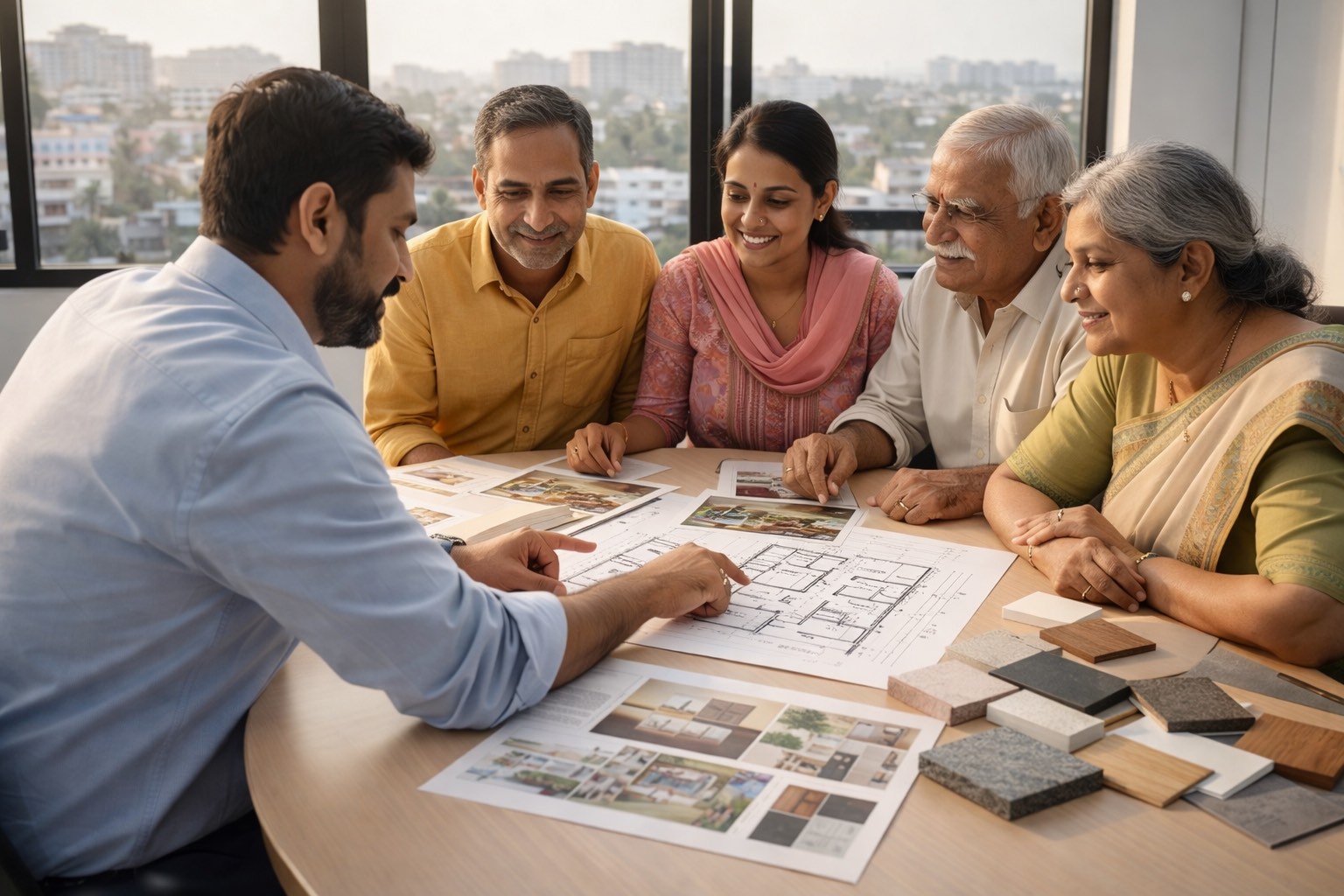
Client Brief to Concept
Translating Homeowner Requirements into Design — A Guide for Indian Residential Architecture
The most consequential decisions in the life of a building are made before a single line is drawn. In the space between a homeowner's aspirations and an architect's first concept sketch lies the briefing process — that delicate, demanding act of translation where dreams are converted into dimensions, lifestyles into layouts, and family cultures into spatial configurations.
It is also, in Indian practice, the phase most frequently rushed, undervalued, or skipped entirely. The consequences ripple through the entire project life: rooms that are too small for how the family actually lives, kitchens that cannot accommodate Indian cooking, guest rooms that sit empty for eleven months while the study is crammed into a bedroom corner, and — most painfully — homes that require costly mid-construction changes because the brief was never properly established.
This guide examines the complete journey from client brief to concept design in the Indian residential context. It draws on professional frameworks (CoA, RIBA, AIA), Indian building standards, and the cultural specificities that make Indian home design a discipline unto itself — from the puja room to the dual kitchen, from Vastu compliance to multi-generational living.
"Architecture is really about well-being. I think that people want to feel good in a space... On the one hand it is about shelter, but it is also about pleasure." — B.V. Doshi (1927–2023), Pritzker Prize laureate, 2018
1. The Professional Framework: Stages of Design
The Council of Architecture (CoA), constituted under the Architects Act, 1972, divides architectural services into seven stages. The first two — Inception and Concept Design — encompass the briefing-to-concept journey and together account for approximately 20% of the architect's fee (Council of Architecture, 2019).
| Phase | CoA Stage | Key Activities | Deliverables |
|---|---|---|---|
| Inception | Stage 1 | Understanding requirements, site visit, feasibility, establishing the brief, fee agreement | Design brief document, site analysis report, Letter of Engagement |
| Concept Design | Stage 2 | Developing spatial layouts, massing, orientation studies, concept options | Concept plans (1:200 or 1:100), elevations, 3D views, outline specifications, preliminary cost estimate |
The RIBA Plan of Work 2020 (UK) and AIA phases (USA) follow similar structures. The RIBA's 2020 revision introduced a critical insight: the design brief is not a fixed document but a living record that evolves as design progresses — from strategic brief to detailed project brief. This principle is equally applicable to Indian practice, where family requirements frequently evolve through the design conversation (RIBA, 2020).
Typical Timeline: Brief to Concept Approval
| Activity | Duration | Notes |
|---|---|---|
| Initial consultation | 1–2 weeks (1–2 meetings) | Understanding requirements, site visit, fee discussion |
| Briefing / programming | 2–4 weeks | Detailed questionnaire, multiple discussions, site analysis |
| Brief sign-off | 1 week | Review, revisions, formal approval |
| Concept design (first option) | 3–4 weeks | Developing the initial concept based on brief |
| Concept presentation and feedback | 1–2 weeks | Presenting to client, receiving feedback |
| Concept revision / alternative option | 2–3 weeks | Revising or developing second option |
| Concept approval | 1 week | Final revisions, formal sign-off |
| Total | 10–16 weeks | Approximately 3–4 months; often extends to 4–6 months in practice |
The Indian reality: Timelines extend due to multiple family decision-makers requiring consensus, Vastu consultant coordination, festive season breaks, and the common practice of showing designs to "our relative who is an engineer." A realistic expectation for briefing-to-concept approval in Indian residential practice is 4–6 months.
2. The Client Brief: A Comprehensive Questionnaire
The design brief is not a casual conversation — it is a structured, documented inquiry that must capture the full complexity of how a family lives, what they aspire to, and what they can afford. The architect who takes a brief in a single meeting is almost certainly missing critical information. William Pena's foundational text on architectural programming identifies five categories of inquiry: function, form, economy, time, and energy — all of which must be addressed (Pena and Parshall, 2012).
Section A — Family and Lifestyle
| Category | Key Questions |
|---|---|
| Family composition | Number of members; ages; joint or nuclear family; live-in parents/in-laws; children's ages and developmental needs |
| Future planning | Expected family changes over 10 years — ageing parents moving in, children leaving, potential rental unit |
| Daily routines | Wake/sleep patterns; cooking habits (who cooks, frequency, cuisine style); children's study and play patterns |
| Lifestyle | Hobbies (music, art, gardening, yoga, reading); fitness; pet ownership; frequency of guests and overnight stays |
| Work from home | Number of people working from home; frequency; video-call needs; whether clients visit the home |
| Domestic help | Live-in or visiting staff; number; specific quarters and separate access needed |
| Vehicles | Cars, two-wheelers, bicycles; covered vs open parking; EV charging provisions |
| Cultural / religious | Puja room requirements; daily practices; festivals celebrated at home; sacred plant needs (tulsi, neem) |
Section B — Room-by-Room Spatial Requirements
| Room | Key Questions |
|---|---|
| Living room | Formal, informal, or combined; TV viewing orientation; seating capacity; floor seating (Indian style); shoe removal at entrance |
| Dining | Separate or open to kitchen; number of seats; floor dining option; frequency of large gatherings (20+ guests) |
| Kitchen | Who cooks; Indian cooking intensity (heavy masala, tandoor, tadka); wet kitchen + show kitchen; pantry; breakfast counter; gas vs induction |
| Master bedroom | Attached bath; walk-in wardrobe; dressing area; study corner; private balcony; bed size preference |
| Children's rooms | Shared or separate; study area; play space; future conversion to guest room or independent unit |
| Parents' room | Ground floor access; attached bath with grab bars; proximity to puja room and garden; semi-independence |
| Guest room | Frequency of use; attached bath; convertible vs dedicated; ground floor preference |
| Puja room | Size and formality; daily puja duration; havan space; ventilation for incense; storage; directional preference (NE) |
| Home office | Dedicated room vs corner; client visits; video-call background; acoustic separation from household |
| Servant quarters | Live-in accommodation size; separate toilet/bath; separate entry; proximity to kitchen/service zone |
| Utility / wash | Washing machine; drying area (indoor/outdoor); ironing; broom and cleaning storage |
| Terrace | Usable terrace vs dead roof; terrace garden; clothes drying; social gatherings; future floor potential |
| Outdoor spaces | Garden; lawn; sit-out; barbecue; children's play; kitchen garden; car porch design |
Section C — Budget and Timeline
| Topic | Key Questions |
|---|---|
| Total budget | Overall budget envelope; construction budget (excluding land); interior fit-out budget (separate); landscape budget |
| Budget flexibility | Fixed ceiling or flexible; priorities if cuts needed; phased construction acceptable |
| Financing | Self-funded or loan; loan sanction status; payment schedule constraints |
| Timeline | Desired move-in date; hard deadlines (school admission, wedding, retirement); phased occupancy acceptable |
| Quality expectations | Economy, standard, premium, or luxury finishes; specific material or brand preferences |
Section D — Style, Sustainability, and Special Requirements
| Topic | Key Questions |
|---|---|
| Visual preferences | Reference images (Pinterest boards, magazine clippings); homes they admire and why; homes they dislike and why |
| Style direction | Contemporary, traditional, transitional, minimalist, regional vernacular, or eclectic |
| Sustainability | Solar panels; rainwater harvesting; natural ventilation priority; green building certification interest |
| Vastu | Strict compliance, selective adherence, Vastu-neutral, or no requirement; specific non-negotiables |
| Accessibility | Elderly members; wheelchair provisions; future-proofing for ageing in place; lift provision |
| Expansion | Vertical expansion (additional floor); horizontal extension; future subdivision into independent units |
| Technology | Home automation; smart lighting; security systems; structured cabling; EV charging |
"The first thing an architect does is to take a programme and transform it into spaces." — Louis Kahn (1901–1974), architect (Twombly, 2003)
3. Site Analysis: Reading the Land
No design concept can be developed in isolation from the site. The site is not a blank canvas — it is a document that records climate, orientation, topography, soil, views, sounds, and regulatory constraints. The architect's site analysis is as foundational to design as the client brief.
Site Analysis Checklist
| Category | Parameters to Document |
|---|---|
| Location and access | Address, survey number, municipal jurisdiction; approach road width; access points; public transport proximity |
| Plot geometry | Dimensions (all sides); area; shape; boundary markers; encroachments |
| Orientation | True north; plot orientation relative to road; sun path (summer and winter solstice); predominant wind direction by season |
| Topography | Ground levels (spot levels); slope direction and gradient; natural drainage; flood risk; cut/fill requirements |
| Soil and subsoil | Soil type (visual, pending geotechnical report); bearing capacity indication; water table depth; rock presence; expansive soil risk |
| Climate zone | NBC climate classification; annual temperature range; rainfall pattern; humidity; extreme weather risk |
| Sun and light | Sun angles at solstices; shadow patterns from neighbours; hours of direct sunlight on each face; glare sources |
| Wind | Prevailing direction (season-wise); wind speed; tunnel effects from neighbouring buildings; breeze paths to harness |
| Views | Desirable views to frame; undesirable views to screen; sky views and visual openness |
| Noise | Traffic noise levels; industrial/commercial sources; religious establishments; flight path; railway proximity |
| Neighbours | Adjacent building heights; window positions (privacy); boundary walls; overshadowing potential |
| Vegetation | Existing trees (species, girth, protected status); impact on design and foundation |
| Services | Water supply (municipal/bore well); sewer availability; electricity (single/three phase); internet infrastructure |
| Regulatory | Zoning; permissible FSI/FAR; setbacks; height restriction; coverage limit; parking norms; heritage restrictions |
India's NBC 2016 classifies the country into five climate zones, each demanding a fundamentally different design response (Bureau of Indian Standards, 2016):
| Climate Zone | Key Cities | Design Response |
|---|---|---|
| Hot-Dry | Jodhpur, Jaisalmer, Ahmedabad | Thick walls, small openings, courtyards, evaporative cooling |
| Warm-Humid | Chennai, Mumbai, Kolkata, Goa | Cross-ventilation, deep shading, raised plinths, large openings |
| Composite | Delhi, Lucknow, Nagpur, Bhopal | Adaptive design; courtyards with seasonal use; variable strategies |
| Temperate | Bengaluru, Pune, parts of Deccan | Moderate insulation, good ventilation, outdoor living spaces |
| Cold | Shimla, Leh, Srinagar, Shillong | Insulation, solar passive heating, compact planning, south orientation |
Source: NBC 2016 / SP 7:2016; Krishan et al. (2001) Climate Responsive Architecture.
"In India, the crucial factor is not the cold or the rain, but the sun and the warm weather. The overwhelming issue in a tropical country is the open-to-sky space." — Charles Correa (1930–2015), architect, from The New Landscape (Correa, 1985)
4. Indian Residential Space Standards
Typical Room Sizes in Indian Practice
| Room | 1 BHK (400–600 sqft) | 2 BHK (700–1000 sqft) | 3 BHK (1200–1800 sqft) | 4 BHK (2000–3000 sqft) | Villa (3000+ sqft) |
|---|---|---|---|---|---|
| Living room | 120–150 | 150–200 | 200–300 | 250–400 | 400–600 |
| Dining | Combined | 80–100 | 100–150 | 120–180 | 180–250 |
| Kitchen | 50–70 | 60–80 | 80–120 | 100–150 (+pantry) | 150–200 (+wet kitchen) |
| Master bedroom | 120–150 | 140–170 | 170–220 | 200–300 | 300–450 |
| Second bedroom | -- | 100–130 | 120–160 | 150–200 | 200–300 |
| Third bedroom | -- | -- | 100–140 | 120–170 | 180–250 |
| Master bath | 30–40 | 35–45 | 45–60 | 60–80 | 80–120 |
| Common bath | -- | 25–35 | 30–40 | 35–50 | 50–70 |
| Puja room | Niche/shelf | Niche/alcove | 20–35 | 35–60 | 60–100 |
| Study / office | -- | -- | 60–80 (optional) | 80–120 | 120–200 |
| Servant quarter | -- | -- | -- | 60–80 (+toilet) | 80–120 (+toilet) |
| Utility / wash | Part of kitchen | 20–30 | 30–40 | 40–60 | 60–80 |
All areas in square feet. Sizes represent common market practice in Indian metro and Tier-1 cities (2024–26).
NBC 2016 Minimum Standards (for reference):
- Habitable room: 9.5 sq m (102 sq ft) minimum; 2.4 m minimum width
- Kitchen: 5.0 sq m (54 sq ft) minimum; 1.8 m minimum width
- Bathroom: 1.8 sq m (19 sq ft) minimum; 1.2 m minimum width
- WC: 1.1 sq m (12 sq ft) minimum; 0.9 m minimum width
- Ceiling height: 2.75 m (9 ft) minimum for habitable rooms
- Staircase: 1.0 m minimum width; riser max 190 mm; tread min 250 mm
Source: NBC 2016, Part 3 (Bureau of Indian Standards, 2016).
5. Budget Allocation: Where the Money Goes
One of the most common sources of client-architect conflict is budget misalignment. The homeowner states a construction budget of Rs 50 lakhs but expects finishes, interiors, and landscaping that would cost Rs 1 crore. The architect's responsibility at the briefing stage is to establish a realistic budget framework — clearly separating construction cost from total project cost.
Typical Budget Allocation for Indian Residential Construction
| Component | Economy (Rs 1500–2000/sqft) | Mid-Range (Rs 2000–3500/sqft) | Premium (Rs 3500–6000/sqft) | Luxury (Rs 6000+/sqft) |
|---|---|---|---|---|
| Structure (foundation, RCC, masonry) | 35–40% | 30–35% | 25–30% | 20–25% |
| Finishing (flooring, walls, paint, doors, windows) | 25–30% | 25–30% | 28–32% | 30–35% |
| Plumbing and sanitary | 8–10% | 8–10% | 8–12% | 10–12% |
| Electrical | 8–10% | 8–10% | 8–10% | 8–10% |
| HVAC (if applicable) | 0–2% | 2–4% | 5–8% | 8–12% |
| Landscape and external works | 2–3% | 3–5% | 5–8% | 8–12% |
| Architect fees | 5–8% | 6–10% | 8–12% | 10–15% |
| Contingency | 5–10% | 5–10% | 5–8% | 5–8% |
| Interior fit-out (additional) | Not included | 15–25% of construction cost | 25–40% | 40–60% |
Indicative figures for Indian metro and Tier-1 cities (2024–26). Land cost excluded. Interior fit-out is typically a separate budget from construction. GST additional.
"A doctor can bury his mistakes, but an architect can only advise his client to plant vines." — Frank Lloyd Wright (1867–1959), architect
6. Cultural Considerations: What Makes an Indian Home Indian
The brief for an Indian home must navigate cultural specifics that Western architectural programming texts do not address. These are not peripheral details — they are fundamental to how the home will be used.
Indian Client Requirements Mapped to Design Responses
| Client Requirement | Design Implications | Key Considerations |
|---|---|---|
| "We want a puja room" | Dedicated space ideally in NE zone; ventilation for incense/camphor; fire-safe materials near lamp area; marble or stone floor; natural light preferred | Size ranges from niche (2x2 ft) to walk-in room (8x10 ft); some families need havan space; acoustic impact of bells and chanting |
| "Joint family — parents living with us" | Ground-floor accessible bedroom with attached bath; grab bars; wider doors (900 mm+); lift provision or future-proofing; proximity to puja room and garden | Balancing independence with togetherness; separate TV viewing; dietary differences may need kitchen flexibility |
| "We work from home" | Dedicated office with acoustic separation; proper lighting; video-call background wall; data infrastructure; separate entry if clients visit | Post-COVID, this is now a standard requirement; distinguish "desk in bedroom" from "professional studio" |
| "We entertain frequently" | Open-plan living-dining; indoor-outdoor flow; bar counter; guest powder room near entertaining zone; ambient lighting | Wet kitchen behind show kitchen; extra guest parking; terrace party space |
| "Vastu is very important" | Room placement per Vastu: master bedroom SW, kitchen SE, puja NE, entrance N/E; no toilets in NE; water elements in NE | Negotiate between strict Vastu and site constraints early; document agreed deviations; some Vastu principles align with building science |
| "We need servant quarters" | Separate accommodation with toilet/bath; proximity to service zone; separate entry; privacy screening; ventilation and light per NBC standards | Design with dignity — same habitable room standards apply; security considerations for separate access |
| "Children are young — safety first" | Balcony railings min 1100 mm with non-climbable design (max 100 mm gap); window restrictors; rounded edges; visible play areas from kitchen | Design must evolve — today's playroom becomes tomorrow's teen study; avoid over-designing for a temporary phase |
| "Parents are elderly" | Step-free entry (ramp); ground-floor bedroom and bath; lever handles; adequate night lighting (sensor); wider passages (1200 mm+); future lift shaft | Universal design benefits all ages; aging-in-place is a growing need in India |
| "We want a courtyard" | Central open-to-sky space; rain drainage; surrounding rooms open into courtyard; planting for shade; cross-ventilation driver | Traditional Indian house form; thermal chimney effect; privacy from outside while openness within; mosquito management |
| "Separate wet and show kitchen" | Two zones: wet (heavy cooking, strong exhaust, oil-resistant) behind show (display, hosting, light prep); both need water and gas; visual screening between | Standard in premium Indian homes; addresses reality of Indian cooking while maintaining open-plan aesthetics |
| "Future vertical expansion" | Column-beam structure (not load-bearing walls); foundation designed for additional load; staircase extending upward; plumbing/electrical capacity for future floor | Cost of stronger foundation now vs retrofitting later; structural engineer designs for future load; municipality approval needed for additional floor |
| "Big terrace for functions" | Structural design for live load; waterproofing critical; drainage; parapet height and safety; power and water points; shade provision | Uniquely Indian — terraces used for drying, socialising, sleeping, festivals; many families host weddings and celebrations on terraces |
The Threshold Sequence
The entrance to an Indian home carries a ritual significance that the architect must design for, not leave to chance:
Street → Gate → Pathway → Shoe removal area → Main door → Foyer → Living room
This sequence is fundamental. Shoe removal is universal in Indian homes — a dedicated shoe storage zone (cupboard or rack) must be designed before the main door threshold, sheltered from rain, and sized for the entire family plus guests. The threshold itself (dehliz) is often decorated with rangoli, kolam, or toran, and the main door frequently has specific Vastu requirements for placement and material.
"A house is not just a shelter. It is a world in itself." — Charles Correa (1930–2015), architect
7. From Brief to Concept: The Translation
The concept design phase is where the architect synthesises the brief, the site analysis, and their own design intelligence into a spatial proposition. It is simultaneously analytical and creative — the architect must honour every constraint while finding the design idea that transcends them.
The Concept Design Process
1. Bubble diagrams and adjacency matrices: Mapping which spaces should be close to each other (kitchen near dining, puja room near parents' bedroom) and which should be separated (children's play area away from study, servant quarters accessible but private).
2. Zoning: Dividing the home into functional zones — public (living, dining, guest), private (bedrooms, bathrooms), service (kitchen, utility, servant quarters), and semi-public (verandah, courtyard, terrace). The transition between zones defines the character of the home.
3. Site response: Placing the building on the plot to maximise advantages — southern rooms for warmth in cold climates, northern rooms for cool stability in hot climates, living spaces opening to the best views, bedrooms away from noise, and service areas with practical access.
4. Massing and form: Developing the three-dimensional character — single mass or articulated volumes, flat roof or sloped, courtyard or linear plan, vertical or spread.
5. Material and structural logic: Choosing between load-bearing masonry, RC frame, or hybrid systems; exploring material palettes that respond to climate and budget.
How Concept Design is Presented in India
| Method | Usage Level | Best For |
|---|---|---|
| Hand sketches and diagrams | Common at first meeting | Explaining spatial concepts and relationships |
| 2D printed drawings (1:100) | Standard deliverable | Plans, sections, elevations — the formal record |
| 3D exterior renders | Now nearly universal | Visualising the building in context; client expectation |
| 3D interior walkthrough | Growing standard | Living rooms, kitchens, master bedrooms |
| Physical / foam models | Rare in residential | Complex sites, premium projects |
| Virtual Reality (VR) | Emerging | Premium segment; immersive spatial experience |
| Material and mood boards | Highly effective in India | "Touch and feel" — Indian clients respond strongly to physical samples |
The Indian residential client increasingly expects photorealistic 3D renders as a standard deliverable, not a premium add-on. Social media — particularly Instagram and Pinterest — has raised visual expectations significantly. The architect who presents only 2D plans will lose the client who has been scrolling through photo-real imagery for months.
"The process of designing is a process of discovering — not of inventing." — Peter Zumthor, architect (Zumthor, 2006)
8. Bridging the Communication Gap
The client-architect relationship in India faces specific communication challenges that must be addressed proactively.
| Gap | Description | How to Bridge |
|---|---|---|
| "Drawing vs reality" disconnect | Clients struggle to read 2D plans; spatial scale surprises them on site | Use 3D renders, VR walkthroughs; visit similar completed projects together |
| Budget amnesia | Client states budget X, expects features worth 2X; omits interior fit-out and fees | Provide detailed budget breakdown at brief stage; separate construction cost from total project cost |
| The Pinterest effect | Client shows images of luxury homes from different climates and scales as reference | Acknowledge aspirations; explain what can be adapted (material palette, spatial quality) vs what cannot (20-ft ceiling in 10-ft restriction) |
| Timeline optimism | Expects completion in 6–8 months for a 2500 sq ft home; ignores approvals and monsoon | Present realistic timeline with buffer; show approval timelines (2–6 months in many cities) |
| Specification vagueness | "Good quality" means different things to different people | Use physical samples, specific product names; take clients to material showrooms during briefing |
| Multiple decision-makers | Joint families with conflicting preferences across generations | Conduct separate interviews; synthesise into a single brief; present findings to the full family for consensus |
| Vastu vs practicality | Client insists on Vastu compliance that conflicts with site or optimal planning | Discuss early; present Vastu-compliant and optimal-planning options side by side; engage Vastu consultant jointly |
"Architecture has to be rooted in a context — in the climate, in the light conditions, in the way people live." — Raj Rewal (b. 1934), architect
9. The Design Brief Document: A Contractual Anchor
The signed design brief, along with the Letter of Engagement, forms the contractual basis for the architect's services. Any changes to the brief after sign-off justify additional fees and timeline extensions — a principle supported by CoA Conditions of Engagement (Council of Architecture, 2019).
A professional design brief document should contain:
1. Project identification: Client name, site address, survey number, plot area
2. Project vision: Client's aspirational statement about the home — in their words
3. Accommodation schedule: Room-by-room list with approximate sizes, adjacency preferences, and priority ranking
4. Budget envelope: Total budget with allocation breakdown; clearly stated inclusions and exclusions
5. Timeline: Target dates for design completion, approval submission, construction start, and occupation
6. Site constraints: Summary of site analysis findings — regulatory limits, climate zone, soil, orientation
7. Design parameters: Style direction, material preferences, sustainability goals, Vastu requirements
8. Special requirements: Accessibility, expansion plans, technology, security
9. Approval signatures: Client sign-off acknowledging the brief as the basis for design
The brief is not a bureaucratic formality. It is the architect's defence against scope creep, the client's assurance that their needs have been heard, and the shared foundation on which the concept will be built. Without it, design becomes an exercise in moving targets.
"Touch the earth lightly." — Glenn Murcutt (b. 1936), architect, Pritzker Prize laureate, 2002
References
- Alexander, C., Ishikawa, S. and Silverstein, M. (1977) A Pattern Language: Towns, Buildings, Construction. New York: Oxford University Press.
- Blyth, A. and Worthington, J. (2010) Managing the Brief for Better Design. 2nd edn. London: Routledge.
- Bureau of Indian Standards (1983) IS 10827 — Guidelines on Building Planning: Integration of Vastu Provisions. New Delhi: BIS.
- Bureau of Indian Standards (2016) SP 7:2016 — National Building Code of India 2016. New Delhi: BIS.
- Cherry, E. (1999) Programming for Design: From Theory to Practice. New York: John Wiley & Sons.
- Ching, F.D.K. (2015) Architecture: Form, Space, and Order. 4th edn. Hoboken: John Wiley & Sons.
- Correa, C. (1985) The New Landscape. Mumbai: The Book Society of India.
- Council of Architecture (2019) Conditions of Engagement and Scale of Charges. New Delhi: CoA.
- Cuff, D. (1992) Architecture: The Story of Practice. Cambridge, MA: MIT Press.
- Government of India (1972) The Architects Act, 1972 (Act No. 20 of 1972). New Delhi.
- Krishan, A. et al. (2001) Climate Responsive Architecture: A Design Handbook for Energy Efficient Buildings. New Delhi: Tata McGraw-Hill.
- Lawson, B. (2005) How Designers Think: The Design Process Demystified. 4th edn. Oxford: Architectural Press.
- Pena, W.M. and Parshall, S.A. (2012) Problem Seeking: An Architectural Programming Primer. 5th edn. Hoboken: John Wiley & Sons.
- Rapoport, A. (1969) House Form and Culture. Englewood Cliffs: Prentice-Hall.
- Royal Institute of British Architects (2020) RIBA Plan of Work 2020. London: RIBA Publishing.
- Twombly, R. (ed.) (2003) Louis Kahn: Essential Texts. New York: W.W. Norton & Company.
- Unwin, S. (2014) Analysing Architecture. 4th edn. London: Routledge.
- Zumthor, P. (2006) Thinking Architecture. 2nd edn. Basel: Birkhauser.
Author's Note: This guide draws on published professional practice frameworks (CoA, RIBA, AIA), Indian building standards (NBC 2016), and established references on architectural programming and design process. Space standards and budget allocations are indicative and represent common practice in Indian metro and Tier-1 cities — they will vary by region, market segment, and project specifics. Vastu provisions reference IS 10827 as a guideline, not a mandatory code. The client brief questionnaire is comprehensive but should be adapted to each project's scale and context.
Disclaimer: This article is for informational and educational purposes only. It does not constitute professional architectural advice. Architectural services must be provided by architects registered with the Council of Architecture in accordance with the Architects Act, 1972, and applicable professional regulations.
Export this guide
Related Tools — Try Free
Home Building & Interior Cost Calculator — 20 Cities
Construction + interior costs for 20 Indian cities across kitchen, wardrobes, flooring, painting, ceiling.
Cost CalculatorStructural Modification Approval Checklist
41 items across structural assessment, society approval, municipal compliance, and safety.
Approval ChecklistClient Brief Generator
8-section questionnaire that produces a professional design brief PDF with signature lines.
Brief Generator